
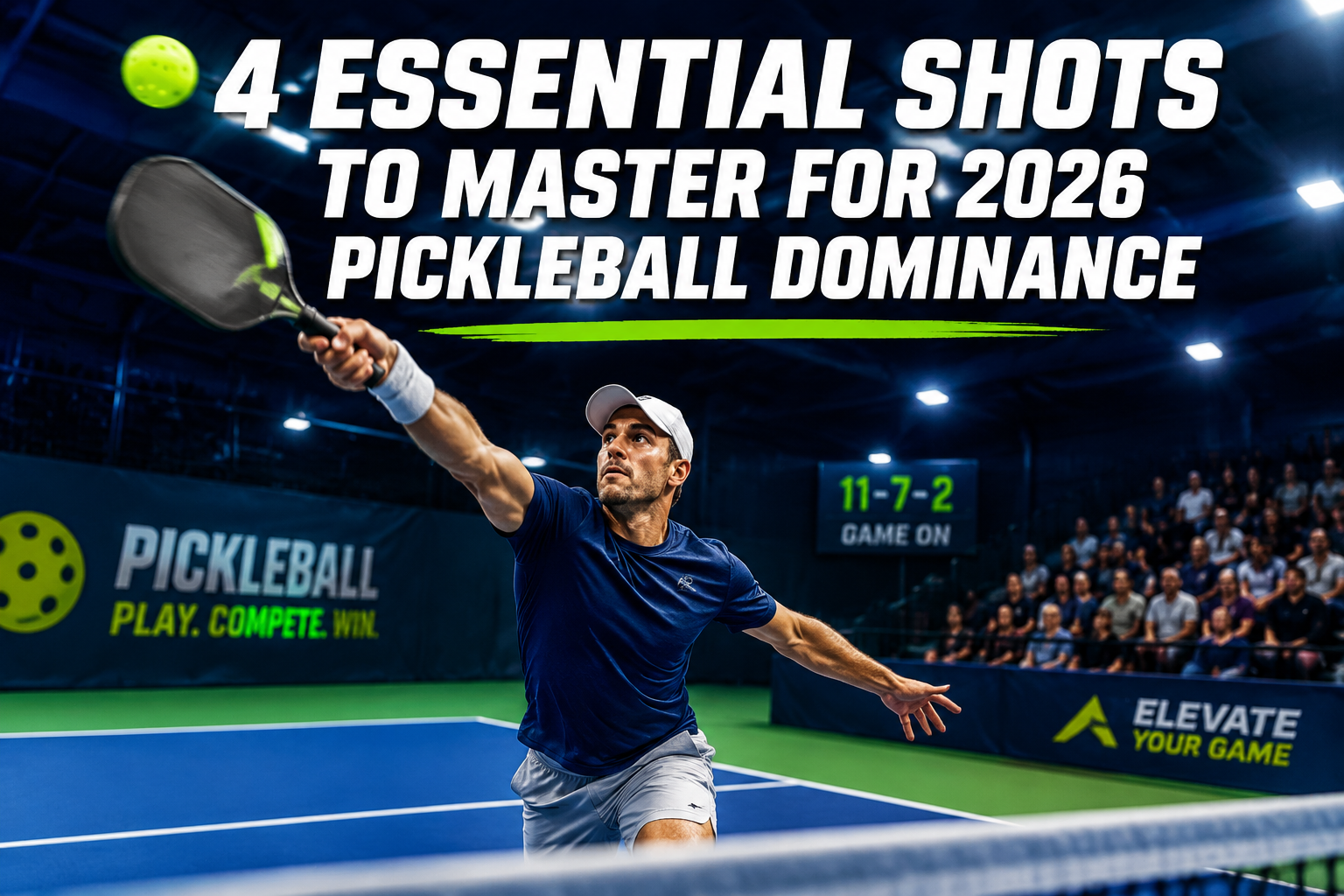
4 Essential Shots to Master for 2026 Pickleball Dominance: Drills, Progressions, and Pro Examples
Last updated: June 24, 2026
Quick Answer: The four shots that separate competitive pickleball players from recreational ones in 2026 are the body shot block, the low-ball pickup, the wide-shot recovery, and the overhead smash. Mastering these four with structured drills and correct progressions will cut your unforced errors and put you in control of more rallies, faster.
Key Takeaways
- Body shot blocks require a backhand paddle position held out front — treat them as redirects, not swings
- Low-ball pickups demand knee bend, not waist bend, with contact made in front of your body
- Wide-shot recovery is 80% footwork — move your feet first, then swing
- Overheads start with a sideways turn and shuffle back, not a backpedal
- Pro players like Christian Alshon recommend 10–15 minutes of fundamental shot drilling before every session [2]
- The “4 Corners Drill” is one of the best tools for building precision across all four shot types [3]
- Footwork drills like the Split Step and Prep Step directly improve your ability to handle all four shots [5]
- Research shows the third shot drop has a specific speed and angle window for success — technique matters more than power [7]
- Beginners and intermediate players both benefit from drilling these shots in isolation before combining them in live play
- Consistent practice of these four shots builds the foundation for reaching the 4.0 level and beyond
Why These Four Shots Define 2026 Pickleball Success
The 4 Essential Shots to Master for 2026 Pickleball Dominance aren’t flashy. They’re the shots that come up in almost every rally and that most recreational players handle poorly. Body shots, low balls, wide balls, and overheads are the four situations where points are most commonly lost — not because players don’t know what to do, but because they haven’t drilled the correct mechanics enough to execute under pressure.
If you’re looking to build a strong foundation in pickleball skills, these four shots are exactly where to start. Each one has a clear technique, a common error pattern, and a drill progression that works.

Shot 1: The Body Shot Block
The body shot block is a defensive redirect, not an offensive swing. When an opponent fires the ball directly at your torso, the instinct is to swing. That instinct will cost you the point.
The Correct Technique
- Hold the paddle out in front of your body with a backhand grip
- Keep a wide stance and lean slightly forward
- Absorb the ball’s pace and angle the paddle face to redirect it low over the net
- Stay compact — no big backswing [1]
Common Mistake
Pulling the paddle back to swing creates a timing gap and sends the ball long or into the net. Keep the paddle face still and let the ball’s pace do the work.
Drill Progression
- Feed drill: Have a partner stand at the kitchen line and feed balls directly at your chest and hips from 3–4 feet away. Focus only on redirection angle.
- Speed-up drill: Partner feeds faster balls from the transition zone. Practice absorbing pace without flinching.
- Live rally: Play points where your partner is allowed to speed up at your body at any time. React and reset.
Shot 2: The Low-Ball Pickup
For balls near your feet, the fix is always in your legs, not your arms. Bending at the waist to reach a low ball almost always results in a pop-up — exactly what your opponent wants.
The Correct Technique
- Bend your knees to drop your body level down
- Make contact in front of your body, not beside or behind it
- At the kitchen line, try to volley low balls before they bounce when possible
- During transitions, stop moving forward before swinging — set your feet as your opponent makes contact [1]
Common Mistake
Continuing to walk forward while hitting a low ball kills your control. Stopping first gives you a stable platform and reduces pop-ups significantly.
Drill Progression
- Drop and pick: Stand at the kitchen line. Drop a ball yourself and practice picking it up with a low volley, focusing on knee bend.
- Partner feed: Partner feeds low balls to your feet from the opposite kitchen line. Alternate forehand and backhand.
- Transition drill: Start at the baseline and move forward while your partner feeds a low ball mid-transition. Practice stopping and setting before contact.
💡 Pro tip: Think of your knees as the elevator. The lower the ball, the lower the floor you need to reach.
Shot 3: The Wide-Shot Recovery
Wide shots are won or lost with footwork, not reach. Stretching your arm to cover a wide ball is the most common error at every level below 4.5.
The Correct Technique
- Move your feet first — get your body behind the ball before swinging
- After contact, recover toward the center of the court immediately
- Finish with your weight on your outside leg to push back toward center faster
- From the baseline, move diagonally forward to cut off angles and take the ball earlier [1]
Common Mistake
Overreaching with the arm while the feet stay planted. This produces weak, off-balance shots and leaves you out of position for the next ball.
Drill Progression
- Cone recovery drill: Place cones at the center of the court. After every wide ball, sprint back and touch the center cone before the next feed.
- Alternating wide feeds: Partner alternates feeding wide left and wide right from across the net. Focus on footwork, not power.
- Live crosscourt rally: Play crosscourt-only points to force wide ball situations repeatedly.
For players working on movement efficiency, footwork fundamentals and the Split Step and Prep Step drills are worth adding to your routine [5].
Shot 4: The Overhead Smash
The overhead smash is the most satisfying shot in pickleball — and the most botched. The most common error is backpedaling in a straight line, which kills balance and timing.
The Correct Technique
- The moment you see a lob, turn sideways immediately and shuffle backward
- Set the paddle in a throwing-motion position (elbow up, paddle back)
- Use your non-dominant hand to track the ball as it rises
- If you’re out of position, reduce power and focus on placement over the sideline rather than going for a winner [1]
Drill Progression
- Catch the lob: Before hitting overheads, practice catching lobs with your non-dominant hand. This trains your eyes to track the ball correctly.
- Short lob feeds: Partner lobs from the kitchen line. Practice the sideways shuffle and setup without swinging hard.
- Full overhead: Partner lobs from the baseline. Execute full overhead with placement target (sideline cones).
🎯 Advanced tip: Directing overheads away from opponents toward the sidelines is one of the most underrated ways to finish points cleanly at the 4.0+ level [4].
How to Drill All Four Shots Together
The 4 Essential Shots to Master for 2026 Pickleball Dominance work best when drilled individually first, then combined into a sequence. Here’s a simple session structure:
| Phase | Time | Focus |
|---|---|---|
| Warm-up | 5 min | Dinking and soft hands |
| Shot isolation | 10–15 min | One shot per block (rotate) |
| Combination drill | 10 min | 4 Corners Drill [3] |
| Live play | 15–20 min | Apply shots in real points |
Pro player Christian Alshon recommends spending 10–15 minutes on fundamental shots before moving to specialized work in every practice session [2]. The 4 Corners Drill, developed by coach Will East, is particularly useful for building precision across all four shot types by targeting specific court zones [3].
For more structured practice ideas, check out essential drills for developing consistency in your pickleball game.
What the Research Says About Shot Mechanics
Science backs up what coaches have been saying for years. A study on the third shot drop found that the initial ball speed needs to stay within a specific range — roughly 10.9 to 16 m/s depending on shot direction — and the launch angle matters more than spin [7]. This means technique and consistency beat power on most shots.
The same principle applies to all four shots covered here. Controlled mechanics and correct positioning produce better results than trying to muscle the ball.
If you want to go deeper on advanced techniques for spin and placement, that’s the natural next step after locking in these four fundamentals.
Common Mistakes Across All Four Shots
Most errors on these shots share the same root causes:
- Swinging instead of redirecting on body shots and low balls
- Arm-reaching instead of foot-moving on wide shots
- Backpedaling instead of shuffling sideways on overheads
- Not stopping to set feet before contact during transitions
Fixing these habits takes repetition, not just awareness. Drill the correct movement pattern until it replaces the old one.
For help identifying and correcting specific swing flaws, the technical errors guide at Rally Racket is a solid resource.
FAQ
Q: How long does it take to master these four shots? Most players see noticeable improvement in 4–6 weeks of consistent drilling, 3–4 sessions per week. Full mastery under match pressure takes longer — usually several months.
Q: Should beginners focus on these shots or the serve first? Learn a reliable serve first, then shift focus to these four shots. The serve gets you in the rally; these shots keep you in it. See our guide on mastering key serving techniques for a starting point.
Q: Can I practice these shots alone? Body shots, overheads, and wide shots need a partner or ball machine. Low-ball pickups can be partially practiced solo with a drop-and-hit drill.
Q: What’s the best drill for improving all four shots at once? The 4 Corners Drill is the most efficient multi-shot drill for precision and court coverage [3].
Q: Do these shots apply to singles play too? Yes, all four apply in singles. Wide-shot recovery and overhead positioning are even more critical in singles because there’s no partner to cover court.
Q: How do I stop popping the ball up on low balls? Bend your knees more and make contact in front of your body. If the ball is still going up, you’re either too late on contact or not getting low enough.
Q: Is spin important on body shot blocks? No. Spin is secondary on blocks. Focus on paddle angle and absorbing pace. Keep it simple [7].
Q: What footwork drills help most with wide-shot recovery? The Split Step and Prep Step are the two most effective footwork drills for court coverage and reaction speed [5].
Q: How do I know if I’m ready to move to advanced shots? When you can handle body shots, low balls, wide balls, and overheads consistently in live play without losing position, you’re ready to add shots like the Erne or ATP [6].
Q: Does gear affect how well I can execute these shots? A paddle with the right grip size and weight helps, but technique matters far more. If you’re unsure about your equipment, check out our essential gear guide for new pickleball players.
Conclusion
The 4 Essential Shots to Master for 2026 Pickleball Dominance — body shot blocks, low-ball pickups, wide-shot recovery, and overheads — aren’t the most exciting shots to drill. But they’re the ones that will actually move your game forward.
Here’s your action plan:
- Pick one shot per week and drill it in isolation for 10–15 minutes per session
- Add the 4 Corners Drill to your rotation once you’ve worked each shot individually
- Record yourself or ask a partner to watch for the common mistakes listed above
- Apply each shot in live play the same session you drill it
The racket sports community at Rally Racket is built on exactly this kind of practical, step-by-step improvement. Keep showing up, keep drilling, and the results will follow.
References
[1] How To Master The 4 Hardest Pickleball Shots Body Shots Balls At Your Feet Wide Shots Overheads – https://www.pickleballglobe.com/2026/06/06/how-to-master-the-4-hardest-pickleball-shots-body-shots-balls-at-your-feet-wide-shots-overheads/
[2] Drilling Like The Pros Pickleball Training Routines Explained – https://pickleball.com/learn/drilling-like-the-pros-pickleball-training-routines-explained
[3] The 4 Corners Drill – https://pickleballunion.com/the-4-corners-drill/
[4] Underrated Pickleball Shots – https://pickleballunion.com/underrated-pickleball-shots/
[5] Pickleball Footwork – https://www.pickleballworkouts.com/blog/pickleball-footwork
[6] Pickleball Shots Techniques Library Every Shot You Need To Know – https://pickleball.com/docs/en/article/pickleball-shots-techniques-library-every-shot-you-need-to-know
[7] Third Shot Drop Research – https://arxiv.org/abs/2501.00163


