
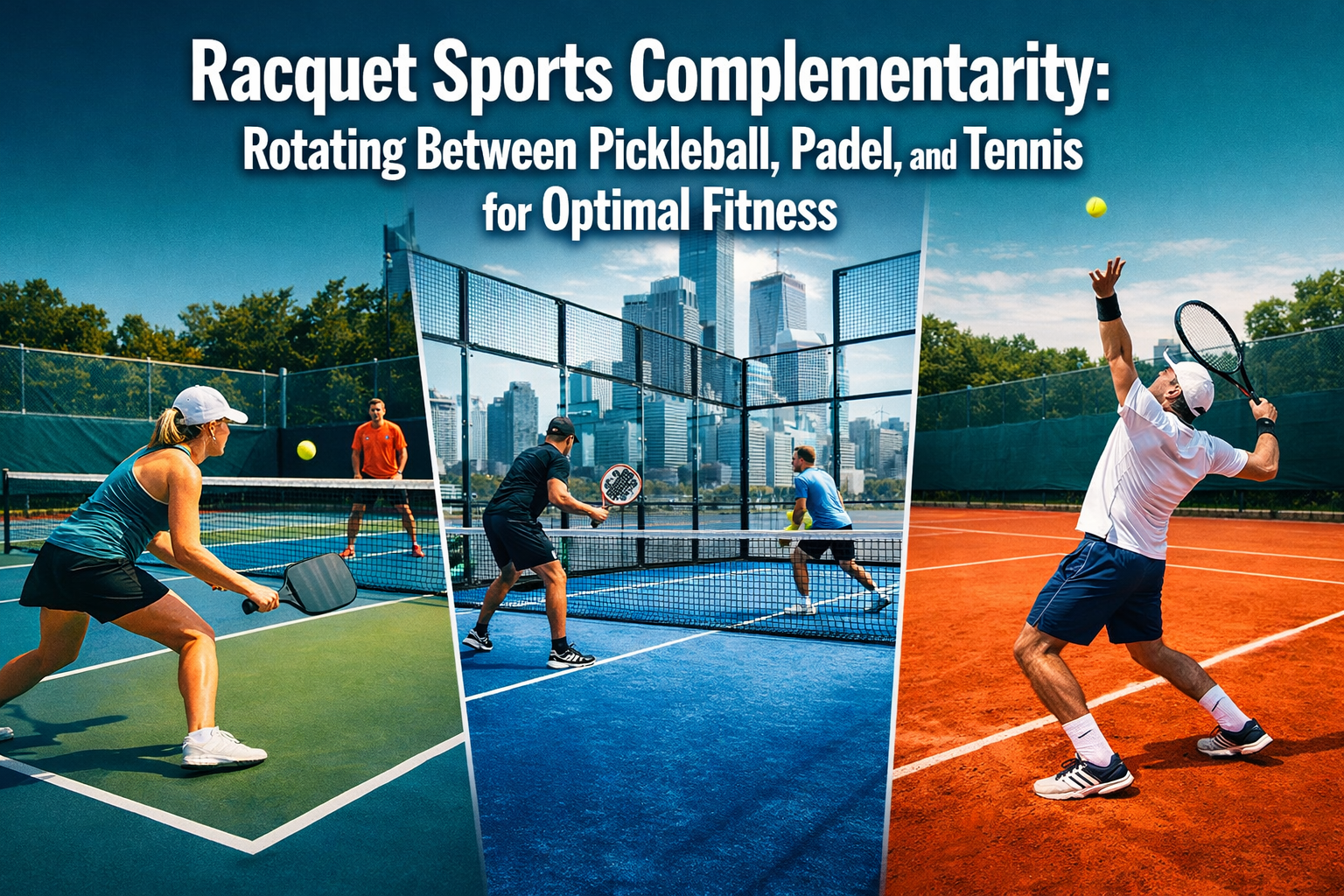
Racquet Sports Complementarity: Rotating Between Pickleball, Padel, and Tennis for Optimal Fitness
Last updated: April 6, 2026
Quick Answer
Rotating between pickleball, padel, and tennis gives players a more balanced fitness profile than sticking to just one sport. Each game trains different movement patterns, muscle groups, and mental skills, so cross-playing reduces overuse injuries while keeping motivation high. A structured weekly rotation of all three can improve agility, endurance, and court IQ across the board.
Key Takeaways
- Racquet sports complementarity means the strengths of one sport fill the gaps of another, creating a more complete athlete.
- Pickleball builds quick reflexes and soft-touch control; padel develops spatial awareness and wall-play strategy; tennis builds power, footwork range, and stamina.
- Rotating sports weekly reduces repetitive strain injuries common in single-sport players.
- In 2026, padel is growing at 51% year-over-year in US clubs, while pickleball has achieved 311% cumulative growth — making both increasingly accessible [2].
- Urban players benefit most from cross-sport rotation since padel and pickleball courts are appearing in compact city spaces [1].
- Beginners can start rallying in pickleball within minutes, making it the ideal entry point for a multi-sport routine [1].
- A simple 3-day rotation (one sport per session) is enough to see fitness and skill gains across all three games.

What Is Racquet Sports Complementarity and Why Does It Matter in 2026?
Racquet sports complementarity is the idea that pickleball, padel, and tennis each develop distinct physical and tactical skills that reinforce each other when played in rotation. No single sport covers every fitness base, but together they come close.
In 2026, this concept has become more relevant than ever. Courts that were once underused are now consistently booked, and recreational facilities are repainting court markings to accommodate multiple sports on shared surfaces [1]. Players are moving away from long-duration, high-commitment training toward shorter, repeatable sessions with flexible participation [1]. Rotating between three sports fits that lifestyle perfectly.
Here’s what each sport primarily develops:
| Sport | Primary Fitness Benefit | Key Skill Developed |
|---|---|---|
| Pickleball | Cardiovascular endurance, reaction time | Soft touch, net play, quick volleys |
| Padel | Lateral agility, strategic thinking | Wall rebounds, positioning, doubles teamwork |
| Tennis | Full-body power, stamina, footwork range | Groundstrokes, serve mechanics, court coverage |
“Each sport fills a gap the others leave open. That’s the whole point of rotating.”
How Do These Three Sports Complement Each Other Physically?
Each sport targets the body differently, and that’s exactly what makes the combination so effective for balanced fitness.
Pickleball keeps sessions short and explosive. The smaller court means constant direction changes and quick bursts of speed, which trains fast-twitch muscle fibers. Its low-impact nature also makes it ideal for active recovery days between more demanding sessions. The physical benefits of pickleball include improved hand-eye coordination, balance, and cardiovascular health.
Padel demands spatial awareness and smart positioning within an enclosed glass court. Wall rebounds add a problem-solving element that sharpens anticipation and court vision. Because padel is almost always played as doubles, it also builds communication skills and team court coverage.
Tennis is the endurance and power anchor of the trio. Longer rallies, a larger court, and a heavier ball demand more from the legs, core, and shoulders. Tennis footwork — especially the split step and recovery shuffle — directly improves movement quality in both pickleball and padel.
Common mistake: Treating all three sports as interchangeable. They’re not. Pickleball’s dinking game requires patience and a soft grip; tennis rewards big swings. Mixing up technique without awareness can reinforce bad habits across sports.
What Does a Practical Weekly Rotation Look Like?
A simple 3-session-per-week rotation is enough to build cross-sport fitness without burning out.
Sample weekly plan:
- Monday — Pickleball: 60-minute session focused on net play and dinking. Low impact, good for starting the week fresh. Great for improving coordination and agility.
- Wednesday — Tennis: 75-minute session emphasizing groundstrokes and footwork drills. Higher intensity, full-court movement.
- Friday — Padel: 60-minute doubles match. Focus on wall play and positioning. Social and strategic.
- Weekend: Optional open play in whichever sport feels right, or active rest.
Choose this rotation if:
- You’re an intermediate player in at least one of the three sports.
- You have access to at least two of the three court types nearby.
- Your goal is balanced fitness, not competitive mastery of a single sport.
Adjust it if:
- You’re a beginner — start with two sessions of one sport before adding a second.
- You’re recovering from a shoulder or knee injury — lean on pickleball’s lower impact until cleared.
How Does Rotating Sports Help Prevent Overuse Injuries?
Single-sport players are more vulnerable to repetitive strain injuries because they repeat the same joint movements hundreds of times per session, every session. Rotating sports changes the mechanical load on your body.
Tennis players commonly deal with lateral epicondylitis (tennis elbow) from repeated groundstroke impact. Pickleball players can develop wrist strain from constant paddle control. Padel players sometimes experience knee stress from lateral lunging on hard courts.
When you rotate, no single joint bears the full weekly load. The muscles and tendons get varied stimulus, which promotes recovery and resilience.
Injury prevention tips for multi-sport players:
- Always warm up with dynamic stretches before switching sports — each game uses slightly different movement patterns.
- Give at least one full rest day between tennis sessions, since it’s the highest-impact of the three.
- Strengthen your rotator cuff and hip stabilizers off-court — these muscles support all three sports.
- Pay attention to grip differences. Pickleball paddles are held lighter than tennis rackets; forcing a heavy grip in pickleball is a fast track to forearm strain.
Which Sport Should Beginners Start With in a Multi-Sport Routine?
Start with pickleball. New players can rally within minutes due to smaller courts, slower ball speed, and straightforward rules [1]. That immediate feedback loop builds confidence quickly and removes the intimidation factor that often stops beginners from trying racket sports at all.
Once comfortable with pickleball basics — understanding the rules and developing a consistent rally — add padel next. Padel introduces strategy through wall rebounds without overwhelming beginners [1]. Tennis can come third, since it demands the most technical skill and physical conditioning.
Beginner progression path:
- Weeks 1–4: Pickleball twice a week
- Weeks 5–8: Pickleball + one padel session per week
- Weeks 9+: Full three-sport rotation
How Are Urban Players Accessing All Three Sports in 2026?
Access has never been better, especially in cities. Padel is described as “taking over” major urban centers like New York City, with rapid adoption driven by its social format and compact court footprint [3]. Pickleball courts are being added to gyms, parks, and even rooftops. Multi-use court spaces are attracting increased investment, with lower barriers to organizing local leagues compared to traditional sports [1].
Practical tips for urban players:
- Search for multi-sport facilities that offer pickleball and padel on the same site — these are increasingly common.
- Many tennis clubs now offer padel as an add-on membership option.
- App-based court booking (for padel especially) has made it easy to find open slots without a club membership.
- Check community centers — pickleball courts are often free or low-cost and easy to find locally.
What Gear Do You Need to Rotate Between All Three Sports?
You don’t need to invest heavily all at once. Start with what’s available and build from there.
Minimum gear per sport:
- Pickleball: A mid-range composite paddle ($60–$120) and a pack of outdoor balls. See our guide on choosing the right pickleball paddle for specifics.
- Padel: A padel racket ($80–$150 for beginners) and padel-specific balls (lower pressure than tennis). Many clubs rent rackets, so try before you buy.
- Tennis: A strung racket ($70–$150) and a can of balls. Court shoes with lateral support are non-negotiable for injury prevention.
Shared gear: Court shoes with good lateral support work across all three sports, though tennis-specific shoes offer the best durability on hard courts. Moisture-wicking athletic wear is universal.
Edge case: Don’t use a tennis racket for padel or vice versa — they’re built for different ball weights and swing mechanics. The crossover doesn’t work and can lead to poor technique habits.
FAQ
Can skills from one racket sport transfer to another? Yes. Hand-eye coordination, court positioning, and reading your opponent’s body language all transfer across pickleball, padel, and tennis. Technical stroke mechanics are sport-specific, but athletic instincts carry over.
Is rotating between three sports too much for a recreational player? Not if sessions are spaced out. Three 60-minute sessions per week — one per sport — is manageable for most adults and actually reduces injury risk compared to playing one sport three times a week.
Which sport burns the most calories? Tennis generally burns the most calories per hour due to the larger court and longer rallies. Pickleball and padel are lower in caloric burn per session but easier to play more frequently, so weekly totals can be comparable.
Do I need to join a club for padel? Not necessarily. Club membership helps with consistent court access, but many urban facilities now offer pay-per-session padel bookings through apps.
Can older adults do a three-sport rotation? Yes. Pickleball’s low-impact design makes it especially well-suited for older players. A rotation that leans heavier on pickleball and padel, with tennis as an occasional option, works well for adults 55+.
How long before I see fitness improvements from rotating? Most players notice improved agility and endurance within 6–8 weeks of consistent three-sport rotation.
Does playing padel help my tennis game? Yes. Padel sharpens net instincts, doubles positioning, and soft-touch volleys — all of which translate directly to tennis doubles play.
What if I only have access to two of the three sports? A pickleball-tennis or pickleball-padel pairing still delivers strong complementarity. Any two-sport rotation beats single-sport repetition for balanced fitness.
Conclusion
Racquet sports complementarity — rotating between pickleball, padel, and tennis for optimal fitness — is one of the smartest training strategies available to recreational players in 2026. Each sport develops something the others don’t, and together they build a more complete, injury-resistant athlete.
Your next steps:
- Pick the sport you know best and play it this week.
- Book one session of a second sport in the next two weeks — most facilities offer intro sessions.
- After a month, add the third sport and settle into a consistent rotation.
- Track how your movement, endurance, and court sense improve across all three games.
The racket sports community is growing fast, courts are more accessible than ever, and the barrier to trying something new has never been lower. Start rotating, stay consistent, and enjoy the variety.
References
[1] Pickleball Padel Or Tennis Why Racket Sports Are Exploding In 2026 And How San Angelo Is Catching Up – https://tynmagazine.com/pickleball-padel-or-tennis-why-racket-sports-are-exploding-in-2026-and-how-san-angelo-is-catching-up__trashed/
[2] The Racket Sports Boom Evolves Typti – https://insider.fitt.co/the-racket-sports-boom-evolves-typti/
[3] Watch – https://www.youtube.com/watch?v=jqOsWLGw8TA


