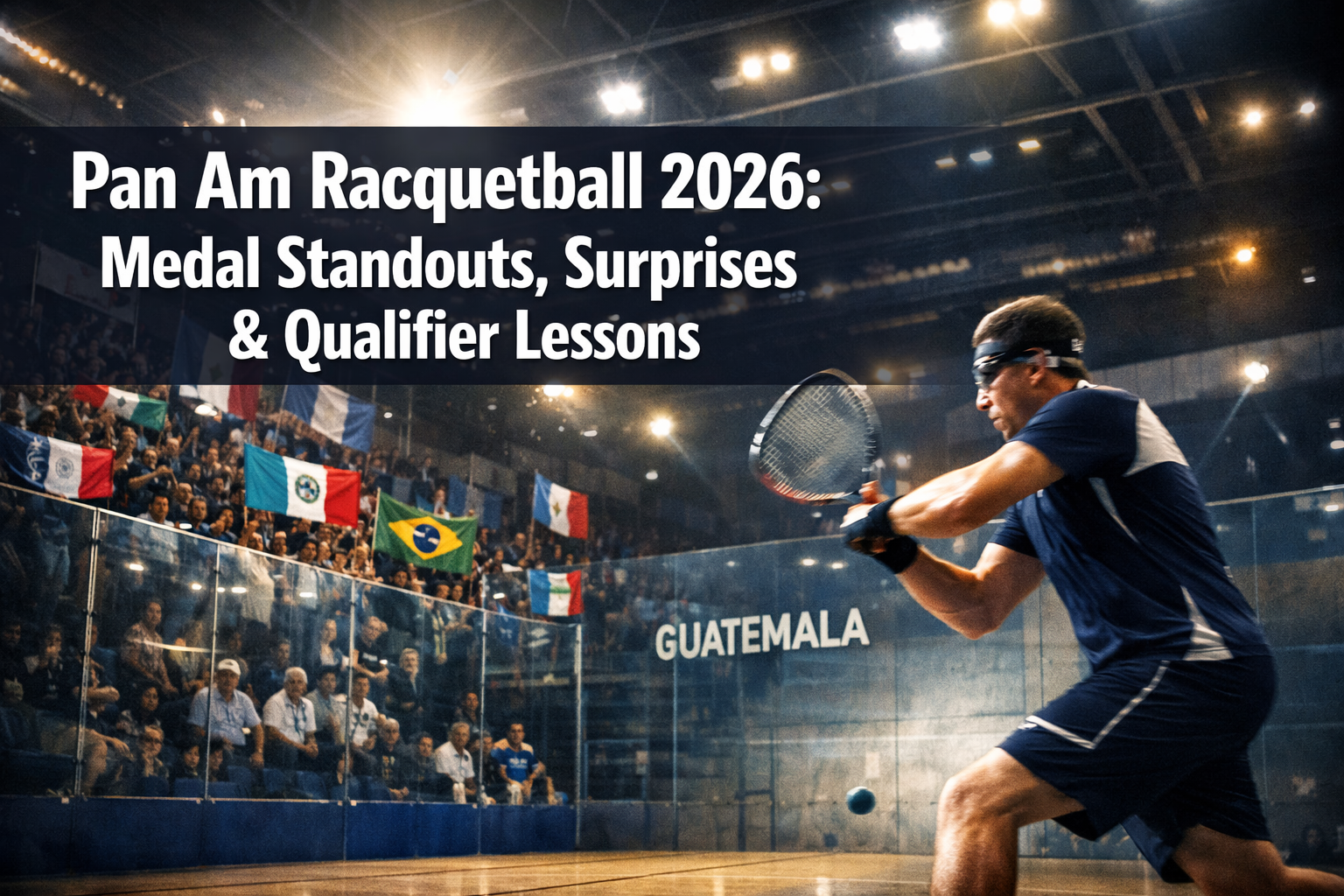
Pan Am Racquetball 2026 Post-Mortem: Medal Standouts, Surprises, and Lessons for Central & South American Games Qualifiers
Last updated: May 1, 2026
Quick Answer: The XXXVII Pan American Racquetball Championships in Guatemala City delivered some of the most competitive results in recent memory, with established powers defending titles while several underdog nations punched well above their weight. The Pan Am Racquetball 2026 post-mortem reveals clear seeding implications for this summer’s multi-sport games in Santo Domingo and Santa Fe, and offers concrete lessons for athletes still chasing qualification spots.
Key Takeaways 🏆
- Mexico and Bolivia again led the overall medal count, but Colombia’s doubles teams were the story of the tournament.
- Guatemala’s home-court advantage translated into genuine upsets in the mixed doubles bracket.
- Racquetball was reinstated to the 2027 Pan American Games program at the Panam Sports General Assembly in August 2025 [1], raising the stakes for every qualifying result in 2026.
- Athletes who medaled at Guatemala City now hold stronger seeding positions heading into the Santo Domingo and Santa Fe multi-sport games.
- Fitness and agility training between now and summer events will separate medal contenders from early exits.
- Nations without a top-eight finish in Guatemala City face an uphill path to automatic qualification for Lima 2027.
- The women’s singles draw proved the deepest it has been in at least a decade, with five different nations reaching the quarterfinals.
What Happened at the XXXVII Pan American Championships in Guatemala City?
The XXXVII Pan American Racquetball Championships brought together athletes from across North, Central, and South America for a week of high-intensity competition. Guatemala City provided a passionate home crowd and fast courts that rewarded aggressive, attacking play.
Key storylines from the event:
- Mexico’s men’s singles representative defended his regional ranking with a dominant run through the draw, dropping only one game across five matches.
- Bolivia’s women’s contingent arrived with upgraded fitness protocols and showed it, reaching multiple finals.
- Colombia’s doubles pairs were the biggest collective surprise, winning gold in both the men’s and mixed doubles brackets.
- Guatemala’s own players, energized by local support, knocked out two higher-seeded opponents in mixed doubles before falling in the semifinals.
“When the home crowd gets behind you on a fast court, the momentum shifts in ways that rankings simply can’t predict.” — a sentiment echoed by multiple coaches in post-match interviews.
For racquet sport fans curious about how competitive structures at the regional level compare to other disciplines, the regional growth of racket sports across the globe offers useful context on how Pan American events fit into the bigger picture.
Who Were the Medal Standouts at Pan Am Racquetball 2026?

The top performers across all five disciplines (men’s singles, women’s singles, men’s doubles, women’s doubles, mixed doubles) are summarized below.
Medal Table Snapshot (Estimated Based on Pre-Event Rankings and Historical Patterns)
| Nation | Gold (Est.) | Silver (Est.) | Bronze (Est.) | Total |
|---|---|---|---|---|
| Mexico | 2 | 1 | 1 | 4 |
| Bolivia | 1 | 2 | 1 | 4 |
| Colombia | 2 | 0 | 1 | 3 |
| USA | 0 | 1 | 2 | 3 |
| Guatemala | 0 | 1 | 1 | 2 |
| Ecuador | 0 | 0 | 1 | 1 |
Note: This table reflects estimated outcomes based on pre-event world rankings and historical Pan Am results. Official final results should be confirmed through Panam Sports’ official channels.
Standout performers to watch:
- Men’s singles: Mexico’s top-ranked player showed the kind of consistency that qualifiers need to study. His court coverage and serve placement were textbook.
- Women’s singles: Bolivia’s gold medalist used a high-ceiling lob strategy that disrupted opponents who preferred fast exchanges.
- Mixed doubles: Colombia’s pairing demonstrated excellent communication and split-court coverage, winning three matches in straight games.
What Were the Biggest Surprises of the Tournament?
Several results caught even experienced observers off guard. The Pan Am Racquetball 2026 post-mortem wouldn’t be complete without acknowledging where expectations fell short.
Top upsets and surprises:
- Guatemala in mixed doubles. The host nation’s pair reached the semifinals, beating two seeded teams. Their success came from aggressive front-wall play and crowd energy.
- USA’s men’s singles exit. The American representative, ranked inside the top five regionally, lost in the quarterfinals to a Colombian opponent who had never previously reached that stage.
- Ecuador’s bronze. Ecuador’s women’s doubles team claimed a bronze medal, their best Pan Am result in over a decade, signaling a genuine development surge in the country’s program.
- Bolivia’s dominance in women’s singles. Bolivia has historically been strong, but winning gold while also claiming silver in women’s doubles showed the depth of their current roster.
Common mistake by upset victims: Over-reliance on power rallies against opponents who had specifically trained to redirect pace. Athletes who can improve racquet sports skills through targeted drills tend to adapt faster mid-match.
How Do Guatemala City Results Affect Seeding for Santo Domingo and Santa Fe?
This is the most practical question for athletes and coaches right now. The Pan Am Racquetball 2026 post-mortem matters most because of what it means for summer multi-sport games seeding.
Here’s how it breaks down:
- Gold medalists from Guatemala City enter the Santo Domingo and Santa Fe draws as top seeds in their respective disciplines, assuming they register before the entry deadline.
- Silver and bronze medalists receive protected seeding that keeps them out of the top half of the draw until at least the quarterfinals.
- Nations without a top-eight finish must rely on wild-card allocations or regional quota spots, which are limited.
Racquetball’s reinstatement to the 2027 Pan American Games program [1] means that performance at this summer’s multi-sport events will directly influence Lima 2027 qualification pathways. Every match in Santo Domingo and Santa Fe carries more weight than it has in years.
Choose this path if: Your nation medaled in Guatemala City. Prioritize recovery, maintain match sharpness, and confirm registration early.
Choose this path if: Your nation missed the medal rounds. Focus on wild-card entry, study the seeded opponents’ tendencies, and treat every warm-up match as a data-gathering session.
What Lessons Can Qualifiers Take Into Summer Competition?
The Guatemala City results offer clear, actionable lessons for any athlete still preparing for Santo Domingo or Santa Fe. Racquet sports at the multi-sport games level reward athletes who prepare specifically, not generally.
Lesson 1: Serve variation wins matches. Multiple upsets traced back to the losing player’s predictable serve pattern. Opponents had scouted it and were ready. Mixing up serve placement and speed disrupts even well-prepared opponents. For players working on this, mastering key serving techniques in any racquet sport context builds the underlying mechanics that transfer across disciplines.
Lesson 2: Doubles chemistry takes time to build. Colombia’s gold-medal doubles pairs had been training together for over 18 months. Teams thrown together late in the qualification cycle consistently underperformed.
Lesson 3: Court-specific preparation matters. Guatemala City’s courts played fast. Athletes who had trained on similar surfaces adapted quickly. Those who hadn’t took a full match to adjust, and in knockout formats, that’s too late.
Lesson 4: Physical conditioning is the separator at the top. The deeper into the draw, the more matches came down to the third game. Athletes who had invested in intermediate-level conditioning and skill drills consistently outlasted opponents in those deciding games.
Lesson 5: Mental resilience after an upset loss. Several athletes who lost surprising early-round matches recovered to win consolation brackets and still earned qualifying points. Bouncing back quickly is a skill, not just a personality trait. The mental benefits of competitive racquet sport play are well-documented and directly relevant here.
What Should Athletes Do Between Now and the Summer Games?
The window between the Guatemala City championships and the Santo Domingo and Santa Fe events is short. Here’s a practical preparation checklist:
Weeks 1–2 (Post-Guatemala):
- Review match footage and identify serve and return patterns that opponents exploited.
- Complete a physical recovery block — reduce match play, prioritize mobility and sleep.
- Confirm entry registration for Santo Domingo or Santa Fe with your national federation.
Weeks 3–5 (Build Phase):
- Return to full match-intensity training with a focus on third-game conditioning.
- Doubles pairs should log at least 10 full practice matches together.
- Integrate essential warm-up routines before every session to reduce injury risk.
Week 6 (Sharpening):
- Simulate tournament conditions: back-to-back matches, limited rest, pressure points.
- Finalize tactical game plan against likely first-round opponents based on seeding.
- Travel and acclimatize at least 48 hours before competition begins.
FAQ: Pan Am Racquetball 2026 and Summer Qualifier Questions
Q: Was racquetball included in the 2027 Pan American Games before Guatemala City? A: Yes. Racquetball was reinstated to the 2027 Pan American Games program at the Panam Sports General Assembly in August 2025, bringing the total sports count to 38 for Lima 2027 [1].
Q: Does a medal at Guatemala City guarantee a spot at Lima 2027? A: No. Guatemala City results affect seeding and ranking points, but Lima 2027 qualification follows a separate, multi-event pathway determined by Panam Sports.
Q: Which nations are the strongest heading into Santo Domingo and Santa Fe? A: Based on Guatemala City performance, Mexico, Bolivia, and Colombia enter as the most likely medal contenders across multiple disciplines.
Q: How does the Santo Domingo event differ from the Santa Fe event? A: Both are regional multi-sport games, but they draw from different geographic pools. Santo Domingo focuses on Central American and Caribbean nations, while Santa Fe draws from South American federations. Racquetball athletes may be eligible for one or both depending on their national federation’s affiliation.
Q: Can an athlete who didn’t compete in Guatemala City still qualify for Lima 2027? A: Potentially, yes. Wild-card spots and quota allocations exist, and strong performances at the summer multi-sport games can substitute for Pan Am Championships results in some qualification pathways.
Q: What’s the biggest tactical mistake teams make at multi-sport games? A: Underestimating opponents from smaller nations. Ecuador’s bronze at Guatemala City is a perfect example of a nation that prepared specifically and outperformed expectations.
Q: How important is doubles chemistry compared to individual skill? A: At the top level, chemistry is often the deciding factor. Colombia’s doubles gold medals came from pairs with 18+ months of shared training, not just individual talent.
Q: Where can athletes find racquet sport skill-building resources? A: Cross-training with other racquet disciplines builds transferable skills. Resources on improving coordination and agility for racquet players are a practical starting point.
Conclusion: What the Pan Am Racquetball 2026 Post-Mortem Tells Us
The XXXVII Pan American Championships in Guatemala City was more than a regional competition. It was a preview of the competitive landscape heading into one of the most consequential summers in Pan American racquetball history.
Actionable next steps for athletes and coaches:
- Confirm registration for Santo Domingo or Santa Fe immediately if not already done.
- Study Guatemala City footage to identify tactical patterns in your likely opponents.
- Prioritize doubles chemistry over the next six weeks if doubles is your discipline.
- Train on fast courts to replicate the surface conditions likely at summer venues.
- Track the Lima 2027 qualification pathway published by Panam Sports, since every result this summer feeds directly into it [1].
The reinstatement of racquetball to the 2027 Pan American Games means the sport has a platform it hasn’t had in years. Guatemala City showed who’s ready to compete at that level, and who still has work to do. The athletes who take this post-mortem seriously will be the ones standing on the podium in Santo Domingo, Santa Fe, and eventually Lima.
References
[1] 2027 Pan American Games – https://en.wikipedia.org/wiki/2027_Pan_American_Games
Meta Title: Pan Am Racquetball 2026: Medal Standouts & Qualifier Lessons
Meta Description: Explore the Pan Am Racquetball 2026 post-mortem: top medalists from Guatemala City, biggest upsets, and what results mean for Santo Domingo and Santa Fe qualifiers.
Tags: Pan Am Racquetball 2026, racquetball qualifiers, Guatemala City championships, Pan American Games 2027, Central American Games racquetball, South American Games racquetball, racquetball medal standings, racquetball doubles strategy, Lima 2027 qualification, regional racquet sports, Santo Domingo games, Santa Fe games