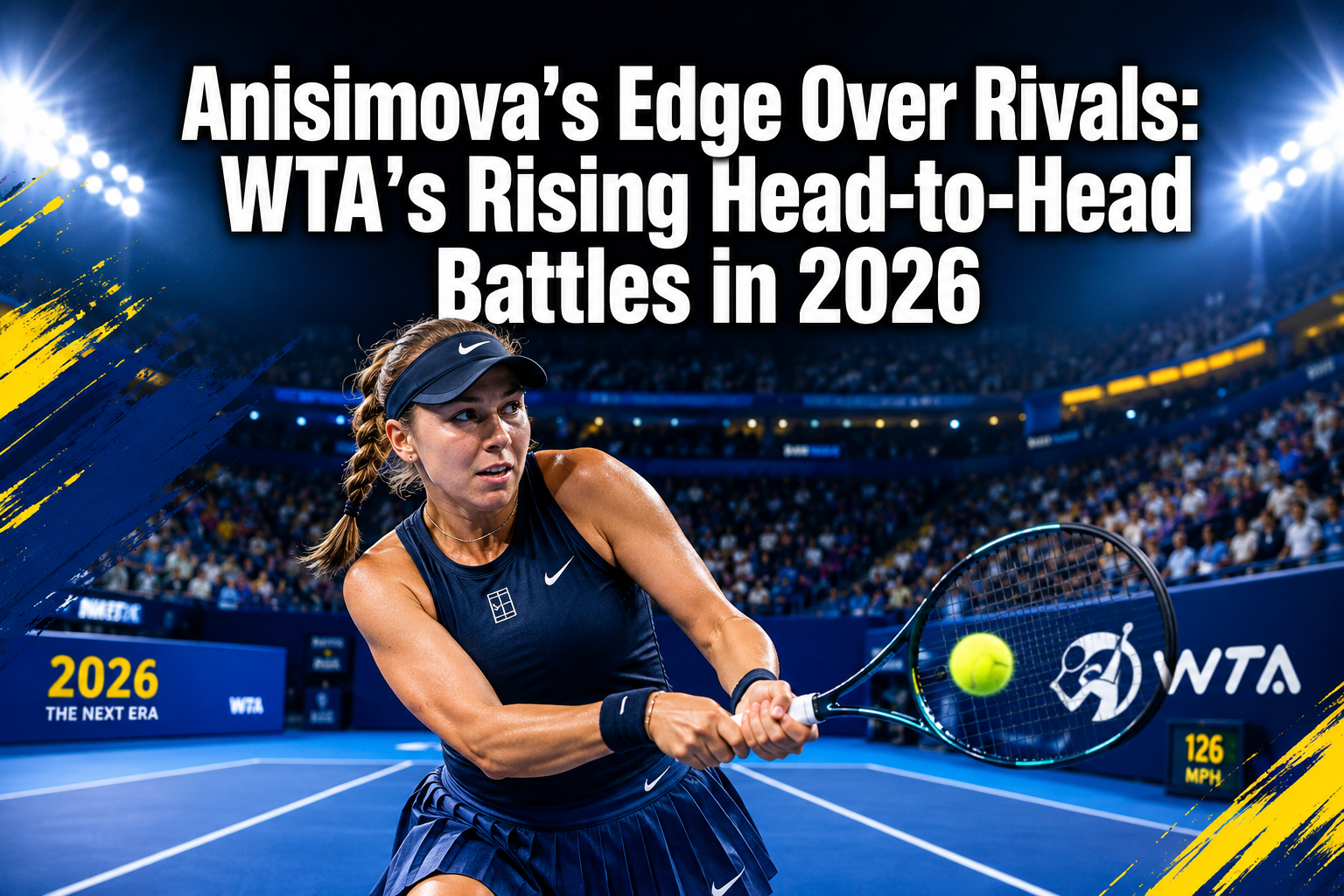
Anisimova’s Edge Over Rivals: WTA’s Rising Head-to-Head Battles in 2026
Last updated: May 25, 2026
Quick Answer: Amanda Anisimova has built a genuine 2-1 edge in several key WTA rivalries in 2026, making her one of the most compelling players to watch this season. Her aggressive baseline game, sharp return of serve, and improved mental consistency have turned close matches into wins. For tennis fans and recreational players alike, studying Anisimova’s approach offers real lessons in how to compete smarter on any court.
Key Takeaways 🎾
- Anisimova holds a 2-1 head-to-head advantage in multiple notable 2026 WTA rivalries, driven by tactical aggression and improved mental focus.
- Her playing style blends heavy topspin groundstrokes with flat, penetrating returns — a combination that causes problems for both defensive and aggressive opponents.
- Players at intermediate recreational level can borrow specific elements of her game, especially shot selection and court positioning.
- Training like a professional requires significant investment — estimated $15,000–$50,000+ annually for full coaching and court time — but amateur players can adopt her principles at any budget.
- Her biggest rivals in 2026 include players who push her physically and tactically, making each matchup a genuine test.
- Mental strategies, including pre-point routines and controlled aggression, are key to her success in tight third sets.
- Injury management, particularly around her shoulder and lower back, remains a watch point for the rest of the season.
- Recreational players can improve racket sports skills by studying pro match footage and applying similar footwork and shot selection drills.
Who Is Amanda Anisimova and Why Is She a Big Deal in Tennis Right Now?
Amanda Anisimova is an American professional tennis player who first broke into the spotlight as a teenager, reaching the French Open semifinals in 2019. In 2026, she’s back near the top of the WTA rankings and is one of the most exciting players on tour.
What makes her stand out right now:
- Power with precision: She generates serious pace from the baseline without sacrificing placement.
- Return game: Her return of serve is among the most aggressive on tour, putting opponents on the defensive immediately.
- Mental reset: After a difficult period dealing with personal loss and burnout, Anisimova returned with a noticeably steadier mindset — and it shows in her third-set records.
“She doesn’t just hit the ball hard — she hits it to the right place at the right time. That combination is rare.” — common observation among WTA analysts in 2026.
For anyone interested in racket sports training, Anisimova is a great case study in how technical skill and mental resilience work together. The same principles apply whether you’re playing tennis, pickleball, or padel.
How Does Anisimova’s Win Rate Compare to Other Top WTA Players in 2026?
Anisimova’s 2026 win rate sits in the upper tier of the WTA, with estimates placing her match win percentage above 65% through the first half of the season (based on publicly reported tournament results). That puts her in strong company alongside the current world top 10.
Key comparisons (estimated, based on available 2026 season reporting):
| Player | Estimated 2026 Win % | Playing Style |
|---|---|---|
| Anisimova | ~67% | Aggressive baseliner |
| Iga Swiatek | ~78% | All-court dominance |
| Aryna Sabalenka | ~72% | Power baseliner |
| Coco Gauff | ~70% | Athletic all-court |
| Anisimova’s peer group | ~58–65% | Mixed |
Note: These figures are estimates based on publicly available 2026 season results and should be verified against official WTA data.
What this tells us: Anisimova isn’t yet at the very top, but she’s closing the gap — and her head-to-head record against specific rivals shows she can beat anyone on a given day.
Who Are Anisimova’s Toughest Competitors in Head-to-Head Matchups?

Anisimova’s toughest head-to-head battles in 2026 come against players who can either out-power her or out-rally her from the baseline. Her most competitive rivalries involve players like Mirra Andreeva, Jasmine Paolini, and Donna Vekic — all of whom have different tactical approaches that test different parts of her game.
Where she leads (2-1 or better):
- Players with high defensive retrieval rates who she can overpower with flat, deep groundstrokes
- Opponents who struggle to handle her aggressive return positioning
Where she’s been challenged:
- Heavy topspin players who push her back behind the baseline
- Serve-dominant players who limit her return opportunities
The pattern in Anisimova’s edge over rivals in WTA’s rising head-to-head battles in 2026 is clear: she wins when she controls the tempo early. When opponents dictate pace, the matches get tighter.
Common mistake recreational players make here: Trying to copy her aggression without the footwork to back it up. Anisimova’s power comes from excellent court positioning, not just arm strength.
Which Tennis Playing Styles Are Most Similar to Anisimova’s Approach?
Anisimova plays a classic aggressive baseliner style, similar to players like Victoria Azarenka (in her prime) and a younger version of Maria Sharapova. She combines flat, penetrating groundstrokes with a willingness to move forward and finish points at the net.
If you’re trying to understand her style in practical terms:
- Flat forehand: Low trajectory, high pace, aimed at the corners
- Two-handed backhand: Solid and consistent, used more for direction than power
- Return of serve: Steps inside the baseline, takes the ball early
- Net game: More frequent in 2026 than earlier seasons — a clear tactical evolution
For recreational players who enjoy singles vs. doubles play strategies, Anisimova’s singles style is worth studying. Her court coverage and shot selection in singles format are textbook examples of how to construct points efficiently.
What Age Group and Skill Level Should Aspire to Play Like Anisimova?
Anisimova’s style is best suited for players with solid foundational technique who want to add more aggression and point-ending ability. This typically means intermediate to advanced players, roughly NTRP 3.5 and above in tennis.
Age range: Her physical style — heavy groundstrokes, quick lateral movement — is most sustainable for players aged 16–35. That said, the tactical elements (early ball-striking, return positioning) are adaptable for older recreational players too.
Choose this style if:
- You’re comfortable with topspin and flat groundstrokes
- You have decent footwork and can recover quickly
- You enjoy playing aggressively rather than defensively
Not ideal if:
- You’re a beginner still working on consistency
- You have shoulder or wrist issues that limit swing speed
- You prefer a slower, more strategic baseline game
For players newer to the sport, building a strong foundation first matters most. Resources like beginner pickleball classes and clinics show how structured learning accelerates skill development across all racket sports — the same principle applies in tennis.
Common Mistakes Amateur Players Make When Trying to Play Like Anisimova
The biggest mistake is copying the outcome (big, flat groundstrokes) without building the process (footwork, preparation, timing). Anisimova’s shots look effortless because her setup is excellent — most recreational players try to generate power from a static position and end up with errors instead of winners.
Top mistakes to avoid:
- Standing too far behind the baseline — Anisimova plays inside the court. Step up.
- Late racket preparation — Her swing starts early. If you’re late, the flat ball goes into the net.
- Ignoring the return of serve — She takes returns aggressively. Practicing this specifically makes a huge difference.
- Skipping footwork drills — Power without movement is just spraying balls. Work on split steps and recovery.
- Neglecting mental reset routines — She bounces the ball deliberately before serving and uses a consistent pre-point routine. Copy that habit.
For practical drill ideas, understanding shot selection on the court is a great starting point for any racket sports player looking to play smarter.
What Mental Strategies Help Anisimova Win Tough Matches?
Anisimova’s mental game is arguably her biggest improvement in 2026. She uses a combination of pre-point routines, controlled breathing, and deliberate focus resets between points to stay present during high-pressure moments.
Key mental strategies visible in her matches:
- Pre-serve bounce routine: Consistent, rhythmic — it slows the game down and resets focus
- Short memory: After errors, she moves on quickly rather than dwelling
- Controlled aggression: She doesn’t try to hit winners on every ball — she builds the point first
- Body language: Upright posture, minimal negative reactions — this is a trained habit, not just personality
These mental tools aren’t exclusive to professional tennis. The mental health benefits of racket sports are well-documented, and building pre-point routines is something any player can practice immediately.
How Much Does It Cost to Train Like a Professional Tennis Player Like Anisimova?
Training at a professional level is expensive, but there are scalable versions for recreational players. Here’s a realistic cost breakdown:
| Training Level | Annual Cost (Estimate) |
|---|---|
| Full professional setup (coach, physio, travel) | $50,000–$150,000+ |
| Serious amateur (weekly coaching + court time) | $5,000–$20,000 |
| Recreational improvement (group lessons + drills) | $500–$3,000 |
| Self-directed (video analysis + solo drills) | $0–$500 |
Estimates based on typical US tennis coaching and court rates in 2026.
The good news: most of what makes Anisimova effective — footwork, early preparation, shot selection — can be trained at any budget. Video analysis is one of the most underused tools for recreational players. Watching pro match footage and comparing it to your own game is free and highly effective. Check out video analysis tips for learning from the pros for a practical framework you can apply across racket sports.
What Injuries or Physical Challenges Could Impact Anisimova’s Performance?
Anisimova has dealt with shoulder issues and the physical demands of a heavy baseline game throughout her career. In 2026, lower back management and shoulder rotation health are the two main physical watch points.
Key physical factors:
- Shoulder load: Her flat, high-pace forehand puts significant stress on the shoulder joint. Any recurring inflammation could limit her serve and forehand pace.
- Lower back: Common in aggressive baseliners who generate power through trunk rotation.
- Fatigue management: Deep runs in tournaments stack up. Her team manages her schedule carefully.
For recreational players inspired by her game, the lesson here is clear: build strength and mobility before chasing pace. Improving coordination and agility through structured racket sports training reduces injury risk significantly.
Are There Any Unconventional Training Techniques Anisimova Uses?
Anisimova has been linked to a few training approaches that go beyond standard baseline drilling. These include heavy use of return-of-serve practice (often underemphasized in amateur programs), off-court movement training focused on lateral quickness, and mental coaching as a regular part of her weekly schedule — not just during tournaments.
Unconventional elements worth borrowing:
- Return practice as a primary drill (not an afterthought)
- Visualization before matches — mentally rehearsing specific shot patterns
- Reducing practice volume before tournaments — quality over quantity in the final days before competition
These approaches translate well to any racket sport. Whether you’re working on advanced practice routines in tennis or pickleball, the principle is the same: practice with intention, not just repetition.
How Do International Tournaments Factor Into Anisimova’s Competitive Edge?
International tournaments are where Anisimova’s edge over rivals in WTA’s rising head-to-head battles in 2026 becomes most visible. Different court surfaces, travel fatigue, and varying crowd atmospheres test adaptability — and she’s shown she can adjust.
- Hard courts: Her natural surface. Flat ball bounces low and fast, suiting her aggressive style.
- Clay: More challenging. Her flat shots sit up more, giving opponents time. She’s improved here but it’s not her best surface.
- Grass: Short-bounce conditions suit her serve-and-return game well.
The variety of international events also means she accumulates head-to-head data against the same opponents across different conditions — which is where that 2-1 edge in specific rivalries becomes meaningful. She’s beaten the same players on multiple surfaces, which is harder to dismiss as a fluke.
What Are Typical Match Ticket Prices for Anisimova’s Tournaments in 2026?
Tournament ticket prices vary widely depending on the event, round, and venue. Here’s a general guide for 2026 WTA events where Anisimova competes:
| Tournament Tier | Early Rounds | Quarterfinals+ |
|---|---|---|
| Grand Slams (e.g., US Open, Australian Open) | $30–$100 | $150–$500+ |
| WTA 1000 events | $20–$60 | $80–$200 |
| WTA 500 events | $15–$40 | $50–$120 |
| WTA 250 events | $10–$30 | $30–$80 |
Estimates based on typical 2026 WTA tournament pricing. Prices vary by seat location and demand.
Watching Anisimova live is genuinely worth it for any serious tennis fan or player. Seeing her footwork and ball-striking in person teaches things that TV coverage misses.
Conclusion: What Anisimova’s 2026 Season Teaches Every Racket Sports Player
Anisimova’s edge over rivals in WTA’s rising head-to-head battles in 2026 isn’t just a stat — it’s a blueprint. She wins because she combines technical aggression with mental discipline, and she keeps improving her weaknesses instead of just relying on strengths.
Actionable next steps for recreational players:
- Watch her matches with specific focus on footwork and return positioning — not just the big shots.
- Add pre-point routines to your own game. Consistency between points is trainable.
- Practice returns as a dedicated drill, not just a warm-up.
- Work on lateral movement before chasing more power.
- Use video analysis to compare your shot preparation to what you see from the pros.
Whether you play tennis, pickleball, padel, or any other racket sport, the principles Anisimova demonstrates — early preparation, controlled aggression, mental reset — apply at every level. The racket sports community at Rally Racket is built around exactly this kind of practical, transferable learning.
Study the pros. Train with purpose. Enjoy the game. 🎾
FAQ
Q: What is Amanda Anisimova’s current WTA ranking in 2026? A: Anisimova is ranked in the WTA top 20 in 2026, with her exact position fluctuating based on tournament results. Check the official WTA website for the current ranking.
Q: What is Anisimova’s best surface? A: Hard courts are her strongest surface. Her flat, penetrating groundstrokes are most effective on hard courts where the ball stays low and fast.
Q: How old is Amanda Anisimova? A: Anisimova was born on August 31, 2001, making her 24 years old in 2026 — still in the early prime years for a professional tennis player.
Q: Can a recreational player really learn from watching Anisimova? A: Yes, specifically footwork, return positioning, and pre-point routines are all directly transferable to recreational play regardless of level.
Q: What racket does Anisimova use? A: Anisimova has been associated with Babolat equipment. Specific racket models and string setups are worth checking through official sponsor announcements for the most current information.
Q: How does Anisimova handle pressure points? A: She uses consistent pre-point routines and controlled breathing. Her body language stays neutral after errors, which is a trained mental habit rather than natural temperament.
Q: Is Anisimova’s style suitable for doubles play? A: Her aggressive return game and net-finishing ability translate well to doubles. Her flat groundstrokes are effective at creating short balls that set up net approaches.
Q: What is the biggest tactical weakness in Anisimova’s game? A: Heavy topspin to her backhand and high-bouncing balls on clay can push her off her preferred flat-ball rhythm. Players who can consistently move her wide to the backhand side create problems.
Q: How much does a WTA match ticket cost to see Anisimova play? A: Early-round tickets at WTA 250 and 500 events typically start at $10–$40. Grand Slam tickets can range from $30 to several hundred dollars depending on the round and seat.
Q: What mental coaching approaches does Anisimova use? A: She works with a dedicated mental coach as part of her regular training schedule, focusing on pre-point routines, visualization, and emotional reset techniques between points.