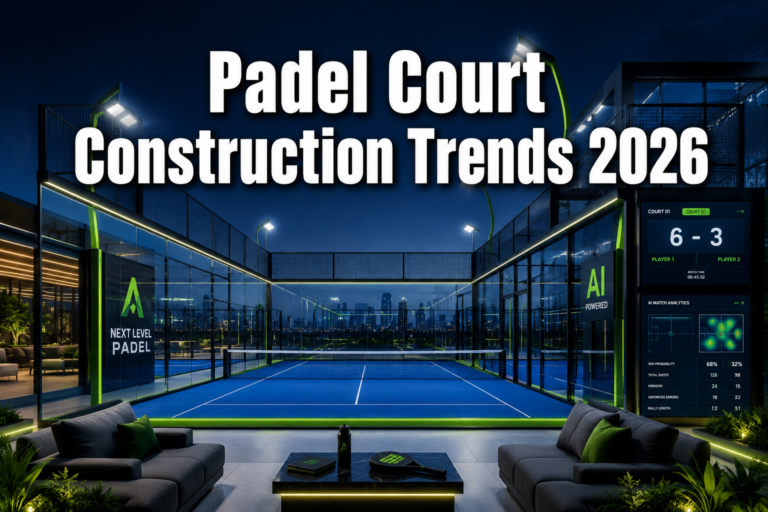
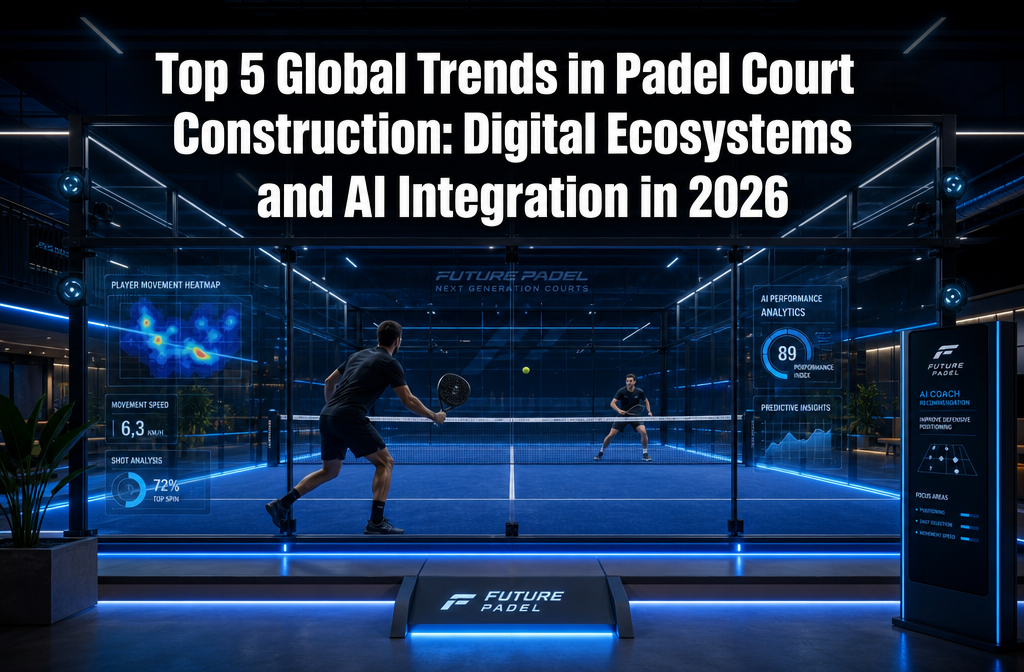
Top 5 Global Trends in Padel Court Construction: Digital Ecosystems and AI Integration in 2026
Last updated: June 7, 2026
Quick Answer: The top 5 global trends in padel court construction — digital ecosystems and AI integration in 2026 — are smart sensor networks, AI-powered player analytics, automated booking platforms, VR training simulations, and modular court designs with app-controlled management. These trends are reshaping how clubs build, manage, and monetize padel facilities worldwide, benefiting everyone from casual weekend players to elite competitors.
Key Takeaways
- Padel is now played on over 50,000 courts worldwide, with smart court construction accelerating fast [3]
- AI analytics tools track player movement, shot speed, and positioning in real time to deliver personalized coaching feedback [2]
- Automated booking and management platforms are the fastest-adopted digital tool in new padel club builds [3]
- Spain, Sweden, Italy, and the UAE are leading the charge in high-tech padel court innovation
- A fully AI-integrated padel court costs roughly €80,000–€200,000+ to build, depending on sensor density and software licensing [2]
- VR training simulations are emerging at premium academies, though they remain rare at community clubs
- Privacy concerns around biometric and movement data are real and require clear player consent policies
- Smart courts benefit amateur players most — the feedback gap between coached and uncoached players narrows significantly
- Maintenance for high-tech courts requires both sports facility staff and IT support — a common planning oversight
- The padel growth trajectory makes this one of the most investable racket sports sectors in 2026
What Exactly Is a Padel Court and How Is It Different From Tennis?
A padel court is an enclosed playing surface roughly one-third the size of a tennis court, surrounded by glass walls and metal mesh that are active parts of play. Unlike tennis, padel uses solid perforated rackets (not strung), a slightly depressurized ball, and allows balls to bounce off the back walls — making rallies longer and more social.
Key differences at a glance:
| Feature | Padel | Tennis |
|---|---|---|
| Court size | 10m × 20m | 10.97m × 23.77m (singles) |
| Walls | Glass + mesh (in play) | None |
| Racket | Solid, perforated | Strung |
| Scoring | Same as tennis | Same |
| Typical format | Doubles | Singles or doubles |
| Learning curve | Gentler | Steeper |
Padel’s enclosed format also makes it ideal for sensor installation — cameras and radar units can be mounted on walls without interference, which is a big reason why the padel hybrid game format has become a testing ground for AI sports technology.
The Top 5 Global Trends in Padel Court Construction: Digital Ecosystems and AI Integration in 2026
These five trends are driving the current wave of next-generation padel facility builds across Europe, the Middle East, and the Americas. [1]
Trend 1: Smart Sensor Networks and Adaptive LED Lighting
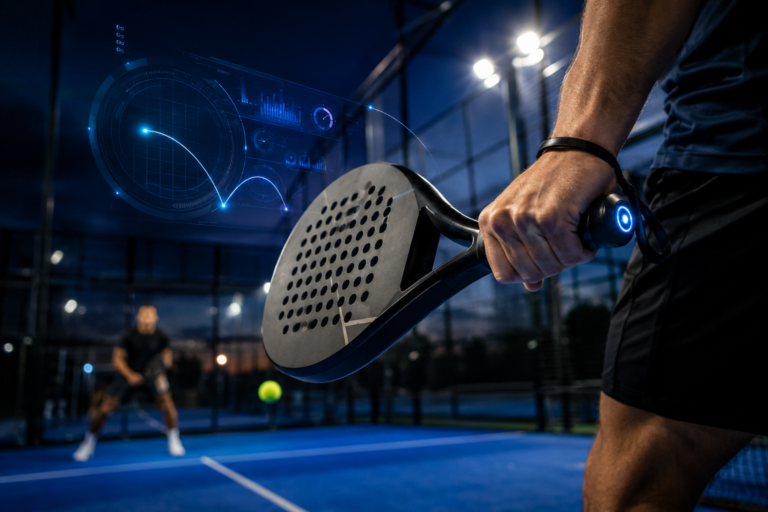
Modern padel courts now embed radar, LiDAR, and camera-based sensors directly into the court structure during construction. These systems track ball speed, spin, bounce angle, and player positioning in real time. Adaptive LED systems adjust brightness and color temperature based on time of day, match intensity, or broadcast requirements — all controlled via smartphone. [1]
Trend 2: AI-Powered Player Analytics
Leading clubs are installing AI analytics platforms that process sensor data into actionable coaching insights. After each match, players receive a breakdown of their court coverage, shot selection patterns, and weak zones — similar to what professional teams have used for years. [2]
Trend 3: Automated Booking and Club Management Platforms
Automated digital booking systems are now standard in new padel builds. These platforms handle court reservations, membership management, payment processing, and waitlist notifications — all in one app. This has dramatically reduced admin overhead and improved court utilization rates. [3]
Trend 4: VR Training Simulations
A smaller but growing number of premium padel academies are adding VR training pods alongside their courts. Players wear headsets and practice footwork, reaction drills, and shot selection in simulated match environments before stepping onto a real court. [2]
Trend 5: Modular Court Designs with Digital Ecosystems
Modular padel courts — pre-fabricated panels that assemble quickly — now come pre-wired for sensors, cameras, and connectivity. Clubs can deploy a digitally enabled court in days rather than weeks, and scale their tech stack as budget allows. [1]
Which Countries Are Leading Digital Padel Court Innovation Right Now?
Spain, Sweden, Italy, and the UAE are the clear frontrunners in high-tech padel court construction in 2026. Spain remains the global heartbeat of padel with the highest court density, while Sweden has become a leader in smart facility management software. The UAE is investing heavily in climate-controlled indoor smart courts as part of broader sports tourism infrastructure. [1]
Countries to watch:
- 🇪🇸 Spain — highest court volume, most AI analytics deployments
- 🇸🇪 Sweden — leading booking platform innovation
- 🇮🇹 Italy — fastest-growing new court market in Europe
- 🇦🇪 UAE — premium indoor smart courts for sports tourism
- 🇺🇸 USA — early-stage but accelerating, especially in Florida and California
How Much Does It Cost to Build a High-Tech Padel Court with AI Features?
A standard padel court build runs €25,000–€50,000 for a basic outdoor structure. Adding a full digital ecosystem — sensors, AI analytics software, adaptive lighting, and booking integration — pushes total costs to €80,000–€200,000 per court, depending on the technology tier chosen. [2]
Cost breakdown (estimated ranges):
- Basic court structure: €25,000–€50,000
- Smart sensor array: €10,000–€30,000
- AI analytics platform (annual license): €3,000–€15,000/year
- Adaptive LED system: €5,000–€20,000
- Automated booking software: €1,500–€6,000/year
- VR training pod (optional): €15,000–€40,000
Choose the full AI package if: your club has 4+ courts, runs coaching programs, or wants to attract competitive players. For a single community court, start with booking software and adaptive lighting — the ROI is faster.
What Digital Sensors Work Best for Tracking Padel Gameplay?
Camera-based computer vision systems combined with radar sensors currently offer the best accuracy for padel tracking. Camera arrays mounted at ceiling height or on the back glass walls capture full-court coverage, while radar units measure ball speed with high precision. [1]
Sensor types used in 2026 smart courts:
- Computer vision cameras — player movement, positioning, court coverage
- Radar/Doppler sensors — ball speed, serve velocity
- Pressure-sensitive flooring (emerging) — footwork and weight distribution
- Wearable IMU sensors — player-worn, tracks swing mechanics
The best systems combine at least two sensor types for cross-validated data. Single-sensor setups tend to have blind spots or lag issues during fast exchanges.
Can AI Really Improve Player Performance in Padel Sports?
Yes — and the improvement is most pronounced for amateur and intermediate players. AI analytics close the coaching gap for players who don’t have regular access to a professional coach. By reviewing post-match data on court coverage, shot patterns, and positioning errors, recreational players can self-correct faster than with video review alone. [2]
For those looking to build on this with structured practice, pairing AI feedback with solid court positioning strategies makes a real difference. The data tells you where you’re going wrong; good positioning habits fix it.
What Data Can Smart Padel Courts Actually Track During a Match?
Smart padel courts can track a wide range of performance and gameplay metrics in real time. This data is stored, analyzed, and delivered to players through a connected app after the session. [1] [2]
Data tracked by current smart court systems:
- Ball speed and spin rate
- Shot placement and frequency by court zone
- Player movement distance and speed
- Rally length and point construction patterns
- Serve and return statistics
- Reaction time estimates
- Heart rate (if wearable is paired)
This level of detail was previously available only to professional teams. Now it’s accessible to anyone playing on a digitally equipped court — a genuine shift for the racket sports community.
Are Smart Padel Courts Worth the Investment for Clubs and Academies?
For clubs running structured coaching programs or targeting competitive players, smart courts offer a strong return. Higher membership fees, premium coaching packages, and increased court utilization driven by app-based booking all contribute to faster payback. [2] [3]
Worth it if:
- You run 4+ courts with coaching programs
- Your target market includes competitive or performance-focused players
- You want to differentiate from local competitors
Less urgent if:
- You’re building a single recreational court for a community center
- Your budget is under €60,000 total
- Your player base is primarily casual social players
The automated booking platform alone — the most affordable piece of the digital stack — typically pays for itself within 12–18 months through reduced admin costs and improved court fill rates. [3]
Who Should Consider Building a Next-Generation AI-Enabled Padel Court?
Private sports clubs, hotel and resort operators, real estate developers adding amenity courts, and dedicated padel academies are the best candidates for full AI-enabled court builds. Community recreation centers and schools can benefit from partial digital integration — starting with booking software and basic sensor packages. [2]
The padel equipment 2026 landscape has matured enough that even mid-tier builds can access solid technology without going all-in on enterprise-level systems.
What Are the Top Manufacturers of Smart Padel Court Technology in 2026?
Several companies have established strong positions in the smart padel court technology space. While the market is still consolidating, key players include established court builders who have added tech partnerships and pure-play sports analytics firms entering the padel market. [1] [2]
Notable categories of providers:
- Court construction specialists with integrated sensor packages (primarily Spanish and Swedish firms)
- Sports analytics platforms adapted from football and tennis (expanding into padel)
- Booking and club management SaaS companies with padel-specific features
- LED and lighting specialists offering adaptive systems for indoor courts
No single manufacturer dominates all five technology layers yet — most clubs assemble a stack from two or three providers, which is worth factoring into your integration planning.
How Do AI-Integrated Courts Help Amateur Versus Professional Players?
Amateur players gain the most from AI-integrated padel courts because they lack consistent access to coaching. The system acts as an always-available coach — flagging positioning errors, shot selection habits, and movement inefficiencies that would otherwise go unnoticed for months. [2]
Professional players use the same data differently: for tactical preparation, opponent scouting, and injury prevention through movement load monitoring. The data is the same; the application changes based on player level.
For recreational players who also enjoy other racket sports, the skills transfer is real. The movement and positioning awareness developed through AI feedback on a padel court carries over to court-free racket sports and other formats too.
Are There Privacy Concerns with AI Tracking in Sports Facilities?
Yes — and they’re legitimate. Smart padel courts collect biometric-adjacent data including movement patterns, physical performance metrics, and (if wearables are used) heart rate. Players should be informed clearly about what data is collected, how it’s stored, and who can access it. [1]
Best practices for clubs:
- Provide clear opt-in consent before first use
- Allow players to download and delete their own data
- Store data on secure, GDPR-compliant servers (critical for European clubs)
- Never share individual performance data with third parties without explicit consent
- Anonymize aggregate data used for facility reporting
Clubs that skip this step risk losing player trust — and in Europe, face regulatory penalties.
What Mistakes Do People Make When Integrating Technology into Sports Facilities?
The most common mistake is treating technology as an add-on rather than planning for it from the start of construction. Retrofitting sensor systems into an existing court costs significantly more than building with them integrated from day one. [1] [2]
Other frequent mistakes:
- Underestimating IT infrastructure needs — smart courts need reliable high-speed internet, often requiring dedicated fiber connections
- Ignoring staff training — front desk and coaching staff need to understand the systems to help players use them
- Buying the most expensive system without matching it to player demand — a community club doesn’t need enterprise-level analytics
- No maintenance plan — high-tech courts need both sports facility maintenance and IT support on call
- Poor data UX — if the app is confusing, players won’t use the data, and the investment loses its value
What Maintenance Challenges Come with High-Tech Padel Court Systems?
High-tech padel courts require two types of maintenance that traditional courts don’t: physical upkeep of sensors and cameras, and ongoing software and connectivity management. Sensors can be knocked out of calibration by hard ball impacts on glass walls, and camera lenses need regular cleaning in dusty or outdoor environments. [1]
Maintenance checklist for smart court operators:
- Monthly sensor calibration checks
- Quarterly camera lens cleaning and alignment verification
- Software updates for analytics platforms (often automatic, but need monitoring)
- Annual review of data storage and security protocols
- Backup internet connection in case primary connectivity fails
Budget roughly 8–12% of your initial technology investment annually for maintenance and software licensing. Clubs that skip this planning often find their smart systems degrading within 18 months.
FAQ
Q: How long does it take to build a smart padel court from scratch? A standard padel court takes 4–8 weeks to construct. Adding pre-integrated smart technology to a modular build adds 1–2 weeks. Retrofitting an existing court with sensors takes 3–5 days of downtime per court.
Q: Do players need a smartphone to use smart court features? Most AI analytics platforms deliver data through a mobile app, so a smartphone is effectively required. Some clubs also offer tablet kiosks at courtside for players who prefer not to use personal devices.
Q: Can smart court data be used for official tournament ranking? Not currently in most governing body frameworks. Smart court data is used for training and performance development, not official ranking calculations, as of 2026.
Q: Is padel easier to learn than tennis for beginners? Generally yes. The enclosed court reduces the area to cover, the walls keep balls in play longer, and the solid racket is easier to control than a strung frame. Most beginners feel competent after 3–5 sessions.
Q: What internet speed does a smart padel court need? A minimum of 100 Mbps dedicated upload/download is recommended for real-time data processing across multiple courts. Facilities with 4+ courts should consider a dedicated fiber connection.
Q: Are VR training systems available for home use? Some consumer-grade VR padel training apps exist, but they’re far less sophisticated than facility-grade systems. Home VR training is best treated as a supplement to court time, not a replacement.
Q: How do automated booking platforms reduce admin costs? By handling reservations, payments, cancellations, and waitlist management automatically, clubs can reduce front desk staffing hours by 30–50%, according to operator estimates reported in industry sources. [3]
Q: Can a padel club add smart features in phases rather than all at once? Yes — and this is often the smarter approach. Start with booking software and adaptive lighting, then add sensor analytics in year two as revenue grows. Most platforms are designed to scale.
Q: What happens to player data if a club closes or changes software providers? Players should always request a data export before a club switches platforms. Reputable providers offer data portability as a standard feature. Check this before signing any contract.
Q: Is padel popular enough in the USA to justify smart court investment now? The US market is growing fast, particularly in Florida, Texas, and California. Early investors in smart courts in these markets are positioning well, but the payback timeline is longer than in Spain or Italy where player density is higher.
Conclusion
The top 5 global trends in padel court construction — digital ecosystems and AI integration in 2026 — aren’t just for elite clubs or professional academies. They’re becoming the new baseline for any serious padel facility that wants to attract players, retain members, and deliver real value.
Here’s what to do next:
- If you’re a club operator: Start with automated booking and adaptive lighting — lowest cost, fastest ROI. Plan sensor integration into your next court build from day one.
- If you’re a player: Seek out clubs with AI analytics in your area. Even one session of data-backed feedback can accelerate your improvement faster than months of unguided practice.
- If you’re evaluating padel as a business: The padel growth numbers support investment, but match your technology tier to your market — don’t overbuild for a community that wants social play, not performance data.
- Everyone: Stay informed about privacy policies at any smart court you use. Your movement and performance data has real value — make sure you know how it’s being used.
The racket sports community is at an exciting inflection point. Padel courts are becoming as much about data as they are about glass walls and rubber balls. Whether you’re chasing improvement or building a business, the smart money is on getting familiar with these trends now.
References
[1] Barcelona Takeaways 5 Global Trends From Padel World Summit – https://www.porticosport.de/padel-nachrichten/barcelona-takeaways-5-global-trends-from-padel-world-summit
[2] Europe Padel Court Market 2026 Investment Trends Costs Commercial Padel Court Construction Guide – https://www.ldkpadel.com/news/europe-padel-court-market-2026-investment-trends-costs-commercial-padel-court-construction-guide-299429.html
[3] A New Era Of Global Expansion Over 50000 Padel Courts Worldwide – https://www.clusterpadel.com/en/padel-news/20250630/a-new-era-of-global-expansion-over-50000-padel-courts-worldwide.aspx