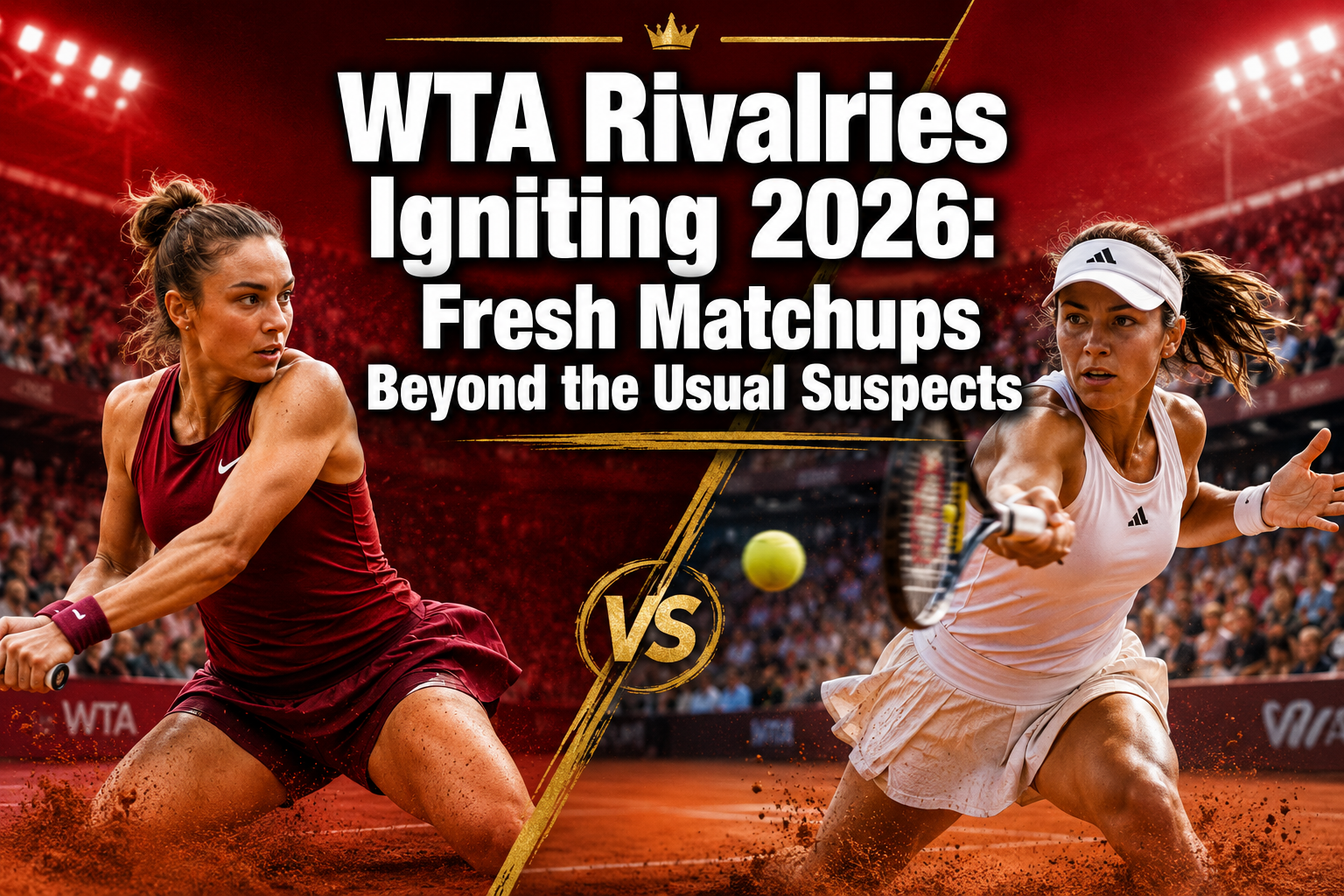
WTA Rivalries Igniting 2026: Fresh Matchups Beyond the Usual Suspects
Last updated: June 8, 2026
Quick Answer: The most exciting WTA rivalries igniting 2026 aren’t just Sabalenka vs. Rybakina — they’re the parity-driven head-to-heads between rising stars like Mirra Andreeva, Marta Kostyuk, Maja Chwalińska, and Paula Badosa. These fresh matchups are reshaping tour depth, generating real geopolitical drama, and creating the next generation of must-watch tennis rivalries.
Key Takeaways
- 🎾 Mirra Andreeva (age 19) won her first Grand Slam title at Roland Garros 2026, defeating Maja Chwalińska 6-3, 6-2 in the final [1]
- 🌍 The Andreeva vs. Kostyuk rivalry carries real geopolitical weight — Kostyuk refuses to shake hands with Russian opponents [2]
- 💰 Elena Rybakina leads 2026 prize money earnings at $4,055,262; Andreeva has already earned $1,782,849 this season [8]
- 🇵🇱 Chwalińska’s run from qualifier to Roland Garros finalist is expected to push her into the WTA top 30 [1]
- 🏆 The 2026 WTA Finals in Riyadh (Nov. 7–14) will be the proving ground for these emerging rivalries [7]
- 📈 The WTA 125 calendar features 43 tournaments in 2026, giving developing players more chances to build competitive records [10]
- 🤝 Social media and personal backstories — not just on-court results — are driving fan investment in these new matchups [6]
- 🎯 Playing style contrasts (baseline grinders vs. aggressive servers) are making these fresh rivalries more visually dramatic than classic power-vs-power duels

Which Young Tennis Players Are Creating the Most Heat Right Now
The two names generating the most buzz in mid-2026 are Mirra Andreeva and Maja Chwalińska. Andreeva, just 19 years old, claimed her first Grand Slam title at Roland Garros on June 6, 2026, beating Chwalińska 6-3, 6-2 in the final [1]. Chwalińska’s story is equally compelling — she entered as a qualifier and made it all the way to the final, a run that’s set to launch her into the top 30 of the WTA rankings [1].
Other players generating heat:
- Marta Kostyuk (Ukraine) — reached her first WTA 1000 final at the Madrid Open [2]
- Paula Badosa (Spain) — returning from injury, facing Daria Snigur at the Libema Open [3]
- Anhelina Kalinina and Moyuka Uchijima — each with two WTA 125 titles in 2026 [10]
These aren’t household names yet for casual fans, but inside the racket sports community, they’re the players everyone’s tracking.
How Do These New WTA Rivalries Compare to Classic Tennis Matchups
Classic rivalries like Serena vs. Sharapova or Navratilova vs. Evert were defined by years of head-to-head data and clear stylistic contrasts. The fresh matchups in WTA rivalries igniting 2026 are still early-stage, but they’re building fast — and with more emotional layers.
Former world No. 1 Garbiñe Muguruza has pointed to Sabalenka vs. Rybakina as the current benchmark rivalry in women’s tennis [5]. But what’s different about the newer matchups is that they’re driven by parity — players who are genuinely close in ranking, style, and ambition — rather than one dominant player versus a challenger.
| Rivalry Type | Classic Era | 2026 Emerging |
|---|---|---|
| Ranking gap | Often wide | Usually narrow |
| Style contrast | Power vs. craft | Varied, multi-surface |
| Emotional driver | Competition | Geopolitics + personal story |
| Media coverage | TV-first | Social-first |
| Prize money gap | Significant | Closing fast |
What Makes a Tennis Rivalry Really Explosive in 2026
A rivalry becomes explosive when three things overlap: competitive closeness, personal stakes, and public narrative. In 2026, the Andreeva vs. Kostyuk matchup checks all three boxes. Their Madrid Open final meeting wasn’t just a tennis match — Kostyuk has publicly stated she won’t shake hands with Russian opponents due to the ongoing conflict between Ukraine and Russia [2]. That context turns every point into something bigger.
What also fuels rivalry heat in 2026:
- Social media presence — players who share training clips and personal stories build fan loyalty before matches even happen
- Surface versatility — players who compete across clay, hard, and grass create more rivalry touchpoints per season
- Upset potential — when rankings are close, any result feels meaningful
For players in the racket sports community looking to understand what makes elite competition tick, studying these dynamics is genuinely useful. The mental side of the game — knowing your opponent’s story, managing pressure, staying focused — applies whether you’re playing WTA tennis or a local pickleball tournament. Court positioning strategies and mental composure go hand in hand at every level.
Who Are the Rising Stars Most Likely to Clash on Court
The players most likely to define the next wave of WTA rivalries share a few traits: they’re aged 18–24, they’re winning on multiple surfaces, and they’re already collecting top-30 results.
Top rising stars to watch:
- Mirra Andreeva (Russia, 19) — Roland Garros champion 2026, WTA ranking No. 6 [1]
- Maja Chwalińska (Poland, 23) — Roland Garros finalist, expected top-30 entry [1]
- Marta Kostyuk (Ukraine, 22) — WTA 1000 finalist, Madrid Open 2026 [2]
- Daria Snigur (Ukraine) — first-round opponent for Badosa’s comeback at Libema Open [3]
- Moyuka Uchijima (Japan) — two WTA 125 titles in 2026 [10]
Choose to watch Andreeva vs. Chwalińska if you want to see a pure tennis rivalry still in its opening chapter — two players who’ve now met at the biggest stage and will almost certainly clash again.
Choose to watch Andreeva vs. Kostyuk if you want the rivalry with the most emotional and geopolitical weight in 2026.
How Much Prize Money Is at Stake in These Emerging Rivalries
Prize money is a real motivator, and the numbers in 2026 are significant. Elena Rybakina leads the tour with $4,055,262 in earnings, followed closely by Aryna Sabalenka at $4,020,272 [8]. For the rising stars, Mirra Andreeva has already earned $1,782,849 this season — a number that will jump considerably after her Roland Garros title [8].
The 2026 WTA Finals in Riyadh (November 7–14) will feature the top eight singles players and doubles teams, with prize money among the highest on the tour calendar [7]. For players like Chwalińska and Kostyuk, breaking into that top eight is both a ranking goal and a financial one.
The 43-tournament WTA 125 calendar also provides a meaningful earnings pathway for developing players [10], which is why rivalries are forming at every tier of the tour — not just at the top.
What Training Techniques Are Driving These Competitive Dynamics
The physical and tactical preparation behind these rivalries is more sophisticated than it looks. Players like Andreeva and Kostyuk are working with multi-disciplinary teams covering movement, nutrition, mental coaching, and video analysis.
Key training elements shaping 2026’s competitive dynamics:
- Return-of-serve patterns — with big servers like Rybakina dominating, players are drilling return positioning extensively
- Transition play — moving from defense to offense quickly is a hallmark of Andreeva’s style
- Fitness base — longer rallies on clay demand elite endurance; Chwalińska’s qualifier-to-final run at Roland Garros reflects serious physical preparation
- Mental resilience training — especially relevant for players like Kostyuk who compete under additional psychological pressure
This mirrors what any serious racket sports player should be doing. Whether you’re working on advanced practice routines in pickleball or drilling footwork for tennis, the fundamentals of structured training apply across the board. Good warm-up routines and injury prevention matter at every level of play.
Which WTA Rivalries Are Most Marketable for Sponsors — and What Countries Are Producing the Most Talent
The most marketable rivalries combine star power, national pride, and story. Andreeva vs. Kostyuk is a sponsor’s complex challenge — the geopolitical dimension makes some brands cautious — but it generates enormous organic media coverage [2].
From a pure marketing standpoint, Andreeva vs. Chwalińska has strong potential: a teenage Grand Slam champion vs. a qualifier-turned-finalist, two young players with long careers ahead [1].
Countries producing the most competitive female tennis talent in 2026:
- 🇷🇺 Russia — Andreeva is the standout, but the pipeline remains strong
- 🇺🇦 Ukraine — Kostyuk and Snigur both active at high levels despite challenging circumstances
- 🇵🇱 Poland — Chwalińska’s Roland Garros run puts Poland firmly on the map
- 🇰🇿 Kazakhstan — Rybakina continues to anchor the country’s tennis identity
- 🇯🇵 Japan — Uchijima’s WTA 125 success signals growing depth
- 🇪🇸 Spain — Badosa’s comeback and Bucsa’s doubles success keep Spain relevant [3][4]
The WTA 125 circuit’s 43-event calendar in 2026 is also accelerating talent development across Eastern Europe and Asia [10].
How Generational Differences and Playing Style Contrasts Create Drama
Generational gaps are creating real tension on the WTA tour in 2026. Established veterans are watching teenagers like Andreeva win Grand Slams, which shifts expectations for everyone. Players in their mid-to-late 20s are recalibrating their timelines.
Style contrasts that create the most dramatic court confrontations:
- Big server vs. baseline grinder — Rybakina’s serve against a retriever like Kostyuk produces long, tactical battles
- Aggressive topspin vs. flat ball-striking — Andreeva’s heavy topspin creates different problems than Chwalińska’s flatter approach
- Net play vs. baseline dominance — the Bucsa/Melichar-Martinez doubles team’s success at the Rome Internazionali shows how net-oriented play disrupts baseline-heavy pairs [4]
These style matchups are genuinely fun to study, even for recreational players. Understanding shot selection and how different playing styles interact is one of the fastest ways to improve your own game — whether you’re playing tennis, padel, or pickleball.
Are These New Rivalries More Technical or More Psychological — and What Mistakes Do Young Players Make
Both, but the psychological element is increasingly dominant. The Andreeva vs. Kostyuk dynamic shows that mental and emotional factors can shape a match before the first ball is struck [2]. When Kostyuk refuses to shake hands with Russian opponents, that’s a statement that affects the atmosphere on court and in the stands.
Common mistakes young players make when building competitive narratives:
- Letting social media pressure affect match focus — posting too much during tournaments can drain mental energy
- Defining rivalry too early — calling someone a rival after one match sets unrealistic expectations
- Ignoring the physical side — psychological strength without physical preparation leads to late-match collapses
- Reacting to opponents’ narratives — getting drawn into a rival’s story instead of staying focused on your own game plan
This applies directly to recreational players too. Understanding opponent weaknesses and staying mentally disciplined are skills that translate across all racket sports. The racket sports community benefits from watching how elite players handle pressure — and learning from both their successes and their mistakes.
How Social Media and Personal Backstories Are Fueling Tennis Rivalries
Social media has fundamentally changed how tennis rivalries develop. In 2026, a rivalry can gain traction online before players have even met on court more than once. Kostyuk’s public stance on not greeting Russian players has generated millions of impressions across platforms [2], turning a personal decision into a defining part of her public identity.
Paula Badosa’s comeback story — returning from injury to face Daria Snigur at the Libema Open — is the kind of narrative that builds fan investment fast [3]. Followers who tracked her injury recovery feel personally invested in her first-round result.
What’s driving social-first rivalry growth:
- Behind-the-scenes training content builds parasocial connection
- Personal statements on geopolitical or social issues generate media coverage beyond sports outlets
- Short-form video highlights make individual matchups shareable and memorable
- Player personalities (not just results) are now part of the rivalry brand
The WTA has actively highlighted these emerging rivalries as part of its 2026 promotional strategy [6], recognizing that depth of storytelling — not just rankings — is what keeps fans engaged between Grand Slams.
Conclusion: Why These Fresh Matchups Matter for Every Tennis Fan
WTA rivalries igniting 2026 go well beyond the usual suspects — and that’s genuinely good news for the sport. Andreeva’s Roland Garros title at 19, Chwalińska’s qualifier-to-finalist journey, Kostyuk’s principled stand, and Badosa’s comeback are the stories that make tennis compelling for fans at every level [1][2][3].
For anyone in the racket sports community — whether you’re a competitive player or a recreational fan — these matchups are worth following closely. They show what happens when technical skill, physical preparation, and mental resilience all come together under pressure.
Actionable next steps:
- Follow the WTA 125 circuit to catch these rivalries early, before they become headline news
- Watch how players like Andreeva use transition play and topspin variation — then try applying similar principles in your own training
- Check out advanced strategies for racket sports to understand how elite tactics translate to recreational play
- Keep an eye on the 2026 WTA Finals in Riyadh (November 7–14) — that’s where this season’s rivalries will crystallize [7]
The next great WTA rivalry is already happening. You just have to know where to look.
FAQ
Who won Roland Garros 2026 in women’s singles? Mirra Andreeva of Russia won her first Grand Slam title at Roland Garros 2026, defeating Poland’s Maja Chwalińska 6-3, 6-2 in the final. Andreeva was 19 years old at the time of her victory [1].
Why won’t Marta Kostyuk shake hands with Russian players? Kostyuk, who is Ukrainian, has publicly stated she refuses to shake hands with Russian opponents due to the ongoing conflict between Russia and Ukraine. This stance has made her matches against Russian players — including Andreeva — particularly charged [2].
Who leads WTA prize money earnings in 2026? As of May 2026, Elena Rybakina leads with $4,055,262, followed by Aryna Sabalenka at $4,020,272. Rising star Mirra Andreeva had earned $1,782,849 before her Roland Garros title [8].
Where are the 2026 WTA Finals being held? The 2026 WTA Finals are scheduled in Riyadh, Saudi Arabia, from November 7 to 14. It’s the third consecutive year the event is held there [7].
What makes Maja Chwalińska’s Roland Garros run significant? Chwalińska entered Roland Garros 2026 as a qualifier — meaning she had to win three matches just to enter the main draw — and reached the final. That run is expected to push her into the WTA top 30 for the first time [1].
Which countries are producing the most WTA talent in 2026? Russia, Ukraine, Poland, Kazakhstan, Japan, and Spain are all generating competitive players at the top and developing levels of the WTA tour in 2026, based on ranking results and tournament performances [1][2][3][8].
What is the WTA 125 circuit and why does it matter? The WTA 125 circuit is a tier of tournaments below the main WTA Tour, featuring 43 events in 2026. It’s where developing players build ranking points and competitive experience before breaking into the top 100 [10].
Is the Sabalenka vs. Rybakina rivalry still the top WTA matchup? Former world No. 1 Garbiñe Muguruza has identified Sabalenka vs. Rybakina as the leading duel in women’s tennis currently [5]. However, emerging rivalries involving Andreeva, Kostyuk, and Chwalińska are rapidly gaining ground in 2026.
How does Paula Badosa fit into the 2026 WTA rivalry picture? Badosa is returning from injury and is scheduled to face Ukrainian Daria Snigur at the Libema Open — their first-ever meeting. Her comeback adds a narrative dimension to the mid-2026 tour calendar [3].
What doubles rivalries are emerging in 2026? The Spanish-American duo of Cristina Bucsa and Nicole Melichar-Martinez reached their first WTA 1000 doubles final together at the Rome Internazionali, defeating the second-seeded team of Katerina Siniakova and Taylor Townsend [4].
References
[1] Mirra Andreeva Gana Su Primer Roland Garros Tras Imponerse A Chwalinska En Dos Sets 3 6 2 6 Cadena Ser – https://cadenaser.com/nacional/2026/06/06/mirra-andreeva-gana-su-primer-roland-garros-tras-imponerse-a-chwalinska-en-dos-sets-3-6-2-6-cadena-ser/?utm_source=openai
[2] La Ucrania Marta Kostyuk Que No Saluda A Sus Rivales Rusas Pelea En Madrid Por Su Primer Wta 1000 Ante La Talentosa Andreeva – https://elpais.com/deportes/tenis/2026-05-02/la-ucrania-marta-kostyuk-que-no-saluda-a-sus-rivales-rusas-pelea-en-madrid-por-su-primer-wta-1000-ante-la-talentosa-andreeva.html?utm_source=openai
[3] Badosa Ya Tiene Rival Para Su Regreso La Ucraniana Snigur F202606 N – https://as.com/tenis/mas_tenis/badosa-ya-tiene-rival-para-su-regreso-la-ucraniana-snigur-f202606-n/?utm_source=openai
[4] Busca Mete Al Tenis Espanol En Una De Las Finales F202605 N – https://as.com/tenis/masters_1000/busca-mete-al-tenis-espanol-en-una-de-las-finales-f202605-n/?utm_source=openai
[5] The Rivalry Today Is Aryna Against Rybakina Garbine Muguruza Identifies Wtas Leading Duel – https://tennisuptodate.com/wta/the-rivalry-today-is-aryna-against-rybakina-garbine-muguruza-identifies-wtas-leading-duel?utm_source=openai
[6] The Rivalries Were Most Excited To Watch In 2026 – https://www.wtatennis.com/news/4422666/the-rivalries-were-most-excited-to-watch-in-2026?utm_source=openai
[7] 2026 WTA Finals – https://en.wikipedia.org/wiki/2026_WTA_Finals?utm_source=openai
[8] 2026 WTA Tour – https://en.wikipedia.org/wiki/2026_WTA_Tour?utm_source=openai
[9] BNP Paribas Open Indian Wells 2026 – https://www.wtatennis.com/tournaments/609/indian-wells/2026?utm_source=openai
[10] 2026 WTA 125 Tournaments – https://en.wikipedia.org/wiki/2026_WTA_125_tournaments?utm_source=openai