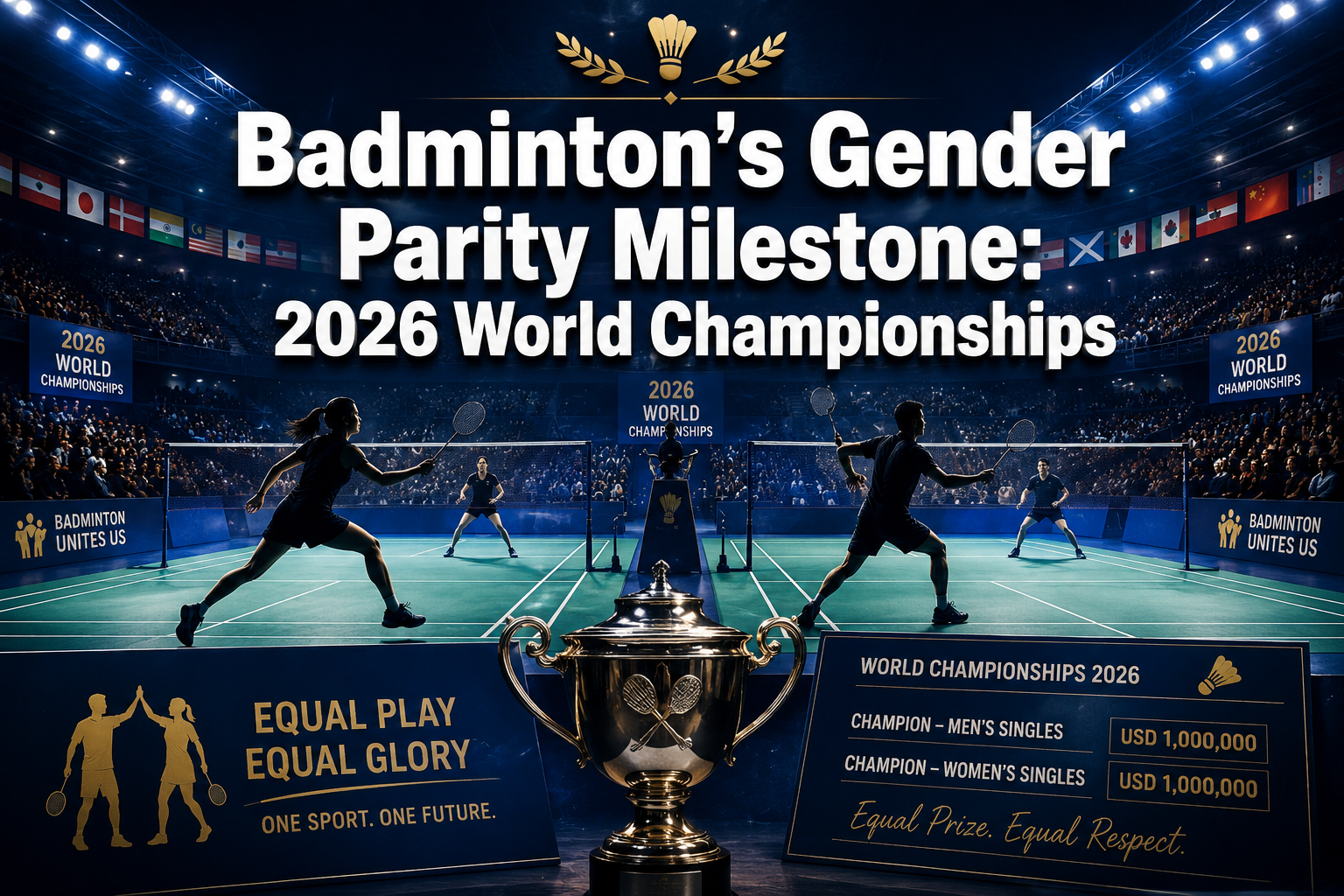
Badminton’s Gender Parity Milestone: How 2026 World Championships Equalized Prizes and Representation
Last updated: June 23, 2026
Quick Answer: Badminton has built one of the strongest gender parity frameworks in professional sport. Since the BWF World Tour launched in 2018, equal prize money across men’s and women’s events has been a core feature at every level — from Super 100 tournaments up through the World Tour Finals. The 2026 World Championships sit within this broader structure, continuing a tradition of equal medal events and equal representation that puts badminton ahead of most racket sports globally. [1][2]
Key Takeaways
- 🏸 The BWF World Tour has paid equal prize money to men’s and women’s disciplines at every tier since its 2018 launch [8]
- 🏆 The 2026 BWF World Championships include five disciplines — men’s singles, women’s singles, men’s doubles, women’s doubles, and mixed doubles — giving women equal medal representation [2]
- 💰 BWF increased prize money for the World Tour Finals cycle 2023–2026, with equal distribution across all disciplines [6]
- 📈 A major World Tour revamp starting in 2027 includes a USD 26.9 million prize pool increase, maintaining equal structures for men’s and women’s events [5]
- 🌍 The World Championships themselves carry no prize money — they are prestige events separate from the commercial World Tour [9]
- ⚡ Badminton’s parity model is frequently cited as a benchmark for other racket sports communities, including growing sports like padel and pickleball
- 🎯 Equal pay structures directly support women’s participation pipelines at grassroots and professional levels
What Is Badminton’s Gender Parity Milestone and Why Does It Matter in 2026?
Badminton’s gender parity milestone refers to the sustained, structural commitment by the Badminton World Federation (BWF) to pay men and women equally across professional tournaments — and to ensure women’s events receive the same platform and prestige as men’s. In 2026, this commitment is more visible than ever.
The 2026 BWF World Championships feature all five standard disciplines, meaning women compete in the same number of events as men, with equal access to the sport’s most prestigious titles [2]. This equal representation at Worlds is not new — but it sits within a broader 2026 context where prize money, media coverage, and tournament structure are all aligning in ways that make this year genuinely significant for the sport.
For the racket sports community watching badminton’s evolution, this is a model worth understanding.
How Did the BWF World Tour Build Equal Prize Money From the Ground Up?

The BWF World Tour, launched in 2018, was designed from the start with equal prize money as a non-negotiable feature. Every tier — Super 1000, Super 750, Super 500, Super 300, and Super 100 — pays the same total purse to men’s and women’s events within each tournament [8][15].
This wasn’t a gradual adjustment. It was a structural decision baked into the Tour’s founding framework, which is what separates badminton from many other sports that still treat pay equity as an ongoing negotiation.
How the prize tiers work:
| Tour Level | Example Events | Equal Pay? |
|---|---|---|
| Super 1000 | All England, Indonesia Open | ✅ Yes |
| Super 750 | Korea Open, French Open | ✅ Yes |
| Super 500 | Denmark Open, Thailand Open | ✅ Yes |
| Super 300 | Regional Opens | ✅ Yes |
| World Tour Finals | Season-ending championship | ✅ Yes |
For the 2023–2026 World Tour Finals cycle, BWF officially announced increased prize money — and that increase was applied equally across all disciplines [6]. So when the top players in the world compete at the Finals, the women’s singles champion earns the same as the men’s singles champion. Full stop.
“Equal prize money isn’t a bonus in badminton — it’s the baseline.”
This is worth noting for players across the racket sports community who follow multiple sports. Badminton got here before tennis’s Grand Slams fully equalized (which happened at varying points between 1973 and 2007), and well before most other racket sports had the conversation at all.
What Role Do the 2026 BWF World Championships Play in Gender Representation?
The 2026 BWF World Championships are a prestige event — the sport’s equivalent of a world title fight — but they operate differently from the commercial World Tour. There is no prize money at the World Championships; the reward is the title itself [9].
That distinction matters. The Championships don’t add to a player’s earnings, but they carry enormous symbolic weight. And in 2026, the event continues to feature equal representation across all five disciplines [2]:
- Men’s Singles
- Women’s Singles
- Men’s Doubles
- Women’s Doubles
- Mixed Doubles
Women compete in three of those five events. Men also compete in three. Mixed doubles is shared. This structure ensures women’s badminton gets the same stage, the same global broadcast attention, and the same pathway to a world title as men’s badminton.
For players developing their badminton tips and skills with professional aspirations, knowing that the top of the sport treats women’s competition as equally important is a meaningful signal.
What’s Changing With the 2027 BWF World Tour Revamp?
The most significant financial shift in badminton’s near future isn’t in 2026 — it’s the major World Tour overhaul announced for 2027. In February 2026, BWF confirmed a revamped structure that includes a USD 26.9 million increase in global prize money across the expanded calendar [5][10].
Key details confirmed so far:
- Expanded tournament calendar with more events at multiple tiers
- Prize money increase of USD 26.9 million distributed across the tour
- Equal structures maintained for men’s and women’s events
- Some events saw tier adjustments (for example, Syed Modi downgraded in the new structure) [5]
This revamp matters because it signals that BWF isn’t just maintaining parity — it’s scaling it up. As the total prize pool grows significantly, women’s events grow with it at the same rate. That’s compounding parity, not just symbolic equality.
For anyone tracking racket sports gear reviews and broader industry trends, this kind of financial commitment from a governing body tends to drive sponsorship, media rights, and equipment investment upward across the board.
How Does Badminton’s Parity Model Compare to Other Racket Sports?
Badminton’s approach to gender parity is genuinely ahead of the curve in the racket sports world. Here’s a quick honest comparison:
Tennis: Grand Slams now pay equally, but many ATP/WTA tour events still have different prize structures. The two tours operate separately, which creates ongoing gaps at lower levels.
Padel: Growing fast, but prize money structures are still developing. Women’s padel earns significantly less than men’s at most professional events. Check out beginner padel tips if you’re exploring the sport.
Pickleball: Rapidly professionalizing, with active debates about equal pay as prize pools grow. Community-building is strong — similar to how online pickleball communities are connecting players globally — but financial parity is still a work in progress.
Squash: Prize money gaps exist, though some major events have moved toward equality.
Badminton’s advantage is that equal pay was built into the World Tour’s architecture from day one, rather than being retrofitted after years of disparity. That structural foundation makes it harder to reverse and easier to scale.
What Does Equal Prize Money Actually Mean for Women Players and Participation?
Equal prize money does more than balance a paycheck. It changes career viability, training investment, and the pipeline of young players entering the sport.
Practical effects on women’s badminton:
- Longer professional careers: When earnings are equal, women can justify the same level of full-time training investment as men
- Better coaching access: Higher earnings support access to top coaches, sports science, and travel — all of which improve racket sports skills at the elite level
- Stronger grassroots pipeline: Young girls seeing professional women earn the same as men are more likely to pursue the sport seriously
- Sponsorship attractiveness: Equal prize structures signal equal commercial value, which attracts sponsors to women’s events
The ripple effect extends beyond the top 10 players in the world. When a Super 300 event pays women’s singles the same as men’s singles, it affects players ranked 50th through 200th — the players who are deciding whether to stay professional or find other work.
This is the part of Badminton’s Gender Parity Milestone: How 2026 World Championships Equalized Prizes and Representation that doesn’t always make headlines but has the most lasting impact on the sport’s health.
What Are the Predicted Ripple Effects Across the BWF Tour and Beyond?
With the 2027 revamp confirmed and the 2026 season cementing equal structures, several ripple effects are already being discussed in the badminton community:
1. Increased depth in women’s draws More financial viability means more players staying professional longer, which raises the competitive level across all tiers.
2. Stronger national federation investment When women’s badminton generates equal prize money, national federations have clearer financial incentive to invest equally in women’s development programs.
3. Media and broadcast interest Equal prize money tends to correlate with equal broadcast treatment over time. More eyeballs on women’s badminton means more sponsorship, which funds more prize money — a positive cycle.
4. Influence on other racket sports Badminton’s model is increasingly referenced in conversations about padel, squash, and even padel vs pickleball development trajectories. Governing bodies in growing sports are watching.
5. Equipment and gear market growth Equal representation drives equal demand. Brands investing in racket sports equipment reviews and product development are increasingly targeting women’s badminton as a growth segment.
Frequently Asked Questions
Does the 2026 BWF World Championships pay prize money? No. The BWF World Championships are a prestige event with no prize money. The financial rewards in professional badminton come through the BWF World Tour circuit [9].
When did badminton start paying equal prize money? The BWF World Tour, launched in 2018, established equal prize money across men’s and women’s events at every tier from the start [8].
How much did BWF increase prize money for the 2027 revamp? BWF announced a USD 26.9 million increase in global prize money as part of the World Tour revamp beginning in 2027 [5].
Are women’s events at the World Championships equal to men’s? Yes. The 2026 BWF World Championships include five disciplines, with women competing in women’s singles, women’s doubles, and mixed doubles — the same number of events as men [2].
Does equal prize money apply to all BWF World Tour levels? Yes. From Super 100 through Super 1000 and the World Tour Finals, all tiers apply equal prize money to men’s and women’s disciplines [1][6].
How does badminton’s parity compare to tennis? Badminton built equal pay into its World Tour structure from 2018. Tennis Grand Slams equalized at different points, but many tour events below that level still have gaps.
Will the 2027 World Tour changes maintain equal pay? Yes. The confirmed revamp maintains equal prize structures for men’s and women’s events while significantly increasing the total prize pool [5][10].
Does equal prize money affect grassroots participation? Indirectly, yes. Equal earnings at the professional level signal equal value, which influences national federation investment, coaching availability, and young players’ decisions to pursue the sport seriously.
Conclusion: What Badminton’s Parity Model Means for the Racket Sports World
Badminton’s Gender Parity Milestone: How 2026 World Championships Equalized Prizes and Representation is really a story about structural design. The BWF didn’t stumble into parity — it built equal prize money into the World Tour’s foundation in 2018 and has been scaling it ever since.
In 2026, the World Championships continue to offer equal representation across all five disciplines, while the broader World Tour operates with equal prize money at every level. The confirmed 2027 revamp will amplify this with a massive prize pool increase, maintaining equal structures as the sport grows [5][6].
Actionable next steps for the racket sports community:
- Follow the BWF World Tour calendar to see equal-pay badminton in action at every level
- Track the 2027 revamp announcements for updated prize structures and tournament schedules
- Use badminton’s model as a reference point when discussing parity in other racket sports you play or follow
- Support women’s badminton by watching, attending, and engaging with women’s events — viewership drives the commercial case for continued investment
Whether you’re focused on improving racket sports skills, following professional circuits, or just passionate about fair sport, badminton’s parity framework is worth knowing. It’s proof that equal pay in racket sports isn’t just possible — it’s already working.
References
[1] 2026 BWF World Tour – https://en.wikipedia.org/wiki/2026_BWF_World_Tour [2] 2026 BWF World Championships – https://en.wikipedia.org/wiki/2026_BWF_World_Championships [5] Expanded World Tour And Prize Pool Among Big Changes Announced By BWF – https://www.business-standard.com/sports/other-sports-news/expanded-world-tour-and-prize-pool-among-big-changes-announced-by-bwf-126020900999_1.html [6] BWF Increases Prize Money World Tour Finals – https://thebridge.in/badminton/bwf-increases-prize-money-world-tour-finals-44759 [8] Badminton World Federation Announces New Tournament Structure Prize Money Increased – https://www.espn.com/badminton/story/_/id/18957785/badminton-world-federation-announces-new-tournament-structure-prize-money-increased [9] Why There Isn’t A Prize Money For BWF World Championships – https://www.reddit.com/r/badminton/comments/swz1jy/why_there_isnt_a_prize_money_for_bwf_world/ [10] BWF World Tour 2027–2030 Hosts Confirmed – https://www.facebook.com/CGTNSportsScene/posts/bwfworldtour-20272030-hosts-confirmed%EF%B8%8Fprize-money-increased-across-all-levelsbwf/1353921053435736/