
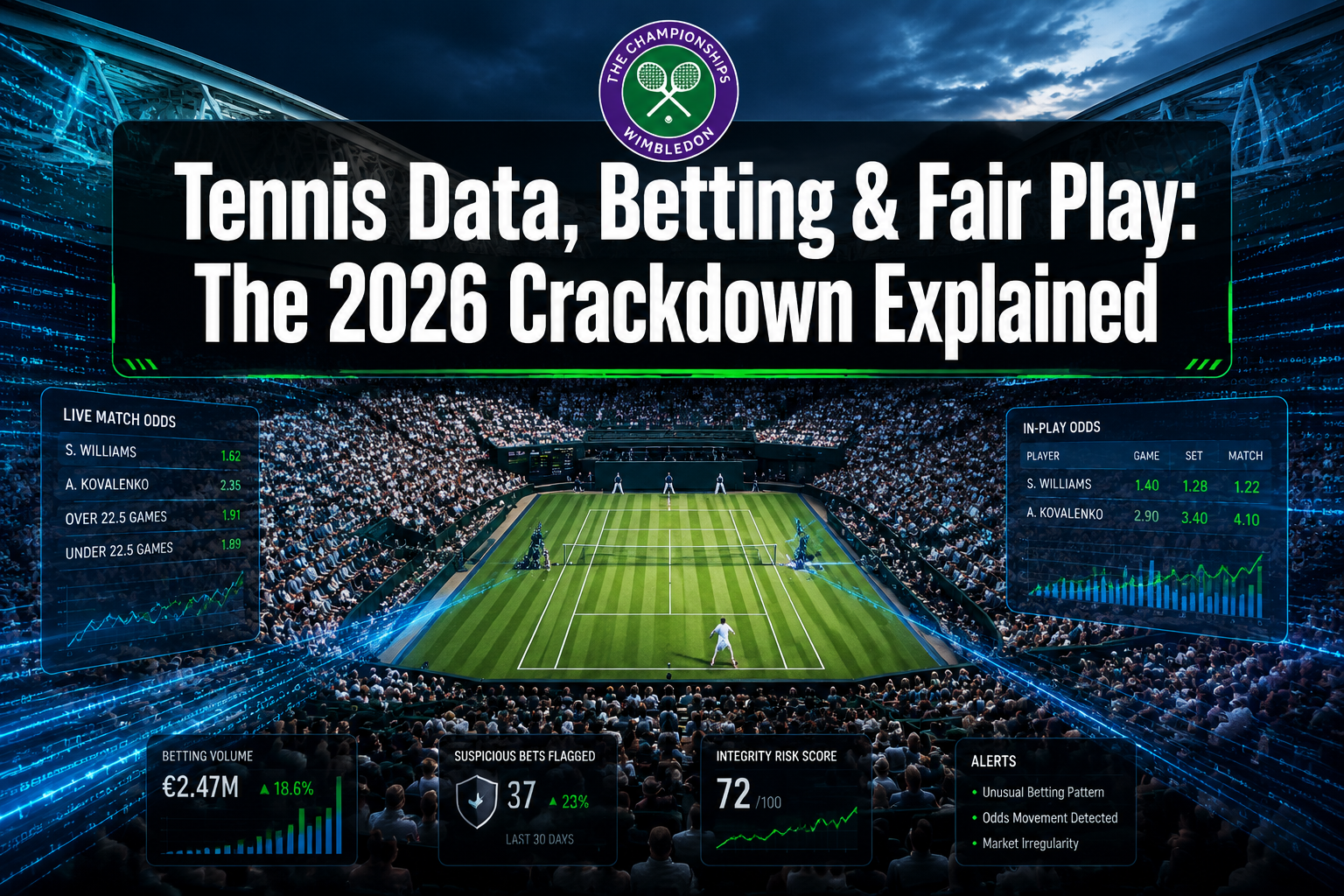
Data, Betting, and Fair Play: How Tennis’s 2026 Crackdown on “Data Companies” Affects Fans and Players
Last updated: June 29, 2026
Quick Answer: In 2026, tennis governing bodies and tournaments are tightening control over who can collect, sell, and use live match data — especially for in-play betting. The crackdown targets unregulated “data companies” that feed real-time stats to sportsbooks, sometimes enabling match manipulation. For fans, it means changes to live stats apps and betting markets. For players and coaches, it draws a clear line between legal performance analytics and illegal data selling.
Key Takeaways
- 🎾 “Data companies” in tennis are third-party firms that collect and sell live match data, often to sportsbooks for in-play betting markets.
- 🚨 In 2026, major tennis organizations are restricting unauthorized data collection at tournaments, citing match-fixing risks.
- 💰 Sportradar holds exclusive official data rights for events like Wimbledon, but faces lawsuits and investor scrutiny over alleged monopolistic practices [3][4][5].
- 📱 Casual fans can still access player stats through official tournament apps and broadcaster platforms — the ban targets commercial data resellers, not public information.
- ⚖️ The International Tennis Integrity Agency (ITIA) provisionally suspended three players in early 2026 under anti-corruption rules [6].
- 🏋️ Wearable fitness trackers like WHOOP were banned from match play at the 2026 Australian Open, sparking debate about the line between health data and performance advantage [2].
- 🏦 Tabcorp paid a $158,400 penalty in February 2026 for accepting 426 illegal in-play bets on tennis matches [1].
- 🌐 Online tennis betting is legal in 39 U.S. states plus Washington, D.C. as of 2026, but regulations vary widely [7].
- 🧑🏫 Coaches and teams can still use internal data analytics tools — the restrictions apply to commercial data distribution, not private performance analysis.
- 📊 The crackdown reshapes the tennis data ecosystem but doesn’t eliminate legitimate sports technology use.
What Are Data Companies in Tennis and Why Are They Being Cracked Down On?
Data companies in tennis are third-party businesses that collect live match statistics — points, serve speeds, ball placement — and sell that information to sportsbooks, media outlets, and other clients. The problem isn’t data itself. It’s who’s collecting it, how fast, and what it’s being used for.
Here’s why it matters in 2026:
- In-play betting (wagering on outcomes during a live match) depends on real-time data feeds. The faster a company gets that data, the more valuable it is to bookmakers.
- Some data collectors operate without official authorization, stationing scouts at smaller tournaments to manually record and transmit match events.
- When a player or official leaks information ahead of the official feed, it creates a window for corrupt betting — placing bets before the odds adjust.
The core issue is that unregulated data pipelines can turn a tennis match into a tool for manipulation. Tennis tours and Grand Slam organizers have responded by locking down who gets official data access and penalizing unauthorized collection.
What Is Match-Fixing and How Do Data Companies Enable It?
Match-fixing in tennis means a player, official, or support staff member deliberately influences the outcome of a match (or specific events within it) for financial gain. Data companies become part of this chain when they provide the fast, granular feeds that make corrupt in-play bets profitable.
The mechanism works like this:
- A corrupt insider (player, ball person, or line judge) agrees to signal specific events — like a double fault or a lost game — to an accomplice.
- The accomplice places bets on those events through a sportsbook using a fast data feed.
- The sportsbook’s odds haven’t adjusted yet because the official data hasn’t arrived.
- The corrupt party profits from the delay between the real event and the official record.
This is sometimes called “courtsider” fraud — having someone physically present to transmit data faster than official channels. The ITIA provisionally suspended Russian player Mark Kaufman and Serbian players Draginja Vukovic and Mila Masic in February 2026 under the Tennis Anti-Corruption Program, illustrating that enforcement is active and ongoing [6].
Common mistake: Assuming match-fixing only involves throwing entire matches. In reality, most corrupt activity targets small, hard-to-detect events within a match, like a specific game or set.
Which Tennis Organizations Are Enforcing the 2026 Data Crackdown?
The main enforcers are the ATP, WTA, ITF, the four Grand Slam organizations, and the ITIA (International Tennis Integrity Agency). Each plays a different role.
| Organization | Role in the Crackdown |
|---|---|
| ITIA | Investigates corruption, suspends players, enforces anti-corruption rules |
| ATP / WTA | Set accreditation rules for data collectors at tour events |
| Grand Slams (e.g., Wimbledon) | Grant exclusive official data rights to approved providers |
| National regulators (e.g., ACMA in Australia) | Fine sportsbooks for illegal in-play betting violations |
Sportradar secured an extended exclusive agreement with Wimbledon in June 2026, covering official data and audiovisual betting rights beyond this year’s tournament [4]. Meanwhile, Australia’s ACMA fined Tabcorp $158,400 in February 2026 for accepting 426 illegal in-play bets on 32 tennis matches [1]. These two events together show how the crackdown operates at both the data supply and the betting demand ends.
What’s the Difference Between Legitimate Tennis Data and Illegal Match Data Selling?
Legitimate tennis data is collected by officially accredited providers under contract with tournaments, used transparently for broadcasting, statistics, and regulated betting. Illegal data selling involves unauthorized collection or insider leaking of live match information for commercial gain.
Think of it this way:
- ✅ Legal: Sportradar collects official Wimbledon data under an exclusive rights agreement and supplies it to licensed sportsbooks.
- ✅ Legal: A coach reviews post-match serve statistics from an official ATP stats platform.
- ❌ Illegal: A courtside scout manually records live point-by-point data and transmits it to an unlicensed betting operator in an unregulated market.
- ❌ Illegal: A player’s support team sells real-time match information to a betting syndicate.
Sportradar itself faced serious scrutiny in April 2026 when Muddy Waters Research and Callisto Research accused the company of operating in unregulated “shadow” markets, leading to a 22% share price drop and a federal securities investigation [5][9]. This shows the line between legitimate and illegitimate can be contested even among major players.
Can I Still Use Tennis Stats Websites and Apps After 2026?
Yes. The 2026 crackdown targets commercial data resellers feeding unregulated betting markets — not the stats apps and websites that casual fans use. Official tournament apps, broadcaster platforms, and ATP/WTA websites continue to provide match scores, player rankings, and historical stats.
What might change for fans:
- Some third-party live score apps that relied on unofficial data feeds may become slower or less detailed.
- In-play betting interfaces in some regions may have fewer markets or delayed odds updates.
- Official apps backed by licensed data providers (like those using Sportradar’s official feeds) should remain fully functional.
If you use an app like the Australian Open official app or the ATP Tour app, you’re accessing data from authorized sources. Those aren’t going anywhere.
How Do Professional Tennis Players Benefit from Data Analytics Companies?
Professional players and their coaching teams use data analytics to study opponent tendencies, optimize serve placement, track physical load, and reduce injury risk. This type of internal performance analysis is entirely separate from commercial data selling and remains fully permitted.
Examples of legitimate player data use:
- Reviewing serve direction heat maps to find patterns in an opponent’s return positioning.
- Monitoring heart rate and recovery metrics between matches to manage fatigue.
- Analyzing rally length data to identify whether a player wins more points in short or long exchanges.
The 2026 Australian Open wearable ban created confusion here. World No. 1 Carlos Alcaraz and other players were told to remove WHOOP fitness trackers before matches. WHOOP’s CEO pushed back, arguing that personal health data “is not steroids” and doesn’t confer a competitive advantage over opponents [2]. This debate highlights a real tension: governing bodies want to control data flows, but players have a legitimate interest in monitoring their own health.
Choose internal analytics if you’re a coach or player looking to improve performance — this is exactly the kind of sports technology use that governing bodies support, not restrict.
How Will the 2026 Tennis Data Company Ban Affect Betting Odds and Predictions?
Restricting unauthorized data companies will slow some in-play betting markets and reduce the number of micro-markets available on smaller tournaments. The overall effect depends on whether a sportsbook uses official data or relied on unofficial feeds.
Key impacts on betting markets:
- Regulated sportsbooks using official data (like Sportradar’s licensed feeds) will see minimal disruption.
- Unregulated or gray-market operators who relied on unauthorized data will face significant gaps in their live odds offerings.
- Altenar’s April 2026 lawsuit against Sportradar alleges that Sportradar’s exclusive data agreements with major leagues, including the ATP, effectively create a monopoly that forces sportsbooks to pay premium prices or go without [3]. If courts agree, it could reshape how official data is distributed.
- As of 2026, online sports betting is legal in 39 U.S. states and Washington, D.C. [7], meaning a large regulated market depends on these official data pipelines staying reliable.
Bottom line for bettors: Expect fewer in-play markets on lower-tier events, but major tournaments like the Grand Slams and ATP Masters events should remain well-covered through official channels.
What Happens to Tennis Betting Markets If Data Companies Are Banned?
A full ban on all data companies isn’t happening — the goal is to eliminate unauthorized providers while strengthening official, regulated ones. Banning all data companies would effectively kill in-play betting, which is a major revenue source for both sportsbooks and, indirectly, tennis tours through sponsorship and media deals.
The realistic outcome is a two-tier market:
- Official data ecosystem: Major tournaments grant exclusive rights to providers like Sportradar, which supply licensed sportsbooks with real-time data.
- Reduced gray market: Unauthorized collectors face accreditation bans, legal action, and fines (as Tabcorp experienced) [1].
The U.S. Department of Justice’s seizure of nearly 400 domains illegally streaming the 2026 FIFA World Cup shows regulators are willing to act aggressively against unauthorized sports data and content distribution [10] — a signal that tennis regulators can expect similar enforcement support.
Are Tennis Coaches and Teams Allowed to Use Data Analytics Internally?
Yes, absolutely. Internal data analytics for coaching and player development is not only permitted — it’s encouraged. The restrictions apply to commercial distribution of live match data, not to a coach reviewing stats on a tablet in the locker room.
Coaches and teams can freely use:
- Video analysis software to break down technique (see how incorporating video analysis can sharpen your game).
- GPS and load monitoring tools during training sessions.
- Official ATP/WTA stats databases for opponent scouting.
- Proprietary apps that process data collected by the team itself.
The key rule: data collected internally, used internally, is fine. Selling or transmitting that data to third parties — especially betting operators — crosses the line.
This principle applies across racket sports. Whether you’re exploring padel strategies or digging into tennis training guides, using data to improve your own game is always a smart move.
Will Tennis Ticket Prices or Streaming Costs Change Because of the Data Ban?
Directly, no — ticket prices and streaming costs are not driven by data company revenues. Indirectly, there could be minor ripple effects if the crackdown reduces sponsorship income from betting companies, but this is speculative and unlikely to be significant at the Grand Slam level.
What’s more likely:
- Streaming platforms that bundle betting features (common in Europe and Australia) may offer fewer in-play markets on smaller events.
- Tournament revenues from official data rights deals (like Wimbledon’s Sportradar agreement) could actually increase as exclusive deals become more valuable [4].
- Fans who pay for premium stats features on third-party apps may see those apps lose some real-time capabilities.
For most recreational fans and players in the racket sports community, the day-to-day experience of watching and enjoying tennis won’t change much.
How Did Data Companies Manipulate Tennis Matches Before the Crackdown?
The most common method was “courtsiding” — placing a person at a live match to transmit point-by-point data faster than official feeds, giving corrupt bettors a split-second advantage to place bets before odds updated. More serious cases involved insiders (players, coaches, or officials) actively signaling pre-arranged events.
The data-manipulation chain typically looked like this:
- Step 1: A corrupt party agrees to influence a specific in-match event (e.g., losing a service game).
- Step 2: An associate at the venue transmits a signal the moment the event begins.
- Step 3: Bets are placed on a fast-feed platform before the official data updates the odds.
- Step 4: Profits are collected and distributed through offshore accounts.
The ITIA’s February 2026 suspensions of three players [6] are a direct result of investigations into this type of activity. Understanding how tournament formats work also helps fans appreciate why lower-tier events (Challengers, ITF tournaments) are more vulnerable — less scrutiny, lower prize money, and more financial pressure on players.
What Are the Penalties for Players or Organizers Caught Working with Banned Data Companies?
Under the Tennis Anti-Corruption Program, players can face bans ranging from one year to a lifetime ban, plus financial penalties, depending on the severity of the offense. Officials and organizers face similar sanctions.
Penalty tiers under the TACP:
| Offense | Typical Penalty Range |
|---|---|
| Failing to report a corrupt approach | Up to 3-year ban |
| Facilitating match-fixing | 2–5 year ban |
| Directly fixing a match or event | 5 years to lifetime ban |
| Working with unauthorized data providers | Fines + accreditation revocation |
For sportsbooks and data companies, national regulators apply their own penalties. Tabcorp’s $158,400 fine for illegal in-play tennis bets in Australia [1] is a recent example — and it was the company’s third violation since 2021, suggesting repeat offenders face escalating consequences.

Conclusion: What This Means for the Racket Sports Community
The 2026 crackdown on unauthorized data companies in tennis is genuinely good news for the sport’s long-term health. Cleaner data pipelines mean more trustworthy match results, fairer competition, and a betting environment that doesn’t put pressure on lower-ranked players.
Here’s what to take away as a fan or player:
- Fans: Your official stats apps and tournament platforms are safe. Expect some third-party live score tools to become less real-time on smaller events.
- Recreational and competitive players: Using data analytics for your own training is encouraged, not restricted. Dig into your stats, review your footage, and keep improving.
- Coaches: Internal performance data is yours to use freely. The line is commercial distribution to betting operators.
- Bettors: Stick to licensed sportsbooks using official data feeds. Unregulated platforms face increasing legal risk.
Tennis’s integrity push is part of a broader shift across all sports toward controlled, transparent data ecosystems. For the racket sports community — from weekend club players to serious competitors — that’s a foundation worth supporting.
Want to go deeper on how data and technology shape competitive play? Check out how video analysis can transform your game or explore what’s happening in the broader sports technology space.
FAQ
Q: What exactly is a “data company” in tennis? A data company in tennis collects live match statistics (scores, serve speeds, point-by-point events) and sells that information to sportsbooks, broadcasters, or other clients. Some are officially licensed; others operate without authorization.
Q: Will my favorite live score app stop working? Official apps from the ATP, WTA, and Grand Slam tournaments are unaffected. Third-party apps relying on unofficial data feeds may become slower or less detailed on smaller events.
Q: Can a tennis player be banned just for talking to a data company? Yes, if that contact involves sharing inside information for betting purposes. Failing to report a corrupt approach is itself a violation under the Tennis Anti-Corruption Program.
Q: Is Sportradar legal? Sportradar holds official data rights with major tournaments including Wimbledon [4], making its core business legal. However, it faces investor scrutiny and lawsuits in 2026 over alleged operations in unregulated markets [5][9].
Q: Does the data crackdown affect recreational tennis players? No. The restrictions target commercial data distribution, not recreational play or club-level coaching analytics.
Q: Why was WHOOP banned at the 2026 Australian Open? Tournament officials restricted wearable devices during match play, citing concerns about data collection. WHOOP argued that personal health data doesn’t constitute a performance enhancer [2].
Q: Can coaches still use data analytics software? Yes. Internal use of analytics tools for coaching and player development is fully permitted. The ban applies to selling or transmitting live match data to third parties.
Q: How many U.S. states allow tennis betting in 2026? Online sports betting, including tennis, is legal in 39 states plus Washington, D.C. as of early 2026, though regulations vary by state [7].
Q: What is “courtsiding”? Courtsiding is the practice of having someone physically present at a match to transmit live data faster than official feeds, giving corrupt bettors a timing advantage on in-play markets.
Q: How can I follow tennis match data responsibly? Use official tournament apps, ATP/WTA websites, or licensed broadcaster platforms. These use authorized data feeds and are fully compliant with 2026 regulations.
References
[1] Tabcorp Pays 158400 Penalty Taking Illegal Play Sports Bets – https://www.acma.gov.au/articles/2026-02/tabcorp-pays-158400-penalty-taking-illegal-play-sports-bets?utm_source=openai
[2] Data Is Not Steroids Whoop Fires Back Amid Australian Open Wearables Ban – https://www.tennis.com/news/articles/data-is-not-steroids-whoop-fires-back-amid-australian-open-wearables-ban?utm_source=openai
[3] Altenar Sues Sportradar In Us Uk Over Data Monopoly – https://www.law360.com/sports-and-betting/articles/2460431/altenar-sues-sportradar-in-us-uk-over-data-monopoly-?utm_source=openai
[4] Sportradar Wimbledon – https://radlwire.com/sportradar-wimbledon/?utm_source=openai
[5] Sportradar Group Ag Srad Faces Investor Scrutiny Amid Muddy Waters Callisto Accusations Of Illegal Business Model Shares Fall 22 Hagens Berman – https://www.prnewswire.com/news-releases/sportradar-group-ag-srad-faces-investor-scrutiny-amid-muddy-waters-callisto-accusations-of-illegal-business-model-shares-fall-22–hagens-berman-302752888.html?utm_source=openai
[6] Itia Cracks Down Russian And Two Serbian Players Sidelined Under Anti Corruption Program – https://tennisuptodate.com/atp/itia-cracks-down-russian-and-two-serbian-players-sidelined-under-anti-corruption-program?utm_source=openai
[7] Is Sports Betting Legal In The Usa Federal And State Laws – https://legalclarity.org/is-sports-betting-legal-in-the-usa-federal-and-state-laws/?utm_source=openai
[8] More Than Half Of States Restrict Betting On Elections – https://www.pewresearch.org/short-reads/2026/06/23/more-than-half-of-states-restrict-betting-on-elections/?utm_source=openai
[9] Sportradar Earnings Take Img Arena Hit But Shadow Market Allegations Dominate – https://www.gamblinginsider.com/news/156803/sportradar-earnings-take-img-arena-hit-but-shadow-market-allegations-dominate?utm_source=openai
[10] Us Seizes Nearly 400 Domains Streaming The 2026 World Cup – https://www.tomshardware.com/service-providers/streaming/us-seizes-nearly-400-domains-streaming-the-2026-world-cup?utm_source=openai