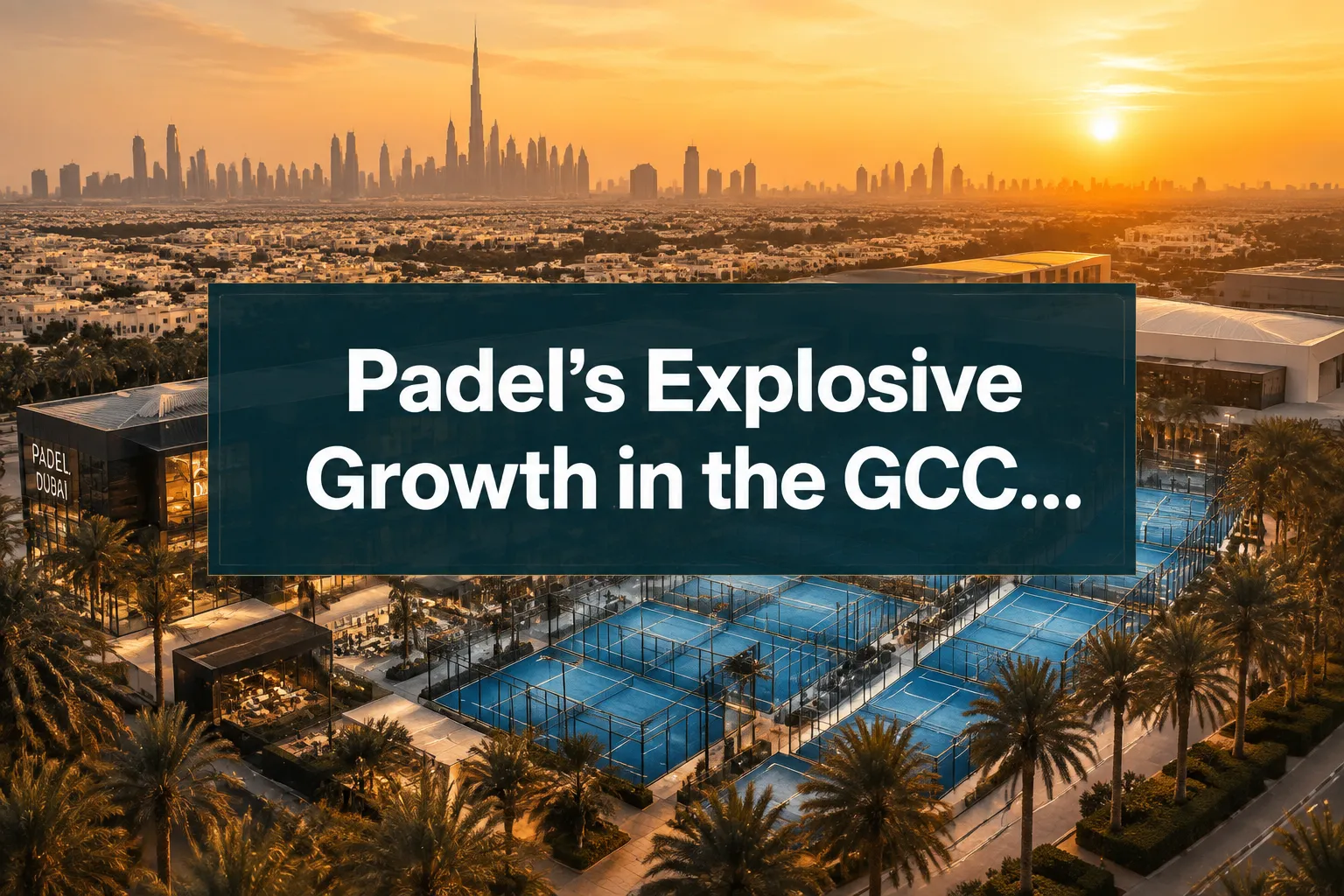
Padel’s Explosive Growth in the GCC: Government Initiatives and 2026 Facility Boom
Last updated: August 2, 2026
Quick Answer: Padel is the fastest-growing racket sport in the Gulf Cooperation Council (GCC), driven by government-backed sports programs, major facility investment in the UAE, Saudi Arabia, and Qatar, and a lifestyle shift toward accessible, social outdoor sports. By 2026, the region has seen a dramatic surge in court construction, professional leagues, and beginner participation, making the GCC one of the most active padel markets in the world.
Key Takeaways
- 🎾 Padel is played on a smaller, enclosed court and is significantly easier to pick up than tennis, making it ideal for beginners.
- 🏗️ The UAE, Saudi Arabia, and Qatar are investing heavily in padel infrastructure as part of broader national sports strategies.
- 🏆 Saudi Arabia’s Vision 2030 and UAE’s National Sports Strategy are key government drivers behind padel’s rapid rise.
- 📈 The GCC padel court count has grown exponentially since 2022, with hundreds of new facilities opening by 2026.
- 💰 Building a padel court in the GCC typically costs between $30,000 and $80,000 USD (estimate based on regional construction benchmarks), depending on materials and location.
- 🌍 Riyadh, Dubai, Abu Dhabi, and Doha are the main hubs for padel clubs, tournaments, and coaching programs.
- 🎯 Beginners need minimal equipment, a padel racket and court shoes, and can play competitively within a few sessions.
- 🤝 The sport’s social, doubles-only format makes it a natural fit for the GCC’s community-oriented culture.
What Is Padel Tennis and How Is It Different from Regular Tennis?
Padel is a racket sport played in pairs on a glass-walled, enclosed court roughly one-third the size of a tennis court. Unlike tennis, the walls are part of the game, players can use them to keep rallies alive, which makes the sport faster-paced and far more forgiving for beginners.
Here’s a quick side-by-side comparison:
| Feature | Padel | Tennis |
|---|---|---|
| Court size | 10m x 20m (enclosed) | 23m x 11m (open) |
| Walls | Glass and mesh walls in play | No walls |
| Scoring | Same as tennis | Same |
| Players | Always doubles (4 players) | Singles or doubles |
| Serve | Underarm only | Overhead |
| Learning curve | Low, beginner-friendly | Moderate to high |
| Equipment cost | Lower entry cost | Higher |
The enclosed court means the ball stays in play longer, rallies are more exciting, and new players don’t spend half the session chasing balls. That accessibility is a huge reason padel is spreading so fast across the racket sports community.
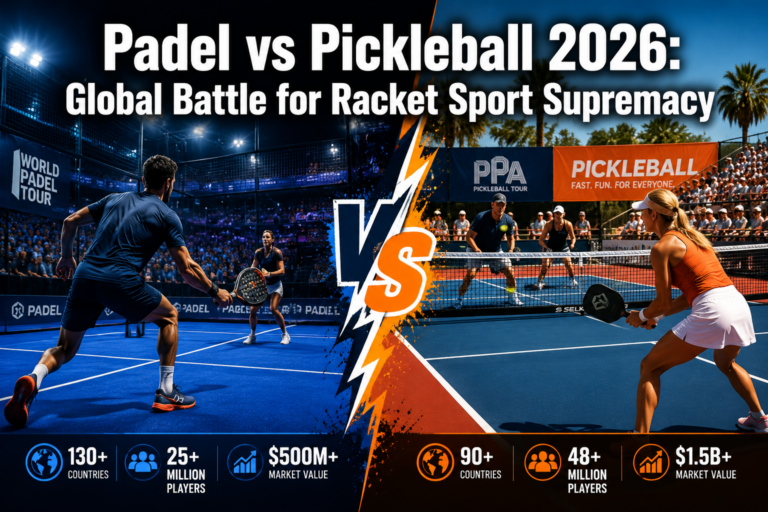
For players curious about how padel compares to other fast-growing racket sports, check out the padel vs pickleball comparison for a deeper breakdown.

Why Is Padel Growing So Fast in the Middle East and Gulf Countries?
Padel’s explosive growth in the GCC comes down to three things: climate-adapted infrastructure, a young and active population, and government investment in sport as a lifestyle pillar.
Key reasons for rapid adoption:
- Climate-friendly courts: Most GCC padel facilities are indoors or covered, making them playable year-round despite extreme summer heat.
- Social format: The doubles-only game fits perfectly with the GCC’s strong culture of group socializing and community activity.
- Expat influence: A large expat population from Spain, Latin America, and Europe, regions where padel is already mainstream, brought the sport with them.
- Low barrier to entry: Players of all ages and fitness levels can enjoy a real game within their first few sessions.
- Media and celebrity visibility: High-profile endorsements and tournament coverage have boosted awareness significantly.
Saudi Arabia’s hosting of the Premier Padel P1 tournament in Riyadh in 2023 was a landmark moment, it signaled to the region that padel was no longer a niche hobby but a serious professional sport with global reach. That event alone accelerated investment timelines across the GCC.
The sport’s growth mirrors trends seen in other racket sports growth stories globally, where accessibility and social play drive adoption faster than traditional competitive models.
What Government Initiatives Are Supporting Padel in the GCC?
Government programs across Saudi Arabia, the UAE, and Qatar are directly funding padel infrastructure and competitive development as part of national sports diversification strategies.
Saudi Arabia, Vision 2030 Sports Pillar Saudi Arabia’s Vision 2030 includes explicit targets to increase sports participation among citizens. The Saudi Padel Federation, established under the Saudi Arabian Olympic Committee, has been instrumental in organizing national leagues, coaching certifications, and youth development programs. Riyadh has become a Premier Padel circuit stop, bringing world-class competition to the region.
UAE, National Sports Strategy The UAE’s sports authority has backed padel through facility grants, club licensing frameworks, and integration into school and community sports programs. Dubai Sports Council has actively promoted padel alongside other racket sports as part of its healthy lifestyle agenda.
Qatar, Post-World Cup Sports Legacy Qatar’s post-2022 World Cup sports legacy program has channeled investment into diverse sports infrastructure. Padel courts have been added to existing sports complexes, and the Qatar Padel Federation has grown its registered player base substantially since 2023.
💡 Key insight: These aren’t just passive endorsements. Government bodies are co-funding courts, subsidizing memberships for nationals, and creating competitive pathways from grassroots to professional level.
How Many Padel Courts Are Being Built in the UAE, Saudi Arabia, and Qatar by 2026?
By 2026, the GCC is estimated to have several thousand padel courts across the three main markets, with the UAE leading in total count and Saudi Arabia growing fastest in new construction (estimates based on industry reporting trends through early 2026).
Approximate court growth by country (estimated):
- UAE: Over 1,000 courts across Dubai, Abu Dhabi, Sharjah, and other emirates, with Dubai alone accounting for the majority.
- Saudi Arabia: Rapid expansion from under 200 courts in 2022 to an estimated 800+ by end of 2026, concentrated in Riyadh, Jeddah, and NEOM-adjacent developments.
- Qatar: Smaller market but growing steadily, with 150-250 courts projected by 2026 across Doha and Al Wakrah.
These numbers reflect both private club investment and government-funded public facilities. The pace of construction in 2025-2026 has been particularly fast, with several large multi-court complexes opening in Riyadh and Dubai.
Padel Court Construction Cost and Investment Requirements in the GCC
Building a single padel court in the GCC typically costs between $30,000 and $80,000 USD (estimate based on regional construction and materials benchmarks), with indoor or climate-controlled setups at the higher end.
Cost breakdown (estimated ranges):
- Basic outdoor court: $30,000,$45,000
- Indoor/covered court with lighting: $55,000,$80,000
- Premium glass panoramic court: $80,000,$120,000+
- Land and permits: Varies significantly by emirate or city
Multi-court complexes (6-12 courts) benefit from economies of scale and are the preferred model for commercial operators. Return on investment is driven by court rental fees (typically AED 150-400/hour in Dubai, based on market estimates), coaching programs, and membership packages.
For investors, the GCC padel market is attractive because of high disposable income, strong expat demand, and government support reducing regulatory friction.
Best Padel Clubs and Facilities in Dubai, Abu Dhabi, and Riyadh
The top padel clubs in the GCC combine quality courts with coaching, social leagues, and modern amenities. Here are the most well-regarded options as of 2026:
Dubai:
- Padel Pro UAE, Multiple locations, professional coaching, active social leagues
- Just Padel, Large multi-court facility with beginner programs
- The Padel Club at Dubai Sports City, Premium facility with international-standard courts
Abu Dhabi:
- Zayed Sports City Padel Courts, Government-backed, accessible pricing
- Yas Island Padel, Part of the broader Yas sports complex
Riyadh:
- Smash Padel Club, One of the largest in the Kingdom, with 10+ courts
- PadelStar Riyadh, Strong coaching program, youth development focus
Most top clubs offer trial sessions, which is the best way to test a facility before committing to a membership.
Padel vs Tennis vs Squash: Which Sport Should You Play?
Choose padel if you want a social, beginner-friendly sport you can enjoy competitively within weeks. Choose tennis if you want a solo-capable sport with deep technical skill development. Choose squash if you want an intense cardio workout in a shorter time window.
| Padel | Tennis | Squash | |
|---|---|---|---|
| Best for beginners | ✅ Yes | ⚠️ Moderate | ⚠️ Moderate |
| Social/doubles focus | ✅ Always doubles | Optional | Mostly singles |
| Physical intensity | Moderate | Moderate, High | Very High |
| Court availability GCC | Growing fast | Established | Established |
| Equipment cost | Low, Moderate | Moderate, High | Low, Moderate |
For players already active in the racket sports community, padel is an excellent complement to tennis or squash, the hand-eye coordination transfers well, and the shorter learning curve means you’re competitive faster.
How to Get Started Playing Padel as a Beginner in the GCC
Getting started with padel in the GCC is straightforward. Most clubs offer beginner sessions, equipment rental, and introductory coaching packages.
Step-by-step for new players:
- Find a local club, Use Google Maps or club directories in Dubai, Abu Dhabi, or Riyadh to locate courts near you.
- Book a beginner session, Most clubs offer 60-minute intro sessions with a coach for AED 100-200 (UAE estimate).
- Rent equipment first, Don’t buy a racket until you’ve played 3-5 times. Rentals are widely available.
- Learn the serve, Padel uses an underarm serve bounced off the ground. It’s simple but has specific rules.
- Focus on wall play, Using the back glass wall is what makes padel unique. Practice this early.
- Join a social league, Most clubs run beginner leagues that are low-pressure and a great way to meet other players.
The sport’s community feel is one of its biggest draws, similar to what makes social connections in racket sports so valuable for players of all backgrounds.
Padel Tournament Opportunities and Professional Leagues in the Gulf Region
The GCC now has a full competitive pathway from beginner club tournaments to professional Premier Padel events.
Competitive structure:
- Club leagues: Weekly or monthly social competitions at local clubs, open to all skill levels.
- National federations: Saudi, UAE, and Qatar padel federations run national ranking tournaments.
- Premier Padel circuit: The global professional tour has held events in Riyadh, with more GCC stops expected through 2026-2027.
- Corporate leagues: Popular in Dubai and Riyadh, with companies sponsoring teams in organized competitions.
Saudi Arabia’s role as a Premier Padel host has been particularly significant. The Riyadh P1 event drew top-ranked players from Spain, Argentina, and Brazil, giving GCC players direct exposure to world-class padel and inspiring a new generation of competitive players.
Is Padel Worth the Membership Cost Compared to Other Sports?
For most recreational players in the GCC, padel membership offers strong value, especially compared to golf or tennis club memberships, which tend to be significantly more expensive.
Typical cost comparison (GCC estimates, 2026):
- Padel club membership: AED 500-1,500/month (UAE)
- Tennis club membership: AED 800-2,500/month
- Golf club membership: AED 3,000-10,000+/month
- Pay-per-court padel: AED 150-400/hour (no membership needed)
The pay-per-court model is particularly accessible, you don’t need a membership to play, which lowers the barrier for casual players. Memberships make sense if you’re playing 3+ times per week.
For players weighing public vs private sports facility options, the same logic applies to padel: private clubs offer better courts and amenities, while public facilities keep costs low.
Common Mistakes Beginners Make When Learning Padel
New padel players tend to make the same handful of errors. Knowing them in advance saves a lot of frustration.
Top beginner mistakes:
- Ignoring the walls, Treating padel like tennis and not using the back glass wall. The wall is your friend.
- Hitting too hard, Power isn’t the priority in padel. Control and placement win more points.
- Standing too close to the back wall, Leaves no room to swing after a wall rebound.
- Neglecting the net position, In padel, controlling the net is critical. Don’t stay at the back.
- Wrong grip pressure, Gripping too tightly reduces feel and wrist mobility. Keep it relaxed.
- Buying the wrong racket, Beginners often buy advanced rackets that are too stiff. Start with a round-shaped, softer racket.
For equipment guidance, the padel equipment 2026 guide covers current racket recommendations by skill level.
Padel Court Booking and Availability Issues in Major GCC Cities
Court availability is one of the biggest practical challenges in the GCC’s booming padel scene. Demand has outpaced supply in Dubai and Riyadh particularly, especially during cooler months (October, April).
Booking tips for GCC players:
- Book 48-72 hours in advance for peak evening slots (6-10 PM) in Dubai and Riyadh.
- Use club apps, Most major clubs have dedicated booking apps with real-time availability.
- Try morning slots, 7-9 AM slots are often available same-day and significantly cheaper.
- Consider off-peak clubs, Newer clubs in emerging neighborhoods often have better availability than established ones.
- Join a regular group, Many clubs reserve recurring weekly slots for regular groups, which guarantees court time.
The 2026 facility expansion has helped ease some pressure, but popular clubs in prime locations still fill up fast during the winter season.
Who Should Play Padel: Age, Fitness Level, and Skill Requirements
Padel is genuinely one of the most inclusive racket sports available. It suits players aged 8 to 80, requires no prior racket sports experience, and can be adapted for varying fitness levels.
Padel is a great fit if you:
- Are new to racket sports and want a fast learning curve
- Play tennis or squash and want a social doubles game
- Are 40+ and want lower-impact sport than running or squash
- Have kids, padel is excellent for family play
- Want to meet people and build a social sports routine
Padel may not be ideal if you:
- Prefer solo sports (padel is always doubles)
- Have significant knee or ankle issues (the lateral movement can be demanding)
- Want a pure cardio workout (squash or singles tennis is more intense)
The sport’s accessibility mirrors what makes other racket sports so welcoming, it’s about playing smarter and enjoying the game, not just being the most athletic person on the court.
Padel Equipment: What Racket and Shoes Do You Need?
A beginner needs two things: a padel racket and a pair of court shoes. Everything else is optional.
Racket guide for beginners:
- Shape: Round rackets are best for beginners, larger sweet spot, more forgiving.
- Core material: EVA foam cores offer better feel and control than harder materials.
- Weight: 355-375g is the ideal range for most adult beginners.
- Budget: Expect to spend $60,$120 USD for a solid beginner racket. Avoid buying premium advanced rackets early.
Shoes:
- Padel-specific or clay-court tennis shoes work best, they provide lateral support and the right grip for artificial turf courts.
- Running shoes are not recommended, they lack the side-to-side stability needed for padel movement.
Optional extras:
- Overgrip tape (improves grip feel, costs under $5)
- Padel balls (slightly depressurized compared to tennis balls, don’t substitute)
- Court bag
For players who also play other racket sports, footwear guidance from the pickleball court shoe selection guide offers transferable advice on what to look for in lateral support and sole grip.
FAQ
Q: Is padel the same as padel tennis? Yes. “Padel” and “padel tennis” refer to the same sport. The official name is simply “padel,” but “padel tennis” is commonly used in some regions to distinguish it from paddle tennis, which is a different game.
Q: Can I play padel alone or do I always need four players? Padel is always played as doubles, four players per game. You can practice solo against a wall, but official play requires four participants.
Q: How long does a padel game last? A standard padel match lasts 60-90 minutes. Social sessions are often booked in 90-minute court slots.
Q: Do I need to be fit to play padel? No. Padel is lower impact than squash or singles tennis. A basic level of mobility and coordination is enough to enjoy the game as a beginner.
Q: What is Premier Padel? Premier Padel is the top professional padel tour, backed by the International Padel Federation (FIP) and FIFA. It features the world’s best players competing at events globally, including in Riyadh, Saudi Arabia.
Q: Is padel popular with women in the GCC? Yes. Padel has strong female participation across the GCC, with dedicated women’s leagues and coaching programs in Dubai, Abu Dhabi, and Riyadh. The sport’s social format and lower physical barrier make it particularly appealing.
Q: Can children play padel? Absolutely. Padel is excellent for children aged 6 and up. Many GCC clubs offer junior programs and use smaller courts or lower nets for younger players.
Q: How does padel scoring work? Padel uses the same scoring system as tennis: 15, 30, 40, game, with sets and tiebreakers. If you know tennis scoring, padel scoring is identical.
Q: Are there padel courts in smaller GCC cities? Yes, though availability is more limited. Cities like Al Ain, Sharjah, Muscat (Oman), and Bahrain’s Manama have growing padel scenes, with new courts opening regularly through 2026.
Q: What’s the difference between padel and platform tennis? Platform tennis is played on a smaller elevated court with a spongy ball and is primarily a North American sport. Padel uses a different court, ball, and rules, the two sports share some surface similarities but are distinct.
Conclusion: Your Next Move in the GCC Padel Scene
Padel’s explosive growth in the GCC is not a trend that’s about to slow down. Government backing, a booming facility pipeline, and a genuinely fun, accessible format have created the conditions for padel to become the dominant recreational racket sport across the Gulf by the end of this decade.
Here’s what to do next:
- Find a club near you, Search for padel courts in your city and book a beginner session this week.
- Rent before you buy, Try 3-5 sessions before investing in your own racket.
- Join a social league, It’s the fastest way to improve and build a playing community.
- Follow the Premier Padel circuit, Watching professional play accelerates your understanding of strategy and positioning.
- Explore the broader racket sports world, Padel skills transfer well to tennis, pickleball, and other racket sports. The racket sports community at Rally Racket is a great place to keep learning.
Whether you’re a complete beginner or a tennis player looking for a fresh challenge, padel in the GCC in 2026 offers an incredible entry point into one of the world’s fastest-growing sports. Get on the court, you’ll understand the hype within the first rally.