From grass to hard courts: how top players are adapting for the North American summer swing
Last updated: August 10, 2026
Quick Answer: The post-Wimbledon transition to the North American hard court season is one of the most demanding shifts in professional tennis. From grass to hard courts, how top players are adapting for the North American summer swing comes down to adjusting footwork, shot selection, physical conditioning, and equipment, typically over a two-to-four-week window before events like the Canadian Open and the US Open.
Key Takeaways 🎾
- Grass courts play low and fast; hard courts play higher and more consistently, completely different timing is required
- The transition window is short (roughly 2-4 weeks), making focused preparation critical
- Footwork and split-step timing need the biggest adjustments when moving to hard courts
- Physical load increases significantly on hard courts, raising injury risk in the knees, hips, and lower back
- String tension and shoe choice should both be reconsidered for hard court play
- Players with big groundstrokes and strong baseline games tend to thrive on hard courts after Wimbledon
- Serve-and-volley specialists often struggle most with the switch
- Conditioning drills should shift toward lateral agility and endurance rather than explosive short bursts

What’s the Difference Between Grass and Hard Court Tennis?
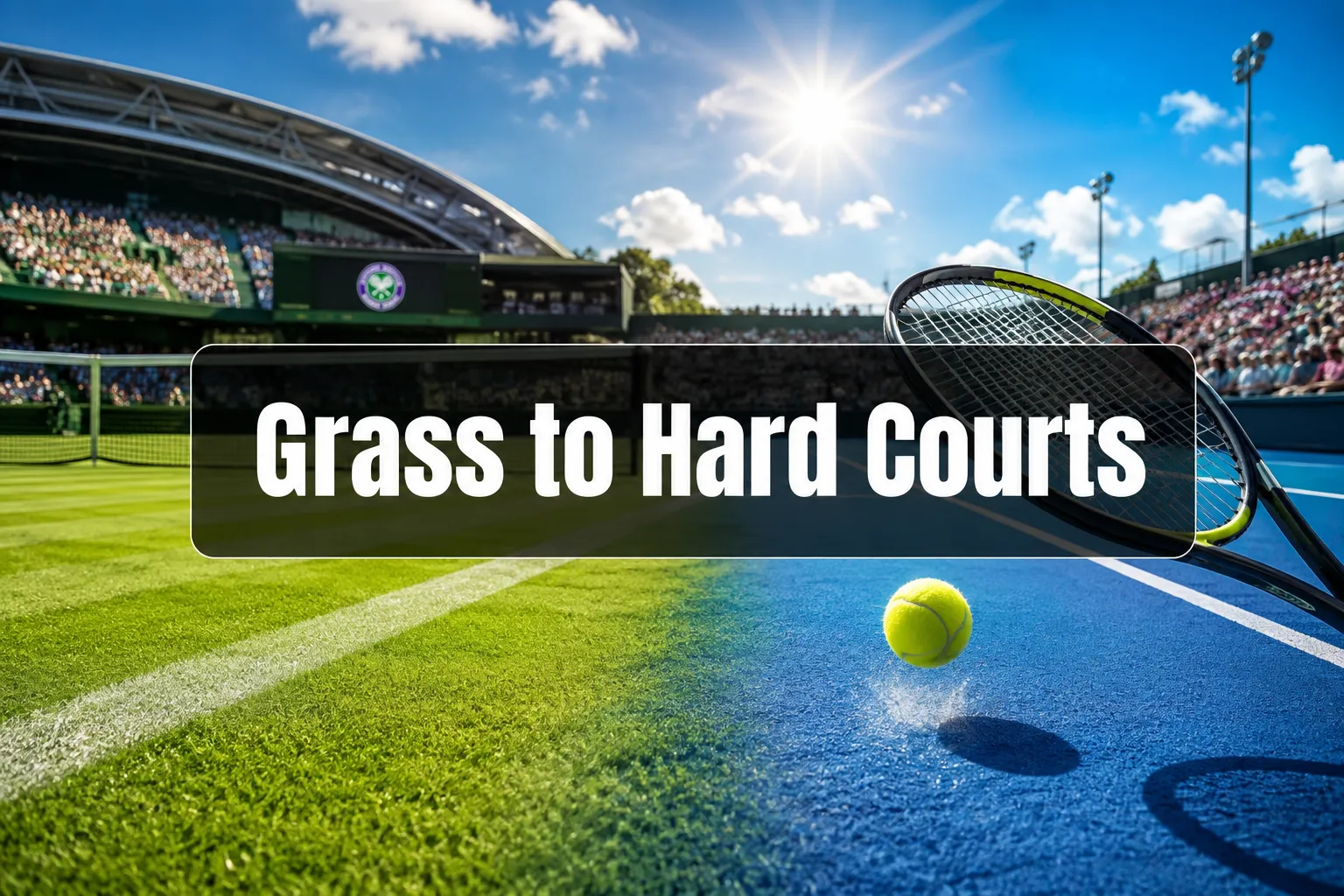
Grass and hard courts play almost like two different sports. Grass is soft, low-bouncing, and fast, the ball skids through and stays below shoulder height. Hard courts are firm, consistent, and produce a higher, more predictable bounce that rewards baseline power.
Here’s a quick breakdown:
| Feature | Grass Court | Hard Court |
|---|---|---|
| Ball bounce height | Low, skidding | Medium to high |
| Ball speed | Very fast | Moderate to fast |
| Surface grip | Slippery, uneven | Consistent traction |
| Rally length | Short | Longer |
| Dominant game style | Serve-and-volley, flat shots | Baseline, topspin |
Key difference for recreational players: On grass, you react. On hard courts, you construct. Points last longer, so fitness and shot variety matter more.
Why Is the Transition from Grass to Hard Courts So Difficult?
The transition is difficult because everything changes at once, timing, footwork, tactics, and physical stress. A player who spent two weeks at Wimbledon has their muscle memory tuned to low, skidding balls. Hard courts demand a completely different contact point and swing path.
Three specific challenges stand out:
- Timing reset: The ball rises higher and sits up longer on hard courts. Players used to taking the ball early on grass often swing through it or mishit on the first few hard court sessions.
- Footwork shift: Grass rewards short, explosive steps and sliding. Hard courts need wider lateral shuffles and a more grounded stance.
- Mental adjustment: Serve-and-volley tactics that worked on grass become liabilities when the opponent has more time to pass on a hard court.
“The surface change isn’t just physical, it’s a complete tactical reset that takes time to feel natural.”
How Do Top Tennis Players Train to Adapt Between Surfaces?
Top players use a structured two-to-four-week block between Wimbledon and the North American hard court swing to rebuild their game from the ground up. This isn’t just about hitting balls, it’s a deliberate reprogramming process.
Typical adaptation protocol:
- Days 1-3: Light hitting sessions focused on feel and timing, no match play
- Days 4-7: Baseline drilling with emphasis on high-ball handling and topspin depth
- Week 2: Practice matches at half-intensity, tracking unforced errors on the new surface
- Week 3-4: Full match simulation, serve practice, and conditioning specific to hard courts
Coaches also use video analysis techniques to compare a player’s contact point and footwork patterns across surfaces, identifying exactly where the timing breaks down.
Which Players Struggle Most with the Grass to Hard Court Switch?
Players who rely heavily on serve-and-volley tactics or flat, low ball-striking tend to struggle most. Their entire game is built around the skidding, fast conditions of grass, and those tools simply don’t transfer.
Players most likely to struggle:
- Serve-and-volley specialists who rarely play long rallies
- Players with flat, low-trajectory groundstrokes (less effective when the ball sits up)
- Smaller players who rely on grass’s low bounce to neutralize powerful baseliners
- Anyone coming back from a grass-court deep run with limited recovery time
Players who adapt fastest: Big topspin baseliners, athletes with strong fitness bases, and players who compete year-round on multiple surfaces.
How Does Ball Speed and Bounce Change on Hard Courts?
On hard courts, the ball bounces higher and more predictably than on grass, but the overall pace depends on the specific surface coating. The US Open’s DecoTurf surface, for example, plays medium-fast, faster than clay, slower than Wimbledon’s grass.
What this means practically:
- Higher contact point: Players need to adjust their swing to handle balls at shoulder height, not hip height
- More topspin is rewarded: Heavy topspin keeps the ball in play and pushes opponents behind the baseline
- Second serve vulnerability: Flat second serves that skid through on grass become easy put-aways on hard courts
For recreational players making the same switch, this is the single biggest adjustment, learning to take the ball later and higher than you would on grass.
Do Tennis Players Need Different Equipment for Hard Courts vs Grass?
Yes, both racquet setup and footwear should change when moving from grass to hard courts. Using the wrong gear is one of the most common mistakes players make during this transition.
Footwear: Grass court shoes have small pimpled soles for grip on slippery turf. Hard court shoes need durable, reinforced soles with herringbone tread patterns for lateral support and abrasion resistance.
Racquet strings: Many players drop string tension by 2-3 lbs for hard courts to add comfort and reduce arm fatigue. The firm surface transmits more shock through the frame, so a slightly looser string bed acts as a buffer.
String type: Multifilament or hybrid strings are popular choices for hard courts because they absorb vibration better than stiff polyester setups that work well on grass.
Choosing the right racket sports equipment is just as important for recreational players making surface transitions as it is for the pros.
How Long Does It Take to Adjust to Hard Court Play?
Most professional players report feeling comfortable on hard courts within 10-14 days of focused practice. Recreational players typically need 3-6 weeks of regular play to fully recalibrate.
Factors that speed up adaptation:
- Prior hard court experience (muscle memory returns faster)
- Consistent daily practice rather than occasional sessions
- Working with a coach to identify specific timing issues
- Proper footwear and equipment from day one
Edge case: Players coming off a long grass-court run (like a Wimbledon semifinal or final) have less recovery and adaptation time, which is why some top players skip the first hard court tune-up event entirely to avoid early-round losses on unfamiliar footing.
What’s the Best Preparation Strategy for the North American Hard Court Season?
The best preparation combines tactical drilling, physical conditioning, and equipment adjustment in a structured sequence. From grass to hard courts, how top players are adapting for the North American summer swing consistently follows this pattern: surface-specific footwork first, then shot construction, then match play.
A practical 3-week prep plan:
- Week 1, Foundation: Footwork ladders, split-step drills, and baseline consistency work. Focus on handling high balls.
- Week 2, Construction: Build point patterns from the baseline. Practice topspin depth and cross-court exchanges.
- Week 3, Competition: Play practice sets, simulate match pressure, and fine-tune serve placement.
Physical preparation matters just as much as technical work. The role of tournaments in competitive play shows that match-ready fitness, not just practice fitness, is what separates prepared players from those who fade in the third set.
What Injuries Are Common During the Grass to Hard Court Transition?
Hard courts are significantly less forgiving than grass, and the transition period carries real injury risk. The most common issues are knee pain, shin splints, and lower back stress, all linked to the increased impact forces from the firmer surface.
Common transition injuries:
- Patellar tendinitis (knee): The repetitive stopping and starting on a hard surface stresses the tendon
- Shin splints: Increased ground reaction force affects the tibia, especially in players who increased volume too quickly
- Plantar fasciitis: Hard courts put more strain on the foot arch, particularly without proper footwear
- Lower back tightness: Longer rallies and more lateral movement load the lumbar spine differently than short grass-court points
Prevention tips:
- Increase hard court volume gradually (no more than 10-15% per week)
- Prioritize dynamic warm-ups before every session
- Replace hard court shoes when the sole shows significant wear
- Add hip and glute strengthening to off-court training
Are There Specific Conditioning Drills for Hard Court Season?
Yes, hard court conditioning should emphasize lateral endurance, deceleration control, and core stability, all of which matter more in longer baseline rallies than in the short, sharp points typical of grass.
Top conditioning drills for hard court prep:
- Lateral shuffle with split-step: Mimics the constant side-to-side movement in baseline exchanges
- Cone agility patterns: Focus on deceleration and change of direction, not just speed
- High-ball groundstroke feeds: A partner or ball machine feeds balls at shoulder height to build timing on the higher bounce
- Endurance baseline rallies: 20+ shot rally practice builds the stamina needed for hard court points
The physical benefits of consistent court training, improved cardiovascular fitness, better joint stability, faster recovery, apply across all racket sports, not just tennis. The physical benefits of regular court play are well-documented across the racket sports community.
Which Players Excel on Hard Courts After Playing Grass?
Players with heavy topspin groundstrokes, strong fitness, and flexible tactical games tend to thrive in the North American summer swing. From grass to hard courts, how top players are adapting for the North American summer swing often comes down to who has the most complete game.
Profile of a hard court specialist:
- Consistent, high-percentage first serve (hard courts punish weak second serves)
- Ability to hit winners from behind the baseline
- Strong two-handed backhand that handles high balls well
- High fitness level to sustain long rallies in summer heat
Historically, players who combine big serving with heavy topspin forehands have dominated the US Open and the hard court swing leading into it. The surface rewards aggression, but controlled aggression, not the flat, low-risk hitting that works on grass.
Common Mistakes Players Make When Switching from Grass to Hard Courts
Most players rush the transition and pay for it with poor results and nagging injuries. Here are the mistakes that show up most often, at every level of the game.
Top mistakes to avoid:
- Keeping grass-court tactics: Trying to serve-and-volley or hit flat on hard courts leads to easy passing shots and errors
- Skipping the footwork reset: Not adjusting the split-step timing causes late arrivals and rushed shots
- Ignoring equipment changes: Playing in grass shoes on hard courts is a fast path to blisters and ankle rolls
- Jumping straight into match play: Competitive pressure before timing is recalibrated leads to bad habits that are hard to undo
- Underestimating fatigue: Hard court rallies are longer, players who don’t build endurance hit a wall in the second set
Recreational players in the racket sports community often skip the preparation phase entirely, which is why the first few hard court sessions feel so frustrating. A little structured practice goes a long way.
Conclusion: Make the Switch Work for You
The post-Wimbledon transition to the North American hard court season is genuinely one of the most demanding shifts in tennis, even for the best players in the world. But with the right approach, it’s also a chance to build a more complete game.
Actionable next steps:
- ✅ Swap your footwear before your first hard court session
- ✅ Drop string tension by 2 lbs and consider a softer string setup
- ✅ Spend the first week on footwork and timing drills, not match play
- ✅ Add lateral agility and deceleration work to your conditioning routine
- ✅ Watch video of your hard court sessions to spot timing differences early
Whether you’re a competitive club player or just getting started in the racket sports community, the same principles apply. Surface transitions reward preparation. Put in the work before the first match, and the hard courts will start to feel like home.
Want to keep improving across all racket sports? Check out our guides on video analysis and learning from the pros and explore how building a local playing community can accelerate your development on any surface.
Frequently Asked Questions
Q: How different is hard court tennis from grass court tennis? Hard courts produce a higher, more consistent bounce and favor baseline play. Grass courts are faster, lower-bouncing, and reward serve-and-volley tactics. The two surfaces require different timing, footwork, and tactics.
Q: How long does it take a professional player to adjust to hard courts after Wimbledon? Most professionals feel comfortable within 10-14 days of focused hard court practice. Players with more hard court experience adapt faster.
Q: Should recreational players change their racquet strings for hard courts? Yes. Dropping string tension by 2-3 lbs and using a multifilament or hybrid string reduces vibration and arm fatigue on the firmer surface.
Q: What shoes should you wear on hard courts? Hard court shoes with herringbone tread patterns and reinforced soles. Never use grass court shoes on hard courts, the grip pattern is wrong and the sole wears out quickly.
Q: Which surface is harder on the body, grass or hard courts? Hard courts are significantly harder on joints because the surface doesn’t absorb impact. Knee, shin, and lower back injuries are more common during the hard court season.
Q: What’s the biggest tactical change when moving from grass to hard courts? Shifting from serve-and-volley or flat ball-striking to topspin baseline construction. Points are longer on hard courts, so consistency and fitness matter more than on grass.
Q: Can beginners use the same preparation strategies as pros? Yes, scaled down. The same principles, gradual volume increase, footwork focus, equipment adjustment, apply at every level. Beginners just need more time (3-6 weeks vs 2 weeks for pros).
Q: Why do some top players skip the first hard court tournament after Wimbledon? Players coming off a deep Wimbledon run have less recovery and adaptation time. Skipping an early event protects both their ranking points and their physical health.
Q: What is DecoTurf and why does it matter for the US Open? DecoTurf is the acrylic surface used at the US Open. It plays medium-fast, harder than clay, slightly slower than grass, and produces a consistent, high bounce that rewards topspin baseliners.
Q: Is the North American hard court swing important for world rankings? Yes. The Canadian Open (Masters 1000), Cincinnati Open (Masters 1000), and US Open (Grand Slam) are all part of the swing, making it one of the most points-rich stretches of the entire season.