World Outdoor Racquetball 2026: Rules, Venues, and Training for Grassroots Outdoor Courts
Last updated: September 11, 2026
Quick Answer: World Outdoor Racquetball 2026 is a growing competitive format played on one-wall and three-wall outdoor courts, governed by USA Racquetball’s official outdoor rule modifications. The flagship 2026 Outdoor Nationals & World Championships is scheduled for July 10-12 at Marina Park in Huntington Beach, California. Players of all skill levels can participate, and grassroots courts are expanding rapidly across the U.S. through the WOR court listing program. [1][2]
Key Takeaways
- 🏆 The 2026 World Championships is at Marina Park, Huntington Beach, CA (July 10-12, 2026) [2]
- 📋 Outdoor rules follow standard USA Racquetball guidelines but with key changes: one serve only, no receiving line, and no standard court size requirement [4]
- 🌍 The 2026 WOR calendar spans California, Florida, Virginia, and more, with events running January through November [3][6]
- 🎾 Outdoor courts are typically one-wall or three-wall formats, played in parks and on concrete or asphalt surfaces [1]
- 💨 Wind is a major gameplay factor outdoors, requiring adjusted shot selection and ball choice
- 🟦 Outdoor racquetball uses a blue ball designed for harder outdoor surfaces, not the standard indoor ball
- 🏅 Beginners can compete, most WOR events include open, novice, and age-based divisions
- 🗺️ Use the WOR Court List master spreadsheet to find grassroots outdoor courts near you [9]
- 💰 Entry fees for WOR events are generally affordable, typically in the $30,$60 range per division (estimate based on regional tournament norms; verify with R2Sports listings)
- 🌱 Grassroots organizers can sanction events through USA Racquetball’s WOR program to join the official calendar [1]
What Are the Official Rules for Outdoor Racquetball in 2026?
Outdoor racquetball in 2026 follows standard USA Racquetball rules with specific modifications designed for open-air, public court environments. The most important change: all divisions use one serve only, there is no second serve if the first is a fault. [4]
Here are the key rule differences from indoor play:
- One serve rule: A fault serve ends the rally immediately; no re-serve is allowed [4]
- No standard court size: Outdoor courts have no official size requirement, so dimensions vary by venue [4]
- No receiving (5-foot) line: The traditional line restricting the receiver’s movement does not apply outdoors [4]
- Singles service lines: On some courts, service lines are marked 18 inches inside each sideline [4]
- No ceiling or back wall required: Many one-wall courts have no side walls or back wall; the playing area adapts to the physical space [4]
- Safety holdups: Any vehicle or stationary crowd entering the playing area is grounds for stopping play [4]
- Shirts optional: Reflecting the park-style environment, shirts are not required for outdoor play [4]
Quick rule to remember: If you’re coming from indoor racquetball, the single biggest adjustment is losing that second serve. Every serve counts, there’s no safety net.
For comparison, if you’re familiar with other racket sports, the basic rules of pickleball follow a similar philosophy of simplified serving rules that keep rallies moving.
Where Is the World Outdoor Racquetball Championship 2026 Being Held?
The 2026 Outdoor Nationals & World Championships is scheduled for July 10-12, 2026, at Marina Park in Huntington Beach, California. The event is sanctioned by World Outdoor Racquetball (WOR) and listed through R2Sports as a national/world championship event. [2]

Beyond the flagship championship, the full 2026 WOR calendar includes events across multiple states: [3][6]
| Event | Date | Location |
|---|---|---|
| Sunshine State Shootout | Jan 31, Feb 1 | Tropical Park, Miami, FL |
| EVE Promotions Beach Bash | March 19-22 | Hollywood, FL |
| Rowlett Rollout | May 2 | Tampa, FL |
| Capital City WOR Championships | June 5-7 | Herndon, VA |
| SacTown Sizzler 3Wall Smash | June 27 | Sacramento, CA |
| Outdoor Nationals & World Championships | July 10-12 | Huntington Beach, CA |
| One Wall Palooza | Aug 1 | Fritz Grupe Park, CA |
| Hollywood Beach Battle | Nov 5-8 | Hollywood, FL |
How Do Outdoor Racquetball Courts Differ from Indoor Courts?
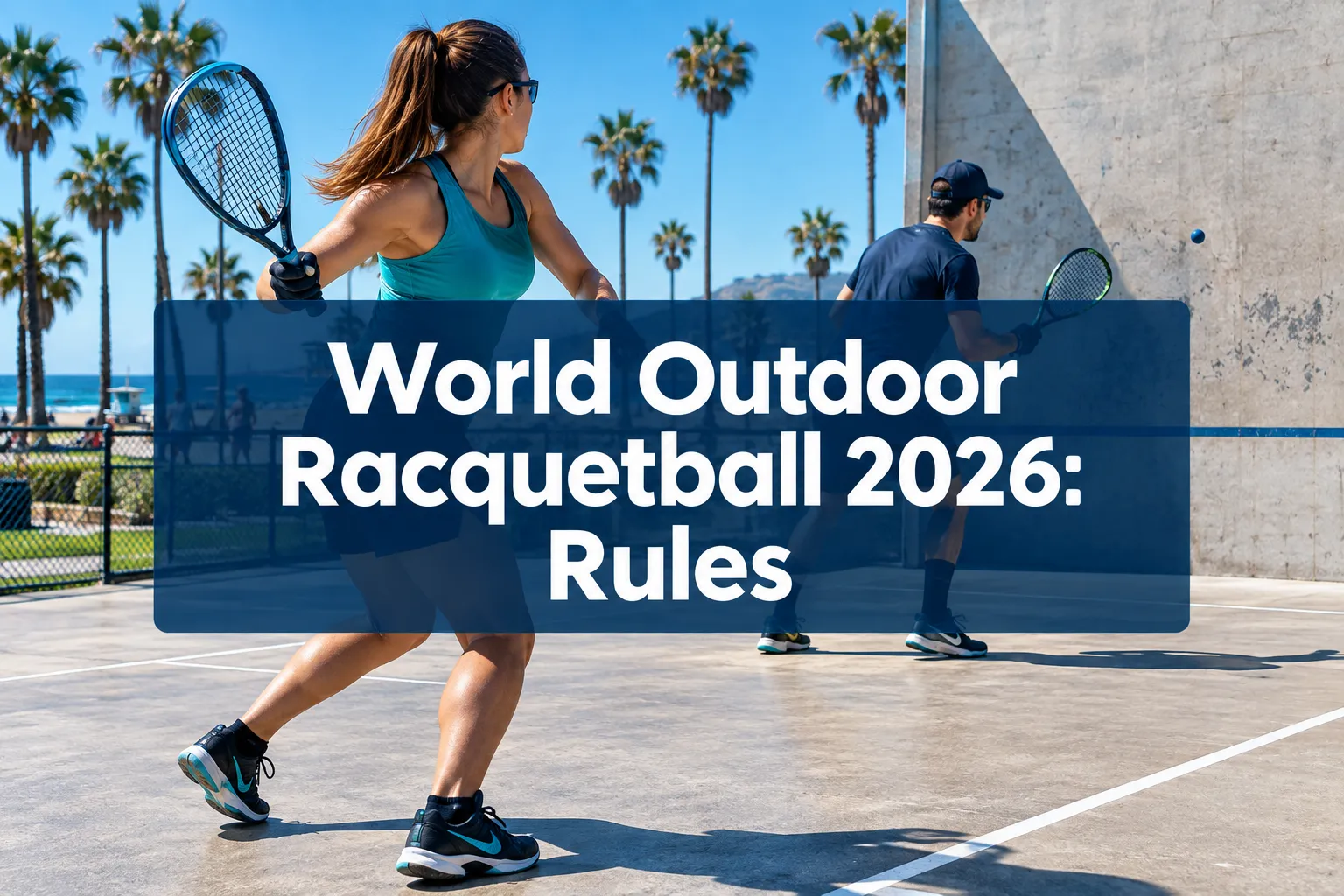
Outdoor racquetball courts are almost always one-wall or three-wall configurations, while indoor courts are fully enclosed four-wall structures with a ceiling. This changes everything about how the game is played. [1][4]
Key structural differences:
- Walls: Outdoor courts have one large front wall (minimum 20 ft wide × 20 ft high for one-wall) or a front wall plus two tapered side walls for three-wall play [4]
- No ceiling: Lob shots and ceiling balls, staples of indoor play, don’t exist outdoors
- No back wall: Players can’t use defensive back-wall setups common indoors
- Surface: Typically concrete or asphalt, which plays faster and harder than indoor hardwood
- No standard dimensions: Court sizes vary significantly from park to park [4]
Playing on concrete vs. clay courts: Concrete is by far the most common outdoor surface in the U.S. It’s fast, unforgiving on knees, and causes the ball to bounce higher and faster. Clay surfaces (more common in some international venues) play slower, with a lower, more predictable bounce. Footwear matters more on clay, court shoes with lateral support are essential on both, but clay demands more grip.
What Equipment Do You Need to Play Outdoor Racquetball?
The core equipment list is short, but the ball choice is critical for outdoor play. Using an indoor ball outdoors will give you unpredictable, overly fast bounces on hard surfaces.
Essential gear:
- Outdoor racquetball ball (blue ball): Designed for harder surfaces; slightly less pressurized than indoor balls for better control [1]
- Racquet: Any standard racquetball racquet works; lighter frames (150-165g) help with the faster outdoor pace
- Court shoes: Cross-training or racquetball-specific shoes with lateral support; avoid running shoes
- Eye protection: Protective eyewear is strongly recommended, even in casual outdoor play
- Glove: Optional but helpful on hot days when grip becomes slippery
Common mistake: Many new outdoor players show up with indoor (black) balls. The bounce is too fast on concrete and makes the game nearly unplayable. Always confirm which ball color the event or court uses before you arrive.
How Much Does It Cost to Enter the World Outdoor Racquetball 2026?
Entry fees for WOR-sanctioned events in 2026 are generally in the $30,$60 range per division, based on typical regional tournament pricing listed through R2Sports. [2] The flagship World Championships at Huntington Beach may have slightly higher fees for multi-division entries. Always check the specific event listing on R2Sports for confirmed pricing, as fees vary by organizer.
Additional costs to budget for:
- USA Racquetball membership: Required for sanctioned events; annual membership fees apply
- Travel and accommodation: Marina Park in Huntington Beach is a public beach venue, so lodging nearby can range widely
- Equipment: If you’re new, budget $40,$80 for an outdoor ball pack and eye protection
Can Beginners Compete in the 2026 World Outdoor Racquetball Tournament?
Yes, WOR events are structured to welcome players at all levels. Most tournaments include open, novice, beginner, and age-based divisions (juniors, seniors, and masters brackets), so first-time competitors aren’t thrown into elite brackets. [1][6]
The Beach Bash-style events in particular are known for their welcoming, festival atmosphere. The first outdoor major of the 2026 season at the Garfield Street courts in Hollywood, Florida, drew a broad mix of recreational and competitive players. [7]
Choose your entry wisely: If it’s your first WOR event, enter the novice or open division rather than the “A” or “Pro” bracket. Most event directors are happy to advise on appropriate placement, just email the tournament director listed on the R2Sports event page.
What’s the Best Way to Train for Outdoor Racquetball?
Training for outdoor racquetball means adapting to faster surfaces, no ceiling, and unpredictable wind. The best approach combines court-specific drills, footwork conditioning, and wind-adapted shot selection.
Top training priorities:
- Practice the one-serve rule: In every drill session, give yourself only one serve. This builds the mental discipline that outdoor competition demands [4]
- Kill shot and pass shot accuracy: Without a ceiling game, low kill shots and wide passing shots become your primary weapons
- Footwork on hard surfaces: Lateral shuffle drills on concrete build the specific muscle memory you need
- Wall drills: Solo front-wall repetition builds consistency, aim for 50+ consecutive controlled rallies before adding power
- Serve variety: Since one serve is all you get, develop at least three reliable serves (drive, lob, Z-serve)
For players looking to sharpen racquet skills systematically, ball machine drills are an excellent supplement for building shot consistency before hitting competitive outdoor courts.
Also, if you play doubles outdoors, communication is just as important as shot-making, see this guide on effective communication in doubles for practical teamwork strategies.
How Does Wind Affect Outdoor Racquetball Gameplay?
Wind is the single biggest variable that separates outdoor racquetball from indoor play. Even a light breeze can push a lob serve off course or carry a passing shot wide of its target.
Practical adjustments for windy conditions:
- Hit lower and harder: Low, flat shots hug the court surface and are less affected by wind than high, arcing shots
- Adjust serve direction: With a tailwind, drive serves travel faster, use them aggressively. With a headwind, lob serves become more effective
- Shorten your backswing: Compact swings give you more control when the ball is moving unpredictably
- Watch the ball longer: Wind can cause late movement; track the ball all the way to contact rather than anticipating its path
- Use the blue outdoor ball: Its construction is specifically designed to reduce wind sensitivity compared to indoor balls [1]
Wind tip from experienced outdoor players: When wind is strong, the player who adapts their shot selection wins more than the player who hits harder.
Is Outdoor Racquetball Harder Than Indoor Racquetball?
For indoor players making the switch, outdoor racquetball feels significantly harder at first, but for different reasons than most expect. The difficulty isn’t raw athleticism; it’s tactical adaptation.
What’s harder outdoors:
- No ceiling game removes a key defensive option
- One-serve rule increases pressure on every serve
- Wind and sun create variables that don’t exist indoors
- Concrete surfaces demand better footwork and joint conditioning
What’s easier outdoors:
- Courts are often free to use in public parks
- The social atmosphere is more relaxed and beginner-friendly
- No court booking required at most grassroots venues
- Equipment costs are lower (no court fees)
For players who enjoy court-free racket sports, outdoor racquetball sits in an interesting middle ground, it needs a wall, but not a full enclosed facility.
How Do I Find Grassroots Outdoor Racquetball Courts Near Me?
The most reliable tool is the WOR Court List master spreadsheet, maintained by USA Racquetball and accessible through WallBall’s Find Local Courts resource. Players and organizers can also submit new venues for inclusion, making it a living, growing map. [9][1]
Other ways to find courts:
- R2Sports event search: Filter by sport and date to find nearby WOR-sanctioned tournaments and their venues [10]
- USA Racquetball’s WOR page: Lists current events and links to regional organizers [1]
- Local parks and recreation departments: Many public parks with handball walls are also used for outdoor racquetball
- Facebook groups and local racquetball clubs: Search “outdoor racquetball [your city]”, grassroots communities often organize through social media
This process is similar to how pickleball players find local courts, for a useful parallel approach, see how to find local pickleball courts for strategies that translate directly to locating any outdoor racket sport venue.
How Do I Qualify for the 2026 World Championships?
Qualification for the 2026 Outdoor Nationals & World Championships at Huntington Beach is open-entry through R2Sports, meaning most divisions do not require a pre-qualification tournament. Players register directly through the event listing. [2]
Steps to enter:
- Create or log in to your R2Sports account
- Search for the 2026 Outdoor Nationals & World Championships event
- Confirm your USA Racquetball membership is current
- Select your division(s) and complete registration before the entry deadline
- Review the event’s specific rules and court format (one-wall vs. three-wall) before arriving
Edge case: Some elite or pro divisions may have ranking requirements. Check the event description carefully or contact the tournament director if you’re unsure about division eligibility.
FAQ
Q: What ball is used in outdoor racquetball? Outdoor racquetball uses a blue ball specifically designed for hard outdoor surfaces. It has slightly different pressure than the indoor black ball to control bounce speed on concrete. [1]
Q: Can I use my indoor racquet for outdoor play? Yes. Any standard racquetball racquet works outdoors. Lighter frames are generally preferred for the faster outdoor pace, but there’s no equipment restriction on racquet type.
Q: Is there a back wall in outdoor racquetball? Not always. Many outdoor courts are one-wall or three-wall formats with no back wall. The playing area is defined by the court’s physical boundaries. [4]
Q: Do I need a USA Racquetball membership to play in WOR events? Yes, a current USA Racquetball membership is required for sanctioned WOR tournament play. [1]
Q: How long does a WOR tournament event typically last? Most single-day grassroots events run 6-8 hours. Multi-day championship events like the World Championships span three days (July 10-12 in 2026). [2]
Q: Are there junior divisions at outdoor racquetball tournaments? Yes. Most WOR events include junior and age-based divisions to encourage youth and senior participation. [6]
Q: What’s the difference between one-wall and three-wall outdoor racquetball? One-wall courts have only a front wall; players hit toward it and play the return off the floor. Three-wall courts add two side walls, creating a partially enclosed space that allows more angle shots and a game closer to indoor racquetball. [4]
Q: Can I organize my own WOR-sanctioned event? Yes. USA Racquetball’s WOR program provides a sanctioning pathway for grassroots organizers. Contact USA Racquetball through the WOR page to start the process. [1]
Q: Is outdoor racquetball popular internationally? The IRF World Championships in Temuco, Chile (October 16-24, 2026) highlights racquetball’s growing global profile. While that event is primarily indoor, international interest supports outdoor growth as well. [5]
Q: How do I improve my outdoor racquetball skills quickly? Focus on the one-serve rule in every practice session, drill low kill shots and passing shots, and practice on concrete surfaces to build court-specific footwork. Consistent wall drills are the fastest path to improvement.
Conclusion
World Outdoor Racquetball 2026 is in a strong moment of growth. With a packed national calendar, a flagship World Championship at one of California’s most iconic beach venues, and a grassroots court network that’s actively expanding, there’s never been a better time to get involved, whether as a player, a competitor, or a community organizer.
Actionable next steps:
- Find your nearest outdoor court using the WOR Court List at 3wallball.com/find-local-courts [9]
- Register for a 2026 event through R2Sports, start with a local or regional event before targeting the World Championships [2]
- Get the right ball, pick up a blue outdoor racquetball before your first session on concrete
- Practice the one-serve rule in every training session from day one [4]
- Connect with local players through USA Racquetball’s WOR community and regional Facebook groups [1]
The outdoor game rewards adaptability, creativity, and consistency over raw power. Get on a wall, start rallying, and the rest follows.
References
[1] USA Racquetball WOR – https://www.usaracquetball.com/wor
[2] R2Sports Event Search – https://r2sports.com/r2sports-event-search.asp?sportID=1&startDate=6/3/2026&searchNow=YES
[3] WOR Outdoor Racquetball Update November 2025 – https://www.usaracquetball.com/news/2025/november/16/wor-outdoor-racquetball-update-november-2025
[4] 6 Outdoor Racquetball Rules – https://www.usaracquetball.com/play/rules/6-outdoor-racquetball
[5] International Racquetball Federation News – https://www.internationalracquetball.com/news/
[6] WOR Outdoor Racquetball Update December 2025 – https://www.usaracquetball.com/news/2025/december/21/wor-outdoor-racquetball-update-december-2025
[7] Pro Racquetball Stats WOR Blog – https://blog.proracquetballstats.com/index.php/category/wor/
[9] Find Local Courts – https://3wallball.com/find-local-courts/
[10] R2Sports Event Search (January 2026) – https://r2sports.com/r2sports-event-search.asp?sportID=1&startDate=1/14/2026&searchNow=YES