Serena Williams’ 2026 comeback and the rise of age-defying champions
Last updated: September 14, 2026
Quick Answer: Serena Williams returned to professional tennis in 2026 after a roughly four-year hiatus, competing first in doubles at Queen’s Club before receiving a wildcard into Wimbledon singles at age 44. Her comeback has reignited a wider conversation about longevity, late-career performance, and what modern training methods make possible for older athletes across all racket sports.
Key Takeaways
- Serena Williams officially announced her return to professional tennis in early 2026 after clearing anti-doping eligibility requirements [8]
- She made her first competitive appearance in over three years at the Queen’s Club Championships in doubles [5][6]
- A Wimbledon wildcard gave her a singles slot at age 44, making her one of the oldest players to compete in the main draw [1][10]
- Her 2026 schedule includes ongoing doubles play alongside Venus Williams [4]
- Experts and media have framed the comeback as a landmark moment for age and longevity in sport [2][7]
- Modern recovery science, load management, and racket sports training methods have made late-career returns more viable than ever
- Serena’s story is inspiring recreational players of all ages to keep competing and improving
- The “age-defying champion” narrative extends beyond tennis to the broader racket sports community
What Is Serena Williams’ 2026 Comeback About?
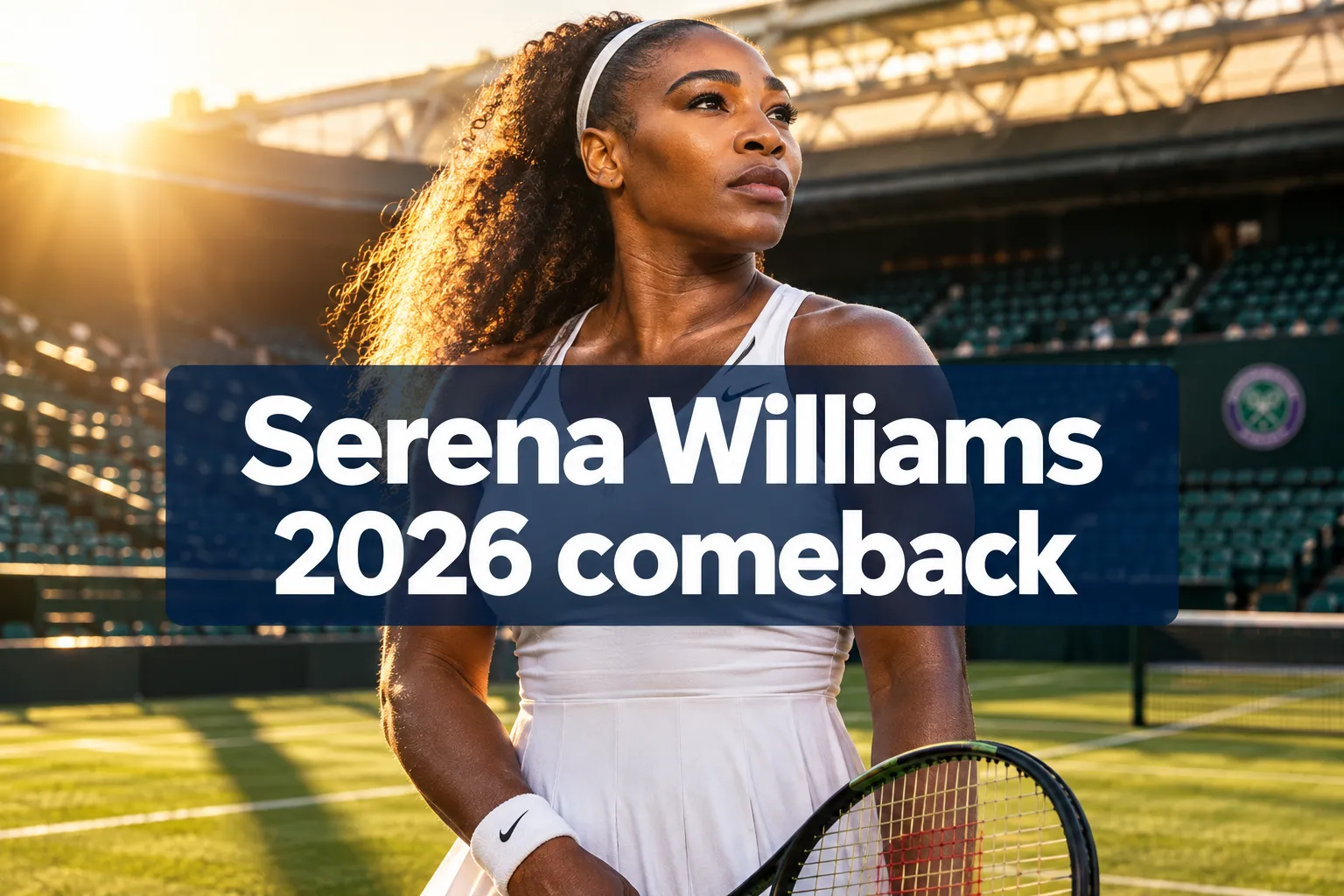
Serena Williams’ 2026 comeback is a return to professional tennis after she announced her retirement at the 2022 US Open. She stepped back onto the court in June 2026, starting with doubles at Queen’s Club, then competing in Wimbledon singles with a wildcard entry [3][5].
The comeback is about more than just match results. It’s a statement on what’s possible for elite athletes in their mid-40s, and it has put the topic of age and longevity at the center of tennis conversations worldwide [1][7].
For the racket sports community, from competitive tennis players to recreational pickleball fans, Serena’s return is a reminder that the game doesn’t have to end when you get older. It can evolve.

How Old Is Serena Williams in 2026, and Why Does That Matter?
Serena Williams was born on September 26, 1981, making her 44 years old for most of the 2026 season. Competing at Wimbledon at 44 places her among the oldest players ever to appear in a Grand Slam singles main draw [1][10].
That age milestone matters because it challenges a long-held assumption: that elite tennis is a young person’s game. The average age of a top-10 women’s player has historically sat in the mid-to-late 20s. Serena playing at 44, and winning a Wimbledon first-round match, shifts that conversation significantly [10].
For recreational players, this is genuinely encouraging. If a player at the highest level can still compete at 44, the idea that you’re “too old” to improve or play competitively starts to look a lot less convincing.
What Happened to Serena Williams After She Retired?
After her retirement announcement at the 2022 US Open, Serena stepped away from competitive tennis entirely. She focused on her family, business ventures, and personal projects outside the sport [4].
The gap between her last professional match and her 2026 return was roughly three and a half years. During that time, she stayed out of the anti-doping testing pool, which meant she needed to complete a mandatory return-to-testing period before becoming eligible to compete again [8].
CNN reported in February 2026 that Serena had fulfilled those requirements and was cleared to return [8]. That clearance was the formal starting gun for everything that followed.
What Tournaments Is Serena Williams Targeting in 2026?
Serena’s 2026 schedule has been built in stages. Her first competitive appearance came at the Queen’s Club Championships in doubles, where she partnered with Venus Williams [5][6]. That match marked her first competitive action in over three years.
From there, she received a wildcard into the Wimbledon singles draw, the tournament most associated with her legacy, where she has won seven singles titles [1][4].
According to reporting from The Athletic/New York Times, her extended 2026 schedule includes further doubles events alongside singles appearances, though the full calendar has been described as flexible and health-dependent [7].
Key 2026 events (confirmed or reported):
- Queen’s Club Championships, doubles (June 2026) [5][6]
- Wimbledon, singles and doubles (July 2026) [1][10]
- Further schedule to be confirmed based on form and fitness [7]
Can Serena Williams Still Compete at the Highest Level?
Based on her Wimbledon 2026 first-round singles match, Serena demonstrated she can still compete at professional level, though the gap between her and the current top players is real. She faced a younger opponent in the first round at Wimbledon 2026, with the match highlighting both her enduring skill and the physical demands of returning after a long absence [10].
The honest answer: competing is different from contending for titles. Serena can win matches and make deep runs, her game IQ, serve, and experience are still elite. Winning a Grand Slam at 44 would be extraordinary even by her standards. But the fact that she’s competing at all at this level is the story in itself.
“The comeback isn’t just about winning. It’s about what it means for every athlete who thought their best days were behind them.”, widely echoed sentiment in 2026 coverage [2][7]
What Training Is Serena Williams Doing for Her 2026 Return?
Serena’s preparation for the 2026 comeback has involved a structured return-to-competition program, though specific training details have not been fully disclosed publicly. What’s known from reporting is that she worked through the anti-doping re-entry process and built up match fitness gradually before Queen’s Club [8][5].
Modern tennis training for older athletes typically combines:
- Load management, carefully controlling how many hours are spent on court to avoid overuse injuries
- Strength and conditioning, maintaining muscle mass and joint stability, which decline with age without targeted work
- Recovery protocols, sleep optimization, nutrition, and physiotherapy built around an older athlete’s recovery timeline
- Match play simulation, practicing under pressure conditions to rebuild competitive sharpness
These methods are not unique to elite tennis. Recreational players looking to improve racket sports skills at any age can apply the same principles: train smart, recover well, and build gradually.
What Are the Risks of Serena Williams Playing at 44?
The risks are real and worth acknowledging honestly. At 44, the body’s ability to recover from intense match play is slower than at 24. Soft tissue injuries, muscles, tendons, ligaments, take longer to heal, and the cumulative load of professional tennis is significant.
Key risk factors for a 44-year-old professional tennis player:
- Higher susceptibility to muscle strains and joint stress
- Longer recovery windows between matches
- Reduced explosive speed compared to younger opponents
- Potential for fatigue-related technical breakdown under long rallies
The Guardian noted that Serena’s return at 44 was being watched closely by sports medicine professionals precisely because of these factors [5]. Her team’s approach, starting with doubles before singles, choosing grass (a surface that suits her game) for her first major, suggests careful risk management.
For recreational players, this is a useful reminder: injury prevention strategies matter at every age, and smart training beats training hard every time.
How Does Serena Williams’ Comeback Compare to Other Age-Defying Champions?
Serena Williams’ 2026 comeback and the rise of age-defying champions is part of a broader pattern in sport. Several athletes have made notable late-career returns or extended their competitive peaks well past the traditional retirement age.
| Athlete | Sport | Notable Late-Career Moment | Age |
|---|---|---|---|
| Serena Williams | Tennis | Wimbledon singles, 2026 | 44 |
| Roger Federer | Tennis | Wimbledon finalist, 2019 | 37 |
| Martina Navratilova | Tennis | Wimbledon mixed doubles title, 2003 | 46 |
| Tom Brady | American Football | Super Bowl win, 2021 | 43 |
Serena’s case is notable because she’s returning from a full retirement announcement, not just managing an injury layoff. That makes her 2026 comeback arguably more remarkable than simply playing deep into a career [1][2].
How Have Modern Training Methods Helped Older Athletes?
Modern sports science has genuinely changed what’s possible for athletes in their 40s. The combination of better recovery technology, smarter load management, and improved nutrition means that physical decline can be slowed significantly compared to previous generations.
Key advances that support older athletes:
- Wearable tracking, monitoring heart rate variability, sleep quality, and training load in real time
- Sports nutrition science, protein timing, anti-inflammatory diets, and hydration protocols tailored to older bodies
- Physiotherapy and prehabilitation, addressing movement imbalances before they become injuries
- Mental performance coaching, helping athletes manage the psychological side of returning after long absences
These tools aren’t just for elite players. Recreational players in the racket sports community benefit from the same principles. Good footwork fundamentals and structured practice, for example, reduce injury risk and extend playing careers at every level.
Who Else Has Made Successful Comebacks in Tennis?
Tennis has a history of successful late returns. Martina Navratilova won Wimbledon mixed doubles at 46. Kimiko Date-Krumm returned to the WTA Tour at 37 after a decade away and competed until her mid-40s. Jimmy Connors reached the US Open semifinals at 39.
What these comebacks share: all involved athletes with exceptional baseline fitness, deep technical knowledge of their game, and support teams built around longevity rather than peak performance [4][7].
Serena’s 2026 comeback fits this pattern. Her technical mastery, particularly her serve and court positioning, doesn’t diminish the way pure speed does. That’s a significant advantage when returning at 44.
What Do Experts Think About Serena Williams’ Comeback Chances?
Expert opinion in 2026 has been cautiously optimistic. Sports scientists and tennis analysts have noted that Serena’s physical profile, powerful serve, smart positioning, mental toughness, gives her genuine tools to win matches even against younger opponents [2][7].
The consensus from coverage across ESPN, The Guardian, and Olympics.com is that her realistic ceiling in 2026 is making competitive runs in early rounds of majors and performing strongly in doubles [1][2][5]. A deep singles run at a Grand Slam would be a significant achievement; winning one would be historic even by her standards.
What experts agree on: the comeback is meaningful regardless of results. It’s changing how the sport, and the broader racket sports community, thinks about age and competitive longevity [7][9].
What Does Serena’s Comeback Mean for Recreational Racket Sports Players?
Serena Williams’ 2026 comeback and the rise of age-defying champions sends a clear message to everyday players: age is not the ceiling you might think it is.
For adults in the racket sports community, whether you play tennis, pickleball, padel, or badminton, this is practical motivation. The physical and mental tools that extend elite careers are available to recreational players too.
A few things worth taking from Serena’s story:
- Start with doubles if returning after a break. Lower physical demand, same competitive buzz. Serena did exactly this at Queen’s Club [5][6].
- Invest in your footwork. It’s the first thing to go and the most important thing to maintain. Check out tips and drills for improving pickleball footwork as a starting point.
- Use structured training, not just match play. Beginner classes and clinics help players at any age build skills more efficiently than just hitting balls.
- Think about gear that supports your body. The right equipment reduces strain. Whether it’s choosing the right pickleball paddle or proper court shoes, racket sports equipment reviews can point you toward smarter choices.
- Join a community. Serena has a team around her. Recreational players benefit from the same support, a local club, a regular group, people who keep you accountable and make the game fun.
If you’re curious about a sport that’s particularly welcoming to players returning after a break, the appeal of pickleball across all age groups is worth reading. It’s one of the fastest-growing racket sports precisely because it’s accessible at any age.
FAQ
Q: When did Serena Williams officially announce her 2026 comeback? Serena Williams announced her return to professional tennis in early 2026. CNN reported in February 2026 that she had cleared anti-doping eligibility requirements and was ready to compete [8][3].
Q: What was Serena’s first match back in 2026? Her first competitive appearance was in doubles at the Queen’s Club Championships in June 2026, partnering with Venus Williams, her first match in over three years [5][6].
Q: Did Serena Williams play Wimbledon singles in 2026? Yes. She received a wildcard into the Wimbledon 2026 singles draw and competed in the first round at age 44 [1][10].
Q: How did Serena’s Wimbledon 2026 singles match go? She played a first-round match against a younger opponent. The match highlighted both her enduring skill and the physical demands of returning after a long absence [10].
Q: Why did Serena need to clear anti-doping requirements before returning? Athletes who step away from sport and leave the testing pool must complete a mandatory re-entry period before competing again. Serena fulfilled those requirements by February 2026 [8].
Q: Is Serena Williams playing doubles as well as singles in 2026? Yes. Her 2026 schedule includes doubles play alongside Venus Williams, with Queen’s Club as the first confirmed doubles event [4][6].
Q: What surface did Serena choose for her comeback, and why? Grass, specifically Queen’s Club and Wimbledon. Grass suits her serve-and-volley style and reduces the physical load compared to hard courts.
Q: What does Serena’s comeback mean for other older athletes? It demonstrates that with modern training, careful load management, and the right support team, competitive performance at 44 is achievable. It’s shifting expectations for late-career athletes across all sports [2][7].
Q: How does Serena’s comeback compare to Martina Navratilova’s longevity? Navratilova won Wimbledon mixed doubles at 46, making her a useful benchmark. Serena is returning from a full retirement rather than simply extending an active career, which makes the comparison interesting but the contexts different.
Q: Can recreational players learn anything from Serena’s training approach? Absolutely. Load management, structured practice, good recovery habits, and playing doubles before singles after a break are all strategies that apply at any level.
Conclusion
Serena Williams’ 2026 comeback and the rise of age-defying champions is one of the most compelling stories in sport right now, and it matters well beyond the professional tour.
For the racket sports community, the takeaway is simple: keep playing, keep improving, and don’t let age set the ceiling on your ambitions. Whether you’re a competitive club player or someone just getting back into tennis, pickleball, or padel after a break, the principles behind Serena’s return apply to you too.
Your next steps:
- Get back on court. Start with doubles if you’re returning after time away, lower stakes, great fun.
- Work on your movement. Footwork is the foundation of every racket sport at every age.
- Find your community. A good playing group keeps you motivated and accountable.
- Choose gear that fits your game. Smart racket sports equipment reviews can help you avoid wasting money on the wrong kit.
- Train with intention. Structured sessions beat random hitting every time.
Serena’s story is still being written. So is yours. 🎾
References
[1] Serena Williams Tennis Singles Comeback Wimbledon 2026 – https://www.olympics.com/en/news/serena-williams-tennis-singles-comeback-wimbledon-2026 [2] Serena Williams Comeback Return Tennis Victoria Mboko Queen Club – https://www.espn.com/tennis/story/_/id/48983377/serena-williams-comeback-return-tennis-victoria-mboko-queen-club [3] Serena Williams Announces Comeback Professional Tennis – https://www.espn.com/tennis/story/_/id/48938711/serena-williams-announces-comeback-professional-tennis [4] 2026 Serena Williams Tennis Season – https://en.wikipedia.org/wiki/2026_Serena_Williams_tennis_season [5] Serena Williams Tennis Comeback Aged 44 Queens London – https://www.theguardian.com/sport/2026/may/28/serena-williams-tennis-comeback-aged-44-queens-london [6] Serena Williams Ends Four Year Tennis Hiatus 2026 Queens Doubles How To Watch Live – https://www.olympics.com/en/news/serena-williams-ends-four-year-tennis-hiatus-2026-queens-doubles-how-to-watch-live [7] Serena Williams Tennis Comeback Tournaments Date – https://www.nytimes.com/athletic/7035378/2026/06/21/serena-williams-tennis-comeback-tournaments-date/ [8] Serena Williams Eligible For Tennis Comeback – https://www.cnn.com/2026/02/09/sport/serena-williams-eligible-for-tennis-comeback [9] BBC Sport Tennis – https://www.bbc.com/sport/tennis/articles/c0jyv69p821o [10] Maya Joint Serena Williams Comeback Wimbledon 2026 Womens Singles First Round Tennis – https://www.theguardian.com/sport/2026/jun/30/maya-joint-serena-williams-comeback-wimbledon-2026-womens-singles-first-round-tennis