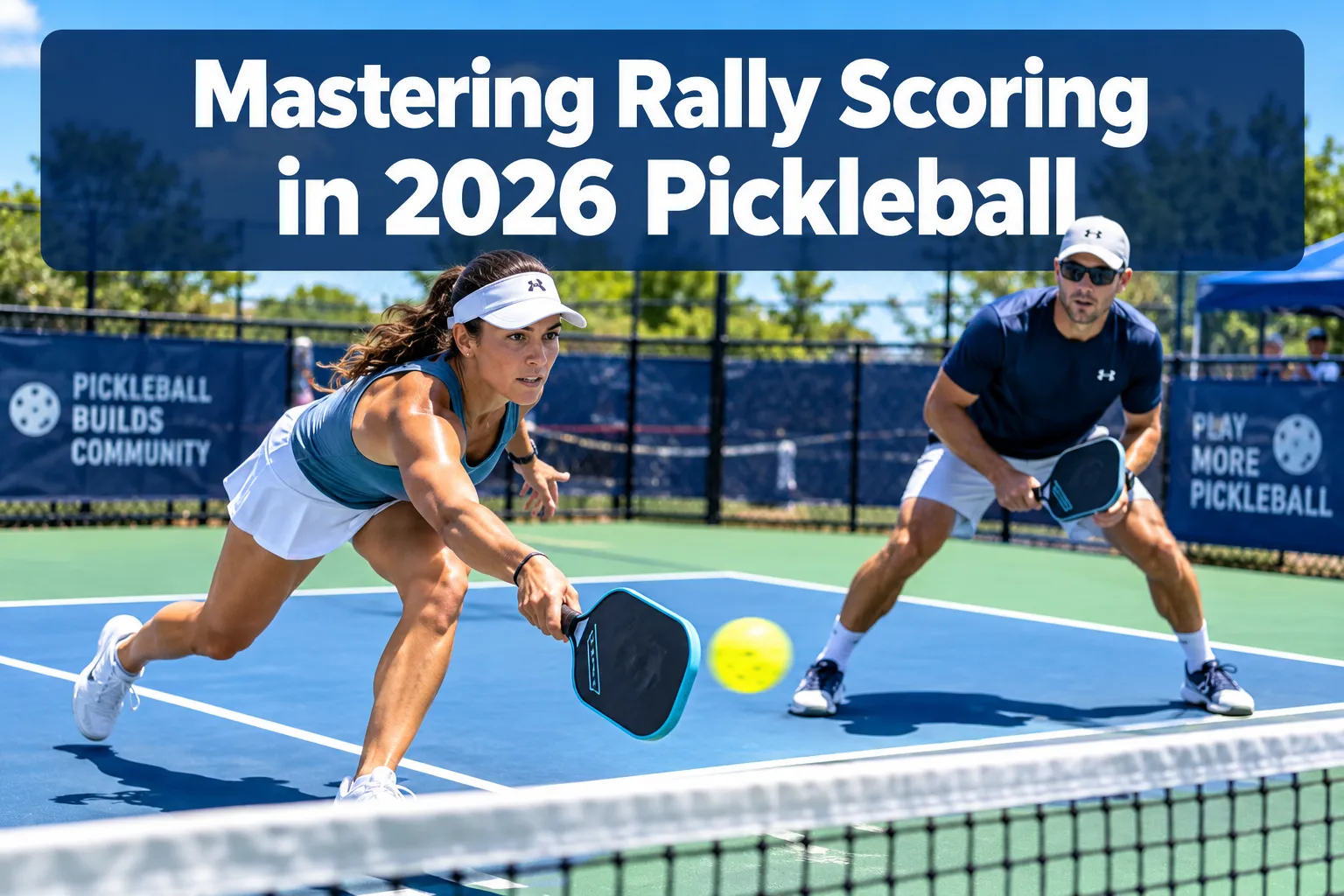
Mastering Rally Scoring in 2026 Pickleball: Advanced Tactics After USA Pickleball’s Freeze Rule Elimination
Last updated: September 16, 2026
Quick Answer: In 2026, USA Pickleball officially removed the freeze rule from rally scoring, meaning any team, serving or receiving, can now win any point at any time, including the final game-winning point. Mastering rally scoring in 2026 pickleball requires adjusting your serve strategy, elevating your return game, and treating every single rally as a full scoring opportunity. This guide covers exactly how to do that.
Key Takeaways
- Every rally scores a point in 2026 rally scoring, there are no “non-scoring” rallies [1][9]
- The freeze rule is gone. The receiving team can now win the game-ending point [3][7]
- Rally scoring is a Tournament Director option, not mandatory for all events [1][9]
- It is not permitted at Golden Ticket events or the USA Pickleball National Championships [1][3]
- Allowed formats include games to 11, 15, or 21 points in single-game or best-of-series structures [9]
- Conservative serving at game point is now a smart tactical choice because a fault directly hands the win to your opponent [6]
- Return-of-serve play has more value than ever, the receiver can now close out a match [2][3]
- Rally scoring has provisional status through 2026, with a formal decision expected in 2027 [2]
- Beginners switching from side-out scoring often underestimate how quickly scores move in rally formats
- Clear score-calling and court positioning communication are critical in doubles rally scoring [10]
What Is Rally Scoring in Pickleball and How Does It Differ from Side-Out Scoring?
Rally scoring awards a point to whichever team wins the rally, regardless of who served. In side-out scoring, the traditional pickleball format, only the serving team can score a point; the receiving team wins the serve but not a point.
Here’s a quick side-by-side comparison:
| Feature | Side-Out Scoring | Rally Scoring (2026) |
|---|---|---|
| Who can score? | Serving team only | Either team |
| Game-ending point | Serving team only | Either team [3][7] |
| Freeze rule | Yes (in rally scoring) | Eliminated [1][3] |
| Score moves faster? | No | Yes |
| Serve faults at game point | Change of serve | Point to opponent [6] |
Under USA Pickleball Rule 14.A, rally scoring means a point is awarded to the team that wins each rally, full stop [9]. If you’re new to pickleball scoring overall, the beginner’s guide to pickleball scoring is a great place to start before diving into rally-specific tactics.

Why Did USA Pickleball Eliminate the Freeze Rule in 2026?
USA Pickleball removed the freeze rule to create a cleaner, more consistent scoring experience where “a point is a point at all times.” The old freeze rule required the serving team to score the game-ending point in rally scoring, which created a confusing hybrid of two systems.
Rules 4.B and 14.A.2 in the 2026 rulebook now confirm that either the serving or receiving team can score the winning point [1][3]. This change eliminates the awkward late-game shift in logic that confused recreational players and complicated event management.
The broader goal is to evaluate rally scoring fairly across a full season. USA Pickleball is conducting an independent third-party study throughout 2026 to assess competitive fairness and scheduling efficiency before making a permanent decision in 2027 [2].
Key point: Rally scoring remains provisional in 2026. Whether it becomes a permanent fixture depends on what the data shows this season [2].
What’s the Difference Between the Freeze Rule and No Freeze Rule in Pickleball?
The freeze rule meant that at game point in rally scoring, the receiving team could not win the game, only the serving team could score the final point. Without the freeze rule, the receiving team can win immediately on any rally, including the last one.
Practical example: Score is 14-10 in a game to 15. The trailing team serves into the net. Under the old freeze rule, that’s just a point to the leading team and a side-out. Under the 2026 rules, that fault immediately ends the game, the leading team wins [6][12].
This single change makes every rally near game point feel higher-stakes, especially for servers.
How Does Removing the Freeze Rule Change Pickleball Strategy?
Removing the freeze rule elevates the value of every rally, especially late in games, and shifts strategic weight toward the return of serve and defensive aggression.
Key strategic shifts in 2026 rally scoring:
- Servers must be more conservative near game point. A fault directly concedes the match, not just the serve [6]
- Returners should be more aggressive. Any forced serving error scores immediately [3][6]
- No rally is “safe” to lose. There are no non-scoring rallies, so point-by-point pressure is constant [5][10]
- Doubles communication matters more. Positioning errors and score confusion cost actual points, not just serves [10]
For doubles teams, this means simplifying stacking schemes, calling the score clearly before every point, and confirming receiving responsibilities out loud. A missed assignment under rally scoring hands a point directly to the other team [10][14].
What Are the Best Offensive Tactics for Rally Scoring Pickleball?
The best offensive tactics for rally scoring center on aggressive but controlled returns, high-percentage third-shot choices, and consistent pressure throughout the entire match, not just when serving.
Top offensive tactics for mastering rally scoring in 2026 pickleball:
- Attack the return of serve. Since the receiving team can now win any point, including the last one, a deep, aggressive return puts immediate pressure on the server [2][3]
- Use the third-shot drop strategically. Getting to the kitchen quickly matters even more when every exchange scores
- Target the server’s feet at game point. A forced fault ends the game in your favor [6]
- Keep serves high-percentage late in games. A conservative, consistent serve is better than a risky ace attempt when one fault loses the match [6][12]
- Poach more in doubles. With every rally scoring, winning short rallies quickly is more valuable than grinding long ones
For players looking to sharpen these skills, the advanced practice routines for mastering complex shots and strategies resource covers drills that translate directly to rally scoring play.
How Do I Adjust My Game to Rally Scoring If I Learned Side-Out Scoring First?
Players who learned side-out scoring need to make one core mental shift: stop thinking of received rallies as “defensive” and start treating them as full scoring opportunities.
Practical adjustment checklist:
- ✅ Call the score before every single rally, both teams can score, so confusion is costly
- ✅ Practice your return of serve as much as your serve
- ✅ Train yourself to stay focused when receiving, not just when serving
- ✅ Adjust your end-game serve selection, go for placement over power near game point
- ✅ Play practice games to 15 using rally scoring to build instincts fast
The essential rules of pickleball for beginners is worth a quick review if any of the 2026 rule changes feel unfamiliar.
Can You Win a Pickleball Match Faster With Rally Scoring?
Yes, rally scoring generally produces faster matches than side-out scoring because every rally changes the score. There are no “wasted” rallies where the receiving team wins the serve but nothing else.
In practical terms, a game to 11 in rally scoring can finish in roughly half the time of a side-out game to 11, depending on skill level. This is one reason Tournament Directors are exploring rally scoring for scheduling efficiency [2][12].
Choose rally scoring if: you want tighter time windows per match, faster results in round-robin formats, or more predictable scheduling.
Stick with side-out if: you’re playing in a Golden Ticket qualifier, national championship pathway, or any event where USA Pickleball mandates traditional scoring [1][3].
Are There Any Downsides to Rally Scoring in Competitive Pickleball?
Rally scoring has real advantages, but it also comes with trade-offs worth knowing before your next tournament.
Potential downsides:
- Serving pressure increases significantly. A single fault at game point ends the match, some players find this stressful [6]
- Less margin for error overall. In side-out scoring, a bad rally when receiving costs nothing. In rally scoring, it costs a point
- Not available at all events. Golden Ticket events and national championships still use side-out scoring [1][3], so players need to stay comfortable with both systems
- Score confusion in doubles. With both teams scoring, miscommunication about who’s receiving or where to stand is more costly [10]
- Still provisional. USA Pickleball may modify or remove rally scoring after 2026, so investing heavily in rally-only tactics carries some risk [2]
How Do Professional Pickleball Players Adapt to Rally Scoring Rules?
Professional players adapt to rally scoring by increasing serve consistency, prioritizing return quality, and maintaining sharper focus across every single point, because there’s no mental “reset” during a non-scoring rally.
At the pro level, the tactical shift looks like this:
- Serves become safer near game point. Pros favor deep, consistent placement over aggressive spin serves when a fault ends the game [6]
- Return games are trained as primary weapons. The receiving team winning the final point is now a real scenario, so returns are practiced with match-closing intent [2][3]
- Doubles teams communicate more explicitly. Score-calling, stacking assignments, and positioning checks happen before every rally [10]
- Mental reset between points is shorter. Rally scoring demands continuous focus because the score changes constantly
For players working toward competitive play, the advanced techniques for mastering spin and placement guide covers the shot-making skills that underpin these pro adaptations.
What Drills Should I Practice to Master Rally Scoring Tactics?
The best drills for mastering rally scoring in 2026 pickleball focus on return quality, serve consistency under pressure, and sustained point-by-point focus across full games.
Drill 1, Pressure Serve Practice: Play games to 11 using rally scoring. At 10, X (game point), the server must land 5 consecutive serves in a target zone before finishing the game. This builds conservative serve habits under pressure.
Drill 2, Return-to-Win Simulation: Play games where the receiving team starts every game at 10-0. They must close out the game from there. This trains the mental habit of treating returns as scoring opportunities.
Drill 3, Full Rally Scoring Scrimmage: Play full games to 15 using 2026 rally scoring rules, no freeze, either team can win. Call the score out loud before every rally. This builds score awareness and communication habits.
Drill 4, Kitchen Pressure Drill: Two players at the kitchen line, rally scoring only. First to 21 wins. Every dink error scores for the opponent. This sharpens consistency and focus in the highest-value court zone.
The drills to enhance coordination and agility for pickleball players resource pairs well with these scoring-specific drills for a complete practice session.
Do All Pickleball Tournaments Use Rally Scoring Now, or Just Some?
Not all tournaments use rally scoring. In 2026, rally scoring is a Tournament Director option, it’s available for sanctioned play but not mandatory [1][9].
Where rally scoring is NOT permitted in 2026:
- Double-elimination doubles events
- USA Pickleball Golden Ticket events
- USA Pickleball National Championship events [1][3]
Where it may be used:
- Single-elimination brackets
- Round-robin formats
- Events where the Tournament Director chooses it and specifies it clearly on entry forms [11]
Allowed rally scoring formats under Rule 15.C.2:
- One game to 11, 15, or 21
- Best 2-of-3 games to 11, 15, or 21
- Best 3-of-5 games to 11, 15, or 21 [1][9]
Always check your event’s entry form and rules sheet before assuming which scoring system applies. For more on how tournaments work and what to expect, see the role of pickleball tournaments in fostering community spirit.
What Mistakes Do Beginners Make When Switching to Rally Scoring?
The most common beginner mistake is treating received rallies as low-stakes, a habit carried over from side-out scoring where losing a received rally had no score consequence.
Other frequent mistakes:
- Forgetting to call the score before each rally, leading to positioning confusion in doubles
- Serving aggressively at game point when a fault immediately ends the match [6]
- Relaxing after winning the serve, in rally scoring, there’s no “safe” point in the game
- Ignoring kitchen violations, these still award a point directly to the opponent, and that matters more when every point counts [10]
- Not adjusting mentally when receiving at game point, beginners often don’t realize the receiving team can now win the game right there [3][7]
How Does Rally Scoring Affect Kitchen Violations and Dead Ball Rules?
In rally scoring, kitchen violations and dead ball situations follow the same rules as side-out scoring, but the consequences are more immediate. Any fault, including a kitchen violation, awards a point directly to the opposing team [9][10].
Under side-out scoring, a kitchen violation by the receiving team only resulted in a side-out. Under 2026 rally scoring, it scores a point for the server. The reverse is also true, a kitchen fault by the serving team scores a point for the receiver.
Dead ball situations (like a ball hitting a permanent object or a player being struck) are handled the same way as in side-out scoring. The rally ends, and the point is awarded based on the fault [9].
This makes kitchen discipline more valuable than ever. One foot fault or early kitchen entry near game point can end a match instantly.
Is Rally Scoring Harder or Easier Than Side-Out Scoring?
Rally scoring is neither strictly harder nor easier, it’s different in ways that favor different player types.
Rally scoring tends to favor:
- Consistent players with strong returns
- Players with good mental focus across long point sequences
- Teams with clear doubles communication
Side-out scoring tends to favor:
- Players with dominant serves (since only the server scores)
- Teams that can grind long rallies when receiving without worrying about the score
For most recreational players, rally scoring feels faster and more exciting. For competitive players used to side-out, the adjustment period is real, especially around end-game serve selection and return aggression [5][6].
FAQ
Q: Can the receiving team win the final point in 2026 rally scoring? Yes. The freeze rule has been eliminated. Under Rules 4.B and 14.A.2, either the serving or receiving team can score the game-winning point [1][3].
Q: Is rally scoring mandatory for all USA Pickleball sanctioned events in 2026? No. It’s a Tournament Director option and is specifically prohibited at Golden Ticket events and national championships [1][9].
Q: What happens if a serve hits the net in rally scoring? A serve fault awards a point directly to the receiving team, there are no let serves in pickleball, and faults score for the opponent under rally scoring [9].
Q: How many points do you play to in rally scoring? Allowed formats are games to 11, 15, or 21 points, in single-game or best-of-series structures [1][9].
Q: Will rally scoring become permanent after 2026? USA Pickleball has provisional status on rally scoring through 2026. A formal decision is expected in 2027, informed by an independent third-party study [2].
Q: Does rally scoring change the kitchen (non-volley zone) rules? No, kitchen rules stay the same. But violations now score a point for the opponent immediately, making kitchen discipline more critical [9][10].
Q: Do I need to call the score differently in rally scoring doubles? Yes. Since both teams can score, clear score-calling before every rally is essential to avoid positioning and receiving assignment errors [10].
Q: Is rally scoring used in recreational open play? It can be, but most recreational open play still uses traditional side-out scoring. Check with your local club or court organizers.
Q: What’s the fastest way to get comfortable with rally scoring? Play practice games to 15 using 2026 rally scoring rules, call the score out loud before every rally, and focus on return-of-serve quality from day one.
Q: Does the two-bounce rule still apply in rally scoring? Yes, the two-bounce (double-bounce) rule applies regardless of scoring format [9].
Conclusion
Mastering rally scoring in 2026 pickleball is genuinely achievable with the right mindset shift and a few focused practice adjustments. The core change is simple: every rally scores, the freeze rule is gone, and the receiving team can close out a match just as easily as the server.
Your action steps:
- Review the 2026 rules so you know exactly when rally scoring applies to your events
- Practice conservative serves near game point, one fault hands the win to your opponent
- Train your return of serve with the same intensity as your serve
- Call the score out loud before every rally in doubles
- Play rally scoring scrimmages regularly to build instincts before your next tournament
The pickleball community is still figuring out how rally scoring fits into the long-term landscape of the sport. That makes 2026 a great time to get ahead of the curve. Whether you’re a recreational player or working toward competitive play, the players who adapt fastest will have a real edge.
Stay curious, keep practicing, and enjoy every rally, because now, every single one counts. 🎯
References
[1] USAP Rulebook Change Document – https://usapickleball.org/docs/rules/USAP-Rulebook-Change-Document.pdf [2] Pickleball Rules 2026 – https://www.judgemate.com/en/guides/pickleball-rules-2026 [3] 2026 Rule Changes And Rally Scoring – https://www.sportrules.org/pickleball/2026-rule-changes-and-rally-scoring/ [5] Rally Scoring – https://www.thepickleguide.com/rules/rally-scoring [6] 2026 USA Pickleball Rule Changes What Players Need To Know – https://www.playpickle.sg/news/2026-usa-pickleball-rule-changes-what-players-need-to-know [7] USAP 2026 Rule Changes – https://pickle-times.com/news/usap-2026-rule-changes/ [9] USAP Official Rulebook – https://www.usapickleball.org/docs/rules/USAP-Official-Rulebook.pdf [10] Pickleball Scoring Positioning Rally Scoring – https://usapickleball.org/pickleball-skills/level-three/pickleball-scoring-positioning-rally-scoring/


