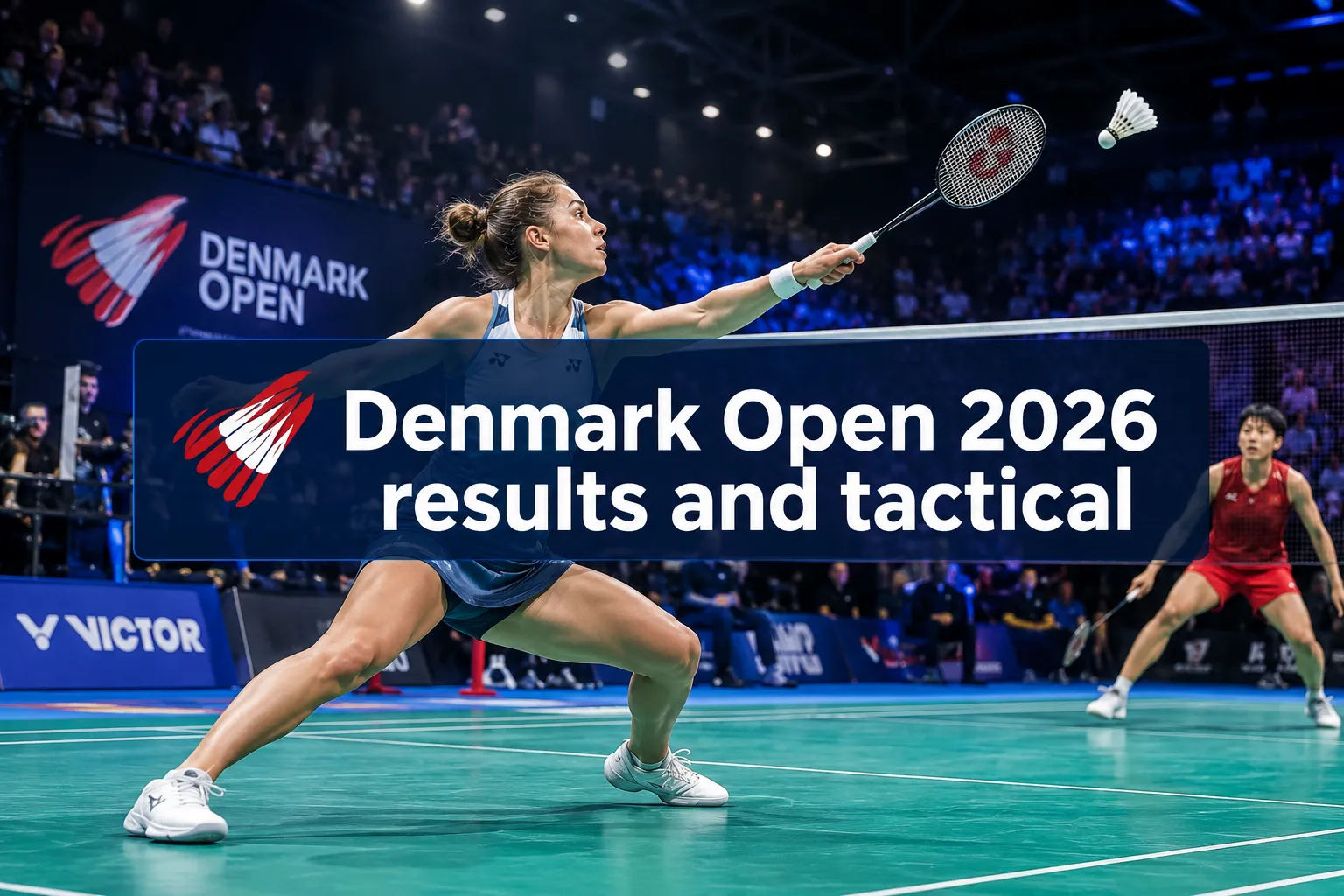
Denmark Open 2026 Results and Tactical Lessons for Club Players
Last updated: November 3, 2026
Quick Answer: The VICTOR Denmark Open 2026 (October 13-18, Odense) delivered five compelling finals with winners from France, South Korea, Indonesia, Malaysia, and China. For club players, the Denmark Open 2026 results and tactical lessons for club players are clear: tempo control, patient rally construction, disciplined net play, and fitness-driven comebacks separated champions from runners-up at every level.
Key Takeaways
- 🏸 Alex Lanier became the first French player to win the Denmark Open men’s singles title, beating Anders Antonsen 21-15, 13-21, 21-13 [1]
- 🏸 An Se-young defended her crown over Akane Yamaguchi 21-23, 21-14, 21-18, coming back from down 5-11 in the decider [2]
- 🏸 Fajar Alfian/Muhammad Shohibul Fikri crushed men’s doubles opponents 21-8, 21-11 with relentless serve pressure [3]
- 🏸 Four of five titles went to Asian players, reinforcing trends in defensive footwork and transition play [3]
- 🏸 Club players can copy champion tactics: energy management, consistent “A-game” patterns, and net control
- 🏸 Entering lower-tier BWF events typically costs $30,$150 USD in entry fees; local club tournaments are far more accessible
- 🏸 Elite players at this Super 750 event used lightweight rackets (80-90g) with fast-flex shafts for quick interceptions
- 🏸 The next Denmark Open is expected in October 2027, continuing its annual Super 750 schedule
What Were the Denmark Open 2026 Badminton Results?
The VICTOR Denmark Open 2026 concluded on October 18 at SJF Bank Arena in Odense, Denmark, as a BWF World Tour Super 750 event. Here are the confirmed champions [1][4][5]:

| Category | Champion(s) | Runner(s)-Up | Score |
|---|---|---|---|
| Men’s Singles | Alex Lanier (France) | Anders Antonsen (Denmark) | 21-15, 13-21, 21-13 |
| Women’s Singles | An Se-young (South Korea) | Akane Yamaguchi (Japan) | 21-23, 21-14, 21-18 |
| Men’s Doubles | Fajar Alfian/Shohibul Fikri (Indonesia) | Aaron Chia/Soh Wooi Yik (Malaysia) | 21-8, 21-11 |
| Women’s Doubles | Pearly Tan/Thinaah Muralitharan (Malaysia) | Hinata Suzuki/Nao Yamakita (Japan) | 21-18, 21-11 |
| Mixed Doubles | Jiang Zhenbang/Wei Yaxin (China) | Feng Yanzhe/Huang Dongping (China) | Finals [3][4] |
An Se-young’s win was particularly historic, her 47th career title makes her the most decorated women’s singles player in badminton history, per multiple reports [2][6].
What Winning Strategies Did Players Use at Denmark Open 2026?
Every champion shared one trait: they controlled the tempo rather than reacting to it. Lanier’s third-game dominance over Antonsen came after he reset his rhythm following a lost second game [1][7]. An Se-young survived being down 5-11 in the decider by sticking to patient, high-percentage rallies rather than forcing the pace [2][6].
Key patterns across all five disciplines:
- Serve-return aggression: Alfian/Fikri’s 21-8 opening game against Chia/Soh Wooi Yik showed how dominant serves and sharp returns can compress a match before it even develops [3]
- Net interception: Pearly Tan/Thinaah prioritized early interceptions over back-court winners, a strategy their post-match comments confirmed was central to their game plan [3][4]
- Targeting the weaker receiver: China’s mixed doubles pairs consistently served and attacked toward the player less comfortable under pressure [3][4]
- Energy conservation early: An Se-young won early-round matches with comfortable margins (21-13, 21-11 scorelines), preserving energy for tougher later rounds [2]
How Can Club Players Use Denmark Open Tactics in Their Matches?
Club players can absolutely apply Denmark Open 2026 tactics, the principles transfer across all skill levels. The key is stripping each tactic down to its core habit and practicing it deliberately.
Three immediate changes any club player can make:
- Pick a serve pattern and stick to it. Alfian/Fikri’s dominance started with consistent, pressuring serves. At club level, varying your serve length and direction reliably is more effective than trying one flashy serve.
- Win the net early in each rally. Thinaah/Pearly’s strategy of cutting off mid-court exchanges works at any level. Practice doubles play tactics and partner communication to build this habit.
- Use your “A-game” in early rounds. Don’t try risky shots when winning comfortably. Save your energy and mental focus for tighter matches.
The biggest takeaway from An Se-young’s comeback: trust your fitness and your plan. Panicking when trailing leads to errors. Patience leads to points.
What Are the Most Common Tactical Mistakes at Denmark Open Level, and What Club Players Get Wrong Too?
Even at Super 750 level, tactical errors show up clearly in scorelines. Club players make the same mistakes, just more often.
Common tactical errors seen across Denmark Open 2026 matches [1][8][9]:
- Changing strategy mid-rally when ahead, leading to unforced errors
- Serving predictably under pressure, opponents read and attack early
- Ignoring mid-court gaps, especially in doubles, leaving the middle undefended
- Burning energy on showy shots in winnable exchanges instead of simple, effective placements
For club players, improving footwork fundamentals is often where these errors are really rooted, poor positioning leads to rushed, low-percentage shot choices.
Which Doubles Strategies Worked Best at Denmark Open 2026?
In both the men’s and women’s doubles, the winning teams focused on net dominance and early-ball interception rather than grinding baseline rallies. Alfian/Fikri’s 21-8, 21-11 destruction of the Malaysian pair showed how aggressive serve-and-attack sequences can end games before the opponent finds rhythm [1][3].
What worked in doubles at Denmark Open 2026:
- Front-court pressure from one player while the partner covers the rear, consistent rotation
- Role clarity, both pairs knew exactly who was attacking and who was defending at any moment
- Short-serve variation to force the receiver into a passive return position
- Intercept over retrieve, cutting off cross-court drives rather than chasing them
Club doubles players can build these habits with structured partner drills that boost team communication and strategy.
What’s the Difference Between Denmark Open Tactics and Club-Level Play?
The tactics are similar, the execution gap is enormous. Champions at this Super 750 event can sustain precise shot placement across a 60-minute three-game match while under intense pressure. Club players are working toward that consistency, not expected to match it.
Where the real gap lies:
- Shot consistency under fatigue: Elite players maintain placement quality in game three. Club players often see technique break down after 20 minutes.
- Reading the opponent: Top players adjust tactics between games. Most club players play the same way regardless of what’s working.
- Physical baseline: An Se-young’s ability to come back from 5-11 down is partly tactical, but it’s also world-class fitness [2].
The practical lesson: focus on court positioning and movement awareness before trying to copy elite shot selections. Movement quality is the foundation everything else sits on.
Is Denmark Open 2026 for Beginner or Advanced Club Players Only?
The tournament itself is elite-only (BWF World Tour Super 750). But the lessons from Denmark Open 2026 results and tactical lessons for club players apply to every skill level. Beginners benefit from studying basic patterns, serve variation, net positioning. Intermediate players can work on tactical adjustment between games. Advanced club players can study specific match footage for shot-selection detail [8].
Choose your learning focus based on your level:
- Beginner: Watch how winners move to the net after attacking. Copy the habit, not the shot.
- Intermediate: Study how Lanier reset after losing game two. Practice composure under pressure.
- Advanced: Analyze Alfian/Fikri’s serve patterns and how they disrupted returns in game one [1][3].
How Do You Practice Denmark Open Championship Techniques Locally?
You don’t need a Super 750 court to train like a Denmark Open finalist. Most key techniques come down to repeatable drills with a partner or coach.
Practical local practice ideas:
- Multi-shuttle net drills, feed shuttles rapidly to practice interception and quick recovery. This mirrors the front-court pressure style seen from both doubles champions.
- Serve-and-third-shot routines, serve, watch the return, play a predetermined attack shot. Builds the Alfian/Fikri pattern at a manageable pace.
- “Comeback” practice sets, start practice games down 5-11 and practice closing them out. Trains the mental composure An Se-young demonstrated [2][6].
- Video review sessions, even 10 minutes watching your own club match footage reveals error clusters. Pair this with watching Denmark Open highlights for comparison [8].
For structured technique development, advanced spin and placement techniques offer a great starting framework to build on.
What Equipment Do Elite Players Use at Denmark Open?
Elite BWF players typically use rackets in the 80-90g range with stiff or extra-stiff shafts for fast interceptions and precise placement. String tension at this level commonly runs 28-32 lbs, much higher than typical club player setups (22-26 lbs). Footwear is non-negotiable, court-specific badminton shoes with lateral support and gum rubber soles.
Key equipment traits at Denmark Open 2026 level:
- Racket weight: 80-90g (3U or 4U) for quick swing and recovery
- String tension: 28-32 lbs for control at high speed (not recommended for beginners)
- Grip: Thin replacement grips for better feel and control
- Shuttles: Feather shuttles (Yonex AS or VICTOR series) for BWF-spec play
Club players don’t need elite-spec equipment to improve. Choosing the right gear for your level matters more than matching a pro’s setup. The racket sports equipment reviews at Rally Racket cover practical gear choices for every budget and skill level.
How Much Does It Cost to Enter Tournaments Like Denmark Open?
The Denmark Open itself is invitation-only for BWF-ranked professionals. For club players, the equivalent entry points are local club tournaments, regional open events, and national-level opens.
Estimated entry costs for club-level badminton tournaments (2026):
- Local club tournaments: Free to $20 USD
- Regional open events: $20,$60 USD per category
- National open (non-BWF): $50,$150 USD
- BWF International Challenge/Series events (lower tier): $30,$100 USD + travel
Getting involved in your local tournament scene is easier than most players think. Understanding how community events and local clubs host tournaments can help you find your first competitive opportunity.
When Is the Next Denmark Open Badminton Tournament?
The Denmark Open runs annually as part of the BWF World Tour Super 750 calendar, typically held in October in Odense, Denmark. Based on the 2026 schedule (October 13-18), the next edition is expected in October 2027. No official dates for 2027 have been confirmed as of publication [4][10].
Follow the BWF World Tour calendar and the official Denmark Open website for announcements.
How Do You Counter the Strategies Used at Denmark Open?
The best counter to Denmark Open-level tactics is consistency, because most high-level strategies depend on forcing errors, not outright winners. If you don’t give them the error, the strategy breaks down.
Tactical counters club players can practice:
- Against net pressure: Lift deep to the back corners to reset the rally rather than trying to play through the net player
- Against aggressive serves: Step into the shuttle early and return to the body or feet to reduce the attacker’s angle
- Against targeting the weaker player: The “weaker” partner should practice receiving under pressure specifically, targeted drills build confidence fast
- Against tempo changes: Stay on your serve-and-return routine regardless of score. Routine beats panic every time.
FAQ
Who won the Denmark Open 2026 men’s singles? Alex Lanier of France won the men’s singles title, defeating home favorite Anders Antonsen 21-15, 13-21, 21-13. He became the first French player to win this title. [1][7]
Who won the Denmark Open 2026 women’s singles? An Se-young of South Korea defended her crown, beating Akane Yamaguchi 21-23, 21-14, 21-18. It was her 47th career title and ninth of the 2026 season. [2][6]
Where was the Denmark Open 2026 held? The tournament was held at SJF Bank Arena in Odense, Denmark, from October 13-18, 2026. [3][4]
Can recreational players actually apply professional tournament tactics? Yes, the core principles (net control, serve variation, composure under pressure) apply at every level. The execution standard differs, but the habits transfer directly.
What level of player benefits most from studying Denmark Open results? Intermediate and advanced club players gain the most from tactical analysis. Beginners benefit more from focusing on movement and basic consistency first.
What string tension do elite badminton players use? Most BWF-level players string at 28-32 lbs. Club players typically perform better at 22-26 lbs for more power and forgiveness.
Is the Denmark Open part of the BWF World Tour? Yes. It is a BWF World Tour Super 750 event, one of the highest-ranking tournaments below the Finals. [4][10]
What made the men’s doubles final so one-sided? Alfian/Fikri used relentless serve pressure and early racket preparation to keep Aaron Chia/Soh Wooi Yik permanently on defense. The final score, 21-8, 21-11, reflected how completely they controlled the front court. [1][3]
How often is the Denmark Open held? Annually, typically in October, in Odense, Denmark. [10]
What is the best way to study Denmark Open tactics as a club player? Watch match replays focusing on one specific element per viewing, serves, net play, or tactical resets after losing a game. Pick one habit to copy, then drill it with a partner.
Conclusion
The Denmark Open 2026 results and tactical lessons for club players aren’t just highlights for fans, they’re a practical playbook. Champions like An Se-young and Alex Lanier showed that composure after setbacks, disciplined shot selection, and smart energy management win matches at every level.
Your next steps:
- Pick one tactic from this article (serve variation, net interception, or comeback composure) and make it your focus for the next two weeks of practice.
- Watch at least one Denmark Open 2026 match replay with a specific question in mind: “What does this player do after losing a rally?”
- Find a local club tournament to test your progress in a real match environment.
- Connect with your racket sports community, improvement is always faster with partners who push you.
Whether you play badminton, pickleball, padel, or tennis, the tactical principles here, patience, positioning, and pressure, apply across the board. That’s what makes studying elite events so valuable for the rest of us.
References
- Denmark Open 2026 Final Results. badmintonworldtour.com.
- An Se-young Claims 9th Title of 2026 Season. koreajoongangdaily.com.
- Denmark Open 2026 Asian Winners. asiasportshub.com.
- Thank You for an Historic Victor Denmark Open 2026. denmarkopen.dk.
- 2026 Denmark Open. wikipedia.org.
- The Denmark. cricketnmore.com.
- An Se Young Defends Denmark Open Crown After Three Game Comeback Over Akane Yamaguchi. karlobag.eu.
- Denmark Open 2026. getgoodatbadminton.com.
- Denmark Open 2026 Quarter Final Results. facebook.com.
- Denmark Open. wikipedia.org.