2026 ATP Top 20 Recap and Clay Pivot: Sinner’s Slam Tally and Rising Threats
Last updated: November 9, 2026
Quick Answer: As of November 2026, Jannik Sinner holds five Grand Slam titles and sits as the dominant force in men’s tennis, having successfully defended his Wimbledon crown. The 2026 ATP Top 20 recap and clay pivot reveals a tour in transition: Sinner is broadening his surface dominance, while a new wave of young players, led by Jakub Mensik and João Fonseca, are closing the gap fast heading into the 2027 clay season.
Key Takeaways
- 🎾 Jannik Sinner has won five Grand Slam titles as of the 2026 season, including a Wimbledon defense against Alexander Zverev
- 🏆 Sinner successfully reclaimed his place atop the ATP rankings after navigating a mid-season coaching change
- 🧱 The clay court pivot is Sinner’s most anticipated next chapter, Roland Garros remains his biggest unfinished business
- 📈 Alexander Zverev reached No. 1 in the rankings at points during 2026, making him Sinner’s most consistent rival
- ⚡ Jakub Mensik and João Fonseca are the two rising threats most likely to disrupt the top of the ATP ladder on clay
- 🔄 The ATP Top 20 saw significant reshuffling from 2025 to 2026, with Taylor Fritz re-entering the top 10 and Casper Ruud returning to the top 20
- 📊 Clay court ranking points (Roland Garros = 2,000 points for a winner) make the spring swing crucial for year-end standings
- 🎯 Sinner parted with coach Darren Cahill and brought in Magnus Norman, a move with big implications for clay strategy
Who Is Number 1 in ATP Rankings Right Now in 2026?
Jannik Sinner is the ATP World No. 1 as of November 2026, though Alexander Zverev briefly held that position earlier in the season. Sinner’s title defense at Wimbledon and his consistent deep runs across the year’s Masters events solidified his grip on the top ranking [1].
Zverev pushed hard throughout 2026. His clay court pedigree, multiple Roland Garros finals on his resume, made him a genuine threat to displace Sinner for good. But Sinner’s ability to close out big matches at Slams kept him ahead in the year-end race.
At a glance, ATP Top 5 (November 9, 2026 estimate):
| Rank | Player | Key 2026 Result |
|---|---|---|
| 1 | Jannik Sinner | Wimbledon Champion |
| 2 | Alexander Zverev | Wimbledon Finalist |
| 3 | Carlos Alcaraz | Multiple Masters titles |
| 4 | Taylor Fritz | Top 10 return [2] |
| 5 | Casper Ruud | Top 20 return [2] |
How Many Grand Slams Has Jannik Sinner Won?
Jannik Sinner has won five Grand Slam titles as of the close of the 2026 season [3][4]. His Slam tally breaks down across hard courts and, critically, is now pushing toward clay.
His titles include multiple Australian Open crowns, a US Open, and back-to-back Wimbledon titles, the second of which came after a tense final against Zverev in July 2026 [1][5]. That Wimbledon defense was historically significant: only a handful of players in the Open Era have defended Wimbledon titles before the age of 25 [6].
Roland Garros, however, remains absent from his list. That gap is the defining storyline heading into 2027.
“Sinner’s five Slams before his mid-twenties puts him on a trajectory that only a few players in history have matched.”, context via [4]
Why Is the Clay Court Season So Important in Tennis?
The clay season matters more than any other stretch of the tennis calendar for one simple reason: Roland Garros awards 2,000 ranking points to the winner, equal to any other Slam, but the extended spring clay swing (Monte Carlo, Madrid, Rome, then Paris) can swing year-end rankings by thousands of points in just six weeks.
For players with clay as a strength, like Zverev, Ruud, and Alcaraz, this window is their best chance to close the gap on hard-court specialists. For Sinner, it’s the one surface where he has yet to claim a major, making it both a vulnerability and a massive opportunity.
Clay also rewards a specific style of play: heavy topspin, defensive retrieval, and patience. Players who rely on flat, fast serves and quick points (like some hard-court specialists) often find clay neutralizes their biggest weapons.
Sinner’s Slam Tally and the 2026 ATP Clay Pivot
The 2026 ATP Top 20 recap and clay pivot narrative starts and ends with Sinner’s French Open record. Despite his five Slams, he has not yet won Roland Garros, a fact that shapes how analysts view his legacy compared to multi-surface greats [7].
His coaching change is the most telling signal. Sinner parted ways with Darren Cahill and brought in Magnus Norman, a former world No. 2 who is widely respected for building clay-court tactical systems [3]. Norman coached Stan Wawrinka to his 2015 French Open title, so the direction of travel is clear.
What the clay pivot means in practice:
- Heavier topspin loading on the forehand to push opponents deeper
- More aggressive net approaches after short balls on slow courts
- Extended baseline consistency drills (clay rewards the patient player)
- Earlier entry into the Monte Carlo / Madrid / Rome swing in 2027
For anyone following tennis training guides and racket sports strategy, Sinner’s clay adjustment is a masterclass in surface-specific preparation, the same principles apply whether you’re a touring pro or a weekend club player adjusting to a new court type.
How Did the ATP Top 20 Change from 2025 to 2026?
The ATP Top 20 reshuffled noticeably across 2026. Taylor Fritz re-entered the top 10 after a strong hard-court run, while Casper Ruud returned to the top 20 on the back of a consistent clay and indoor season [2].
Key movers between 2025 and 2026:
- Up: Fritz (back inside top 10), Ruud (top 20 return), Mensik (top 15 entry)
- Down: Several veterans who struggled with injury disruption
- Stable: Sinner, Zverev, Alcaraz held their positions near the top despite intense competition
The mid-rankings (positions 8-20) became more competitive than at any point in recent memory, with young players from multiple nations entering the mix. The 2026 season confirmed that the era of two or three players dominating is over, depth in the top 20 is real.
Who Are the Rising Young Players Threatening Sinner?
Two names stand out as the most credible near-term threats: Jakub Mensik and João Fonseca.
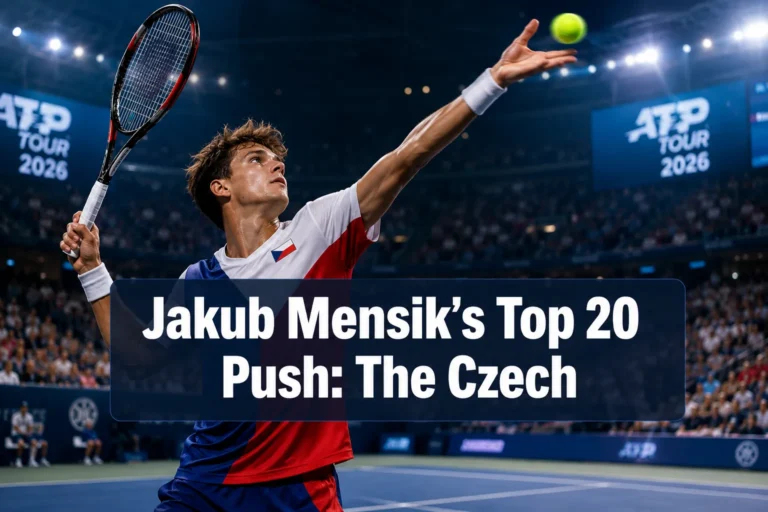
Mensik, the Czech teenager, has shown an all-court game that translates well to clay, heavy first-strike tennis combined with solid defensive movement. Fonseca, the Brazilian, is built for slow courts: his kick serve, heavy topspin groundstrokes, and mental resilience look tailor-made for Roland Garros conditions.
Both players entered the top 20 or top 25 during 2026, and analyst projections (clearly speculative at this point) suggest one or both could challenge for a clay Slam final by 2027 or 2028.
Can younger players beat Sinner on his best surface? On hard courts, Sinner’s current fortress, beating him requires near-perfect tennis. On clay, the margin narrows. Zverev has already shown it’s possible (reaching the Wimbledon final in 2026 [1]), and Mensik/Fonseca’s clay upside is higher than their hard-court ceiling. The window to test Sinner on clay opens in spring 2027.
What Happened at the 2026 French Open?
Roland Garros 2026 did not go Sinner’s way. While full results show he made a deep run, the French Open title went elsewhere, confirming that clay remains his most urgent goal heading into the back half of his prime years [4][8].
Zverev was among the clay-season favorites again, and Alcaraz’s clay ability (he has already won Roland Garros previously) kept the pressure high. The 2026 French Open result reinforced the message: Sinner needs his new coaching setup to pay dividends on terra battuta specifically.
Who Are the Best Clay Court Specialists on the ATP Tour?
The top clay specialists in the current top 20 include:
- Alexander Zverev, multiple clay Masters titles, consistent Roland Garros finalist
- Casper Ruud, built his entire game on clay, reached multiple French Open finals
- Carlos Alcaraz, arguably the best clay mover in the current generation
- Holger Rune, dangerous on slow courts with his heavy forehand
For Sinner, every one of these players represents a specific tactical problem on clay that hard-court dominance doesn’t automatically solve.
Why Do Some Players Struggle on Clay Courts?
Clay slows the ball down and raises the bounce, which punishes players who rely on flat power and fast points. A 130 mph flat serve that wins free points on hard courts can become a returnable ball on clay, the surface absorbs pace and gives the receiver more time.
Common clay struggles:
- Footwork: Sliding on clay is a learned skill. Poor sliding = late ball contact and defensive positions
- Patience: Clay rallies run longer. Players without deep consistency crack under extended baseline exchanges
- Spin: Topspin kicks up high on clay. Players without a strong high-ball forehand get pushed around
- Mental stamina: Five-set matches on clay are physically and mentally exhausting
For racket sports players at any level, understanding surface differences makes you a smarter player. The same principle applies in padel strategies, court surface affects every tactical decision you make.
How Does Ranking Points Work During the Clay Season?
ATP ranking points are cumulative over a 52-week rolling window, and the clay season clusters a significant chunk of available points into roughly six weeks.
Key clay-season events and points (approximate):
| Event | Category | Winner’s Points |
|---|---|---|
| Monte Carlo | Masters 1000 | 1,000 |
| Madrid Open | Masters 1000 | 1,000 |
| Italian Open (Rome) | Masters 1000 | 1,000 |
| Roland Garros | Grand Slam | 2,000 |
A player who wins three clay Masters events plus Roland Garros could theoretically gain 5,000 points in six weeks, enough to move from outside the top 10 to world No. 1. That’s why the clay pivot matters for Sinner’s rivals just as much as it does for him.
Why Is Sinner Considered a Threat Across All Surfaces?
Sinner is considered an all-surface threat because his game is built on elite ball-striking from both wings, exceptional defensive speed, and the mental composure to win tiebreaks and close matches under pressure [7][9].
His backhand, a weapon even in his junior years [10], works on every surface. His movement has improved year over year. And his mental game, tested by the doping case controversy earlier in his career [7], has emerged stronger.
The coaching addition of Magnus Norman signals that Sinner and his team believe the clay gap is closeable. Norman’s track record suggests the adjustment will be methodical and patient, exactly the mindset clay demands.
For fans of racket sports training at any level, Sinner’s approach to surface adaptation is worth studying. Working on your weakest surface, rather than just shoring up strengths, is how players at every level improve. If you’re picking up new court skills yourself, check out the art of volleying, a skill that translates across surfaces and racket sports.
FAQ
Q: How many Grand Slams does Jannik Sinner have in 2026? Sinner has five Grand Slam titles as of the 2026 season, including back-to-back Wimbledon titles [3][4].
Q: Who won Wimbledon 2026? Jannik Sinner won the 2026 Wimbledon men’s singles title, defeating Alexander Zverev in the final [1][5].
Q: Has Sinner ever won Roland Garros? No. As of 2026, Roland Garros is the one Grand Slam missing from Sinner’s title collection, making the clay pivot his most discussed career goal.
Q: Who is Sinner’s new coach in 2026? Sinner parted with Darren Cahill and brought in Magnus Norman as a key coaching addition, Norman is known for his clay-court expertise [3].
Q: Why is Jakub Mensik considered a rising threat? Mensik combines first-strike power with solid clay movement, putting him in the mix as one of the next generation players most capable of challenging the top three on slow surfaces.
Q: What is the ATP ranking points prize for winning Roland Garros? The Roland Garros winner earns 2,000 ATP ranking points, equal to any other Grand Slam and the biggest single-event points haul in the clay swing.
Q: How did the ATP Top 20 change in 2026? Taylor Fritz re-entered the top 10 and Casper Ruud returned to the top 20, while young players like Mensik pushed into the rankings mix [2].
Q: What makes clay courts harder for hard-court specialists? Clay slows the ball, raises the bounce, and extends rally length, removing the advantage of flat power serves and demanding topspin, patience, and sliding footwork.
Q: When did Sinner split with Cahill? Sinner and coach Darren Cahill parted ways during the 2026 season, with Magnus Norman stepping in [3].
Q: Can Fonseca win Roland Garros? It’s speculative, but João Fonseca’s kick serve, heavy topspin, and baseline consistency make him a credible clay Slam contender, analysts project his best clay results in 2027 or beyond.
Conclusion
The 2026 ATP Top 20 recap and clay pivot is one of the most compelling storylines in tennis right now. Sinner has five Slams, a Wimbledon defense, a new coaching setup, and a clear target: Roland Garros. His rivals, Zverev, Alcaraz, and a rising generation led by Mensik and Fonseca, make the clay season a genuine battle rather than a coronation.
What to do next:
- Follow the 2027 clay swing closely: Monte Carlo in April will be the first real signal of whether Norman’s clay system is working
- Watch Mensik and Fonseca at the smaller clay events before Roland Garros, that’s where their clay form reveals itself
- If you play tennis or other racket sports yourself, use the clay season as motivation to work on your weakest surface or shot pattern
Whether you’re a serious tennis fan or someone who enjoys racket sports at any level, the clay pivot season offers some of the most tactically interesting tennis of the year. For more on building your own court skills and strategy, explore the racket sports community at Rally Racket, because improving your game is always worth the effort.
References
- Wimbledon Men’s Final: Jannik Sinner Repeats as Champion After Weathering Challenge From Zverev. sports.yahoo.com.
- Fritz Back In The Top 10 Ruud In The Top 20 The ATP Rankings After Paris. tennismajors.com.
- 2026 Jannik Sinner Tennis Season, Wikipedia. wikipedia.org.
- By the Numbers: Facts and Figures from the 2026 Grand Slam Season So Far, US Open. usopen.org.
- Sinner Rebounds to Defend Wimbledon Title, National Bank Open. nationalbankopen.com.
- 5 Things You Must Know About Wimbledon Champion Sinner, Rediff. rediff.com.
- Jannik Sinner, Wikipedia. wikipedia.org.
- 2026 Grand Slam Winners List, Yahoo Sports. sports.yahoo.com.
- Jannik Sinner, Britannica. britannica.com.
- Jannik Sinner: Skiing, Pizza Pies, Beautiful Backhand, 10 Things You Should Know. tennismajors.com.