
Mental Toughness in the Fast-Paced Era: Adapting Your Routine to Shorter Changeovers and Shot Clocks
Last updated: November 23, 2026
Quick Answer: Mental toughness in the fast-paced era means compressing your mental reset into seconds, not minutes. As shot clocks shrink across basketball, tennis tiebreaks tighten, and changeover windows get shorter, athletes who train specific breathing, self-talk, and reset cues perform better under pressure than those relying on longer preparation habits. The good news? A reliable routine takes only 3-5 seconds once it’s trained.
Key Takeaways
- Shot clocks are expanding rapidly: by 2026, roughly 29-32 U.S. states use a 35-second high school basketball shot clock, with more mandating it in 2026-27 [1][2]
- A compressed pre-shot routine of 3-5 seconds is enough when it’s rehearsed consistently
- Mental toughness under time pressure is a trainable skill, not a fixed personality trait
- The biggest mistakes players make: over-thinking during the countdown, skipping the reset entirely, and relying on old long-form routines
- Breathing is the fastest mental reset tool available, one controlled exhale can lower heart rate quickly enough to sharpen focus
- Scenario-based practice (simulating countdowns during drills) is more effective than general mindfulness work alone
- Racket sports like tennis, padel, and pickleball all have timing constraints that reward compact, automatic routines
- Self-talk quality matters more than quantity when time is short, one clear phrase beats a paragraph of inner dialogue
What Sports Have Shot Clocks and Shorter Changeovers?
Shot clocks, serve clocks, and timed intervals now appear across a wide range of sports. Basketball is the most visible example, but racket sports have been tightening their own time rules for years.
In basketball: FIBA updated its official timing rules effective October 1, 2026, standardizing the 24-second shot clock globally [3]. At the high school level in the U.S., the NFHS authorized a 35-second shot clock beginning in 2024-25, with detailed 2026-27 guidelines now in place [4]. Alabama mandated its 35-second clock for the 2026-27 season [2], Texas (UIL) approved a phased rollout starting as early as 2028-29 for larger classifications [5], and Wisconsin voted to allow it in nonconference varsity games from 2026-27 onward [6].
In racket sports:
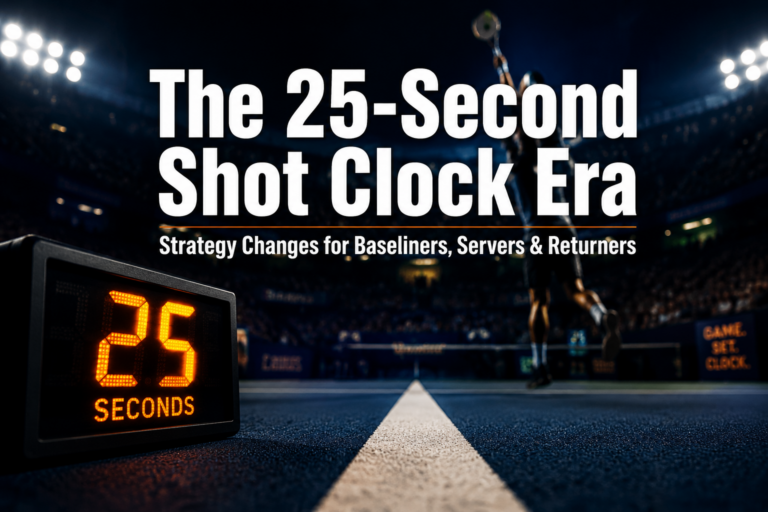
- Tennis uses a 25-second serve clock between points (ATP/WTA Tour), with 90-second changeovers at odd games and 2-minute breaks at sets
- Pickleball (MLP/PPA formats) has introduced shot clocks and serve timing to speed up elite play
- Padel follows ITF-aligned timing rules with limited time between points
- Badminton (BWF) enforces strict 60-second interval rules between games
The pattern is clear: across sports, the gap between plays is shrinking. That makes mental toughness in the fast-paced era less about grinding through long matches and more about resetting fast and repeatedly.
What’s the Difference Between Mental Toughness in Slow vs. Fast-Paced Games?
In slower-paced formats, mental toughness means sustaining focus over long stretches and recovering from errors with time to reflect. In fast-paced formats, it means making quality decisions quickly and resetting before the next demand arrives.
Think of it this way: a slow game rewards patience and endurance. A fast game rewards automaticity and composure. Both require mental strength, but the skills look different in practice.
| Format | Key Mental Demand | Reset Window |
|---|---|---|
| Slow (traditional tennis) | Sustain focus, manage energy | 60-90 seconds |
| Fast (tiebreak, shot clock) | Quick decision, instant reset | 5-25 seconds |
| Racket sports (pickleball fast format) | Rapid pattern recognition | 3-10 seconds |
Coaches at Wisconsin programs framed it well: success now requires “player development, toughness, execution and the ability to adapt to whatever the game required” [6]. That adaptability is the core skill.
Do Shorter Shot Clocks Make Mental Toughness More Important?
Yes, and the evidence from coaches across multiple states points in one direction. Shorter shot clocks don’t just change tactics; they change the psychological demands on every player.
Colorado coaches noted that the main mental adjustment under the new CHSAA shot clock is late-game clock management: knowing when to foul, when to speed up, and how to stay composed with a countdown always running [7]. For teams already playing fast, the shot clock adds minimal tactical disruption. But for teams used to deliberate, controlled possessions, it introduces constant low-level anxiety.
For racket sports players, the equivalent pressure comes from serve clocks and compressed changeovers. When you have 25 seconds instead of 60, there’s no room for a wandering mind. That’s not a threat, it’s actually an opportunity to build cleaner, more automatic focus habits.
How Do You Adjust Your Pre-Shot Routine for a Faster Clock?
Shorten the routine without removing it. A 3-5 second pre-shot routine that’s deeply rehearsed outperforms a 15-second routine that’s improvised.
Here’s a practical compressed routine for racket sports players:
- Exhale once, slow, controlled breath out (1-2 seconds)
- Reset cue, a physical anchor like bouncing the ball twice or tapping the strings (1 second)
- One self-talk phrase, something like “see it, hit it” or “stay low” (1 second)
- Execute, commit fully, no second-guessing
The key is that steps 1-3 happen in the background of physical preparation, not in addition to it. Practiced correctly, this whole sequence fits inside a serve clock window.
💡 Common mistake: Players try to keep their old 10-step routine and just do it faster. That creates more anxiety, not less. Build a new short routine from scratch and train it separately.

How Much Time Do You Actually Need for a Pre-Shot Routine?
Research in sports psychology consistently suggests that experienced athletes need less preparation time than they think. For elite-level players, pre-performance routines of 3-6 seconds are common and effective when automated through repetition.
The NFHS 2026-27 shot clock guidelines [4] and FIBA’s 2026 rule updates [3] both reflect the same underlying assumption: athletes at competitive levels can and should make decisions within compressed windows. The 35-second possession clock resets to 25 seconds after an offensive rebound [8], a detail that demands players mentally recalibrate mid-possession, not just at the start.
For a tennis serve clock, 25 seconds sounds like plenty. But subtract toweling off, walking to the baseline, and reading the court, and there are roughly 8-10 seconds left for mental preparation. That’s actually enough, as long as those seconds are used deliberately.
Choose this approach if: You’re a recreational player who currently bounces the ball five or more times before serving. Cutting to two bounces with a breath reset will feel uncomfortable at first but becomes automatic within 2-3 weeks of consistent practice.
Can You Stay Mentally Tough When You Have Less Time to Prepare?
Absolutely, and many players actually perform better with less preparation time, not more. Overthinking is a bigger performance killer than under-preparation.
The challenge is that time pressure amplifies self-doubt. When the shot clock or serve clock is ticking, players who haven’t trained a reset routine default to anxious scanning: “Am I ready? What if I miss? What’s the score?” That internal noise is what hurts performance, not the shortened window itself.
Alabama coaches implementing the 2026-27 mandate noted that the shot clock is designed to increase pace of play and limit prolonged ball control [2], meaning the clock itself forces a mental commitment that many players struggle to make voluntarily.
Practical fix: During practice, set a phone timer for 8 seconds. Before every drill rep, complete your reset routine before the timer goes off. Do this for 15 minutes per session for two weeks. The pressure becomes familiar, and familiar pressure stops feeling threatening.
What Are Common Mistakes When Adapting to Shorter Changeovers?
The most common errors aren’t tactical, they’re mental habits that don’t scale down well.
- Skipping the routine entirely when stressed, which removes the only anchor available
- Speeding up self-talk until it becomes noise rather than a cue
- Clock-watching obsessively, which splits attention between the game and the display
- Trying to solve tactical problems during the reset window instead of clearing the mind
- Carrying the last point into the next one, with less time between plays, emotional baggage compounds faster
Coaches across Texas, Colorado, and Wisconsin programs all flag late-game clock management as the hardest mental adjustment [5][6][7]. The score is tight, the clock is short, and there’s no time to recover from a rushed decision. Players who have rehearsed end-of-game scenarios in practice handle this far better than those who haven’t.
How Do Elite Athletes Handle Quick Transitions Between Plays?
Elite athletes use automaticity, deeply grooved routines that run without conscious effort, to bridge the gap between plays. This frees cognitive bandwidth for reading the game rather than managing internal state.
The practical implication is that elite-level mental toughness isn’t about willpower in the moment. It’s about preparation that makes the moment require less willpower. NFHS-aligned rule documents now include contingencies like having a PA announcer call out remaining time when a shot clock fails [9], meaning players must maintain focus even when time information is imperfect or verbal rather than visual. That’s a cognitive load that only well-trained athletes handle smoothly.
For racket sports players, the equivalent scenario is a malfunctioning scoreboard during a tiebreak. Players who rely on external cues to manage their mental state fall apart. Players with internal routines keep going.
Is Mental Toughness Training Different for Fast-Paced Sports?
Yes, in one important way: the training must simulate time pressure, not just mental challenge. General mindfulness or visualization work builds a foundation, but it doesn’t replicate the specific stress of a countdown.
What works for fast-paced sports:
- Scenario-based drills with live timers
- “Compressed possession” practice, completing a full tactical sequence in under 10 seconds
- End-of-game simulations with score pressure and time pressure combined
- Short breathing resets practiced hundreds of times until they’re automatic
What doesn’t transfer well: long meditation sessions, unlimited-time visualization, or practice environments with no time constraints. These build general focus, but not the specific reflex of resetting fast.
Given the rapid expansion of shot clocks across high school and international basketball between 2024 and 2028 [1][3][4], sports psychology curricula are already shifting toward scenario-based, time-constrained training as a core method.
How Do You Practice Staying Focused With Limited Time Between Shots?
The most effective method is deliberate pressure inoculation, regularly exposing yourself to the exact discomfort of limited time until the discomfort no longer triggers avoidance.
Three drills that work for racket sports players:
Serve clock drill: Set a 20-second timer. Complete your full pre-serve routine and serve before it expires. If you miss the window, it counts as a fault. Do this for an entire service game.
Rally reset drill: After each point in a practice rally, your partner calls out a 5-second countdown. You must complete a physical and mental reset (breath, cue, phrase) before the next point starts.
Pressure serve practice: Play tiebreakers only during practice sessions, no full sets. The compressed, high-stakes format of a tiebreak naturally simulates shot-clock-style pressure.
For players who want to explore pickleball specifically, check out these essential tips for new pickleball players and the guide on smart shot selection during gameplay, both cover decision-making under pressure in a compact format.
What Do Players Struggle With Most When Adjusting to Faster-Paced Games?
The single biggest struggle is the loss of the “comfort buffer.” Most recreational players have unconsciously built their confidence on having enough time, time to towel off, time to self-correct, time to breathe. When that buffer shrinks, confidence can wobble before the actual skill does.
Coaches implementing the CHSAA shot clock in Colorado observed that “run-and-gun” teams adapted quickly because their pace was already fast, the clock matched their natural rhythm [7]. Teams that relied on deliberate ball control found the adjustment much harder, not because they lacked skill, but because they lacked a mental framework for playing under constant countdown pressure.
The fix isn’t to become a faster player. It’s to become a player whose mental state is independent of how much time is available. That’s the real definition of mental toughness in the fast-paced era.
Racket sports players dealing with stress and mental load on court will also find value in Rally Racket’s coverage of the mental health benefits of playing pickleball, the same psychological principles around stress relief apply directly to managing game-day pressure.
FAQ
Q: What is a shot clock in basketball? A shot clock is a countdown timer that limits how long an offensive team can hold the ball before attempting a shot. In NFHS high school rules (2026-27), it’s set at 35 seconds, resetting to 25 after an offensive rebound [4][8].
Q: Does tennis have a shot clock? Tennis uses a serve clock, currently 25 seconds on ATP and WTA tours between points. It’s not identical to a shot clock, but it creates the same pressure to complete a mental reset quickly.
Q: How long should a pre-shot routine be under time pressure? 3-5 seconds is enough for a trained routine. The key is that the routine must be rehearsed to the point of automaticity, not improvised during competition.
Q: Can breathing really help in 2-3 seconds? Yes. A single controlled exhale (slow, deliberate) activates the parasympathetic nervous system quickly enough to reduce acute stress. It’s one of the most evidence-supported mental performance tools available.
Q: What states mandated a shot clock for 2026-27? Alabama (AHSAA) mandated its 35-second clock for the 2026-27 season [2]. Wisconsin approved optional use in nonconference varsity games starting 2026-27 [6]. Texas (UIL) approved a phased rollout beginning no earlier than 2028-29 for larger classifications [5].
Q: Does playing faster games hurt recreational players? Not necessarily. Faster formats reduce overthinking for many recreational players. The challenge is building a brief, reliable reset routine beforehand so the speed feels controlled rather than chaotic.
Q: Is mental toughness trainable? Yes. Sports psychology consistently shows that mental skills, including composure under time pressure, improve with specific, deliberate practice. It’s not a fixed trait.
Q: What’s the best self-talk phrase for a compressed routine? Short, action-focused phrases work best: “See it, hit it,” “Stay low,” “One point.” Avoid evaluative language like “Don’t miss”, focus on what to do, not what to avoid.
Q: How is padel different from tennis in terms of timing pressure? Padel follows ITF-aligned timing rules with limited time between points, similar in structure to tennis. The smaller court and faster rally pace mean mental resets happen even more frequently per minute of play.
Q: Where can I learn more about managing mental pressure in racket sports? Rally Racket has several guides worth reading, including how pickleball enhances mental well-being and the mental health advantages of playing pickleball, both of which cover the psychological side of competitive play.
Conclusion
Mental toughness in the fast-paced era isn’t about being mentally harder. It’s about being mentally faster, building a reset routine so compact and reliable that a 5-second changeover is enough.
Actionable next steps:
- Audit your current routine. Time it. If it takes more than 10 seconds, it won’t survive a shot clock or serve clock environment.
- Build a 3-step compressed reset: one breath, one physical cue, one phrase.
- Train it under pressure. Use a timer during practice drills, not just matches.
- Practice end-of-game scenarios separately, this is where most players lose composure.
- Join a local racket sports community to practice these skills in live, low-stakes competitive environments. Rally Racket’s guide to finding your local pickleball community is a great starting point.
The shot clock isn’t the pressure. The pressure was always there. The clock just makes you deal with it on schedule.
References
- Detroit Free Press, Shot clock, basketball, high school rule, NFHS. freep.com.
- AHSAA, Central Board passes shot clock implementation for basketball beginning with the 2026-27 season. ahsaa.com.
- FIBA, Official Rules 2026 Rule Changes v1.1. assets.fiba.basketball.
- 2026-27 NFHS Basketball Shot Clock Guidelines Final. assets.nfhs.org.
- Times Record News, UIL phasing rollout for 35-second shot clock. timesrecordnews.com.
- Milwaukee Journal Sentinel, WIAA high school basketball shot clock changes get positive reviews. eu.jsonline.com.
- The Journal, The Countdown Is On: Panthers Fired Up as CHSAA Introduces Shot Clock. the-journal.com.
- WSFA, AHSAA to implement shot clock mandate for basketball beginning 2026-27 season. wsfa.com.
- IAHSAA, Basketball Regular Season Manual. iahsaa.org.