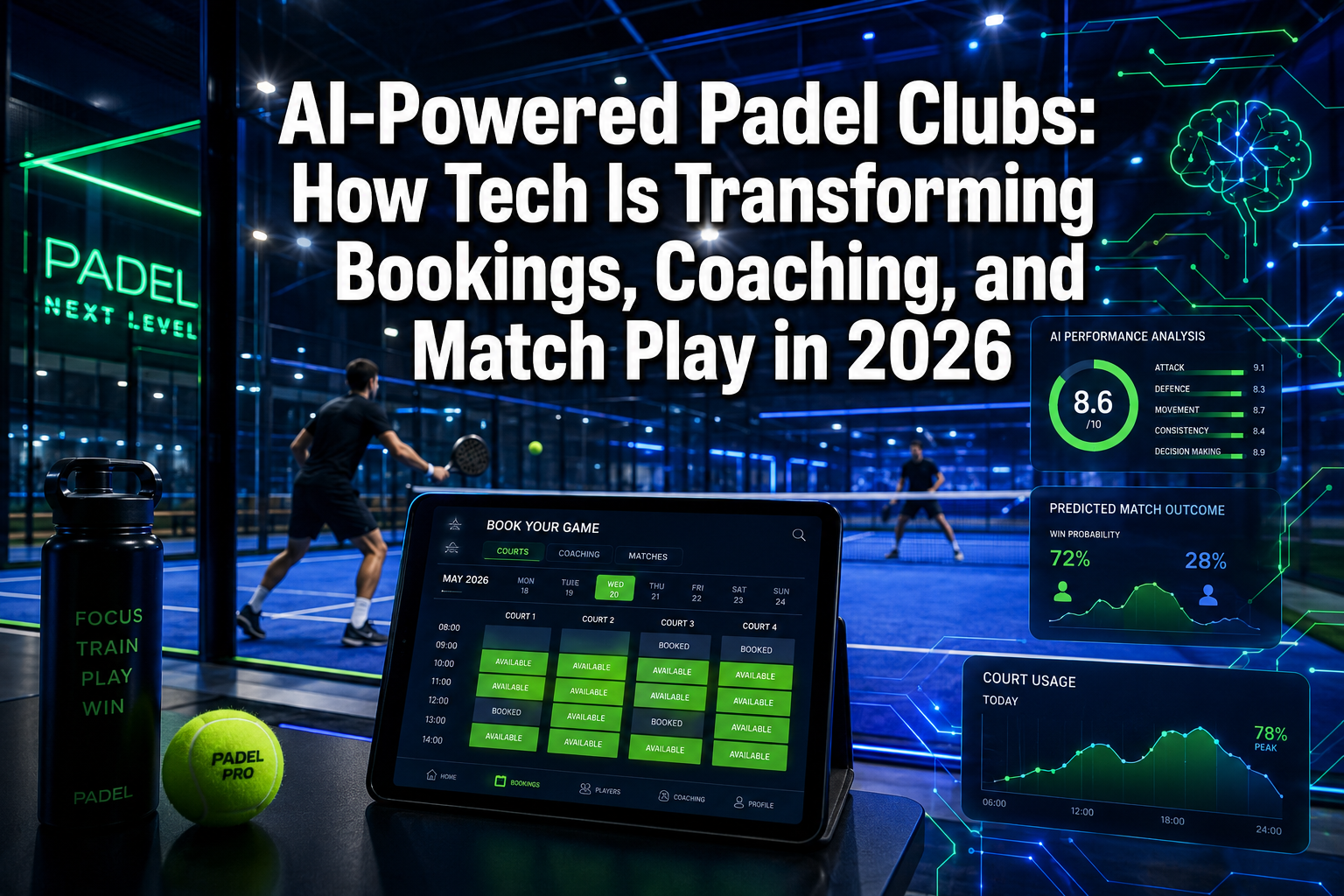
AI-Powered Padel Clubs: How Tech Is Transforming Bookings, Coaching, and Match Play in 2026
Last updated: May 17, 2026
Quick Answer: AI-powered padel clubs use smart booking systems, computer vision coaching tools, and automated match analysis to give players a faster, more personalized experience. In 2026, these tools are no longer reserved for elite facilities — mid-size clubs across Europe, Latin America, and North America are rolling them out to stay competitive and keep courts full.
Key Takeaways 🎾
- AI booking systems reduce no-shows and fill empty court slots automatically using demand prediction.
- Computer vision cameras analyze player movement and shot technique in real time, giving coaching feedback without a coach present.
- Smart line-calling tech (similar to what’s used in professional tennis) is now affordable enough for club-level padel.
- Match data platforms let recreational players track stats, review rallies, and improve padel strategies between sessions.
- Club owners report shorter admin time and higher court utilization rates after adopting AI facility management tools.
- Players in the racket sports community benefit most when they combine tech feedback with hands-on coaching.
- The biggest mistake clubs make is adopting too many tools at once — start with booking automation, then layer in coaching tech.
What Does an AI-Powered Padel Club Actually Look Like?
An AI-powered padel club is a facility that uses machine learning, computer vision, and data automation to handle everything from court reservations to post-match performance reports. It’s not a futuristic concept — it’s what forward-thinking clubs are building right now.
Walk into one of these clubs in 2026 and you’ll notice a few things:
- No front-desk bottlenecks. Bookings, cancellations, and waitlists are managed by an app that learns peak demand patterns.
- Cameras on every court. Not just for security — these record matches, track ball trajectory, and flag technique issues.
- Post-match summaries on your phone. Within minutes of finishing a game, players get a breakdown of rally length, shot accuracy, and positioning.
This is what AI-powered padel clubs: how tech is transforming bookings, coaching, and match play in 2026 looks like at ground level.

How Are AI Booking Systems Changing Court Management?
AI booking systems solve one of the most frustrating problems in club management: empty courts during off-peak hours and overbooked slots during peak times. These platforms analyze historical booking data, local weather, and even local event calendars to predict demand and adjust pricing or availability dynamically.
What this means for players:
- Instant confirmation without calling the club
- Waitlist alerts when a preferred slot opens up
- Dynamic pricing that makes off-peak times cheaper (good for budget-conscious recreational players)
What this means for club owners:
- Fewer staff hours spent on scheduling
- Higher court utilization rates
- Automated reminders that cut no-show rates significantly
Clubs using demand-based pricing tools (similar to models used in hotel and airline industries) have found that spreading bookings more evenly across the week is one of the fastest wins available. If you’re a club owner evaluating where to start, booking automation is the clearest first step — it pays for itself quickly and creates the data foundation for every other AI tool.
Common mistake: Clubs that skip the booking layer and jump straight to AI coaching cameras end up with expensive hardware and no player data to make it useful.
Can AI Really Coach Padel Players? Here’s What the Tech Does
AI coaching tools for padel work by combining computer vision (cameras tracking body and ball movement) with machine learning models trained on thousands of hours of match footage. The result is automated feedback on technique, positioning, and shot selection — delivered through an app after each session.
What AI coaching currently does well:
- Tracking footwork patterns and flagging positioning errors
- Measuring shot consistency (how often a specific shot lands in the target zone)
- Comparing a player’s movement to recommended court coverage patterns
- Identifying which shots are losing the most points
What it still can’t replace:
- A coach’s ability to read a player’s mental state or motivation
- Real-time verbal cues during a rally
- The social and motivational side of group coaching
For beginner to intermediate players — the core of the racket sports community — AI coaching tools work best as a supplement, not a replacement. Use the data to identify one or two specific weaknesses, then bring those to a human coach for targeted drills. If you’re working on mastering your serve techniques and consistency, for example, video-based feedback can show you exactly where your motion breaks down.
What Is Smart Line-Calling and Is It Ready for Club Padel?
Smart line-calling uses computer vision to track ball landing positions and make instant in/out calls — the same technology used at major tennis tournaments for years. In 2026, scaled-down versions are now available for club-level padel courts at a fraction of the original cost.
How it works at club level:
- Cameras mounted at court corners track ball trajectory in real time.
- The system calculates landing position within a few millimeters.
- A visual or audio signal announces the call instantly.
- Disputed points can be reviewed on a tablet replay.
Is it worth it for your club?
| Club Type | Recommended? | Notes |
|---|---|---|
| Competitive/tournament club | Yes | Reduces disputes, adds credibility |
| Mid-size recreational club | Maybe | Depends on budget and player demand |
| Small casual club | Not yet | Cost vs. benefit doesn’t favor it |
The tech is solid, but the ROI depends on your player base. Competitive players and clubs that host local tournaments will get the most value. Casual recreational clubs may find that the investment is better directed toward booking systems or coaching cameras first.
How Does Match Data Help Recreational Players Improve?
Match data platforms give recreational padel players access to the kind of stats that used to be reserved for professionals. After each match, players can review rally counts, shot distribution, error patterns, and court coverage heat maps.
For players who want to genuinely improve padel strategies, this data is genuinely useful — but only if it’s acted on. Here’s a practical approach:
- Review your error patterns first. Most recreational players lose more points from unforced errors than from being outplayed. Find the shot causing the most errors.
- Check your positioning data. Are you consistently out of position after a specific shot? The heat map will show it.
- Compare across sessions. One match is noise. Three to five matches start to show real patterns.
- Bring the data to a drill session. Use it to focus your next practice. Check out these intermediate drills to elevate your game for ideas on turning data insights into court habits.
The racket sports community is increasingly data-literate, and padel is no exception. Players who combine match data with structured practice improve noticeably faster than those who just play more games.
What Should Club Owners Prioritize First?
AI-powered padel clubs: how tech is transforming bookings, coaching, and match play in 2026 is a broad topic, but for club owners the practical question is simpler: where do you start?
Recommended adoption order:
- AI booking and scheduling platform — highest ROI, lowest friction, fastest payback
- Court cameras with match recording — gives players immediate value and builds loyalty
- Performance analytics app — layer this on top once players are used to reviewing footage
- Smart line-calling — add this if you host competitive play or tournaments
Trying to implement everything at once creates staff confusion and player overwhelm. A phased approach works better for most clubs.
Choose AI booking first if: your courts sit empty during off-peak hours or your staff spends more than two hours a day on scheduling.
Choose coaching cameras first if: your club already has a strong coaching program and you want to add value between sessions.
The racket sports gear reviews and club tech evaluations coming out of industry events like RacquetX consistently point to the same finding: clubs that start with operations (booking, facility management) before player-facing tech see better adoption and faster returns.
How Is AI Changing the Social Side of Padel Clubs?
Beyond bookings and coaching, AI is quietly reshaping how players connect with each other. Matchmaking algorithms now pair players of similar skill levels for open court sessions, reducing the frustration of mismatched games. Some platforms also organize social leagues, track player ratings, and send automated invitations to fill open doubles spots.
This matters because padel is fundamentally a social sport. The community aspect — finding partners, building rivalries, organizing group play — is a big part of why people keep coming back. Building community through shared sport is a well-documented driver of long-term participation across all racket sports, and padel is no different.
AI matchmaking doesn’t replace the social bonds players form on court — it just removes the friction of finding the right game at the right time.
What Are the Real Costs of AI Club Technology in 2026?
Costs vary widely depending on the tools and scale, but here’s a realistic ballpark for clubs evaluating options in 2026:
| Technology | Estimated Monthly Cost (per club) | Notes |
|---|---|---|
| AI booking platform | $100–$400 | Scales with court count |
| Court cameras (basic recording) | $50–$150 per court | Hardware cost separate |
| Performance analytics software | $200–$600 | Often bundled with cameras |
| Smart line-calling system | $500–$1,500 | Higher upfront hardware cost |
Note: These are estimated ranges based on publicly available SaaS pricing models and industry reporting as of early 2026. Actual costs vary by provider and region.
For most mid-size clubs (4–8 courts), a realistic starting budget for booking automation plus basic court cameras is in the $500–$800/month range. That’s a manageable investment when weighed against the staff time saved and the increase in court utilization.
FAQ: AI-Powered Padel Clubs
Q: Do players need to download an app to use AI features at a club? Most platforms offer a web-based option, but dedicated apps deliver the best experience for booking, match review, and performance tracking.
Q: Can AI coaching tools work for complete beginners? Yes, but beginners benefit more from human coaching first. Use AI tools once you have the basic mechanics down — the feedback is more actionable when you understand what you’re being told to fix.
Q: Is player data from AI systems private? Reputable platforms follow GDPR and regional data privacy laws. Always check a platform’s data policy before signing up, especially for biometric or movement data.
Q: How accurate is AI line-calling in padel? Current club-level systems are highly accurate for clear in/out calls. Edge cases (balls hitting the frame or wire) can still require human judgment.
Q: Do I need a high-end phone to use padel performance apps? Most apps work on mid-range smartphones from the past three years. Video review features require more storage space than basic stat tracking.
Q: Will AI replace padel coaches? No. AI handles data collection and pattern recognition well. Coaches handle motivation, real-time adjustment, and the human side of improvement — none of which AI replicates effectively.
Q: What’s the best first AI tool for a small padel club? Start with an AI-powered booking and scheduling platform. It’s the lowest-cost, highest-impact entry point for most clubs.
Q: Can recreational players use AI match analysis without a club subscription? Some standalone apps let players upload their own match footage for analysis. Quality varies, but several solid options exist in 2026 for self-coached players.
Conclusion: Where to Go From Here
AI-powered padel clubs are not a distant trend — they’re the new baseline for competitive club management in 2026. For players, the tech means better games, smarter practice, and easier scheduling. For club owners, it means fuller courts and less time buried in admin.
Actionable next steps:
- If you’re a player: Ask your club if they offer match recording or performance tracking. If not, look for a club that does — or explore standalone apps that let you self-analyze.
- If you’re a club owner: Audit how much staff time goes to scheduling each week. That number alone usually justifies the cost of an AI booking platform.
- For both: Don’t let data replace court time. Use insights to focus your practice, then go play. The best improvement still happens on the court.
The racket sports community is growing fast, and padel is leading a lot of that growth. Whether you’re new to the sport or a seasoned competitor, understanding how local clubs and community events shape your game — and how tech is enhancing that experience — puts you in a better position to enjoy it fully.
Play smart. Use the tools. Keep it fun. 🎾