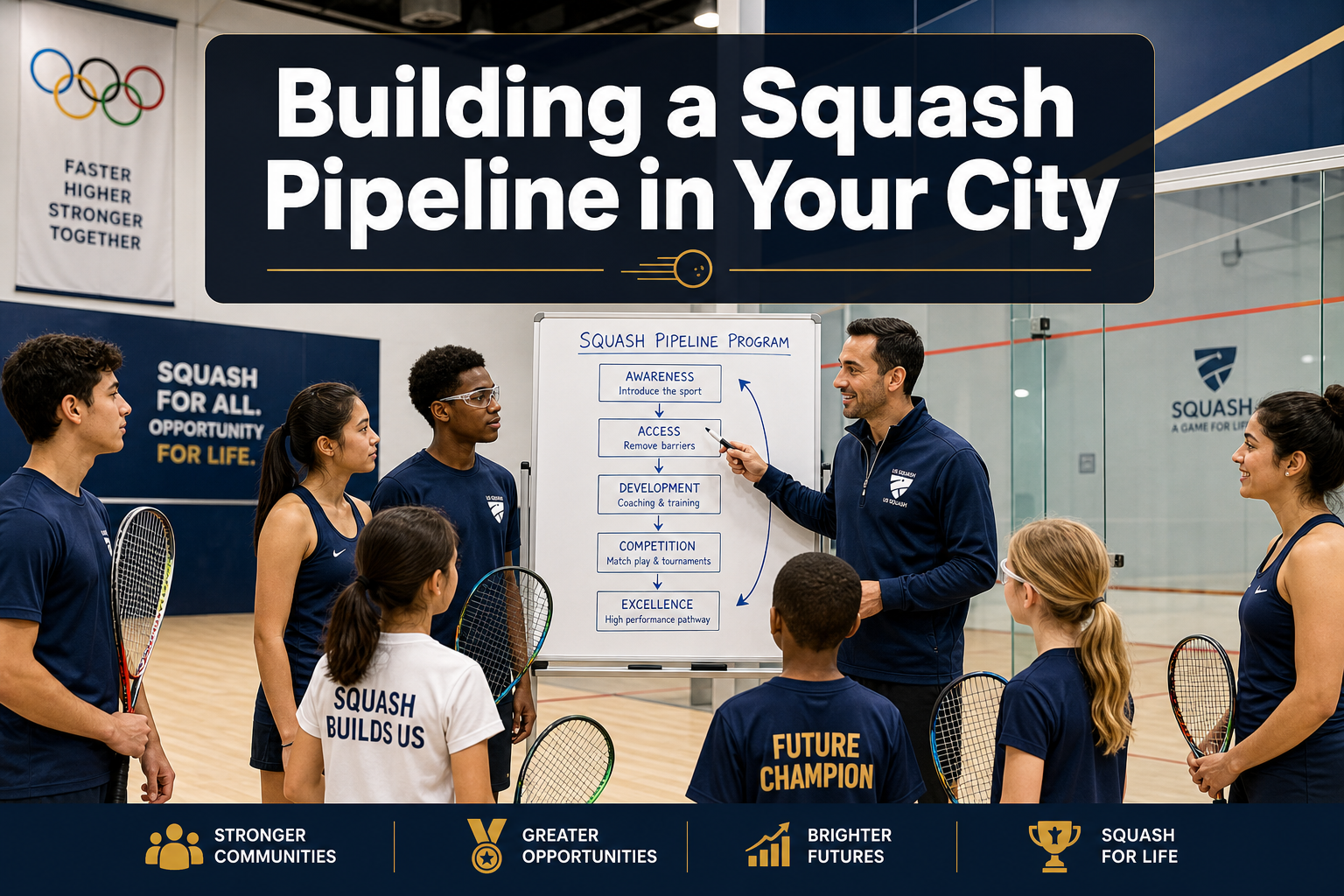
Building a Squash Pipeline in Your City: Practical Steps for Clubs to Ride the Pre-Olympic Participation Wave
Last updated: June 27, 2026
Quick Answer: Building a squash pipeline in your city means creating a clear, structured path from first-time beginner to committed club player — and eventually to competitive athlete. With squash confirmed for the LA 2028 Olympics, clubs that act now on school outreach, affordable beginner programs, and coach development will be best positioned to capture a surge in new players before and after the Games.
Key Takeaways
- A squash pipeline is a structured progression system: beginner → intermediate → competitive, supported by coaching at every stage.
- Olympic inclusion in LA 2028 is already driving formal pipeline planning at national and club levels [10].
- School partnerships and community clinics are the fastest, most cost-effective way to attract new players.
- Beginner adults and kids both benefit from squash — the sport is accessible, low-cost to start, and highly social.
- Starter equipment for a new player costs roughly $50–$120 (racket, eyewear, shoes).
- Clubs that ignore referee and coach development early will struggle to scale their programs sustainably [10].
- Grants and funding from national squash bodies are available — clubs should apply before demand peaks.
- Measuring pipeline success means tracking retention rates, not just sign-ups.
What Is a Squash Pipeline and Why Does It Matter for Clubs
A squash pipeline is a club’s intentional system for moving players from their very first lesson through to regular competition. Without one, clubs end up with a revolving door: people try the sport, enjoy it, and then drift away because there’s no clear next step.
For clubs looking at building a squash pipeline in your city, the pipeline concept matters because it turns casual interest into long-term membership. Think of it like a funnel with three main layers:
- Entry level — free taster sessions, school visits, community clinics
- Development level — beginner group coaching, social leagues, affordable memberships
- Competitive level — junior squads, adult ladders, regional tournaments
The London Squash Project is a strong real-world example of this model in action, using community-linked facilities to bring new urban players into the sport at scale [2]. The goal isn’t just numbers — it’s building a culture where players want to stay.
How Squash Clubs Attract Beginner Players in Their Community
The most effective clubs don’t wait for beginners to find them — they go where the beginners already are. That means schools, gyms, community centers, and workplaces.
Practical outreach tactics that work:
- Free taster days — open the courts on a Saturday morning with loaner rackets and a coach on hand
- “Bring a friend” promotions — existing members are your best recruiters
- Social media short clips — a 30-second video of a beginner’s first rally is more compelling than any brochure
- Workplace wellness tie-ins — pitch squash as a lunchtime fitness option to local businesses
- Pop-up courts at community events — temporary setups at festivals or sports days create curiosity
Just as pickleball programs have shown how community-first thinking builds lasting player bases, squash clubs can apply the same principles. The sport sells itself once someone gets on court — the hard part is getting them there the first time.
Grassroots Squash Programs vs. Competitive Training: What’s the Difference
Grassroots programs are designed for inclusion and fun. Competitive training is designed for performance. Clubs need both, but they should never be confused or merged too early.
| Feature | Grassroots Program | Competitive Training |
|---|---|---|
| Goal | Participation and enjoyment | Performance and ranking |
| Age range | All ages, any fitness level | Typically 10+ with commitment |
| Session format | Group, social, relaxed | Structured drills, match analysis |
| Coach focus | Technique basics, confidence | Tactical development, fitness |
| Cost to player | Low or subsidized | Higher (more coach time) |
| Frequency | 1–2x per week | 3–5x per week |
The “Squash for the 21st Century” framework emphasizes that sustainable club growth depends on keeping these two tracks separate but connected — so a grassroots player always has a visible path to the competitive stream if they want it [5].

How Much Does It Cost to Start a Squash Program at a Local Club
Starting a basic squash program doesn’t require a massive budget. Most clubs can launch a beginner initiative for under $2,000 in setup costs, depending on what equipment they already own.
Estimated startup costs:
- Loaner racket set (10 rackets): $300–$600
- Protective eyewear (10 pairs): $100–$200
- Squash balls (bulk pack): $30–$60
- Coach time (per session): $50–$150 depending on certification level
- Marketing materials (flyers, social posts): $50–$200
- Court hire (if not owned): $15–$40 per hour
England Squash recently received a funding boost specifically to expand outdoor court access and lower participation barriers [7], which shows that national bodies recognize the cost issue and are actively trying to address it. Clubs should check with their national federation for matching grants or subsidized coaching programs before spending their own budget.
Best Ways to Get Kids Interested in Squash Before the Olympics
Kids respond to energy, variety, and the feeling that they’re part of something exciting. The LA 2028 Olympic window is a genuine hook — but only if clubs use it creatively.
What works for youth engagement:
- Squash + STEM programs — partner with schools to teach physics through ball trajectory and racket science. This is a proven model for getting curriculum time and school buy-in [6].
- Mini-squash formats — shorter courts, softer balls, and simplified scoring keep young players engaged before they’re ready for the full game.
- Olympic countdown events — a “Road to LA 2028” themed junior tournament creates excitement and urgency.
- Youth squad identity — team names, matching shirts, and a group chat make kids feel like athletes, not just students.
Youth sports programs across racket sports consistently show that belonging matters as much as skill development for keeping young players engaged long-term.
What Equipment Do Beginners Need to Start Playing Squash
New squash players need three things: a racket, protective eyewear, and court shoes. Everything else is optional at the start.
Beginner equipment checklist:
- ✅ Squash racket — budget options start around $30–$50; mid-range at $60–$100 is fine for most beginners
- ✅ Protective eyewear — non-negotiable for safety; costs $15–$40
- ✅ Court shoes — non-marking soles are required on most courts; $40–$80
- ✅ Squash balls — clubs usually provide these; a double-yellow dot ball is standard for intermediate play, but beginners should start with a blue or red dot (bouncier)
Clubs that provide loaner gear for the first few sessions dramatically improve beginner retention. Once a player buys their own racket, they’re psychologically committed. For guidance on keeping racket sports gear in good condition, proper storage and string care apply to squash rackets just as they do in other racket sports.
How Successful Squash Clubs Structure Their Coaching and Training Levels
The best squash clubs use a tiered coaching model that mirrors the pipeline itself. Each level has a defined purpose, a qualified coach, and a clear exit point that moves players to the next tier.
A practical three-tier coaching structure:
- Beginner tier — group sessions of 6–8 players, focus on basic shots (drive, boast, drop), court movement, and rules. Sessions run 45–60 minutes.
- Intermediate tier — smaller groups of 3–4, tactical awareness, match play, and fitness introduced. Sessions run 60–75 minutes.
- Advanced/competitive tier — individual or pair coaching, video analysis, tournament preparation. Sessions run 75–90 minutes.
US Squash has formalized this approach by partnering with World Squash Officiating to strengthen referee development alongside coach pathways, recognizing that both are essential infrastructure ahead of LA 2028 [10]. Clubs that invest in coach certification now will have a significant advantage when Olympic demand arrives.
For clubs wanting to improve their coaching quality, insights from experienced coaches on avoiding common technical errors translate well across racket sports disciplines.
Common Mistakes Clubs Make When Building Youth Squash Programs
The most common mistake is treating youth programs as a revenue stream too early. Programs that charge full adult rates from day one, or that push kids into competitive play before they’re ready, see high dropout rates within the first three months.
Other mistakes to avoid:
- No clear progression path — kids (and parents) need to see what comes next
- Inconsistent coaching — rotating coaches every few weeks breaks trust and slows development
- Ignoring parents — parent buy-in is critical for youth retention; run one parent info session per term
- Overcrowding beginner sessions — more than 8 kids per court per session reduces contact time and fun
- Skipping the fun — structured drills without games lose kids fast
The reimagining of squash provision in community settings specifically calls out the need to design programs around the player experience first, not the club’s administrative convenience [6].
What Age Should Kids Start Learning Squash Competitively
Kids can start learning squash fundamentals from age 6–7 using mini-squash formats. Competitive play — meaning structured matches against other clubs — is generally appropriate from age 9–10, once basic technique and court awareness are in place.
Pushing competitive play too early tends to create anxiety rather than motivation. The sweet spot for most children is:
- Ages 6–8: Mini-squash, fun-focused, no scoring pressure
- Ages 9–11: Beginner competitive, local club tournaments
- Ages 12+: Regional competition, squad training, performance pathway
How Clubs Can Partner With Schools to Grow Squash Participation
School partnerships are the single most scalable way to build a squash pipeline in a city. One school relationship can funnel 20–50 new young players into a club program per year.
How to approach school partnerships:
- Contact the PE department head directly — bring a one-page proposal, not a sales pitch
- Offer to run a free 4-week taster program during PE time
- Tie it to curriculum goals (fitness, coordination, teamwork)
- Provide all equipment — ask for nothing except court time or gym space
- Follow up with an after-school club option for interested students
The SquashBridge model of building new facilities adjacent to educational institutions is emerging as a leading approach for capturing school-age participation at scale [8]. Clubs without their own courts can still run this model using school sports halls with temporary court markings.
Is Squash a Good Sport for Adults Just Starting Out
Yes — squash is one of the best racket sports for adult beginners, particularly for those who want a high-intensity workout in a short time. A 30-minute beginner session burns more calories than most gym workouts of the same length (based on general fitness research, not a specific study).
Adults who enjoy the social and fitness benefits seen in other racket sports communities will find squash equally rewarding. The enclosed court creates a natural social setting, and beginner leagues are specifically designed so that fitness level doesn’t determine who wins early on.
Choose squash if you:
- Want a fast, efficient cardio workout
- Enjoy one-on-one competition
- Have limited time (30–45 minutes per session is enough)
- Like the idea of measurable skill improvement over time
Squash vs. Racquetball for Beginners: Key Differences
Squash and racquetball are often confused, but they play quite differently. For clubs trying to attract beginners, understanding the distinction helps with messaging.
| Squash | Racquetball | |
|---|---|---|
| Court size | Smaller, narrower | Larger, enclosed ceiling |
| Ball | Small, low bounce | Larger, very bouncy |
| Racket | Longer, lighter | Shorter, stiffer |
| Pace | Tactical, controlled | Fast, reactive |
| Popularity in Olympics | LA 2028 debut | Not currently Olympic |
For beginners, racquetball is slightly easier to pick up in the first session because the bouncier ball gives more reaction time. Squash has a steeper early learning curve but rewards tactical thinking more quickly. Clubs should acknowledge this honestly — it builds trust with new players.
How to Measure the Success of a Squash Pipeline Program
Success isn’t just how many people sign up for a taster session. It’s how many of them are still playing six months later.
Key metrics to track:
- Retention rate at 3 months — target 50%+ of beginners still active
- Progression rate — how many beginners move to intermediate coaching
- Junior-to-adult conversion — how many youth players stay on as adult members
- Court utilization rate — are courts filling up at beginner session times?
- Net Promoter Score (NPS) — do members recommend the club to others?
Review these numbers every quarter, not just annually. A drop in 3-month retention is almost always fixable if caught early — usually it signals a gap in the progression pathway or a coaching consistency issue.
What Resources and Grants Are Available for Starting Squash Programs
National squash federations, sports councils, and Olympic development bodies are the primary sources of funding for new programs. In 2026, with LA 2028 approaching, grant availability is higher than it’s been in years.
Where to look:
- National squash federation (e.g., US Squash, England Squash, Squash Canada) — most have club development grants
- National Olympic Committee programs — many have pre-Games community sport funding streams
- Local government sports development funds — city and county councils often have small grants for new sports programs
- School sport partnerships — some education authorities fund after-school sports directly
England Squash’s outdoor court funding initiative is a direct example of national bodies investing in infrastructure to support grassroots growth [7]. US Squash’s partnership with World Squash Officiating ahead of LA 2028 also signals that funding for coach and referee development is actively available [10].
Clubs should apply early — these funds are competitive and often have rolling deadlines.
Conclusion: Start Building Your Squash Pipeline Now
The pre-Olympic window is open, but it won’t stay open forever. Clubs that build their squash pipeline now — with school partnerships, structured coaching tiers, affordable beginner programs, and a clear progression path — will be the ones that capture the wave of new players that LA 2028 will generate.
Actionable next steps for your club:
- Map your current pipeline — identify where players drop off today
- Run one free community clinic this month — test your outreach messaging
- Contact two local schools — propose a 4-week taster program
- Apply for one grant — check your national federation’s website this week
- Certify one coach at the next available level — invest in your infrastructure now
- Set a 3-month retention target and review it at your next committee meeting
The racket sports community is growing fast across every discipline. Squash has its biggest opportunity in decades. The clubs that treat this moment as a long-term investment — not just a short-term spike — are the ones that will still be thriving in 2030 and beyond.
Frequently Asked Questions
Q: What is a squash pipeline? A: A squash pipeline is a structured system that moves players from beginner taster sessions through to regular competitive play, with coaching support at each stage.
Q: How long does it take to build a functioning squash pipeline? A: A basic pipeline — with beginner and intermediate tiers running — can be operational within 3–6 months. A full competitive pathway typically takes 12–24 months to establish.
Q: Do I need my own courts to start a squash program? A: No. Many clubs start by hiring court time at existing facilities or partnering with schools that have sports halls. Owned courts become important at scale.
Q: What’s the best age to introduce squash to kids? A: Mini-squash formats work well from age 6–7. Structured competitive play is generally appropriate from age 9–10.
Q: How much does it cost a beginner to start playing squash? A: Basic starter equipment (racket, eyewear, shoes) costs roughly $85–$170. Many clubs offer loaner gear for the first few sessions to reduce this barrier.
Q: Is squash harder to learn than pickleball or tennis? A: Squash has a slightly steeper early learning curve than pickleball, but most beginners can rally comfortably within 2–4 sessions with a coach.
Q: How do clubs measure pipeline success? A: The most useful metric is 3-month retention rate — what percentage of beginners are still playing 90 days after their first session.
Q: Are there grants available for starting a squash program? A: Yes. National squash federations, local government sports funds, and Olympic development programs all offer grants. With LA 2028 approaching, funding availability is currently strong.
Q: What’s the difference between squash and racquetball? A: Squash uses a smaller court and a low-bounce ball, rewarding tactical play. Racquetball uses a larger court and a bouncier ball, making it slightly easier for absolute beginners.
Q: How many players do I need to justify starting a beginner program? A: A group of 6–8 players is enough to run a cost-effective beginner session. Most clubs can break even on beginner programs with 10–12 regular participants.
References
[2] London Squash Project Launches – https://londonsquash.org.uk/london-squash-project-launches/ [5] Squash For The 21st Century – https://www.eachoneteachone.is/uploads/4/6/3/3/46337981/squash_for_the_21st_century.pdf [6] Reimaging Of Squash Provision – https://www.onyxsquash.org.uk/squash-academy/reimaging-of-squash-provision/ [7] England Squash Receives Funding Boost For Five Outdoor Courts – https://www.englandsquash.com/news/england-squash-receives-funding-boost-for-five-outdoor-courts [8] Squashbridge New Facility – https://www.squashfacilities.com/post/squashbridge-new-facility [10] Us Squash Partners With World Squash Officiating To Strengthen Referee Development Ahead Of La28 – https://ussquash.org/2026/05/us-squash-partners-with-world-squash-officiating-to-strengthen-referee-development-ahead-of-la28/