Building the Ultimate Racquetball Serve: Techniques from 2026 National Champions and Pan Am Contenders
Last updated: July 10, 2026
Quick Answer: The best racquetball serves combine a repeatable grip, deliberate ball placement, and strategic variety, not just raw power. Top players from the 2026 USA Racquetball National Indoor Championships, including Jake Bredenbeck, Michelle Andersen, and the Manilla family, built their serves around consistency under pressure, since national team matches run best-of-five games to 11 points [4][7]. Master the drive serve and the lob serve first, then layer in spin and deception as your mechanics solidify.
Key Takeaways
- Grip matters most: A firm but relaxed continental (pistol) grip gives you the wrist snap needed for both power and control.
- Drive serves and lob serves are the two foundational types; pros mix them deliberately based on opponent tendencies [2].
- Power comes from hip rotation and weight transfer, not arm strength alone.
- Serve accuracy beats serve speed at the national level, repeatable placement wins more points than an occasional 140 mph rocket [8].
- The legal service box runs from the short line to the service line; both feet must stay inside until the ball passes the short line.
- Common mistakes include telegraphing the serve, standing in the same spot every time, and contacting the ball too high.
- Beginners should start with the high lob serve, it’s forgiving, legal, and forces opponents deep.
- Spin serves (Z-serve, jam serve) are intermediate-to-advanced tools that change the ball’s bounce angle dramatically.
- Practice frequency: Dedicated serve practice 2-3 times per week, in blocks of 15-20 minutes, builds the muscle memory needed for match-day consistency.
- Equipment choices, string tension, racquet weight, and ball type, affect serve feel more than most players realize.
What Is the Proper Grip for a Racquetball Serve?
The correct grip for a racquetball serve is the continental (pistol) grip, where the base knuckle of the index finger aligns with the top bevel of the handle. This grip lets the wrist snap freely through contact, generating both pace and spin without forcing the elbow into an awkward position.
How to find it:
- Hold the racquet by the throat with your non-dominant hand.
- “Shake hands” with the handle, your palm faces the side wall, not the floor.
- Wrap fingers naturally; the thumb rests diagonally across the back of the handle.
- Grip pressure: firm enough that the racquet won’t twist on contact, but loose enough that your forearm stays relaxed.
Common mistake: Gripping too tightly. A death grip kills wrist snap, which is the primary source of serve velocity and spin. Think 6/10 pressure, not 10/10.
How Do I Generate More Power in My Racquetball Serve?
Power in a racquetball serve comes primarily from hip rotation and weight transfer, with the arm acting as a delivery mechanism rather than the engine. Players who try to muscle the ball with their shoulder tend to plateau and develop elbow strain.
The power sequence (in order):
- Load: Shift weight to the back foot during the ball drop.
- Drive: Push off the back foot as the hips rotate toward the front wall.
- Lag: Let the racquet head trail the elbow slightly, this stores energy.
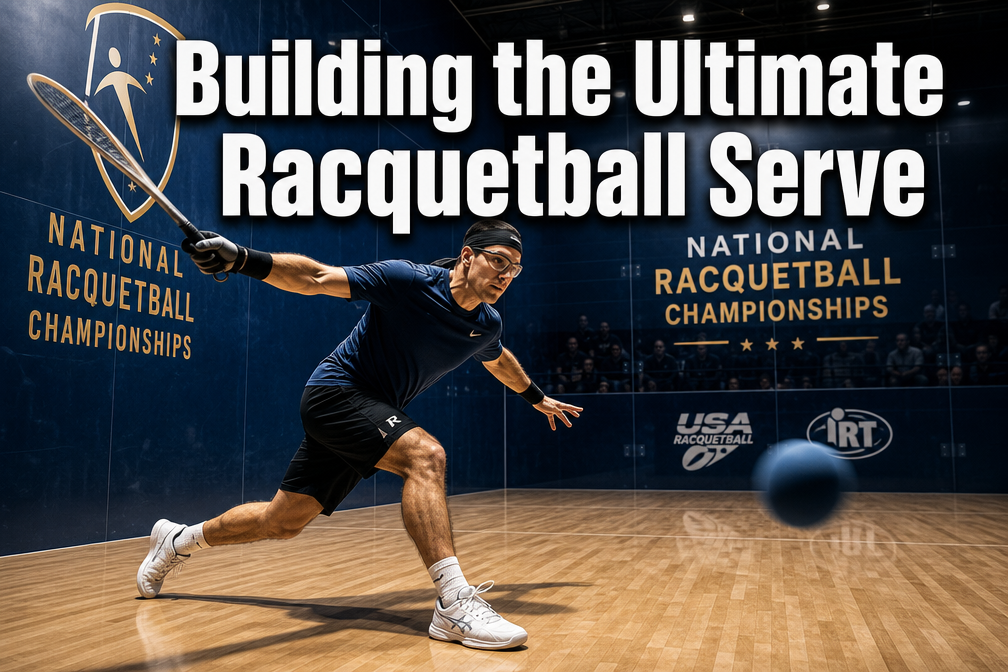
- Snap: Release the wrist through the contact point, striking the ball at roughly knee height for a drive serve.
- Follow-through: Finish across the body toward the opposite hip.
Contacting the ball below the waist (ideally 6-12 inches off the floor for a drive serve) keeps the trajectory low and reduces the opponent’s reaction time [8]. Striking higher gives the ball more arc, which is intentional for lob serves but a mistake on drives.
What’s the Difference Between a Hard Serve and a Soft Serve in Racquetball?
Hard serves (drive serves) travel fast and low, aimed at the back corners to limit the opponent’s setup time. Soft serves (lob serves, half-lob serves) use height and arc to push the opponent deep and disrupt rhythm. Both are essential, pros at the 2026 Pan American Racquetball Championships used serve variety as a primary tactical weapon [3].
| Serve Type | Speed | Target Zone | Best Used When |
|---|---|---|---|
| Drive Serve | High | Back corners, low | Opponent is slow to back wall |
| High Lob Serve | Low | Back wall, shoulder height | Opponent rushes or over-hits |
| Half-Lob Serve | Medium | Back corner, mid-height | Mixing pace to disrupt timing |
| Z-Serve | Medium-High | Side wall to back wall | Opponent struggles with angles |
Best Racquetball Serve Techniques Used by Pros
Building the ultimate racquetball serve, as demonstrated by 2026 National Champions and Pan Am contenders, means owning at least three distinct serve shapes and knowing when to deploy each one. Jake Bredenbeck (2026 Men’s Singles National Champion) and Michelle Andersen (2026 Women’s Singles National Champion) both demonstrated high-consistency drive serves targeted to the backhand corner as their primary weapon, with lob serves used to reset pace [4][7].
Key techniques seen at the 2026 national level:
- Backhand-corner drive: The most common pro serve. Ball hits the front wall 2-3 feet from the side wall, dies in the backhand corner.
- Body jam serve: Aimed directly at the opponent’s hip, limiting swing room. Effective against players with wide backswings.
- Z-serve to the forehand: Hits the front wall near the corner, deflects to the side wall, then travels across court, creates an awkward bounce angle.
- Ceiling lob: Hits the ceiling first, then the front wall, forcing a high, deep return. Legal and underused at intermediate levels.
💡 Pro tip from serve strategy research: The best servers vary position inside the service box, not just serve type. Serving from the left side of the box changes the angle to the right corner dramatically [2].
For a deeper look at how top athletes break down technique on video, the video analysis and pro tips resource at Rally Racket offers a useful framework for studying movement patterns across racquet sports.

How to Improve Serve Accuracy in Racquetball
Serve accuracy improves fastest through target practice with deliberate feedback, not just repetition. Pick a specific 2×2 foot zone in the back corner and track how many serves land there out of 20 attempts. Adjust, then repeat.
Accuracy drill progression:
- Shadow serving (no ball): Rehearse the motion, focusing on contact point consistency.
- Target towels: Place a small towel in the target corner. Aim for it on every serve.
- Pressure sets: Serve 10 in a row; count only the ones that hit the target. Stop when you hit 8/10 consistently before moving to the next serve type.
- Match simulation: Have a partner return serves randomly so you practice serving under movement pressure.
Coaches working with intermediate players often note that inconsistency traces back to an inconsistent ball drop, the toss height and position change slightly each time, which shifts the contact point [8]. Standardize the drop before fixing anything else.
What Are Common Mistakes When Serving in Racquetball?
The most common serving mistakes are telegraphing the serve direction, contacting the ball too high, and serving from the same spot every time. Each of these gives the opponent a significant read advantage.
Mistakes to fix immediately:
- Looking at the target before serving: Train your eyes to stay neutral until the swing starts.
- High contact point: Drives served above the waist arc upward and sit up for easy returns.
- No serve variation: Serving the same drive serve every rally is predictable after 3-4 points.
- Foot fault: Both feet must remain inside the service box until the ball crosses the short line, a common fault under pressure.
- Rushing the motion: A hurried serve loses the kinetic chain. Slow the setup down, even if it feels uncomfortable at first.
For help identifying mechanical flaws in your motion, resources like expert tips on correcting common mistakes in practice translate well across racquet sports.
How Fast Should My Racquetball Serve Be?
There’s no single target speed that defines a good serve. At the recreational level, a consistent drive serve in the 90-110 mph range is effective. At the national level, top men’s players can reach 140+ mph, but elite women’s players like Michelle Andersen prioritize placement and spin over raw speed [7][8].
Choose speed based on your level:
- Beginner: Focus on getting the ball to the back wall legally before worrying about speed.
- Intermediate: Aim for enough pace that the opponent can’t set up comfortably, usually 85-100 mph.
- Advanced/competitive: Use speed as one variable among several; a 95 mph serve to the exact right spot beats a 130 mph serve to the middle.
What’s the Legal Service Box in Racquetball?
The legal service box is the area between the service line (front boundary) and the short line (rear boundary), spanning the full width of the court. Both feet must remain inside this zone from the start of the serve motion until the ball passes the short line.
Key rules to know:
- The ball must hit the front wall first and travel past the short line before bouncing.
- A serve that hits the back wall before bouncing is a long serve (fault).
- A serve that doesn’t reach the short line is a short serve (fault).
- Two consecutive faults result in a side-out (loss of serve).
- The server’s partner must stand in the service box against the side wall during the serve.
Can I Use Different Serves for Different Court Positions?
Yes, and top players do this deliberately. Serving from the left side of the service box opens up a sharper angle to the right (forehand) corner and makes the Z-serve more effective. Serving from the right side creates a better angle to the left (backhand) corner, which is typically the weaker side for right-handed opponents [2].
Position-to-serve pairings:
- Left side of box → Drive serve to right corner or Z-serve
- Center of box → Body jam serve or high lob
- Right side of box → Drive serve to left (backhand) corner
Varying position also prevents opponents from reading your serve before you swing.
What’s the Best Racquetball Serve for Beginners?
The high lob serve is the best starting point for beginners. It’s forgiving on mechanics, rarely faults, and forces the opponent deep into the back court, giving the server time to set up. It also teaches the importance of height and placement rather than power.
Beginner serve progression:
- Master the high lob serve (front wall target: 3-4 feet below the ceiling, aimed toward the backhand corner).
- Add a half-lob serve for pace variation.
- Introduce the basic drive serve once the motion feels natural.
Avoid jumping straight to drive serves, the mechanics are more demanding, and faults are frustrating early on.
How Do I Add Spin to My Racquetball Serve?
Spin is added by brushing the racquet face across the ball at contact rather than hitting straight through it. A Z-serve uses topspin and side-spin to create an unpredictable bounce off the side wall. A jam serve can use slight slice to hug the side wall.
How to practice spin:
- Start slow: brush the outside of the ball with a relaxed wrist snap to feel the difference in ball behavior.
- Watch the ball’s second bounce, spin serves die differently than flat serves.
- The Z-serve target: front wall 1-2 feet from the side wall corner, struck with an inside-out swing path.
Spin serves are most effective when the opponent has already seen several flat drive serves, the change in bounce angle creates hesitation.
What Equipment Affects My Racquetball Serve Quality?
Racquet weight, balance, and string tension all affect serve quality. A lighter, head-heavy racquet generates more swing speed for power serves. A heavier, even-balanced racquet offers more control for placement-focused serves.
Equipment factors:
- String tension: Lower tension (28-30 lbs) adds a trampoline effect for power. Higher tension (32-34 lbs) improves control and feel.
- Grip size: Too large a grip reduces wrist snap; too small increases fatigue and instability.
- Ball type: USA Racquetball-approved balls (Penn HD, E-Core) behave differently in temperature, cold balls are slower and less bouncy, affecting lob serve depth.
Keeping your equipment in good condition matters too. For guidance on maintaining racquet sports gear, gear maintenance tips for optimal performance is a solid reference.
How Often Should I Practice My Racquetball Serve?
Two to three dedicated serve sessions per week, each lasting 15-20 minutes, is enough to build meaningful consistency within 4-6 weeks. Serve practice is most effective when separated from full match play, fatigue changes mechanics and reinforces bad habits.
Sample weekly serve practice block:
- Day 1: Drive serve mechanics, 60 serves, tracking target accuracy.
- Day 3: Lob and Z-serve variety, 40 serves, focusing on placement.
- Day 5: Pressure simulation, serve sets of 10 with a partner returning, competing for points.
Consistent short sessions outperform occasional long ones. Advanced practice routines for complex shots offer additional structure for players ready to push beyond basics.
How Do I Fix a Weak or Inconsistent Racquetball Serve?
A weak or inconsistent serve almost always traces back to one of three root causes: an inconsistent ball drop, a loss of hip rotation, or contact happening at the wrong height. Fix these in order before addressing anything else.
Troubleshooting checklist:
- ☐ Is the ball drop landing in the same spot every time? (Mark the floor with tape to check.)
- ☐ Are the hips fully rotating toward the front wall before the arm swings?
- ☐ Is contact happening below the waist for drive serves?
- ☐ Is the follow-through completing across the body, or stopping early?
- ☐ Is grip pressure consistent, or tightening under pressure?
Video yourself from behind and from the side. Most players are surprised by how much their motion changes when they’re tired or nervous, which is exactly when serve consistency matters most [8].
For players who want structured drills to lock in consistency, essential drills for developing consistency covers the kind of repetition-based training that applies across racquet sports.
Conclusion
Building the ultimate racquetball serve, the kind used by 2026 National Champions and Pan Am contenders like Bredenbeck, Andersen, and the Manillas, isn’t about hitting the ball harder than everyone else. It’s about building a repeatable motion, owning multiple serve shapes, and deploying them with tactical intention [3][4][7].
Your actionable next steps:
- This week: Film your current serve from behind and from the side. Identify the single biggest mechanical flaw.
- Next two weeks: Drill the high lob serve and basic drive serve with target towels, 20 serves per session.
- Month two: Add a Z-serve and vary your position inside the service box.
- Ongoing: Track serve accuracy in practice, aim for 8/10 target hits before adding new serve types.
The serve is the only shot in racquetball where you control every variable. Use that advantage.
FAQ
Q: Can I serve with a backhand motion in racquetball? A: Yes, backhand serves are legal. Some players use a backhand drive serve to create a different angle, though forehand serves are more common at competitive levels because they generate more power for most players.
Q: What is a screen serve in racquetball? A: A screen serve passes too close to the server’s body, blocking the receiver’s view of the ball. It’s called a fault by the referee. You get one screen serve warning before it counts as a fault.
Q: How do I practice serves alone? A: Solo serve practice is highly effective, just serve, let the ball return, and serve again. Use target towels or tape marks on the back wall to track accuracy without needing a partner.
Q: Is the Z-serve legal in all racquetball formats? A: Yes, the Z-serve is legal in standard USA Racquetball rules as long as it hits the front wall first and travels past the short line before bouncing.
Q: What’s a fault serve vs. an out serve? A: A fault serve (like a short serve or screen serve) gives you a second attempt. An out serve (like hitting a side wall before the front wall) immediately ends your serve, no second chance.
Q: How do I serve to a left-handed opponent? A: Reverse your corner targeting. A right-handed player’s backhand corner is on the left side of the court; a left-handed player’s backhand corner is on the right. Adjust your service box position accordingly.
Q: Should I always aim for the backhand corner? A: It’s the highest-percentage target for most opponents, but predictability is dangerous. Mix in body jam serves and forehand-corner drives to keep the receiver guessing.
Q: How does altitude or court temperature affect my serve? A: At higher altitudes, balls travel faster and bounce more, lob serves may go long. In cold courts, balls are less lively, drive serves may not reach the back wall as expected. Warm up a few balls before match play.
References
[2] Serve Strategy – https://cemood.people.wm.edu/racquetball/serve_strategy.htm [3] Daily Blog From The 2026 Pan American Racquetball Championships – https://www.usaracquetball.com/news/2026/march/27/daily-blog-from-the-2026-pan-american-racquetball-championships [4] Results – https://www.usaracquetballevents.com/results.asp [7] Usa Racquetball 2026 National Indoor Championships Broadcasts And Reporting – https://dailyracquetball.com/usa-racquetball-2026-national-indoor-championships-broadcasts-and-reporting/ [8] Mastering The Racquetball Serve Strategies For Accuracy And Power – https://jeffbudzik.wordpress.com/2025/01/08/mastering-the-racquetball-serve-strategies-for-accuracy-and-power/