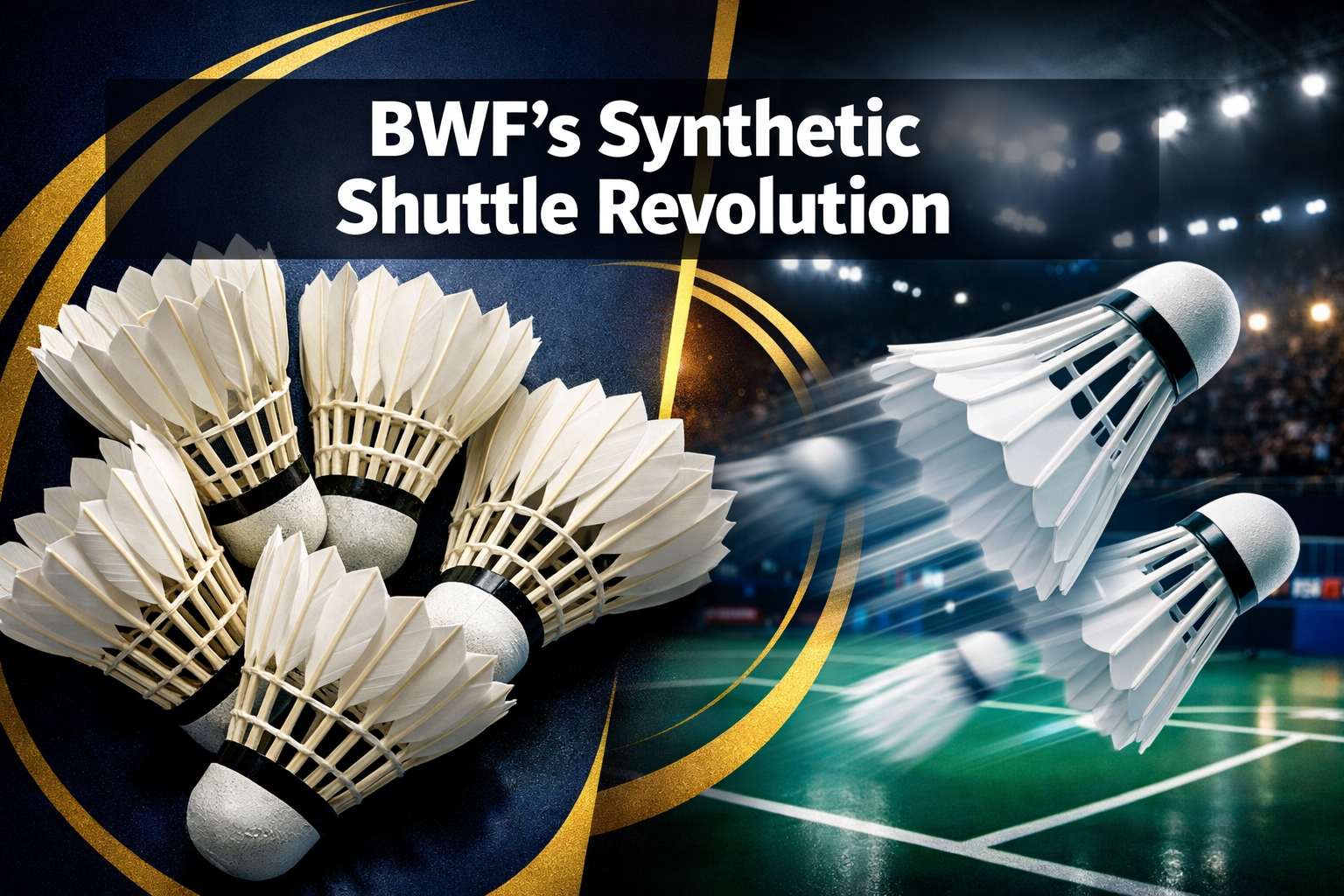
BWF’s Synthetic Shuttle Revolution: How Feather Shortages Are Transforming Professional Badminton Equipment
Last updated: April 21, 2026
Quick Answer
On April 8, 2026, the Badminton World Federation officially approved synthetic shuttlecocks for use at BWF Grade 3 and Junior International tournaments, marking the sport’s most significant equipment shift in decades. [2] The move directly responds to a deepening global feather supply crisis driven by avian flu outbreaks, rising demand, and export restrictions. Two products — the VICTOR New Carbon Sonic Max and the YONEX CROSSWIND 70 — are now cleared for competition use. [1]
Key Takeaways
- ✅ BWF officially approved synthetic shuttles for Grade 3 and Junior International tournaments starting April 2026 [2]
- 🪶 China’s avian flu outbreaks and export restrictions have severely disrupted the global feather shuttle supply chain [1]
- 🏸 Two synthetic shuttles are approved for trial: the VICTOR New Carbon Sonic Max (SC-NCS-MAX-12) and YONEX CROSSWIND 70 [1]
- 📈 Global badminton growth has pushed feather shuttle demand to an all-time high, widening the supply-demand gap [1]
- 🎯 Player feedback suggests synthetic shuttles perform comparably to feather shuttles in rallies, clears, blocks, and attacks — with some acknowledged differences [1]
- 🌍 Implementation is decentralized; national federations like India’s BAI are still determining local rollout plans [1]
- 🔭 BWF’s long-term goal is to evaluate synthetic options for elite-level competition beyond junior and Grade 3 events [1]
- ⚖️ The shift raises questions about fairness, player adaptation, and the future of traditional feather manufacturing
Why Is There a Feather Shuttle Shortage in the First Place?
The global supply of feather shuttlecocks has been under serious pressure for several years. China — the world’s largest manufacturer of badminton shuttles — has faced repeated avian flu outbreaks that have disrupted goose feather harvesting. Add rising export restrictions and a surge in badminton’s global popularity, and the supply-demand gap has become impossible to ignore. [1]
The core problem in plain terms:
- Feather shuttles require high-quality goose or duck feathers, primarily sourced from China
- Avian flu outbreaks reduce flock sizes and trigger supply halts
- Badminton’s global expansion means more players, more tournaments, and more shuttles needed
- Export restrictions limit how much raw material leaves China
The result is that clubs, national federations, and tournament organizers have faced inconsistent supply, price spikes, and quality variation. For a sport where shuttle behavior directly affects play, that’s a real problem — not just a logistical one.
Common mistake: Assuming this is a short-term disruption. Supply chain experts and the BWF itself treat this as a structural, long-term challenge requiring a permanent solution. [1]
What Exactly Did BWF Announce on April 8, 2026?
The BWF approved the use of synthetic shuttlecocks at two specific competition tiers: BWF Grade 3 tournaments and BWF Junior International events. [2][3] This is a formal, sanctioned trial — not an informal experiment.

Two products cleared for use:
| Product | Manufacturer | Model Code |
|---|---|---|
| New Carbon Sonic Max Synthetic Shuttlecock | VICTOR | SC-NCS-MAX-12 |
| CROSSWIND 70 Synthetic Shuttlecock | YONEX | CROSSWIND 70 |
Both products met BWF’s technical specifications before receiving approval. [1] The decision represents a carefully staged approach — starting at junior and lower-tier international events before any consideration of top-level competition.
Choose Grade 3/Junior events as the testing ground because: they offer real competitive conditions with lower stakes than elite events, giving the BWF and players time to gather meaningful performance data without disrupting the sport’s highest-profile tournaments.
How Do Synthetic Shuttles Actually Perform Compared to Feather?
This is the question every badminton player wants answered. According to player performance feedback gathered during the evaluation process, synthetic shuttles perform comparably to feather shuttles across key shot types: rallies, blocks, attacks, defensive plays, and clears. [1]
What players have noted:
- Flight consistency is strong — synthetic shuttles hold their trajectory well
- Speed and spin behave similarly to feather in most shot situations
- Some dynamics changes are acknowledged, particularly in subtle feel and shuttle response at contact
- Durability is a known advantage of synthetic over feather — synthetic shuttles last significantly longer per match
That said, professional players who have trained their entire careers with feather shuttles will notice differences. The feel at the strings, the way the shuttle opens and closes during play, and the sound on contact are all slightly different. These aren’t performance failures — they’re adaptation challenges.
For players looking to improve racket sports skills across disciplines, this kind of equipment evolution is actually familiar territory. Racket sports gear has always evolved, and players adapt.
Who Does This Change Affect Right Now?
Right now, BWF’s synthetic shuttle revolution directly affects:
- Junior international players competing at BWF-sanctioned junior events
- Players and organizers at Grade 3 tournaments globally
- National federations deciding how to implement the new rules locally
- Shuttle manufacturers beyond VICTOR and YONEX who may seek approval
Who it doesn’t affect yet: Players at BWF Superseries, World Championships, or Thomas and Uber Cup events. Those remain feather-only for now.
The decentralization issue: National federations operate independently. For example, the Badminton Association of India (BAI) had not yet issued guidance for state-level events like Karnataka tournaments as of the April 2026 announcement. [1] This means rollout will be uneven across countries in the short term.
For anyone curious about how equipment decisions ripple through a sport’s community, it’s worth reading about racket sports gear reviews to understand how gear changes shape player experience at every level.
What Are the Arguments For and Against Synthetic Shuttles at Pro Level?
This debate is real, and both sides have valid points. Here’s a clear breakdown:
Arguments for synthetic shuttles:
- Solves a genuine supply chain crisis that threatens tournament reliability
- More consistent quality across batches — feather shuttles can vary noticeably
- Lower long-term cost for clubs and federations
- More environmentally sustainable (no animal feathers required)
- Enables badminton growth in regions where feather shuttles are hard to source
Arguments against (or for caution):
- Elite players have trained with feather shuttles for their entire careers
- Subtle performance differences could affect match outcomes at the highest level
- Fairness concerns if some tournaments use feather and others use synthetic
- Shuttle manufacturers with feather supply chains face business disruption
- The “feel” of feather is part of badminton’s identity for many purists
“The supply-demand gap isn’t going away. The BWF’s long-term strategy is clearly to evaluate synthetic options for elite competition — this is a starting point, not an endpoint.” [1]
What Does This Mean for the Future of Badminton Equipment?
BWF’s synthetic shuttle revolution is explicitly framed as a long-term strategic evaluation, not just a stopgap. [1] The Grade 3 and Junior International trials are designed to generate real competition data that informs future decisions about higher-tier events.
What to watch for in the coming months and years:
- Expansion of approved synthetic shuttle products beyond VICTOR and YONEX
- Potential approval for Grade 1 and Grade 2 tournaments
- National federations releasing their own implementation guidelines
- Player associations weighing in on elite-level adoption
- New synthetic shuttle technology from other manufacturers seeking BWF certification
The broader trend in racket sports equipment reviews shows that equipment innovation consistently follows supply, cost, and performance pressures. Badminton is simply reaching that inflection point now.
For players who want to stay ahead of gear changes across multiple sports, checking out resources on renting vs. buying equipment can help frame how to approach new gear decisions smartly — the same logic applies whether you’re picking up a new paddle or adapting to a new shuttle type.
How Should Players and Coaches Prepare for Synthetic Shuttle Play?
If you compete at junior or Grade 3 level, or coach players who do, preparation now is smarter than scrambling later. Here’s a practical approach:
Steps to adapt:
- Get hands-on time with approved synthetic shuttles (VICTOR SC-NCS-MAX-12 or YONEX CROSSWIND 70) before competition
- Focus on feel at contact — adjust your grip pressure and swing tempo if the shuttle response feels different
- Test your smash and clear distances — flight arcs may differ slightly from your usual feather shuttle
- Talk to your coach about any tactical adjustments needed for synthetic shuttle dynamics
- Don’t over-adapt — the performance differences are modest, and overthinking them creates more problems than the shuttle does
Good court positioning strategies and solid footwork fundamentals matter more than shuttle type in most match situations. Focus on what you can control.
Conclusion: What Badminton Players Should Do Right Now
BWF’s synthetic shuttle revolution addresses a real, structural problem in the sport’s supply chain — and the April 2026 approval is just the beginning of a longer transition. Whether you’re a junior player, a club organizer, or a coach, staying informed and getting practical experience with approved synthetic shuttles now puts you ahead of the curve.
Your action steps:
- ✅ If you compete at Grade 3 or Junior International level, source VICTOR or YONEX approved synthetic shuttles and practice with them
- ✅ If you run a club or organize tournaments, review the BWF’s official guidance and check your national federation’s implementation timeline [2][3]
- ✅ If you’re a recreational player, watch this space — synthetic shuttles at club level may become the norm sooner than expected
- ✅ Follow BWF announcements for updates on elite-level adoption
The sport is changing. Players who adapt early — and keep improving their core skills — will be best positioned regardless of what’s flying across the net.
For more practical guides on gear, training, and racket sports strategy, explore the Rally Racket community and keep playing smarter. 🏸
FAQ
Q: When did BWF officially approve synthetic shuttlecocks? BWF announced approval on April 8, 2026, for use at Grade 3 and Junior International tournaments. [2]
Q: Which synthetic shuttles are approved by BWF? Two products: the VICTOR New Carbon Sonic Max Synthetic Shuttlecock (SC-NCS-MAX-12) and the YONEX CROSSWIND 70 Synthetic Shuttlecock. [1]
Q: Are synthetic shuttles allowed at the BWF World Championships? No. As of April 2026, synthetic shuttles are only approved for Grade 3 and Junior International events. Elite-level tournaments still use feather shuttles. [2]
Q: Why is there a feather shuttle shortage? China’s avian flu outbreaks, rising export restrictions, and surging global demand have all combined to create a significant supply-demand gap in feather shuttle production. [1]
Q: Do synthetic shuttles perform the same as feather shuttles? Player feedback indicates comparable performance in rallies, clears, blocks, and attacks, though some subtle differences in feel and dynamics are acknowledged. [1]
Q: Will synthetic shuttles eventually replace feather at all levels? The BWF has not committed to full replacement. The current trials are explicitly designed to evaluate synthetic shuttles for potential broader use — it’s a staged, data-driven process. [1]
Q: How long do synthetic shuttles last compared to feather? Synthetic shuttles are generally more durable than feather shuttles, lasting longer per match — though exact lifespan varies by product and playing conditions.
Q: Are all national federations implementing synthetic shuttles at the same time? No. Implementation is decentralized. For example, India’s BAI had not issued state-level guidance as of April 2026. [1]
Q: Can club players use the approved synthetic shuttles for practice? Yes. The VICTOR and YONEX approved products are available for general use, not just tournament play.
Q: Where can I find the official BWF announcement? The official announcement is available on the BWF website. [2][3]
References
[1] Badminton World Federation’s Synthetic Shuttle Trials Ruffle Feathers – https://www.deccanherald.com/sports/badminton/badminton-world-federations-synthetic-shuttle-trials-ruffle-feathers-3964863
[2] BWF Approves Use of Synthetic Shuttlecocks at Selected Tournaments – https://bwfbadminton.com/news-single/2026/04/08/bwf-approves-use-of-synthetic-shuttlecocks-at-selected-tournaments
[3] Use of Synthetic Shuttlecocks at Selected BWF Tournaments – https://corporate.bwfbadminton.com/news-single/2026/04/08/use-of-synthetic-shuttlecocks-at-selected-bwf-tournaments-tournament-postponement