How An Se-young’s comeback world title is redefining modern women’s singles badminton
Last updated: September 15, 2026
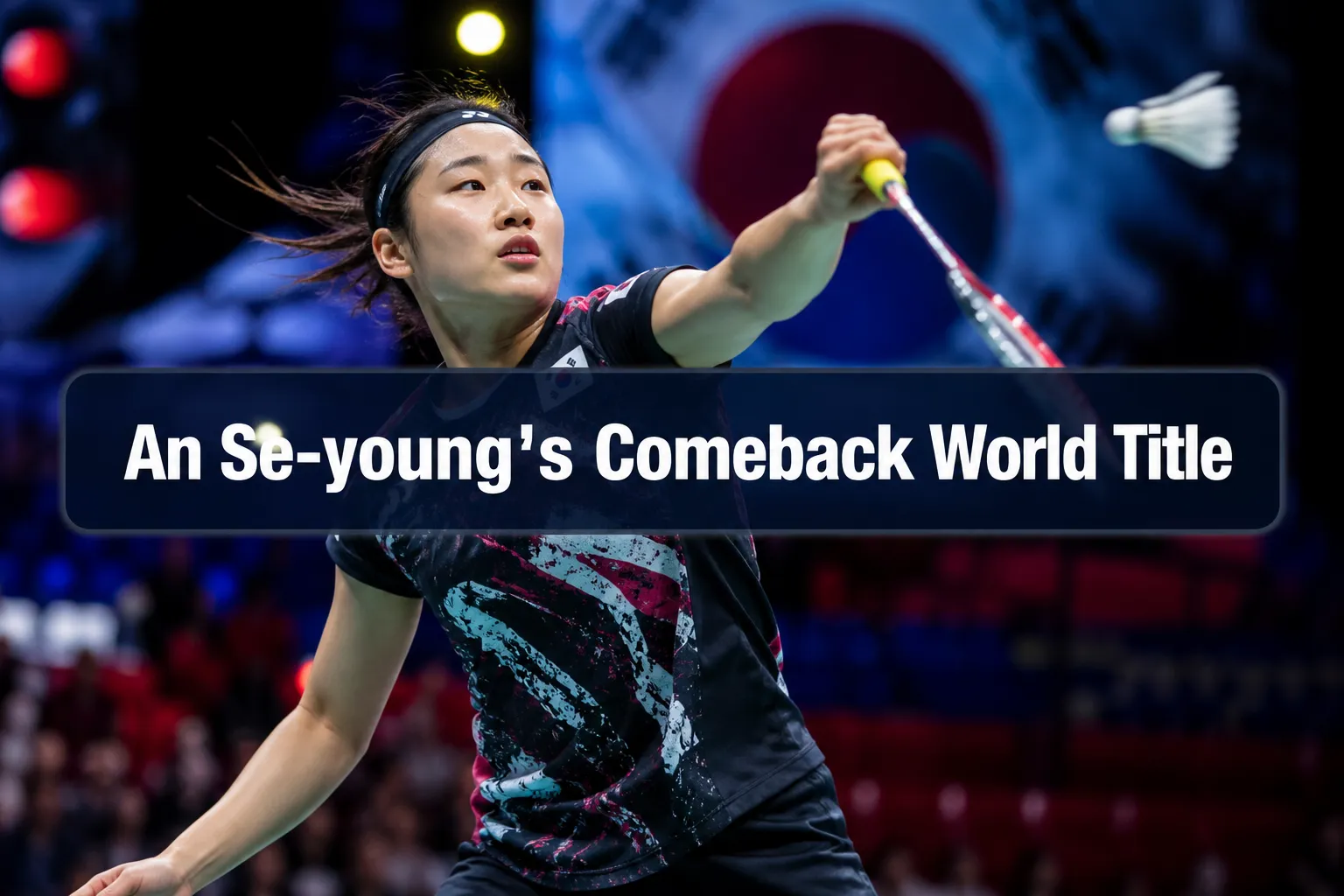
Quick Answer: An Se-young won her second BWF World Championships title on August 23, 2026, in New Delhi, just weeks after withdrawing from the Japan Open with a left foot injury. Her flawless six-match run, not dropping a single game, confirmed her status as the dominant force in women’s singles and set a new standard for what elite-level consistency looks like in modern badminton.
Key Takeaways
- 🏸 An Se-young defeated Akane Yamaguchi 21-17, 21-14 in the 2026 World Championships final, winning in under 50 minutes [2]
- 🦶 She withdrew from the Japan Open in July 2026 with left foot pain, then returned to competition at Worlds just weeks later [10]
- 🏆 She is the first Korean women’s singles player ever to win the World Championships gold, now holding two titles (2023 and 2026) [3]
- 📊 In 2025, she reportedly won 11 titles with a 94.8% winning percentage and became the first badminton player to surpass US$1 million in prize earnings in a single season [14][15]
- 🎯 Her path to the 2026 title was perfect, six matches, six wins, zero games dropped [1][9]
- 💡 Analysts describe her style as “playing like AI”, near-error-free shot selection, elite rally management, and seamless defense-to-offense transitions [4]
- 🌏 The field she beat included top-five players Han Yue, Wang Zhiyi, and world No. 2 Yamaguchi [2][8]
- 📈 Her comeback has sparked fresh discussion about sports science, load management, and injury recovery in elite badminton [6][12]
- 👑 Korean media call her the “Shuttlecock Queen” and the face of Korean badminton [6][7]
Who Is An Se-young and Why Does She Matter in Badminton?
An Se-young is the world No. 1 women’s singles badminton player from South Korea, widely regarded as the best in her generation. Born in 2002, she became the first Korean woman to win the BWF World Championships gold in 2023, and she repeated that feat in 2026, cementing her place at the top of global badminton [3][6].
Her importance goes beyond titles. She plays a style that coaches and analysts actively study, and her dominance has forced rivals to rethink their approach to training and tactics. In a sport historically led by Chinese and Japanese players, An’s rise represents a genuine shift in the competitive landscape.
She’s also a major figure for the racket sports community worldwide. Her story, from junior prodigy to two-time world champion, resonates with players at every level who want to understand what elite performance actually looks like.
What Injury Did An Se-young Have Before Her 2026 Comeback?
An Se-young withdrew from the Japan Open in July 2026 due to pain in her left foot, taking nearly a month away from competition [10][12]. The withdrawal raised real questions about her readiness for the World Championships in New Delhi, which followed shortly after.
Foot injuries are particularly serious for badminton players because the sport demands explosive lateral movement, sudden stops, and constant jumping. Missing even a few weeks can disrupt rhythm, footwork timing, and match sharpness.
What made her comeback remarkable was the speed and completeness of her return. She didn’t ease back in, she arrived in Delhi and immediately played at the highest level, winning every match in straight games [13].
Common mistake to avoid: Rushing back from a foot injury without proper load management. An’s case shows that a structured recovery, even if it means missing one tournament, can set up a stronger return.
When Did An Se-young Win Her World Title Comeback?
An Se-young won the 2026 BWF World Championships women’s singles title on August 23, 2026, in New Delhi, India [7]. She defeated Akane Yamaguchi 21-17, 21-14 in a final that lasted just 49 minutes [2][4].
Her path through the tournament was clean from start to finish:
| Round | Opponent | Score |
|---|---|---|
| Round of 64 | Kaloyana Nalbantova | 21-14, 21-13 |
| Round of 16 | Mia Blichfeldt | 21-16, 21-10 |
| Quarterfinal | Han Yue / Han Weilei | Straight games |
| Semifinal | Wang Zhiyi | Straight games |
| Final | Akane Yamaguchi | 21-17, 21-14 |
Six matches. Six wins. Zero games dropped [1][5][9].

How Does An Se-young’s Playing Style Differ From Other Top Women’s Badminton Players?
An Se-young’s style is built on extreme consistency, physical endurance, and tactical intelligence, not raw power or a single signature shot. Analysts have described her approach as “playing like AI,” meaning she makes very few unforced errors, reads opponents’ patterns quickly, and converts defensive positions into attacking ones [4][14].
Here’s how that compares to the broader field:
- Akane Yamaguchi relies on relentless speed and court coverage, using her athleticism to extend rallies and create opportunities through volume
- Tai Tzu-ying (see more below) built her dominance on deceptive wrist play and creative shot-making
- An Se-young combines physical fitness with tactical precision, she doesn’t just outlast opponents, she outthinks them
This approach is particularly effective in long tournaments where mental fatigue compounds physical tiredness. By keeping error rates low and pressure consistent, she forces opponents into mistakes rather than creating winners herself.
For recreational players looking to improve racket sports skills, this is a key lesson: consistency beats brilliance in most match situations.
How Does An Se-young Compare to Tai Tzu-ying in Badminton?
An Se-young and Tai Tzu-ying represent two different eras and philosophies in women’s singles badminton. Tai Tzu-ying, the Taiwanese legend, dominated the sport through the late 2010s and early 2020s with an unmatched ability to deceive opponents using wrist flicks, disguised drops, and creative court craft.
An Se-young’s game is less about deception and more about suffocation, she applies constant pressure, moves efficiently, and rarely gives opponents anything easy to attack.
Choose Tai Tzu-ying’s approach if you’re a player with exceptional touch and want to win through creativity and variety. Choose An Se-young’s model if you want to build a game that holds up under pressure across long tournaments.
In terms of results, An’s 2025 season (11 titles, 94.8% win rate) and back-to-back 2026 titles at the Malaysia Open and India Open suggest she’s now operating at a level that surpasses Tai Tzu-ying’s peak consistency [14][15].
How Has An Se-young Changed Women’s Singles Badminton Strategy?
How An Se-young’s comeback world title is redefining modern women’s singles badminton comes down to one core shift: the best player in the world no longer wins through flair, she wins through near-perfect execution.
Her dominance has pushed coaches and players to rethink several strategic priorities:
- Rally management over shot-making, Building points patiently instead of going for early winners
- Physical conditioning as a weapon, Outlasting opponents in long rallies through superior fitness
- Defensive resilience, Turning difficult defensive positions into counter-attacks, not just survival
- Mental consistency, Maintaining focus across six matches in a tournament without momentum swings
The fact that she closed out the 2026 World Championship final in under 50 minutes, against the world No. 2, shows how complete this approach can be [2][7].
For players working on their own singles vs. doubles strategies, An’s game is a masterclass in how singles badminton rewards patience and positional control over aggressive risk-taking.
What Makes An Se-young’s Comeback Significant for Women’s Sports?
An Se-young’s comeback is significant because she didn’t just return from injury, she returned and immediately won the biggest title in her sport, without dropping a single game across six matches [1][9][13].
That’s a new benchmark for what’s possible in elite sports recovery. It challenges the assumption that injury breaks inevitably cost a player their edge, and it reinforces the role of sports science and structured rehabilitation in modern competition [6][12].
For women’s sports specifically, her story carries extra weight:
- She’s the first Korean woman to win the World Championships gold, twice [3][6]
- Her 2025 prize money record (reportedly the first badminton player to pass US$1 million in a single season) raised the visibility of women’s singles earnings [14]
- Korean media’s framing of her as the “Shuttlecock Queen” and the face of Korean badminton signals a shift in how women’s racket sports are marketed and celebrated [6][7]
Stories like An’s are exactly the kind of inspiration the racket sports community thrives on. If you’ve found motivation in comeback stories from other sports, you’ll recognize the same spirit in transformative journeys of players across different backgrounds.
What Training Methods Did An Se-young Use for Her Comeback?
Specific details of An Se-young’s rehabilitation program haven’t been publicly disclosed, but coverage of her recovery points to a disciplined, sports-science-driven approach [6][12][13].
Based on what’s been reported, the key elements appear to include:
- Prioritizing recovery over competition, She skipped the Japan Open entirely rather than risk aggravating the foot injury [10]
- Maintaining match sharpness in training, Her performance in Delhi showed no sign of ring rust, suggesting intensive practice sessions during the recovery period
- Load management, Balancing rest with enough physical work to stay competition-ready
- Mental preparation, Returning to a major tournament as the first event back requires significant psychological readiness
The broader lesson for club and recreational players: proper warm-up and injury prevention matter at every level. Check out these essential warm-up routines for racket sports players to build habits that reduce your own injury risk.
Did An Se-young Win Any Titles Before Her Injury?
Yes, An Se-young had an extraordinary run of results before her 2026 foot injury. In 2025, she reportedly won 11 titles with a 94.8% winning percentage, becoming the first badminton player to surpass US$1 million in prize money in a single season [14][15].
She also opened 2026 strongly, winning back-to-back titles at the Malaysia Open and India Open before the foot issue emerged [14].
Her earlier career highlights include:
- 2023 BWF World Championships, Gold (first Korean woman to win) [3]
- 2022 BWF World Championships, Bronze [3]
- 2025 BWF World Championships, Bronze [3]
- Multiple Superseries/Super 1000 titles across 2024 and 2025
The injury interruption in mid-2026 was a brief pause in what has been a sustained period of dominance, not a sign of decline.
What Other Players Are Competing With An Se-young in Women’s Singles?
The top of women’s singles badminton is increasingly concentrated among Asian players, with An Se-young leading a competitive group [2][4][8].
Key rivals as of 2026:
- Akane Yamaguchi (Japan), World No. 2, defeated in the 2026 final. Known for relentless speed and court coverage [2][4]
- Wang Zhiyi (China), Top-five player, beaten by An in the 2026 semifinals [8][9]
- Han Yue / Han Weilei (China), Quarterfinal opponents at the 2026 Worlds, also beaten in straight games [1][5]
- Carolina Marín (Spain), Multiple-time world champion and Olympic gold medalist, though recovering from her own injury history
- Pusarla V. Sindhu (India), Former world champion and consistent top-ten presence
An’s ability to beat Yamaguchi, Wang Zhiyi, and Han Yue in the same tournament, all in straight games, illustrates just how wide the gap has grown between her and the rest of the field [2][9].
How Old Is An Se-young and How Long Was She Out?
An Se-young was 24 years old at the time of her 2026 World Championships victory [4][6]. She withdrew from the Japan Open in July 2026 and returned to competition at the World Championships in New Delhi in August 2026, a break of approximately three to four weeks [10][12][13].
At 24, she’s in the prime years of a badminton career. The sport’s top players typically peak between ages 22 and 28, meaning An has several years of elite competition ahead of her.
Her age also adds context to the “generational shift” narrative: at 24, she consistently beats 29-year-old Yamaguchi, repositioning the competitive hierarchy at the top of women’s singles [2][4][6].
What Challenges Do Female Badminton Players Face That An Se-young Overcame?
Female badminton players at the elite level face a specific set of pressures that An Se-young has navigated better than almost anyone [6][12][13].
Physical challenges:
- Injury management across a dense international tournament calendar
- Maintaining peak fitness while competing almost every month
- Recovering from setbacks (like foot injuries) without losing competitive edge
Competitive pressures:
- Facing opponents who study your game extensively between tournaments
- Managing expectations as the world No. 1, every opponent prepares specifically for you
- Performing in high-stakes finals after five demanding matches in a week
Structural challenges:
- Prize money in women’s badminton, while growing, has historically lagged behind men’s
- Media coverage and sponsorship opportunities have been uneven across different national markets
An’s 2026 comeback addresses all of these directly. Her prize money record, her injury recovery, and her consistency under pressure are all responses to challenges that define the women’s game [6][14][15].
If you’re working through your own mental barriers on court, this guide on staying focused and confident during matches covers strategies that apply across racket sports.
Is An Se-young Still Competing in Badminton in 2026?
Yes, An Se-young is actively competing as of 2026 and is currently ranked world No. 1 [2][4][6]. Her 2026 World Championships win was her most recent major title, and domestic coverage in Korea links her ongoing form directly to expectations for the next Asian Games [6][14][15].
There’s no indication of retirement or a planned extended break. Her quick recovery from the July 2026 foot injury and her dominant performance in New Delhi suggest she’s in strong physical condition and motivated to continue defending her position at the top of the women’s game.
Conclusion: What An Se-young’s Story Means for Racket Sports Players
How An Se-young’s comeback world title is redefining modern women’s singles badminton isn’t just a headline, it’s a practical lesson for anyone who plays racket sports at any level.
Her story offers three clear takeaways you can apply to your own game:
Consistency beats brilliance. An doesn’t win with flashy shots. She wins by making fewer mistakes than everyone else. Whatever racket sport you play, reducing unforced errors is the fastest way to improve your results.
Recovery is part of training. Skipping a tournament to protect a foot injury isn’t weakness, it’s smart load management. Build recovery into your own practice schedule the same way you build drills.
Mental resilience matters. Returning from injury to win a world title, without dropping a game, requires extraordinary focus. Working on the mental side of your game is just as important as the physical side.
Whether you’re picking up a racket for the first time or looking to sharpen your competitive edge, the principles that drive An Se-young’s success apply across every racket sport, from badminton to structuring your own practice sessions for maximum skill development.
The racket sports community has a new benchmark to aim for. The question is: what part of your game are you going to work on next?
FAQ
Q: How many world titles does An Se-young have? An Se-young has two BWF World Championships titles, won in 2023 and 2026, plus bronze medals in 2022 and 2025. She is the first Korean woman to win the World Championships gold. [3][6]
Q: Who did An Se-young beat in the 2026 World Championships final? She defeated Akane Yamaguchi of Japan, ranked world No. 2, by a score of 21-17, 21-14 in 49 minutes on August 23, 2026, in New Delhi. [2][4][7]
Q: Did An Se-young drop any games at the 2026 World Championships? No. She won all six matches in straight games, from the round of 64 through to the final, without losing a single game. [1][9]
Q: What injury did An Se-young have in 2026? She experienced pain in her left foot and withdrew from the Japan Open in July 2026. She returned to competition approximately three to four weeks later at the World Championships. [10][12]
Q: How does An Se-young’s style compare to Akane Yamaguchi’s? Yamaguchi relies on speed and relentless court coverage to create opportunities through volume. An Se-young focuses on tactical precision, low error rates, and converting defensive positions into counter-attacks. [4][14]
Q: Is An Se-young the best women’s singles badminton player in the world? As of 2026, she is ranked world No. 1 and holds the most recent World Championships title. Her 2025 season (11 titles, 94.8% win rate) and her 2026 comeback title support that claim. [2][6][14]
Q: What was An Se-young’s prize money record? In 2025, she reportedly became the first badminton player to surpass US$1 million in prize earnings in a single season. [14][15]
Q: How old is An Se-young? She was 24 years old at the time of her 2026 World Championships victory. [4][6]
Q: What is the “generational shift” in women’s badminton? It refers to 24-year-old An Se-young consistently defeating 29-year-old Akane Yamaguchi and repositioning the competitive hierarchy at the top of women’s singles, with Korean media framing it as a new era in the sport. [2][4][6]
Q: Can recreational players learn anything from An Se-young’s game? Yes. Her emphasis on consistency, error reduction, and rally patience translates directly to club and recreational play. Reducing unforced errors and building physical endurance are improvements any player can work on.
References
[1] Chosun English Sports – https://www.chosun.com/english/sports-en/2026/08/25/JTAJDKJIXZHMDHL7XOVA3SHJ7M/ [2] Korea Herald – https://www.koreaherald.com/article/10849252 [3] An Se-young Wikipedia – https://en.wikipedia.org/wiki/An_Se-young [4] Chosun English Sports – https://www.chosun.com/english/sports-en/2026/08/24/KBRD7KYSW5FFVMOAKM4DBXZEBQ/ [5] Chosun English Sports – https://www.chosun.com/english/sports-en/2026/08/18/3LMK74UGVRBQFPMW5XWUTP6FRE/ [6] Asia Economy English – https://www.asiae.co.kr/en/article/2026082322131019582 [7] Chosun English Sports – https://www.chosun.com/english/sports-en/2026/08/23/CQJT7JDELRA57BAXTST76YF5FM/ [8] Yonhap News Agency English – https://en.yna.co.kr/view/AEN20260821010300320 [9] Chosun English Sports – https://www.chosun.com/english/sports-en/2026/08/25/ELVDQRJKTJE3DKD55DCGBGDKHI/ [10] Chosun English Sports – https://www.chosun.com/english/sports-en/2026/08/25/JYW7DFWBQRFULDEBQLVQUCFGKE/