Mental Toughness in Racquetball: Mindfulness Drills from 2026 Pan Am and Indoor Champs Mentors
Last updated: November 13, 2026
Quick Answer: Mental toughness in racquetball is the ability to stay focused, regulate emotions, and perform consistently under pressure, especially in close matches or high-stakes tournaments. The mindfulness drills promoted by 2026 Pan Am and Indoor Champs mentors target breath control, attention resets, cue-word anchoring, and growth-mindset habits that any player can practice in 10-15 minutes per day.
Key Takeaways
- 🧠 Mental toughness in racquetball is a trainable cognitive-motor skill, not a personality trait
- 🎯 Top mentors from the 2026 Pan American Championships stress process over outcome: focus on controllables, not the scoreboard
- 💨 The “Exhaust Valve” exhale drill and “Focal Point Reset” are two of the simplest tools to stop spiraling after a lost point
- 📅 Consistent daily practice of 10-15 minutes of attentional-focus drills yields noticeable results within 3-6 weeks
- 🔄 Doubles play doubles as a “brain gym” for shared focus, emotional regulation, and in-match communication
- ⚠️ The most common mental mistake is giving mechanical self-instructions mid-rally, which splits attention
- 💡 Visualization and mindfulness work best together, they target different mental skills
- 🏆 The 2026 IOC consensus on athlete mental health confirms that mental toughness training must sit inside a supportive, safe environment, not glorify emotional suppression
- 📍 Players at every skill level benefit from mental training, but the drills look different for beginners vs. competitive athletes
What Exactly Is Mental Toughness in Racquetball and Why Does It Matter
Mental toughness in racquetball is not about grinding through pain or never feeling nervous. It is the ability to hold attention, regulate emotions, and make fast, clear decisions under competitive stress, rally after rally, game after game.
The International Racquetball Federation highlighted this in August 2026, describing racquetball doubles as a “brain gym” that forces athletes to hold attention, make split-second strategy shifts, and manage impulses with a partner [1][2]. Singles builds individual focus and reflexes; doubles layers in real-time communication and social decision-making [1][2]. Both formats demand cognitive-motor integration that goes far beyond raw grit.
Why it matters practically:
- Racquetball rallies happen fast, reaction time and decision quality degrade under mental fatigue
- A single emotional spiral (anger, doubt, frustration) can cost an entire game
- Athletes who manage attention well recover faster between points and adapt strategy mid-match
How Mindfulness Drills Actually Improve Your Racquetball Game
Mindfulness drills improve racquetball performance by training the brain to notice distractions, label them without judgment, and return to a chosen focus point, usually breath or the ball. This is not relaxation; it is active attention management.
A March 2026 attentional-focus guide for athletes outlines five practical drills that translate directly to racquetball: Grid Concentration (scanning numbers in sequence), Mindfulness Breath Count (restarting at one when attention wanders), chaos-environment practice, cue words, and Focal Point Resets [3]. The recommendation is 10-15 minutes of this work daily. These drills are closely related to the role of mindfulness in pickleball and staying present during play, which coaches across racquet sports are adapting for their own athletes.
“Mental toughness training is not about suppressing emotion, it’s about noticing thoughts and returning to the task.”, consistent theme across 2026 Pan Am mentor interviews [4][5]
What Specific Mindfulness Exercises Did the 2026 Pan Am Racquetball Champions Use
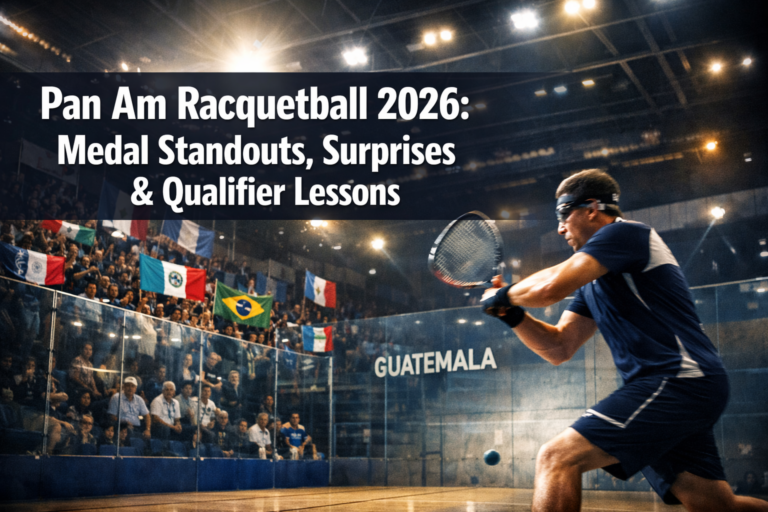
Mentors and players heading into the 2026 Pan American Championships in Guatemala City (March 28, April 4) described four recurring practices in IRF and USA Racquetball coverage [4][5][6].

1. The Focal Point Reset After a mistake, athletes briefly look at a fixed object, often a logo or mark on the front wall, take one controlled breath, and mentally “flush” the last rally [3]. This short ritual prevents rumination from carrying into the next point.
2. The Exhaust Valve Drill A deliberate, audible exhale before the next serve or return. The physical act of releasing breath signals the nervous system to downshift and re-anchor attention to the present moment.
3. Cue Word Anchoring Players choose a single word (examples: “here,” “smooth,” or “trust”) to repeat internally during the pre-serve routine. The word interrupts anxious self-talk and replaces it with a neutral focus anchor [3].
4. Structured Routine as Mental Prep USA Racquetball’s daily blog from the 2026 Pan Am Championships described how U.S. team mentors formalized pre-match logistics, arriving at the venue, securing equipment, then practicing, as a strict sequence that reduces decision fatigue and stabilizes attention before competition begins [6].
How to Stay Mentally Tough During Long or Close Racquetball Matches
The key to staying mentally tough in a close match is committing to process over outcome: focus only on the next point, not the final score. IRF-covered athletes at the 2026 Pan Am Championships consistently described “staying very focused” and trusting their preparation rather than chasing the result [4][5].
Practical tactics for long matches:
| Situation | Mental Tool | Why It Works |
|---|---|---|
| Lost three points in a row | Focal Point Reset | Stops the rumination spiral |
| Tight tiebreaker (12-12) | Exhaust Valve Exhale | Lowers arousal, sharpens attention |
| Opponent making odd shots | Cue Word Anchor | Keeps focus on ball, not opponent |
| Fatigue setting in | Breath Count Reset | Re-engages prefrontal decision-making |
The added psychological pressure of broadcast matches (the 2026 Pan Am event was aired widely across the Americas) made focusing on controllables even more critical, something mentors explicitly coached their athletes on [5].
For players who also compete in other racquet sports, the strategies around staying focused and confident during matches follow very similar principles and are worth reviewing alongside racquetball-specific work.
Is Mindfulness Better Than Visualization for Racquetball Performance
Mindfulness and visualization are not competing tools, they train different mental skills and work best together. Mindfulness trains present-moment attention and emotional regulation; visualization trains movement patterns, confidence, and strategic rehearsal.
Choose mindfulness drills if:
- You struggle with anxiety, choking under pressure, or ruminating after mistakes
- Your focus drifts mid-rally or between points
Choose visualization if:
- You want to rehearse a specific shot or tactical scenario before a match
- You’re preparing for a high-stakes environment you haven’t competed in before
Common mistake: Players who only visualize winning without also training present-moment focus often freeze when the actual match diverges from their mental script. Pairing both practices addresses this gap. Coaches working from the 2026 Indoor Champs framework tend to build visualization into warm-up routines and mindfulness into point-by-point match play.
Who Needs Mental Training for Racquetball and at What Skill Level
Every racquetball player benefits from some form of mental training, but the focus shifts with skill level. Beginners benefit most from simple breath-count drills and basic pre-point routines. Intermediate players can add cue words and Grid Concentration exercises. Competitive and elite players need the full toolkit: emotional regulation under broadcast pressure, shared focus in doubles, and growth-mindset coaching [1][2][7].
The 2026 IOC consensus statement on elite athlete mental health reinforces that mental toughness training must sit inside supportive environments, with leadership behaviour and organizational culture that protect well-being, not glorify emotional suppression [7]. Racquetball federations are aligning their high-performance programs with this framework.
This principle also applies at the recreational level. Players who build good mental habits early, much like those who build a strong technical foundation from the start, tend to progress faster and enjoy competition more.
Common Mental Mistakes Racquetball Players Make During Competition
The single most damaging mental mistake is giving yourself mechanical coaching instructions during a rally (“bend your knees, swing through, follow the ball”). This splits attention at the exact moment it needs to be unified on the ball.
Other frequent errors:
- Scoreboard fixation: Checking the score mid-game instead of focusing on the next point
- Opponent-watching: Spending attention on the opponent’s body language or errors instead of your own execution
- Emotion escalation: Letting one bad call or unlucky skip-ball build into frustration that disrupts the next three points
- Skipping pre-point routines under pressure: Athletes often abandon their reset rituals precisely when they need them most
The “Thought Ban Ritual”, where athletes agree to stop giving mechanical self-instructions and instead focus only on the ball, is a direct antidote to overthinking in tight matches.
How Long Does It Take to See Results from Mental Toughness Training in Racquetball
Most players notice meaningful changes in focus and emotional recovery after 3-6 weeks of consistent daily practice (10-15 minutes per day). This assumes the drills are practiced both off-court (standalone attention exercises) and on-court (applied during point play and practice matches) [3].
Deeper changes, like reliably staying calm in a 14-14 tiebreaker or quickly recovering from a referee error, typically develop over 2-3 months of match experience combined with deliberate mental training.
At the October 2026 IRF World Racquetball Championships, USA Racquetball team members described focusing on “improving with every match” and “being ready when it matters most”, a growth-mindset cue that mentors use to frame progress as incremental rather than sudden.
Can Mindfulness Help with Racquetball Anxiety and Choking Under Pressure
Yes. Mindfulness directly targets the cognitive patterns behind choking: excessive self-monitoring, fear of negative evaluation, and attention shifting inward at the wrong moment. A November 2026 Psychology Today article on “thought-watching” for athletes introduces a drill where competitors notice and label their thoughts, then return to a breathing anchor [8]. Applied to racquetball, this pairs naturally with grip-change checks or wall-target drills before a serve.
The Breath Count Reset is especially useful for pre-match nerves: count exhales from one to ten, restart whenever the mind wanders. Players who practice this regularly report shorter recovery times after anxious moments during matches [3]. The mental health benefits of racquet sport play are well-documented across paddle and racquet sports, and anxiety reduction is consistently among the top reported benefits.
How Often Should You Practice Mindfulness Drills to Improve Racquetball Focus
Daily practice of 10-15 minutes is the benchmark recommended by attentional-focus coaches working with competitive athletes [3]. This can be split: 5 minutes off-court (Breath Count, Grid Concentration, or thought-watching) and 5-10 minutes on-court (Focal Point Resets after each mistake during practice).
Weekly structure used by 2026 Pan Am-level mentors (estimated):
- Monday, Friday: 10 min morning breath-count or thought-labeling session
- Every practice session: Use Focal Point Reset and cue-word anchor during drills
- Pre-match: 3-breath Exhaust Valve sequence + structured arrival routine [6]
- Post-match: Brief review of mental patterns (not technical errors) in a training journal
Skipping mental training during heavy physical training weeks is a common error. Mentors emphasize treating mental reps with the same consistency as physical ones [4].
Best Mindfulness Drills to Do Right Before a Racquetball Match
Three pre-match drills stand out for immediate, practical use:
- 3-Breath Exhaust Valve, Three slow, audible exhales while standing in the warm-up area. Signals transition from “travel mode” to “compete mode.”
- Cue-Word Activation, Silently repeat your chosen anchor word five times while bouncing the ball or adjusting grip.
- Focal Point Walk, Walk onto the court and visually locate your chosen focal point (front wall mark, corner). This physically anchors your attention to the playing environment before the first serve.
These are brief enough to fit inside a standard warm-up and directly address the two biggest pre-match mental risks: scattered attention and rising anxiety. For players who want to combine physical and mental warm-up skills, mastering serve techniques and drills for consistent performance offers a solid complement to these mental exercises.
Where Can You Find the 2026 Pan Am Racquetball Mentors for Coaching
The International Racquetball Federation (IRF) is the most direct route, their news hub and category pages for Pan American Championships list coaches and national federation contacts [2][5]. USA Racquetball’s website publishes team staff information alongside tournament coverage [6]. Individual coaches from the 2026 Championships, including mentors associated with top-ranked players, often list contact details through national federation directories.
Contemporary racquetball training platforms as of late 2026 are packaging technical instruction with mental and tactical preparation together, rather than treating them as separate add-ons [9]. Searching IRF-affiliated national federations in your region is the most reliable starting point for connecting with coaches who use the 2026 championship framework.
Conclusion
Mental toughness in racquetball is a skill set, and the mindfulness drills from 2026 Pan Am and Indoor Champs mentors prove it can be trained systematically. The core framework is straightforward: build consistent pre-match routines, use Focal Point Resets after mistakes, practice the Exhaust Valve exhale in tight moments, and anchor attention with a personal cue word. Add 10-15 minutes of daily off-court attention training, and most players see real progress within weeks.
Actionable next steps:
- Pick ONE drill this week, the Exhaust Valve exhale is the easiest entry point
- Add a 5-minute Breath Count session each morning before training
- During your next practice match, apply the Focal Point Reset after every lost point
- Track your mental patterns (not just scores) in a brief post-match journal note
- Explore IRF and USA Racquetball resources to connect with certified coaches using the 2026 championship framework
For players who want to go deeper on the intersection of mindfulness and racquet sport performance, insights from top coaches on effective mental and skill-improvement techniques offer a broader perspective that transfers well across racquet sports.
FAQ
What is the simplest mindfulness drill for a racquetball beginner? The Breath Count Reset, count exhales from one to ten, restart when your mind wanders. It takes five minutes, needs no equipment, and directly trains the attention control that racquetball demands.
How is mental toughness different from confidence in racquetball? Confidence is a belief about your ability; mental toughness is the capacity to stay focused and perform regardless of whether confidence is high or low. A mentally tough player can compete effectively even on a bad day.
Can doubles racquetball help build mental toughness? Yes. The IRF explicitly frames doubles as a “brain gym” that trains shared focus, emotional regulation, and in-match problem-solving, skills that also sharpen singles performance [1][2].
What is the Focal Point Reset? After a mistake, the player looks at a chosen fixed object (often a mark on the front wall), takes one controlled breath, and mentally releases the last rally before the next point [3].
Does mental toughness training replace technical practice? No. Mental training works alongside technical work. The 2026 Pan Am mentors describe daily structured practice sessions as the foundation, mental training improves how effectively athletes use that practice time [4][6].
At what age should racquetball players start mental training? Simplified versions (breath focus, basic cue words) are suitable from junior level onward. The key is matching the complexity of the drill to the player’s developmental stage.
How long is a typical mental training session for a competitive racquetball player? 10-15 minutes off-court per day, plus consistent application of two or three on-court rituals during every practice session [3].
Is choking under pressure a sign of weak character? No. Choking is a cognitive-attentional phenomenon that happens when self-monitoring overwhelms automatic execution. It is addressable with specific mindfulness and thought-labeling drills [8].
Do the 2026 training methods still reflect current best practice? As of late 2026, the methods align with the IOC consensus on elite athlete mental health and are being actively applied at world championship level [7]. The core principles (attention training, emotional regulation, growth mindset) are well-established and stable.
Where can I read more about the 2026 Pan American Racquetball Championships? The IRF Pan American Championships category page and USA Racquetball’s tournament blog are the most detailed public sources [5][6].
References
- International Racquetball Federation August 2026. internationalracquetball.com.
- IRF News. internationalracquetball.com.
- Locking In: Mastering Attentional Focus Training In Mental Performance. athletesuntapped.com.
- International Racquetball Federation March 2026. internationalracquetball.com.
- IRF Pan American Championships. internationalracquetball.com.
- Daily Blog From the 2026 Pan American Racquetball Championships. usaracquetball.com.
- IOC Consensus Statement on Athlete Mental Health (TAFISA). tafisa.org.
- Thought Watching for Athletes and Others. psychologytoday.com.
- Tandfonline RIRS Vol 19 No 3. tandfonline.com.