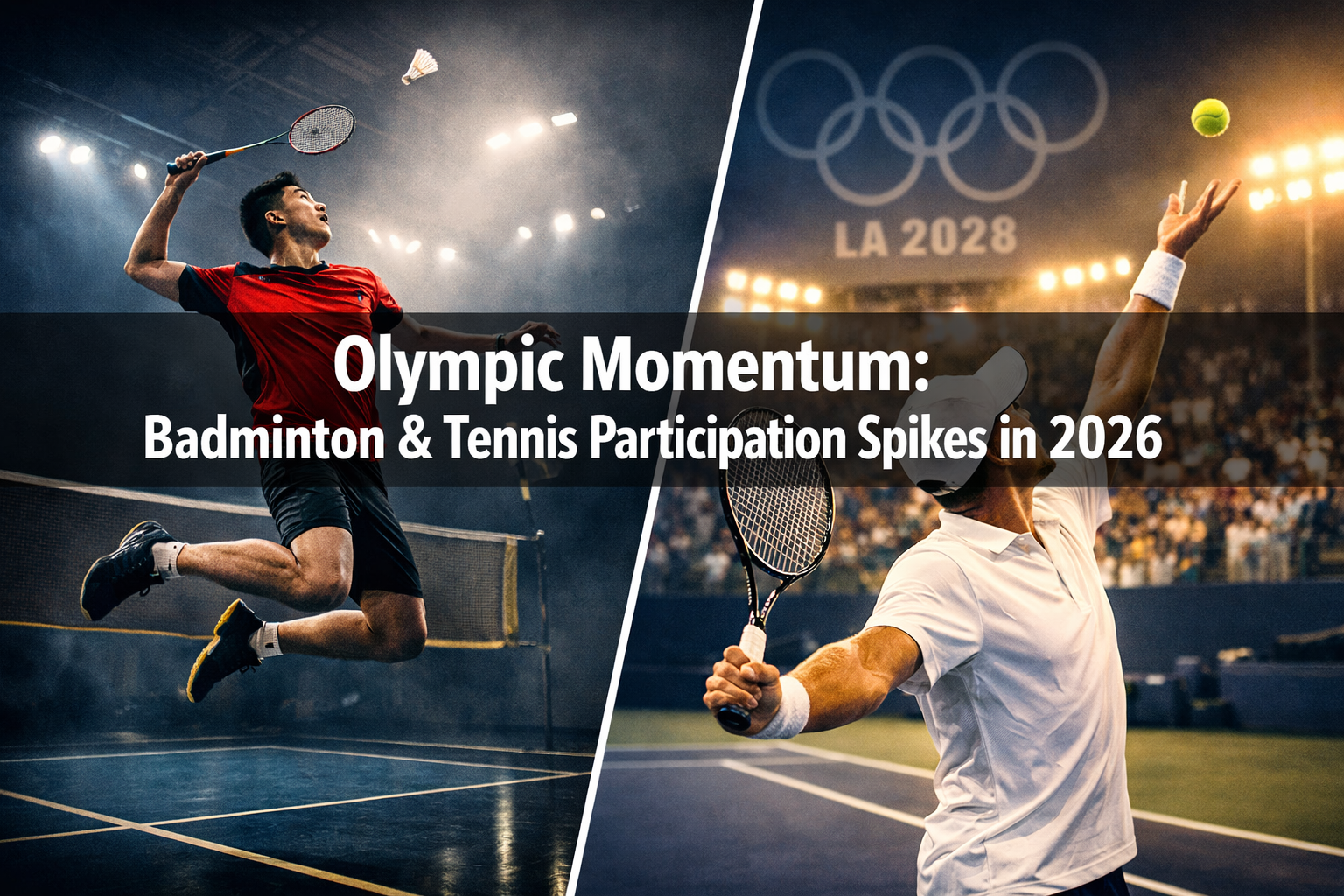
Olympic Momentum: How 2028 Preparations Are Fueling Badminton and Tennis Participation Spikes in 2026
Last updated: April 3, 2026
Quick Answer
The lead-up to the Los Angeles 2028 Olympics is already driving measurable interest in badminton and tennis at the grassroots level in 2026. New qualification pathways, relaxed ranking requirements, and high-profile national heroes are pulling beginners onto courts in growing numbers. Clubs that act now, with beginner clinics, viewing events, and smart programming, are best positioned to ride this wave.
Key Takeaways 🏸🎾
- Olympic Momentum: How 2028 Preparations Are Fueling Badminton and Tennis Participation Spikes in 2026 is a real, measurable trend, not just hype.
- The 2026 Asian Games (September–October 2026) will award the first guaranteed Olympic spots for LA 2028, kicking off the qualification race early. [1]
- Badminton’s official IOC-approved qualification period runs May 3, 2027 through April 30, 2028, with the LA28 Olympic Ranking on May 2, 2028 determining spots. [5]
- Tennis has relaxed its regional champion ranking requirement to Top 500 (down from Top 400), widening the door for more nations. [1]
- The 2027 Pacific Games in Tahiti now serves as a new qualification pathway for Olympic tennis, a historic first for the Pacific region. [1]
- The “national hero effect” — fans picking up rackets after watching their country’s players compete — is a well-documented post-Olympic participation driver.
- Clubs running beginner clinics tied to Olympic coverage and viewing parties are seeing stronger sign-up rates in 2026.
- Racket sports like tennis, badminton, and pickleball share transferable skills, making crossover participation easier than ever.

Why Is Olympic Momentum Driving Participation Spikes Right Now?
The Olympic cycle creates a predictable surge in racket sports interest, and 2026 sits right in the sweet spot. With LA 2028 close enough to feel real but far enough away for beginners to dream, more people are picking up rackets for the first time — or returning after years away.
The mechanism is straightforward: high-profile qualification events generate media coverage, media coverage produces national heroes, and national heroes inspire fans to play. This pattern repeated after London 2012 (badminton boom in Asia and the UK), Rio 2016 (tennis uptick in Latin America), and Tokyo 2020. Now, Olympic Momentum: How 2028 Preparations Are Fueling Badminton and Tennis Participation Spikes in 2026 is following the same script, but with a few new twists that make this cycle especially interesting.
What’s different in 2026:
- Qualification events are starting earlier, meaning media coverage begins sooner
- New regional pathways (like the Pacific Games) are bringing in nations that previously had little Olympic tennis representation [1]
- Social media amplifies every qualifying match to global audiences almost instantly
- Clubs and national federations are proactively running “road to LA” campaigns
What Are the Key Qualification Changes Fueling the Buzz?
Several structural changes to Olympic qualification for both sports are generating fresh excitement in 2026, and they matter for participation because they expand the pool of countries and athletes with realistic Olympic dreams.
Tennis Qualification Updates for LA 2028
- First spots awarded at the 2026 Asian Games (Aichi Prefecture and Nagoya, September 19–October 4, 2026), making this the opening chapter of the Olympic qualification story. [1]
- Top 500 ranking threshold for regional champions (down from Top 400), deliberately giving more players a realistic path. [1]
- Six special entry positions reserved in both men’s and women’s main draws, with four going to regional champions. [1]
- The 2027 Pacific Games (Tahiti, July 24–August 8, 2027) confirmed as a qualification pathway, the first time Pacific nations have this direct route. [1]
- Maximum four competitors per country, so regional champion spots only activate if a nation hasn’t already filled its quota. [1]
Badminton Qualification Updates for LA 2028
- The IOC approved badminton qualification regulations in December 2025. [5]
- The official qualification period runs May 3, 2027 through April 30, 2028. [5]
- The LA28 Olympic Ranking on May 2, 2028 determines initial qualification. [5]
- LA 2028 will feature badminton at a dedicated venue, with Team USA badminton building national awareness. [3][4]
Why this matters for beginners: When more countries have genuine Olympic hopes, more local clubs get funding, more coaches get hired, and more beginner programs launch. The qualification rule changes aren’t just administrative — they ripple all the way down to community courts.
How Does the “National Hero Effect” Work in Racket Sports?
The national hero effect is simple: when a player from your country competes at the Olympics, participation in that sport spikes locally. It’s been documented across multiple sports cycles and is one of the most reliable drivers of grassroots growth.
For badminton and tennis in 2026, this effect is already visible in several ways:
- Increased search interest in “how to play badminton” and “tennis lessons near me” correlates with major qualification events
- Club membership inquiries tend to spike in the weeks following televised international matches
- Youth enrollment in junior programs climbs when a national player reaches a high-profile stage
Choose this strategy if: Your club is near a city with a strong diaspora community connected to a badminton powerhouse nation (Indonesia, China, South Korea, India, Denmark). Those communities respond especially strongly to Olympic qualification news.
The same applies to tennis, where players from emerging tennis nations qualifying through the new Pacific Games pathway [1] will generate fresh enthusiasm in regions that previously felt shut out of the Olympic conversation.
What Practical Steps Can Clubs Take to Capitalize on This Surge?
Clubs that plan ahead in 2026 will capture the most new players. The window between now and the start of the official qualification period (May 2027) is ideal for building beginner pipelines.
🏸 Beginner Clinic Blueprint
- Schedule a “Road to LA” introductory clinic tied to a major qualification event broadcast date
- Keep sessions short (60–75 minutes) and focused on fun, not technique overload
- Offer a follow-up series of 4–6 weeks to convert one-time attendees into regular players
- Partner with local schools — Olympic years are excellent for PE program tie-ins
- Use social media to share short clips from clinics, tagging national federation accounts
🎾 Viewing Party Strategies
| Event | Timing | Viewing Party Format |
|---|---|---|
| 2026 Asian Games Tennis | Sept–Oct 2026 | Club screening + free trial session after |
| Major badminton Grand Prix events | Ongoing 2026–2027 | Watch party + Q&A with club coach |
| 2027 Pacific Games Tennis | July–Aug 2027 | Community event with beginner demo |
| LA 2028 Olympics | Summer 2028 | Full viewing series + recruitment drive |
Common mistake: Clubs that wait until the Olympics themselves to run beginner programs miss the best window. The 18 months before the Games, when qualification drama is unfolding, is when curiosity peaks.
How Do Badminton and Tennis Skills Transfer to Other Racket Sports?
One of the underappreciated benefits of the 2026 participation surge is that new players entering through badminton or tennis often discover a wider racket sports world. Skills transfer more than most beginners expect.
Shared fundamentals across racket sports:
- Hand-eye coordination developed in badminton translates directly to tennis and pickleball
- Court positioning principles apply across all net-based racket sports — see our guide on court positioning strategies for a practical breakdown
- Mental resilience under pressure is universal — the mental strategies for high-stakes matches guide covers this well
- Footwork and agility developed through badminton drills benefit players in every racket sport
For players exploring multiple sports, our pickleball vs. tennis comparative analysis is a useful starting point for understanding how these games relate to each other. And if you’re building a broader fitness routine around racket sports, incorporating racket sports into your weekly exercise plan offers a practical framework.
What Gear Do New Badminton and Tennis Players Actually Need?
New players inspired by Olympic coverage often want to buy gear immediately — which is great, but they don’t need to spend a lot to start.
Badminton Basics
- Racket: A mid-range graphite racket (around $30–$60) is plenty for beginners
- Shuttlecocks: Plastic shuttles for outdoor or casual play; feather shuttles for serious indoor sessions
- Footwear: Non-marking indoor court shoes are essential for grip and ankle support
Tennis Basics
- Racket: A pre-strung beginner racket ($50–$100 range) works well; avoid cheap unbranded options
- Balls: Standard pressurized balls for hard courts; low-compression balls (Stage 1 or 2) for absolute beginners
- Shoes: Tennis-specific shoes with lateral support, not running shoes
For players who also want to explore pickleball as part of their racket sports journey, our guide to choosing your first pickleball paddle covers the gear selection process in detail.
Edge case: Players coming from badminton to tennis often grip the racket too tightly at first. A relaxed grip produces better results in both sports — worth flagging in any beginner clinic.
FAQ: Olympic Momentum and Racket Sports Participation in 2026
Q: When does the LA 2028 badminton qualification period officially start? The official qualification period runs from May 3, 2027 through April 30, 2028, with the LA28 Olympic Ranking on May 2, 2028 determining initial spots. [5]
Q: Which tennis event awards the first Olympic spots for LA 2028? The 2026 Asian Games (September 19–October 4, 2026) will award the first guaranteed positions in the LA 2028 Olympic tennis cycle. [1]
Q: What ranking do regional tennis champions need to qualify for LA 2028? Singles winners from major regional tournaments need to maintain a Top 500 ranking — relaxed from the previous Top 400 threshold — to secure their Olympic spot. [1]
Q: Is the Pacific Games a new Olympic tennis qualification pathway? Yes. The 2027 Pacific Games in Tahiti (July 24–August 8, 2027) is confirmed as a qualification pathway for LA 2028 Olympic tennis, which is a historic first for Pacific nations. [1]
Q: How many special entry positions are available for Olympic tennis at LA 2028? Six special entry positions are reserved in both men’s and women’s main draws, with four allocated to regional champions and two for another specific group. [1]
Q: Does playing badminton help with tennis, or are they too different? They share core skills: hand-eye coordination, court awareness, and footwork. Badminton players often adapt to tennis faster than complete beginners, though the heavier racket and slower ball take adjustment.
Q: What’s the best way for a club to attract new players during the Olympic buildup? Run beginner clinics timed to major qualification events, host viewing parties, and offer short follow-up series to convert curious newcomers into regular members.
Q: Can beginner players realistically improve racket sports skills in time for 2028 community tournaments? Absolutely. Two years of consistent practice — even two sessions per week — is enough for most beginners to reach a competitive recreational level. Consistent drills to enhance coordination and agility accelerate progress across all racket sports.
Q: Where can I find a local racket sports community to join? Check national federation websites, local recreation centers, and community apps like Meetup. Our guide on building your racket sports network has practical tips that apply beyond pickleball.
Conclusion: Your Next Steps in 2026
Olympic Momentum: How 2028 Preparations Are Fueling Badminton and Tennis Participation Spikes in 2026 isn’t a trend to watch from the sidelines. It’s an opportunity to act on right now.
For players: This is a great time to start or return to badminton or tennis. Courts are filling with beginners, coaches are launching new programs, and the energy around both sports is genuinely high. Pick up a racket, find a local clinic, and enjoy the ride toward LA 2028.
For clubs and coaches: The 18-month window before the official qualification period begins is your best recruitment opportunity. Plan beginner clinics around the 2026 Asian Games coverage, build viewing party traditions, and create clear pathways from first session to regular membership.
For multi-sport athletes: If you already play one racket sport, now is an ideal time to cross-train. The skills transfer, the fitness carries over, and the racket sports community is more welcoming than ever.
The Olympic cycle is one of sport’s most powerful participation engines. In 2026, that engine is already running — and the courts are open.
References
[1] Los Angeles Olympic Tennis Qualification – https://tennispulsehub.com/news-center/los-angeles-olympic-tennis-qualification
[3] Badminton – Team USA – https://www.teamusa.com/los-angeles-2028/olympics/sports/badminton
[4] Badminton – LA28 – https://la28.org/en/games-plan/olympics/badminton.html
[5] IOC Approves Badminton Qualification Regulations for LA 2028 – https://corporate.bwfbadminton.com/news-single/2025/12/15/ioc-approves-badminton-qualification-regulations-for-la-2028