Pickleball Courts vs Racquetball: Hybrid Facility Designs Winning Club Investments in 2026
Last updated: October 23, 2026
Quick Answer: Hybrid pickleball-racquetball facilities are among the fastest-growing club investments in 2026 because a single converted racquetball court can support four pickleball courts, dramatically increasing court time and membership revenue. The two sports have different space, wall, and surface requirements, but smart design bridges them efficiently. For most clubs, a hybrid approach outperforms betting on either sport alone.
Key Takeaways
- A standard racquetball court (20×40 ft) fits two pickleball courts side-by-side with minimal modifications.
- Pickleball is far more popular in 2026 by raw player count, but racquetball retains a loyal, paying membership base.
- Hybrid court conversion typically costs less than building new dedicated pickleball courts from scratch.
- The biggest investment mistake clubs make is under-budgeting for soundproofing and lighting upgrades.
- Revenue from pickleball court rentals, clinics, and leagues can accelerate ROI within 18-36 months (estimate based on reported industry trends, assuming mid-size club capacity).
- Surface choice (sport tile vs. hardwood refinish) is the single biggest variable in conversion cost.
- Pickleball equipment costs per court are significantly lower than racquetball infrastructure.
- Small clubs should start with one hybrid conversion before committing the entire facility.
What’s the Actual Difference Between Pickleball and Racquetball Courts?
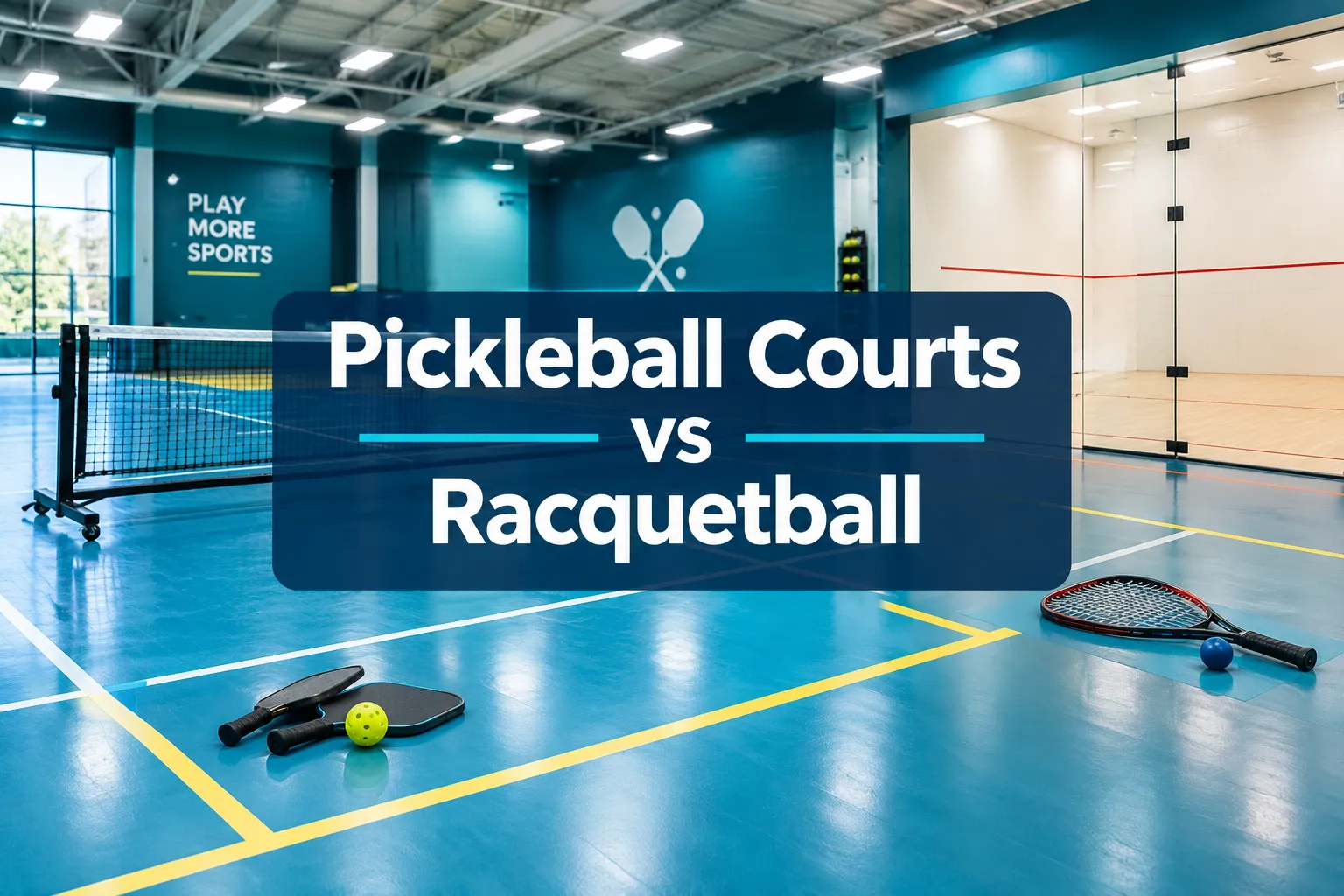
Pickleball and racquetball courts differ in three key ways: dimensions, enclosure, and surface. Pickleball is played on an open, outdoor-style court (20×44 ft), while racquetball uses a fully enclosed four-wall court (20×40 ft) with a ceiling in play. This structural difference is what makes hybrid design both challenging and interesting.

Here’s a side-by-side breakdown:
| Feature | Pickleball Court | Racquetball Court |
|---|---|---|
| Dimensions | 20 ft × 44 ft | 20 ft × 40 ft |
| Enclosure | Open (no walls required) | Fully enclosed, 4 walls + ceiling |
| Net height | 34 in (center), 36 in (sides) | No net |
| Surface | Concrete, asphalt, sport tile | Hardwood or sport surface |
| Ceiling | Not in play | In play (20 ft min height) |
For a deeper dive into court layout, check out this guide to pickleball court dimensions and layout.
Key distinction for hybrid design: Pickleball doesn’t need walls, but racquetball courts already have them. That means the walls become an asset, or an obstacle, depending on how the conversion is handled.
What Are the Court Size Requirements for Pickleball vs Racquetball?
A pickleball court requires a minimum playing area of 20×44 ft, with recommended total space of 30×60 ft including out-of-bounds clearance. A racquetball court is exactly 20×40 ft with 20-foot-high ceilings.
The good news: a racquetball court with its surrounding corridor space often meets or exceeds the minimum footprint needed for pickleball. Two pickleball courts fit inside a space that once held one racquetball court and its buffer zone, which is the core math behind why hybrid designs make financial sense.
Space planning rule: If you have a row of four racquetball courts, that footprint typically supports 8-10 pickleball courts, depending on corridor width and wall removal decisions.
Can You Play Both Sports on the Same Court?
Yes, with caveats. A racquetball court can be marked for pickleball use with painted or taped lines, a portable net, and adjusted lighting. Players can switch between sports by swapping the net and ignoring the opposing sport’s lines.
However, a pure racquetball court isn’t ideal for pickleball because:
- The enclosed walls create bounce confusion for pickleball players
- Ceiling height is fine, but wall proximity can feel cramped
- Racquetball floors (hardwood) work for pickleball but benefit from a non-slip refinish
Best hybrid use case: Designate some courts as “pickleball-primary” (walls removed or opened) and keep 1-2 courts as true racquetball courts. This retains racquetball members while serving the much larger pickleball demand.
How Much Does It Cost to Build a Hybrid Pickleball Racquetball Facility?
Conversion costs vary widely based on existing infrastructure, but here are reasonable estimates based on industry-reported project ranges as of 2026:
- Surface refinish or sport tile overlay: $3,000,$8,000 per court
- Wall removal or partial opening: $5,000,$15,000 per court pair
- Lighting upgrade to LED (pickleball spec): $2,000,$6,000 per court
- Portable pickleball nets: $200,$500 each
- Permanent net posts: $800,$2,000 per court
- Line painting/taping: $300,$800 per court
- Soundproofing upgrades: $3,000,$10,000 (often the most underestimated cost)
💡 Rough total estimate for converting 4 racquetball courts into a hybrid facility: $40,000,$100,000, depending on how much structural work is needed. New dedicated construction runs higher.
Compare that to building brand-new dedicated pickleball courts, which can run $25,000,$50,000 per court for indoor construction. Conversion nearly always wins on cost.
Common mistake: Clubs often skip proper HVAC and acoustic upgrades to save money upfront, then face member complaints and additional spend within a year. Budget for sound management from day one.
Are Hybrid Sports Facilities Actually Profitable for Club Owners?
For most clubs in 2026, yes, but profitability depends heavily on local demand, pricing strategy, and membership mix. Pickleball courts vs racquetball: hybrid facility designs winning club investments in 2026 isn’t just a trend headline, it reflects real membership growth numbers clubs are reporting.
Pickleball generates revenue through:
- Court rental fees (typically $10,$25/hour per court)
- League fees and round-robin events
- Clinics and lessons (high margin)
- Membership upsells
Racquetball still contributes through loyal members who pay full dues and often purchase additional services. Losing racquetball entirely risks alienating that segment.
Decision rule: If your current racquetball courts sit empty more than 60% of open hours, conversion will likely improve revenue. If racquetball is still drawing strong attendance, a hybrid approach protects both income streams.
For clubs thinking about building a broader community around the courts, see this guide on joining a club and community engagement for pickleball.
Is Pickleball or Racquetball More Popular in 2026?
Pickleball is significantly more popular by player count in 2026. Multiple sports industry groups have tracked pickleball participation growing into the tens of millions of players in the U.S. alone, while racquetball participation has declined steadily from its peak in the 1980s and 1990s.
That said, racquetball players are deeply committed. They tend to play more frequently per week than casual pickleball players and are often higher-spending club members.
For club operators, this means:
- Pickleball brings volume (more new members, broader age range)
- Racquetball brings loyalty (retention, higher per-member spend)
- A hybrid model captures both
Pickleball’s rising popularity across generations is a key driver, it attracts players from age 8 to 80, making it uniquely powerful for facility programming.
How Do You Convert an Existing Racquetball Court to Pickleball?
Converting a racquetball court to pickleball is a 5-step process that most facilities can complete in a weekend per court pair.
- Assess the floor surface. Hardwood floors need a non-slip finish; cracked concrete needs repair or an overlay. Sport tile is the most versatile solution.
- Decide on wall configuration. Keeping walls saves money but limits the “open court” feel pickleball players prefer. Removing one or two walls (with structural assessment) creates a more natural playing environment.
- Install or mark court lines. Use permanent paint for dedicated pickleball courts, or contrasting tape for reversible hybrid setups.
- Set up net infrastructure. Permanent posts are worth the investment for high-traffic courts. Portable nets work for flexible scheduling.
- Upgrade lighting. Pickleball requires even, shadow-free illumination. Most racquetball lighting is ceiling-centered and creates glare; LED upgrades with wider spread fix this.
The essential equipment guide for pickleball covers what players will expect once the courts are ready.
What Equipment and Setup Costs Are Different Between the Two Sports?
Racquetball infrastructure is built into the court itself (walls, floor, ceiling). Pickleball adds portable or permanent equipment on top of a simpler open surface.
Racquetball facility costs include:
- Court construction/maintenance (walls, ceiling, hardwood floor)
- Ball dispensers, protective eyewear rentals
- Higher HVAC needs (fully enclosed spaces)
Pickleball facility costs include:
- Nets and posts ($200,$2,000 per court depending on type)
- Paddle and ball rentals (low cost, high turnover)
- Outdoor surface maintenance if applicable
Where pickleball wins on cost: No specialized wall construction, lower per-sport equipment investment, and faster court setup/teardown for multi-use scheduling.
What’s the Best Hybrid Court Design for a Small Club vs Large Facility?
Small club (2-4 courts total): Keep at least one racquetball court intact for existing members. Convert remaining courts to dedicated pickleball. Use portable nets so courts can flex between open play, leagues, and private lessons. Focus budget on lighting and surface quality over structural changes.
Large facility (8+ courts): Zone the facility deliberately. Create a “pickleball wing” with permanent nets, scorekeeping displays, and social seating. Maintain a “racquetball zone” with 2-3 fully enclosed courts. This physical separation reduces noise conflicts and improves each sport’s experience.
🏆 Pro tip: The most successful hybrid facilities in 2026 treat the lobby and social space as a shared community hub. A well-designed lounge between court zones increases member dwell time and secondary spending (pro shop, café, lessons).
For inspiration on what top facilities are doing, read about regional pickleball clubs and their facility programs.
What Common Mistakes Do Club Owners Make With Hybrid Court Designs?
When analyzing pickleball courts vs racquetball: hybrid facility designs winning club investments in 2026, the failure patterns are consistent across facility types.
Top mistakes:
- Skipping acoustics: Pickleball is loud. The hollow “pop” of a paddle carries through walls. Without sound treatment, racquetball members near pickleball courts will complain.
- Under-sizing the pickleball zone: Adding one or two pickleball courts and calling it done rarely satisfies demand. Plan for at least 4 pickleball courts to run meaningful programming.
- Ignoring sight lines: Open pickleball courts placed beside enclosed racquetball courts create scheduling confusion. Clear signage and physical separation matter.
- Using the wrong surface: Slick hardwood without a resurfacing coat causes injuries. Always verify slip resistance before opening.
- Not consulting players: Surveying current members before committing to a design prevents costly redesigns. Racquetball players and pickleball players have strong opinions about space allocation.
Safety matters too, a good surface and layout directly reduces injury risk. See injury prevention strategies for pickleball players for what players need from a well-designed court.
What Are the Maintenance Differences Between Pickleball and Racquetball Courts?
Racquetball courts require more intensive structural maintenance because all four walls and the ceiling are active playing surfaces. Any crack, scuff, or uneven panel affects play and safety. Floor refinishing on hardwood is needed every 3-7 years depending on traffic.
Pickleball courts are simpler to maintain:
- Outdoor courts: Crack repair, repainting lines, net hardware checks (annually)
- Indoor courts: Surface cleaning, net hardware, occasional line repainting
- Shared surfaces: The hybrid court needs attention to both sets of markings and surface condition
Cost comparison (annual maintenance estimate, per court):
- Racquetball court: $1,500,$4,000/year (wall repairs, floor refinishing amortized)
- Pickleball court (indoor): $500,$1,500/year
- Hybrid court: $800,$2,500/year depending on traffic split
Pickleball’s lower maintenance overhead is another factor that makes it a stronger long-term investment for most clubs.
Should You Invest in Hybrid Courts or Stick to Just One Sport?
For most clubs with existing racquetball infrastructure, hybrid is the smarter bet in 2026. Pickleball courts vs racquetball: hybrid facility designs winning club investments in 2026 as a concept only makes sense if your facility can support the transition without gutting a still-profitable racquetball base.
Choose hybrid if:
- You have 4+ existing racquetball courts
- Racquetball court utilization is below 50%
- You’re in a market with growing pickleball demand (most U.S. metro areas qualify)
- You want to attract a broader age demographic
Stick to one sport if:
- Your racquetball membership is strong and growing
- You’re in a niche market where pickleball hasn’t taken hold yet
- Budget only allows for one type of infrastructure
Go pickleball-only if:
- You’re building new and have no existing racquetball base
- Your target demographic skews toward families and recreational players
FAQ
Q: How many pickleball courts fit in one racquetball court? A standard racquetball court (20×40 ft) fits two minimum-spec pickleball courts side by side. With corridor space included, that footprint can comfortably support two courts with proper buffer zones.
Q: Do pickleball players and racquetball players share well in the same facility? Generally yes, but scheduling separation and acoustic buffering are essential. Conflicts arise most often from noise and competition for prime-time court hours.
Q: What’s the minimum budget to start a pickleball conversion? A basic single-court conversion (lines, portable net, surface refinish) can be done for $4,000,$10,000. A full hybrid facility redesign typically runs $40,000,$100,000 or more.
Q: Is pickleball a passing trend or a long-term investment? Participation data through 2026 suggests pickleball is sustained by multi-generational appeal, it draws seniors, families, and competitive athletes. It’s not a short-term fad.
Q: Can outdoor racquetball courts be converted to pickleball? Yes, outdoor racquetball walls can remain as wind barriers, and the floor can be resurfaced for pickleball. This is one of the most cost-effective conversions available.
Q: What surface material works best for hybrid courts? Modular sport tile is the most versatile, it performs well for both sports, is easy to repair, and provides appropriate cushioning and slip resistance.
Q: How long does a court conversion take? A basic conversion (lines + net) takes 1-2 days. A full renovation with wall changes, new lighting, and surface work typically takes 2-4 weeks per zone.
Q: Do hybrid facilities need special insurance? Most sports facility insurance covers multiple court sports, but carriers should be notified of any structural changes. Check with your broker before beginning construction.
Conclusion
The case for pickleball courts vs racquetball: hybrid facility designs winning club investments in 2026 comes down to a simple truth: most clubs are sitting on underused racquetball infrastructure that can be transformed into a high-demand, multi-revenue pickleball hub without abandoning their existing membership.
Actionable next steps for club operators:
- Audit current court utilization, track hourly usage by sport for 30 days before committing to any design.
- Survey your members, ask both racquetball and potential pickleball players what they need.
- Get at least two contractor bids, specify soundproofing, surface type, and lighting in the scope of work.
- Start with one conversion, test demand with a pilot before redesigning the full facility.
- Build programming before the courts open, leagues, clinics, and open play events drive the revenue that justifies the investment.
Pickleball’s broad appeal across ages makes it a natural community anchor. Whether your club goes fully hybrid or keeps a dedicated racquetball zone, the facilities that win in 2026 are the ones that design for flexibility, community, and long-term player retention.