Pongbot and Robotic Training Innovations: Revolutionizing Table Tennis and Racquet Sports Practice at RacquetX 2026
Last updated: April 5, 2026
Quick Answer
At RacquetX 2026, Pongbot made its on-court debut as one of the most talked-about robotic training tools in racquet sports. The AI-driven ball machine delivers consistent, customizable drills for table tennis players and has clear cross-sport applications for pickleball and tennis training. Attendees got hands-on access during a live demo on March 13, 2026, and the buzz since then has been hard to ignore.
Key Takeaways 🎯
- Pongbot is an AI-powered ball machine designed to help players train with consistent, programmable feeds [1]
- It was featured on the on-court agenda at RacquetX 2026, with live demos on Friday, March 13 [2]
- The technology targets players who want to “train like a pro” without needing a dedicated hitting partner [2]
- Pongbot’s drill customization makes it useful beyond table tennis, with applications for pickleball and tennis footwork and reaction training
- Hands-on demos at RacquetX gave attendees direct experience with the machine’s capabilities [2]
- The robot training category is growing fast across all racquet sports, not just table tennis
- For recreational and competitive players alike, robotic trainers offer solo practice flexibility that traditional lessons can’t always provide
What Is Pongbot and Why Did It Turn Heads at RacquetX 2026?
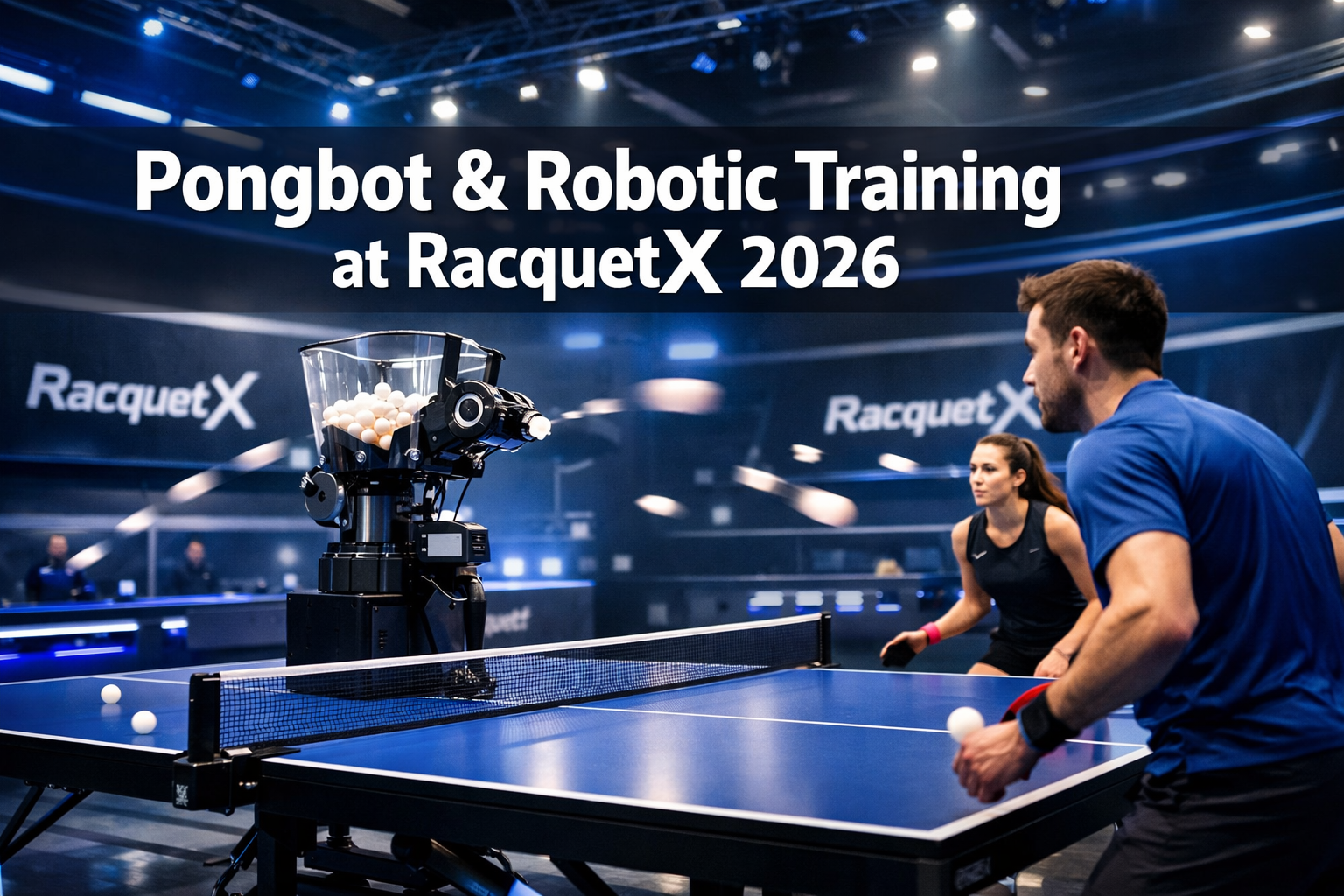
Pongbot is a ball machine technology built for consistent, AI-powered training feeds that players of all skill levels can customize. It launched into the broader racquet sports conversation at RacquetX 2026, where it was showcased as part of the on-court agenda [1][2].
Unlike older, mechanical ball machines that simply shoot balls at a fixed speed and angle, Pongbot’s AI-driven approach lets players dial in specific drill types, spin variations, and feed patterns. That kind of flexibility is exactly what serious players have been asking for.
At RacquetX, the machine drew a crowd. Attendees lined up to try it firsthand during the March 13 on-court session [2], and the feedback from players across skill levels was consistently positive. The appeal was simple: you get repetition, consistency, and challenge, all without waiting for a practice partner to show up.

How Does Pongbot’s AI-Driven Training Actually Work?
Pongbot uses AI to deliver programmable ball feeds that replicate real match scenarios, giving players structured repetition that builds muscle memory faster than casual hitting. The core idea is to remove the inconsistency that comes with human feeding [2].
Here’s what that looks like in practice:
- Customizable drill sequences that target specific weaknesses (backhand loops, short game, cross-court angles)
- Consistent ball speed and spin so players can isolate one variable at a time
- Adjustable feed rate to match a beginner’s pace or push an advanced player to their limit
- Programmable patterns that simulate real rally situations rather than just straight-line feeds
“Train like a pro” — that’s the design philosophy behind Pongbot, and it shows in how the machine handles drill variety. [2]
For players who’ve struggled to find regular hitting partners or can’t always afford hourly coaching, a machine like this changes the math on solo practice. It’s not replacing coaches, but it’s filling a real gap.
What Happened at the RacquetX 2026 Pongbot Demo?
The Pongbot on-court demonstration at RacquetX 2026 took place on Friday, March 13, giving attendees direct, hands-on access to the machine’s capabilities. This wasn’t a passive product display — players actually stepped up and hit [2].
The demo format worked well for a mixed crowd. RacquetX draws coaches, competitive players, recreational athletes, and gear enthusiasts, so the Pongbot team had to appeal to a wide range of experience levels. From what was shown on the on-court agenda, the session was structured to highlight both beginner-friendly settings and more advanced drill configurations [2].
Key moments from the demo included:
- Live drill sessions where attendees could test different feed modes
- Side-by-side comparisons of standard feeds vs. AI-customized patterns
- Coach-led commentary explaining how to integrate the machine into a structured training plan
For anyone at RacquetX who missed it, the session was a clear signal that robotic training tools are moving from niche gadget to mainstream training resource.
Can Pongbot Help Pickleball and Tennis Players Too?
Yes — while Pongbot is designed primarily for table tennis, its core training principles apply directly to pickleball, tennis, and other racquet sports. Reaction time, footwork patterns, and hand-eye coordination are shared skills across all of these games.
Here’s how the cross-sport applications break down:
| Skill Trained | Table Tennis | Pickleball | Tennis |
|---|---|---|---|
| Reaction speed | ✅ Direct | ✅ Strong crossover | ✅ Strong crossover |
| Footwork patterns | ✅ Direct | ✅ Strong crossover | ✅ Moderate |
| Short game touch | ✅ Direct | ✅ Strong crossover (dink game) | ✅ Moderate |
| Spin recognition | ✅ Direct | ✅ Moderate | ✅ Strong crossover |
Pickleball players, in particular, stand to gain a lot. The fast-paced exchanges at the kitchen line demand the same quick-twitch reflexes that table tennis training builds. If you’re working on your pickleball practice sessions, adding table tennis drills with a machine like Pongbot is a genuinely underrated cross-training option.
Tennis players working on their advanced practice routines can also use robotic training to sharpen reaction time between full court sessions.
Who Is Pongbot Best Suited For?
Pongbot is best suited for players who practice frequently, want structured solo sessions, and are serious about improving specific technical skills. It’s less useful for someone who only plays casually once a week.
Choose Pongbot if you:
- Practice 3+ times per week and need consistent ball feeds
- Are working on a specific weakness (e.g., backhand, footwork under pressure)
- Don’t always have a training partner available
- Want to track progress through repeatable drill formats
It may not be the right fit if you:
- Prefer the social and strategic elements of live play
- Are a complete beginner still learning basic form (a coach is more valuable at that stage)
- Only play recreationally and aren’t focused on technical improvement
For players who enjoy the community side of racquet sports, a robotic trainer works best as a supplement to group play, not a replacement for it.
Why Are Robotic Training Tools Growing Across Racquet Sports?
Robotic and AI-assisted training tools are growing because they solve a real problem: quality repetition is hard to get without a consistent hitting partner or expensive coaching hours. The technology has become more accessible, and events like RacquetX 2026 are accelerating mainstream awareness [1].
Several factors are driving this trend:
- Solo practice demand has increased as more adults play recreationally without club memberships
- AI customization makes modern machines far more useful than older fixed-feed models
- Cross-sport appeal means one device can serve players across table tennis, pickleball, and tennis
- Home use viability is improving as machines become more compact and affordable
The evolution of racquet sports equipment has always followed player demand, and right now players want smarter practice tools. Pongbot fits squarely into that trend.
It’s also worth noting that the racquet sports community is growing fast. More players means more demand for training resources, and robotic machines fill a gap that group lessons and YouTube tutorials can’t fully cover. For players looking to improve their racquet sports skills systematically, this kind of technology is a natural next step.
What Should Players Know Before Buying a Robotic Trainer?
Before investing in a robotic ball machine, players should assess their training frequency, available space, and specific skill goals. A machine is only valuable if it matches how you actually practice.
Practical checklist before buying:
- Do you practice solo at least 2–3 times per week?
- Do you have dedicated space (a table, a court, or access to one)?
- Have you identified 2–3 specific skills you want to improve?
- Is your budget aligned with the machine’s feature set?
- Have you tried a demo (like the RacquetX 2026 session) before committing?
Common mistake: Buying based on features alone without testing the machine’s actual feed consistency. A demo, like the one Pongbot offered at RacquetX [2], is the best way to evaluate real-world performance before purchasing.
Also consider how the machine fits into your broader training plan. If you’re working on correcting swing flaws, a robotic trainer gives you the repetition needed to lock in corrections — but you still need to know what you’re fixing first.
FAQ: Pongbot and Robotic Training at RacquetX 2026
Q: What is Pongbot? Pongbot is an AI-powered ball machine designed to deliver consistent, customizable training feeds for table tennis and racquet sports players of all levels. [1]
Q: When was Pongbot demonstrated at RacquetX 2026? The on-court Pongbot demo was scheduled for Friday, March 13, 2026, as part of the RacquetX on-court agenda. [2]
Q: Can beginners use Pongbot? Yes. The machine’s adjustable settings make it accessible for beginners, though players with some basic technique will get more out of structured drill sessions.
Q: Is Pongbot only for table tennis? No. While designed for table tennis, the reaction, footwork, and coordination skills it builds transfer well to pickleball, tennis, and other racquet sports.
Q: How does Pongbot differ from older ball machines? Older machines use fixed mechanical feeds. Pongbot uses AI to create varied, programmable drill patterns that better simulate real match conditions. [2]
Q: Is Pongbot suitable for home use? Based on its design as an accessible training tool for all levels, home use is part of its appeal, though specific space requirements should be confirmed with the manufacturer. [1]
Q: Do I need a coach to use Pongbot effectively? Not necessarily. The machine works well for self-directed practice, but pairing it with occasional coaching sessions will help you identify what to drill and how to progress.
Q: Where can I learn more about RacquetX 2026’s full agenda? The full agenda, including Pongbot’s on-court slot, is available at theracquetx.com. [1][2]
Conclusion: What Pongbot and RacquetX 2026 Mean for Your Training
Pongbot and robotic training innovations at RacquetX 2026 represent a genuine shift in how racquet sports players approach solo practice. The technology isn’t a gimmick — it’s a practical answer to the challenge of getting quality repetitions without always needing a partner or coach on hand.
Actionable next steps:
- If you attended RacquetX 2026, revisit your notes from the Pongbot demo and identify one skill area where consistent machine feeding could help you improve.
- If you missed the demo, check theracquetx.com for any follow-up sessions or resources from the event. [1]
- For pickleball and tennis players, consider adding table tennis cross-training to your routine — the reaction and touch skills transfer more than most players expect.
- Before buying any robotic trainer, try a demo first and match the machine’s features to your actual training frequency and goals.
The racquet sports community is getting smarter about practice, and tools like Pongbot are a big part of why. Whether you’re a weekend pickleball player or a competitive table tennis athlete, there’s something here worth paying attention to.
References
[1] theracquetx – https://theracquetx.com/agenda/2026/ [2] On Court Agenda – https://theracquetx.com/on-court-agenda/