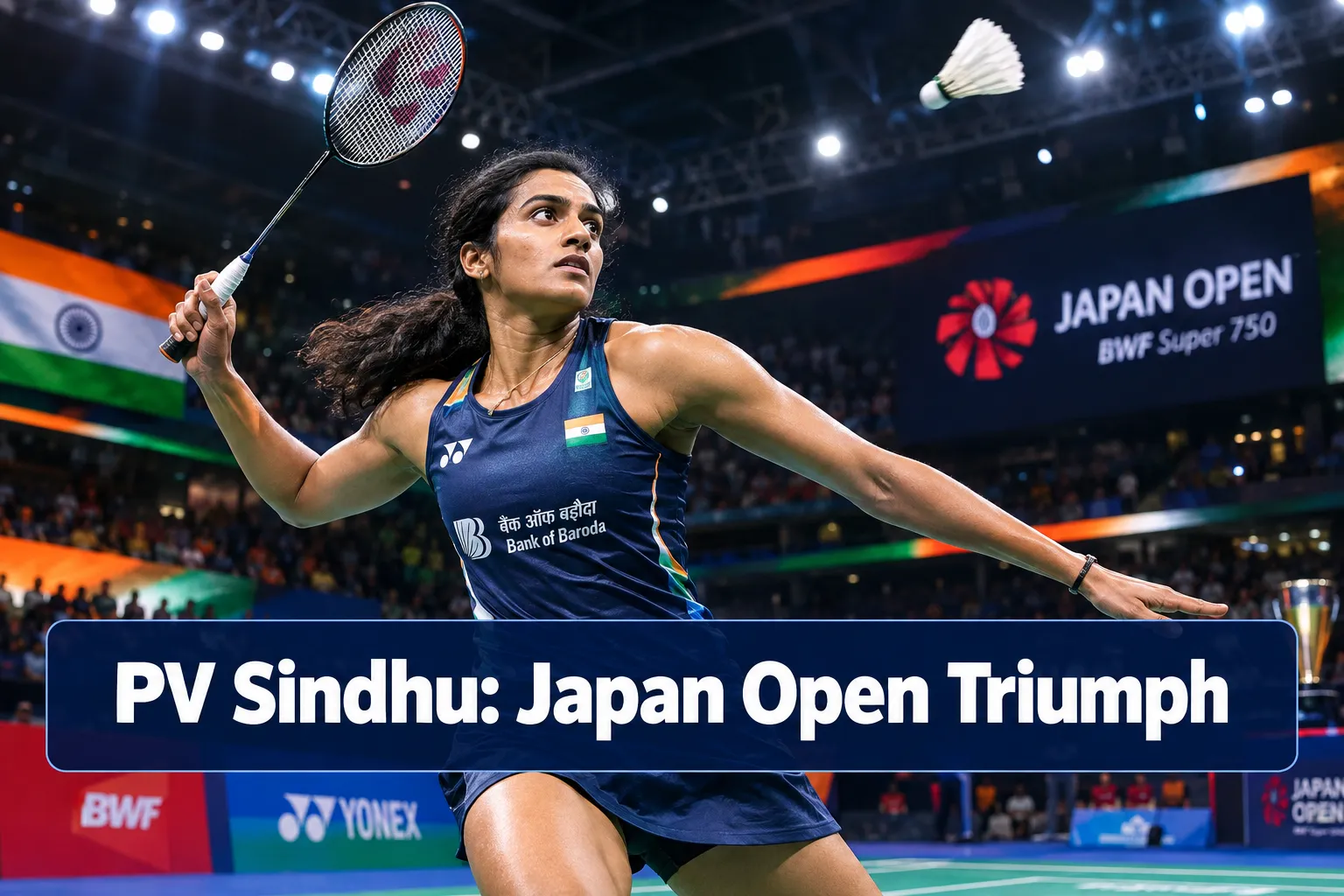
PV Sindhu’s Japan Open Triumph And What Changed In Her Game
Last updated: September 8, 2026
Quick Answer: PV Sindhu won the 2026 Japan Open on July 19, defeating world No. 3 Akane Yamaguchi 21-17, 21-17 in the final at the Tokyo Metropolitan Gymnasium. It was her first BWF Super 750 title, India’s first Japan Open title, and her biggest World Tour win in nearly eight years. The key shift in her game was a move away from power-heavy, extended rallies toward cleaner point construction, better court positioning, and disciplined match management.
Key Takeaways
- 🏸 Sindhu beat Yamaguchi 21-17, 21-17 in about 50 minutes to claim the 2026 Japan Open title [5]
- 🇮🇳 She became the first Indian player ever to win the Japan Open, a tournament dating back to 1981 [2]
- 🏆 At 31, she was also the oldest woman to win a BWF Super 750 title [2][3]
- ⏱️ She did not drop a single game throughout the entire tournament [8]
- 💪 Her quarter-final win over world No. 5 Han Yue took just 35 minutes [6]
- 🔄 The biggest tactical shift: shorter rallies, smarter shot selection, and more controlled court movement [7][8]
- 🧠 Mental composure was a standout factor, especially in the final against a three-time world champion [5]
- 📈 The win ended a title drought of nearly two years and marked a clear return to big-match form [1]
- 🎯 Her game now relies more on point discipline and less on sheer attacking volume [3][7]
What Is the Japan Open Badminton Tournament?
The Japan Open is one of the most prestigious events on the BWF World Tour calendar. It has been running since 1981 and carries Super 750 status, meaning it sits just below the Super 1000 tier in terms of ranking points and prize money.
The tournament attracts the world’s top-ranked players and is held in Japan, a country with a deep badminton culture and several world-class players of its own. Winning it carries serious weight in the sport.
For context, a Super 750 title is a significant career achievement. Most players in the top 10 may win only a handful of these across their careers.
When Did PV Sindhu Win the Japan Open?
PV Sindhu won the 2026 Japan Open on July 19, 2026, at the Tokyo Metropolitan Gymnasium. She defeated Japan’s Akane Yamaguchi in the final with a score of 21-17, 21-17 [5].
The win made her the first Indian player, male or female, to claim the Japan Open title [2]. Multiple reports also described it as her biggest World Tour triumph in nearly eight years [1].
PV Sindhu’s Japan Open 2026 Results: Who Did She Beat?
Sindhu’s run through the draw was dominant from start to finish. She did not drop a single game across the entire tournament [8].
Here’s a summary of her key results:
| Round | Opponent | Score | Notes |
|---|---|---|---|
| Quarter-final | Han Yue (World No. 5) | 21-16, 21-14 | Won in just 35 minutes [6] |
| Semi-final | Chen Yufei | 21-19, 15-10 (ret.) | Yufei retired with a hamstring injury [10] |
| Final | Akane Yamaguchi (World No. 3) | 21-17, 21-17 | Won in approx. 50 minutes [5][2] |
Beating Han Yue in 35 minutes was particularly striking. It showed how efficiently Sindhu was constructing points rather than grinding through long exchanges. The final against Yamaguchi, a three-time world champion, was the clearest signal that her big-match composure had returned [5].

How Did PV Sindhu’s Playing Style Change?
This is the heart of PV Sindhu’s Japan Open triumph and what changed in her game. The short answer: she stopped trying to overpower opponents and started outthinking them.
In her earlier peak years, Sindhu’s game was built on raw power, a tall frame, and aggressive smashing. That style won her two Olympic medals and multiple World Tour titles. But in recent seasons, that approach led to inconsistency, especially against elite opponents who could absorb pace and counter.
What looked different in Tokyo:
- Shorter rallies. Instead of trading 20-plus-shot exchanges, she ended points earlier with better shot placement [6][8]
- Cleaner court positioning. She recovered faster between shots, reducing the gaps opponents could exploit
- Smarter point construction. She set up her attacks more patiently rather than going for outright winners too early [7]
- Consistent level across the week. Holding form from round one through the final was less common in her recent seasons [8]
“Winning was very, very important to me.”, PV Sindhu, after the Japan Open final [8]
This shift from volume-based attacking to point selection and discipline is a meaningful evolution for any racket sports player, not just elite professionals. It’s the same principle that good beginner pickleball strategies teach: win the point with the right shot at the right time, not just the hardest one.
PV Sindhu Technical Improvements After the Japan Open
Several technical improvements stood out during the tournament. These weren’t sudden changes, but they showed up consistently across every match.
Key technical shifts:
- Net play and mid-court control, Sindhu used the forecourt more effectively to force opponents into defensive positions
- Backhand reliability, Fewer unforced errors on the backhand side compared to her 2024-2025 form
- Serve variation, Mixing up serve length and angle to disrupt opponents’ rhythm early in each rally
- Smash placement over power, Targeting the body and sidelines rather than going for pure pace
These aren’t glamorous changes. But for players at any level who want to improve racket sports skills, they reflect a universal truth: precision beats power more often than not at the highest level.
PV Sindhu vs Other Top Badminton Players: How Does She Compare Now?
Sindhu’s Japan Open win puts her back in the conversation with the world’s elite. Here’s a quick look at where she stands:
- Akane Yamaguchi (World No. 3, Japan): Three-time world champion. Sindhu beat her 21-17, 21-17 in the final, showing she can now match Yamaguchi’s speed and consistency [5][2]
- Han Yue (World No. 5, China): A powerful, athletic player. Sindhu dismissed her in 35 minutes in the quarter-final [6]
- Chen Yufei (China): A former world champion. Sindhu led 21-19, 15-10 before Yufei retired injured [10]
What makes this comparison meaningful is that Sindhu beat higher-ranked opponents without dropping a game. That level of consistency against elite competition is what separates a good week from a genuine resurgence [3].
What Makes PV Sindhu’s Game Different Now?
The clearest answer: her game is less dependent on sheer attacking volume and more on point selection, discipline, and match management [3][7].
Previously, Sindhu would sometimes force the issue, going for big smashes at the wrong moment or extending rallies unnecessarily. In Tokyo, she looked more like a player who had a plan for each rally and stuck to it.
Three things that stood out:
- Patience under pressure. She didn’t panic when Yamaguchi pushed back in the final
- Tactical clarity. She knew when to attack and when to reset
- Physical efficiency. Winning in 35 and 50 minutes suggests she’s moving smarter, not just harder [6][5]
This kind of evolution is worth noting for anyone in the racket sports community working on their own game. The best players at every level eventually learn that shot quality beats shot quantity.
PV Sindhu Training Methods and Coaching Changes
Reports around the 2026 Japan Open described Sindhu’s level in Tokyo as resembling her peak years, with emphasis on tactical clarity and mental fortitude [7][3]. While specific details of her current training setup weren’t fully disclosed, the results point to a refined approach.
What the evidence suggests about her preparation:
- Focused work on rally construction and point-ending patterns rather than just fitness
- Improved recovery between tournaments, which may reflect better physical management
- Mental conditioning work, given how composed she looked in pressure moments against Yamaguchi
For players looking to improve their own racket sports training, this is a useful model: targeted practice on specific weaknesses often delivers more than simply hitting more balls.
PV Sindhu Common Mistakes She Fixed
Every player has patterns they fall into under pressure. Based on her recent form before the Japan Open, a few recurring issues appeared to be addressed in Tokyo.
Mistakes that looked corrected:
- Inconsistency across a full tournament. In recent seasons, Sindhu would often have strong early rounds but lose focus in later stages. In Tokyo, she held her level throughout [8]
- Over-reliance on the smash. Going for the big winner too early had cost her points. In Tokyo, she set up attacks more carefully [7]
- Slow starts in games. Her 21-16, 21-14 win over Han Yue showed she was ready from the opening rally [6]
Fixing small, repeatable mistakes is one of the fastest ways to improve in any racket sport. It’s the same logic behind beginner-friendly pickleball drills that focus on reducing errors before adding power.
How Important Is the Japan Open Win for PV Sindhu’s Ranking?
A Super 750 title carries significant ranking points on the BWF World Tour. Winning it moves a player meaningfully up the world rankings, especially if they weren’t defending points from the previous year’s edition.
Beyond the numbers, the win matters for seeding at upcoming events. Higher seeds mean better draws, which reduces the chance of facing top-10 opponents in early rounds.
At 31, Sindhu also proved that age doesn’t automatically mean decline. Being the oldest woman to win a BWF Super 750 title is a data point worth noting for any athlete thinking about longevity in their sport [2][3].
PV Sindhu Injury Recovery and Comeback
Sindhu’s path back to the top wasn’t straightforward. Her previous title before the Japan Open came at the Syed Modi India International in 2024, which meant a drought of nearly two years at the title level [1].
That gap reflected a period of inconsistency and, by some reports, physical challenges. The Japan Open performance suggested those issues are behind her. Winning five matches without dropping a game across a Super 750 draw requires both physical and mental readiness [8].
For recreational players, this is a reminder that comebacks take time and that consistency in training matters more than any single session.
PV Sindhu Mental Game Improvements
Mental composure was arguably the most visible change in Tokyo. Sindhu herself said after the final that winning was “very, very important” to her [8].
Against Yamaguchi, a player known for relentless speed and consistency, staying calm under pressure was essential. The 21-17, 21-17 scoreline wasn’t a blowout, it was a controlled, disciplined performance against a world-class opponent [5].
Signs of improved mental game:
- No visible panic when Yamaguchi pushed back in the second game
- Clean execution on key points rather than going for low-percentage winners
- Consistent body language throughout the match
Mental strength in racket sports is trainable. Whether you’re playing badminton, exploring what sets pickleball apart from other racquet sports, or competing in any other format, the ability to stay composed under pressure is a skill that improves with deliberate practice.
PV Sindhu Future Tournaments After the Japan Open Win
With a Super 750 title and fresh confidence, Sindhu’s schedule for the rest of 2026 will be watched closely. The BWF World Tour calendar includes several high-profile events in the second half of the year, including Super 1000 tournaments and the BWF World Championships.
The Japan Open win gives her:
- Better seedings at upcoming events
- Momentum heading into the World Championships
- Proof of form that should attract attention from coaches and analysts
The racket sports community will be watching to see whether this is a one-week peak or the start of a sustained run. Based on how controlled and efficient she looked in Tokyo, the latter seems more likely [3][7].
Conclusion: What Sindhu’s Win Means for Players at Every Level
PV Sindhu’s Japan Open triumph and what changed in her game offers a clear lesson for anyone who plays racket sports: sustained improvement comes from fixing small things, not reinventing everything.
She didn’t suddenly become a different player. She became a more disciplined version of the player she already was. Shorter rallies. Better shot selection. Cleaner positioning. Composure under pressure. Those are things every player can work on, regardless of level.
Actionable next steps for your own game:
- Identify your most common unforced error and build one drill around reducing it
- Focus on point construction rather than going for winners too early
- Track your consistency across a session, not just your best shots
- Work on mental reset routines between points to stay composed
If you’re just getting started in racket sports, resources like what to expect in your first few pickleball games or attending pickleball meetups can help you build that same foundation of smart, consistent play from day one.
Sindhu’s Tokyo performance is a reminder that the best version of your game is usually built on discipline, not just talent. 🏸
FAQ
Q: When did PV Sindhu win the Japan Open? PV Sindhu won the Japan Open on July 19, 2026, at the Tokyo Metropolitan Gymnasium, defeating Akane Yamaguchi 21-17, 21-17 in the final [5].
Q: Was this Sindhu’s first Japan Open title? Yes. She became the first Indian player ever to win the Japan Open, which has been running since 1981 [2].
Q: What was Sindhu’s biggest win at the 2026 Japan Open? Her quarter-final win over world No. 5 Han Yue, 21-16, 21-14 in just 35 minutes, was especially dominant. The final against world No. 3 Yamaguchi was the most significant result overall [6][5].
Q: Did Sindhu drop any games at the 2026 Japan Open? No. She won every game across all her matches, which highlighted how controlled and consistent her week in Tokyo was [8].
Q: What changed in PV Sindhu’s playing style? Her game shifted from power-heavy, extended rallies toward shorter rallies, smarter shot selection, and better point construction. She also showed improved mental composure throughout the tournament [7][3].
Q: How long was Sindhu’s title drought before the Japan Open? Her previous title came at the Syed Modi India International in 2024, making the Japan Open win her first title in nearly two years [1].
Q: Is the Japan Open a major badminton tournament? Yes. It carries BWF Super 750 status, which is the second-highest tier on the World Tour. Winning it earns significant ranking points and is considered a major career achievement.
Q: Who did Sindhu beat in the semi-finals? She faced Chen Yufei in the semi-finals and led 21-19, 15-10 when Yufei retired due to a hamstring injury [10].
Q: Was Sindhu the oldest woman to win a Super 750 title? Yes. At 31, she was reported to be the oldest woman to win a BWF Super 750 title [2][3].
Q: What does Sindhu’s win mean for her world ranking? A Super 750 title adds significant ranking points and improves her seeding for upcoming tournaments, giving her better draws for the rest of the 2026 season.
References
[1] BWF Japan Open 2026 PV Sindhu Ends Long Title Drought – https://www.olympics.com/en/news/bwf-japan-open-2026-pv-sindhu-ends-long-title-drought-christo-popov-victorious-men-singes
[2] PV Sindhu Becomes First Indian to Win Japan Open Title – https://www.reuters.com/sports/pv-sindhu-becomes-first-indian-win-japan-open-title-2026-07-19/
[3] PV Sindhu BWF Japan Open Win History First Indian Underline Return Big Stage – https://www.espn.com/badminton/story/_/id/49397629/pv-sindhu-bwf-japan-open-win-history-first-indian-underline-return-big-stage
[4] Japan Open 2026 Badminton India Semi Final Report PV Sindhu – https://www.olympics.com/en/news/japan-open-2026-badminton-india-semi-final-report-pv-sindhu
[5] Japan Open 2026 Badminton India Final Report PV Sindhu – https://www.olympics.com/en/news/japan-open-2026-badminton-india-final-report-pv-sindhu
[6] Japan Open 2026 Badminton India Day 3 Report – https://www.olympics.com/en/news/japan-open-2026-badminton-india-day-3-report
[7] PV Sindhu Beats Akane Yamaguchi 21-17 21-17 to Win Japan Open 2026 – https://sports.ndtv.com/badminton/pv-sindhu-beats-akane-yamaguchi-21-17-21-17-to-win-japan-open-2026-11790742
[8] PV Sindhu Japan Open Title Akane Yamaguchi End Drought – https://www.indiatoday.in/sports/badminton/story/pv-sindhu-japan-open-title-akane-yamaguchi-end-drought-2951154-2026-07-19
[9] Japan Open 2026 Badminton India Quarter Final Report PV Sindhu – https://www.olympics.com/en/news/japan-open-2026-badminton-india-quarter-final-report-pv-sindhu
[10] PV Sindhu Japan Open Final Chen Yufei Hamstring Injury Tokyo – https://www.indiatoday.in/sports/badminton/story/pv-sindhu-japan-open-final-chen-yufei-hamstring-injury-tokyo-2950489-2026-07-18

![The Underrated Skill Transforming Pickleball in 2026: Mastering [Key Skill from Video] for Tournament Wins](https://rallyracket.com/wp-content/uploads/2026/06/The-Underrated-Skill-Transforming-Pickleball-in-2026-Mastering-Key-Skill-from-Video-for-Tournament-Wins-768x504.png "The Underrated Skill Transforming Pickleball in 2026: Mastering [Key Skill from Video] for Tournament Wins")