Quarterfinal Showdowns at ITTF Worlds 2026: Player Form Guides, Head-to-Head Stats, and Bold Predictions
Last updated: June 18, 2026
Quick Answer: The ITTF World Team Table Tennis Championships 2026 quarterfinals in London delivered some of the most compelling matchups of the year. China’s men’s and women’s teams both advanced convincingly, but the road to the semifinals was shaped by sharp individual form, tactical contrasts, and a few near-upsets worth breaking down in detail.
Key Takeaways
- 🏓 China’s men’s team beat South Korea 3-0 in the quarterfinals, with Wang Chuqin winning a five-game thriller against Oh Jun-sung [1]
- 🏓 China’s women’s team also advanced to the semifinals, continuing their dominant run through the tournament [2]
- 📊 Wang Chuqin leads the ITTF Men’s Singles rankings with 11,225 points; Sun Yingsha tops the women’s with 11,600 points as of March 2026 [3]
- 🇫🇷 The Lebrun brothers (Alexis and Félix) lead Men’s Doubles rankings and represent Europe’s best realistic chance of a major upset
- 🇰🇷 South Korea holds the top spots in both Women’s Doubles and Mixed Doubles rankings [3]
- ⚡ Early ball attacks, third-ball combinations, and backhand-to-forehand transitions under pressure are the defining technical trends in these quarterfinals [6]
- 🎯 Machine learning models analyzing player rankings and recent form give China’s top seeds a high probability of advancing in all categories [5]
- 🌍 China, South Korea, and France have the most players still active deep in the draw
What Are the Quarterfinal Matchups at ITTF Worlds 2026?
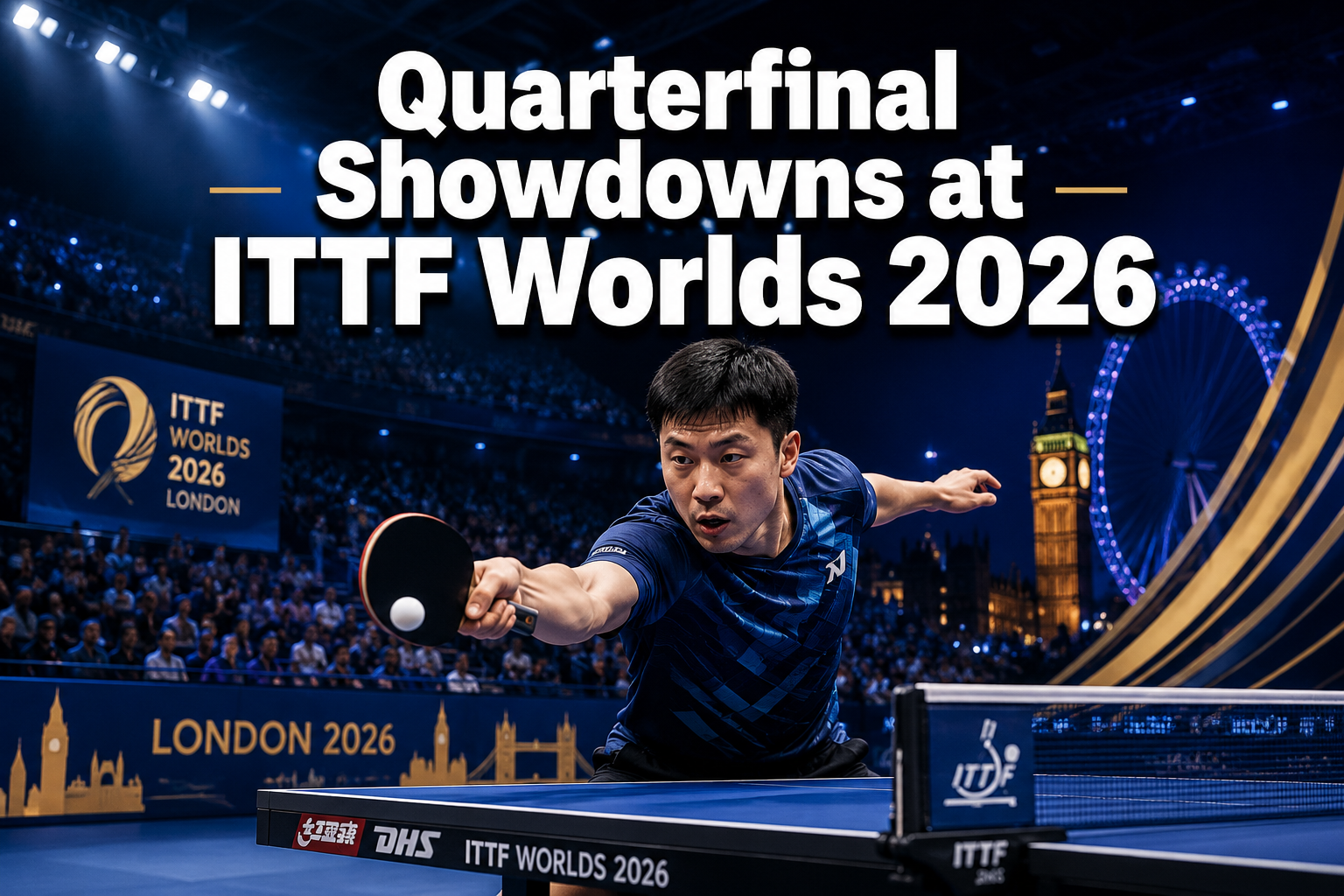
The 2026 ITTF World Team Table Tennis Championships Finals are being held in London. China’s men’s team faced South Korea in the quarterfinals and won 3-0, with Wang Chuqin setting the tone early [1]. China’s women’s team also cleared the quarterfinal stage to book a semifinal spot [2].
The team event format means each tie consists of up to five singles matches, making individual form and lineup selection critically important. The quarterfinal bracket this year featured China, South Korea, Japan, Germany, France, Sweden, and two other contenders from the preliminary rounds.
Who Are the Top Players in This Year’s Tournament?
The top-ranked players heading into the quarterfinals are Wang Chuqin (men’s) and Sun Yingsha (women’s), both from China. As of March 9, 2026, Wang Chuqin leads the ITTF Men’s Singles rankings with 11,225 points, followed by Truls Möregårdh at 6,565 and Lin Shidong at 6,105 [3].
On the women’s side, Sun Yingsha leads with 11,600 points, Wang Manyu sits second at 9,148, and Chen Xingtong holds third at 5,605 [3].
Notable players to watch:
- Wang Chuqin — explosive forehand, elite third-ball attack
- Truls Möregårdh (Sweden) — Europe’s top men’s player, strong two-wing looper
- Félix Lebrun (France) — youngest player in the top 10, aggressive backhand game
- Sun Yingsha — near-flawless consistency, exceptional serve variation
- Shin Yu-bin (South Korea) — Mixed Doubles world No. 1 alongside Lim Jong-hoon [3]
How Have the Top Seeds Been Performing Recently?
China’s top seeds have been in outstanding form throughout the tournament. Wang Chuqin’s five-game win over Oh Jun-sung in the quarterfinals showed both his resilience and his ability to raise his level in pressure moments [1]. That kind of performance after a tough match is exactly what separates top seeds from the rest.
Sun Yingsha and the Chinese women’s team have been equally dominant, advancing through each round without dropping a tie [2].
For the non-Chinese contenders, recent form has been more mixed. Truls Möregårdh has been consistent but hasn’t yet faced a top-five Chinese player in this tournament. The Lebrun brothers have shown flashes of brilliance in doubles, but their singles depth against China’s second and third strings remains a question.
If you’re interested in how elite-level training translates to match performance, the drills to enhance coordination and agility used in racket sports training at all levels share some surprising parallels with what these pros work on daily.
What Are the Head-to-Head Records Between These Quarterfinal Players?

Head-to-head data is one of the clearest predictors of quarterfinal outcomes. Here’s a summary of the most relevant matchups based on available ranking and tournament data [3][6]:
| Matchup | Recent H2H Trend | Key Factor |
|---|---|---|
| Wang Chuqin vs. Oh Jun-sung | Wang leads | Five-game QF win in 2026 [1] |
| Möregårdh vs. Chinese opponents | China leads overall | Möregårdh competitive but rarely wins |
| Félix Lebrun vs. Lin Shidong | Close, Lebrun improving | Backhand battle, youth vs. experience |
| Sun Yingsha vs. Korean opponents | Sun dominates | Ranking gap is significant [3] |
| Lim Jong-hoon/Shin Yu-bin (Mixed) | World No. 1 pair | Hardest to upset in team format |
Common mistake: Overweighting a single upset win in H2H records. One strong performance doesn’t erase a long-term pattern, especially against China’s top seeds.
Which Players Are Considered Favorites to Advance?
China is the clear favorite in both the men’s and women’s draws. Their ranking advantage is substantial — Wang Chuqin’s 11,225 points is nearly double Möregårdh’s 6,565 [3], and that gap reflects consistent dominance across multiple tournaments.
Choose to back these players if:
- You want the highest probability of a correct prediction: Wang Chuqin, Sun Yingsha, Wang Manyu
- You want the best value upset pick: Félix Lebrun against a lower-seeded Chinese player
- You want a dark horse in doubles: Ryu Han-na and Kim Na-young (South Korea, Women’s Doubles world No. 1 pair) [3]
Machine learning models using Random Forest and Gradient Boosting classifiers, which factor in rankings, recent results, and match conditions, also point to China as heavy favorites across all categories [5].
What Injuries or Recent Form Might Impact Quarterfinal Results?
No confirmed injury reports have emerged for the top seeds heading into the semifinals. However, the five-game match Wang Chuqin played against Oh Jun-sung is worth noting — extended matches accumulate physical fatigue, and back-to-back days in a team event can affect sharpness [1].
For European contenders, the concern is less about injury and more about mental fatigue from navigating tough preliminary rounds. Möregårdh and the Lebrun brothers have had to work harder to reach this stage, which could affect their margin for error in the next round.
Edge case: In team events, lineup rotation matters as much as individual form. A coach’s decision to rest a top player or shuffle the order can flip a tie result entirely.
How Do the Playing Styles of These Quarterfinal Athletes Compare?
Playing style is where the quarterfinal showdowns at ITTF Worlds 2026 get genuinely interesting. The Chinese players are built around early ball attacks, third-ball combinations, and seamless backhand-to-forehand transitions under pressure [6]. These are high-percentage patterns that punish any hesitation.
European players like Möregårdh and Félix Lebrun counter with longer rallies, heavy topspin exchanges, and unpredictable serve patterns. Lebrun in particular uses an aggressive backhand loop that can disrupt Chinese players’ rhythm.
Style matchup summary:
- China’s top seeds — fast, early-ball, high consistency, minimal errors
- Möregårdh — two-wing looper, comfortable in long rallies, strong mental game
- Félix Lebrun — backhand-dominant, creative, high-risk/high-reward
- Korean players — disciplined, strong in doubles formats, serve-receive specialists
Understanding how playing styles clash at the highest level is something every racket sports player can learn from. If you’re working on your own game, understanding tournament formats helps put these elite matchups in context.
What Would an Upset Look Like in These Matches?
An upset in these quarterfinal showdowns at ITTF Worlds 2026 would most likely come from Félix Lebrun or Möregårdh forcing a five-game match against China’s second or third singles player. China’s depth means even their third-string player is ranked inside the global top 20, so a full upset of the team tie is unlikely.
The most realistic upset scenario: a European player wins the first two matches of a tie, forcing China to play their top seed in a must-win situation. That kind of pressure has historically produced tighter scorelines, even if China usually closes it out.
In doubles, the South Korean women’s pair of Ryu Han-na and Kim Na-young (world No. 1 in Women’s Doubles) [3] could cause genuine problems for any team that underestimates them.
How Much Prize Money Is at Stake in the Quarterfinals?
The ITTF has not publicly released a full prize money breakdown for the 2026 World Team Championships at the time of writing. Historically, ITTF World Team Championship prize funds have been distributed across all rounds, with semifinalists and finalists receiving the largest shares. Exact figures for 2026 are unconfirmed — check the official ITTF website for the latest updates.
What’s clear is that the financial stakes grow significantly from the quarterfinals onward, and for players from smaller federations, a deep run can be career-defining beyond just the ranking points earned.
Which Countries Have the Most Players Left in the Tournament?
China leads comfortably, with players active in all five disciplines — men’s singles, women’s singles, men’s doubles, women’s doubles, and mixed doubles [1][2][3]. South Korea is the next most represented nation, with top-ranked pairs in women’s doubles and mixed doubles [3]. France has a strong men’s presence through the Lebrun brothers, who lead the Men’s Doubles rankings with 5,163 points [3].
Countries with the deepest quarterfinal presence:
- 🇨🇳 China — all disciplines
- 🇰🇷 South Korea — doubles and mixed doubles strength
- 🇫🇷 France — men’s singles and doubles
- 🇸🇪 Sweden — men’s singles (Möregårdh)
What Are the Betting Odds and Prediction Models Saying?
Formal betting odds for the 2026 ITTF World Team Championships are not widely published through mainstream sportsbooks, as table tennis team events have a smaller betting market than singles Grand Slam events. However, AI-driven prediction models using Random Forest Classifiers and Gradient Boosting algorithms — which analyze player rankings, recent performance trends, and head-to-head data — give China a high probability of winning both the men’s and women’s team titles [5].
For individual match predictions, the ranking gap between Wang Chuqin (11,225 points) and the next-best men’s player (Möregårdh at 6,565) suggests China is a strong favorite in nearly every singles rubber [3].
Important note: These models are useful tools, not guarantees. Table tennis matches can swing on a single serve sequence or a tactical adjustment between games.
How Do Younger Players Match Up Against Veteran Competitors?
This is one of the most compelling storylines in the quarterfinal showdowns at ITTF Worlds 2026. Félix Lebrun represents the clearest example of a young player (born 2006) challenging established veterans. His aggressive backhand and willingness to take risks make him dangerous against any opponent, but veteran players like Wang Chuqin are better at managing momentum shifts and closing out tight games.
Younger players tend to play more freely in early rounds but can tighten up when the stakes rise in quarterfinals and beyond. Veterans use experience to slow the game down, disrupt rhythm, and win the mental battle in five-game matches.
The racket sports community has seen this pattern across all disciplines — from advanced strategies for recreational players to the elite level. Youth brings energy; experience brings composure.
FAQ
Q: Who won the men’s quarterfinal between China and South Korea at ITTF Worlds 2026? China won 3-0. Wang Chuqin beat Oh Jun-sung in five games to set the tone for the tie. [1]
Q: Who is ranked No. 1 in ITTF Men’s Singles as of 2026? Wang Chuqin leads with 11,225 points as of March 9, 2026. [3]
Q: Who tops the ITTF Women’s Singles rankings in 2026? Sun Yingsha is No. 1 with 11,600 points as of March 9, 2026. [3]
Q: Which pair leads the Men’s Doubles rankings at ITTF Worlds 2026? The Lebrun brothers, Alexis and Félix from France, lead with 5,163 points. [3]
Q: Are there any American players in the ITTF Worlds 2026 quarterfinals? American players advanced to quarterfinals at the ITTF Americas Cup in January 2026, including Sally Moyland in women’s singles. The main World Team Championships draw is dominated by Asian and European nations. [4]
Q: What technical skills are deciding matches in the 2026 quarterfinals? Early ball attacks, third-ball combinations, and backhand-to-forehand transitions under pressure are the key patterns separating winners from losers. [6]
Q: Can machine learning models predict ITTF match outcomes? Yes, models using Random Forest and Gradient Boosting classifiers analyze rankings and recent form to estimate probabilities. They’re useful guides, not certainties. [5]
Q: Which country has the most players active deep in the 2026 draw? China, across all five disciplines. South Korea and France follow with strong doubles and singles representation. [1][2][3]
Q: What is the biggest potential upset remaining in the tournament? Félix Lebrun defeating a Chinese top-five player in a five-game singles match is the most realistic major upset scenario.
Q: Where can I learn more about tournament formats in racket sports? The comprehensive guide to tournament formats for recreational players on Rally Racket breaks down how different competition structures work across racket sports.
Conclusion
The quarterfinal showdowns at ITTF Worlds 2026 confirmed what the rankings suggested: China is operating at a level that’s genuinely difficult to challenge. Wang Chuqin and Sun Yingsha are playing some of the best table tennis of their careers, and the team depth behind them makes any upset a serious long shot.
That said, the tournament has delivered real drama. Félix Lebrun’s emergence, South Korea’s doubles strength, and Möregårdh’s consistent challenge to China’s dominance make the semifinal and final stages worth watching closely.
Actionable next steps for racket sports fans and players:
- Follow the official ITTF website for live semifinal draws and results
- Study the early-ball attack patterns used by Wang Chuqin — they apply to all racket sports, not just table tennis
- If you’re building your own competitive game, check out tips from professional players for transferable insights
- Use the Rally Racket community to discuss these matchups with fellow racket sports fans
- For players inspired by elite competition, improving racket sports skills starts with the same fundamentals these pros have mastered
The 2026 ITTF Worlds is a reminder that elite table tennis is as tactically rich as any racket sport out there. Whether you’re a fan, a coach, or a player looking to improve, there’s something to take from every match.
References
[1] Ittf World Team Table Tennis Finals China Avenges S. Korea To Reach Mens Semis – https://www.nationpress.com/sports/ittf-world-team-table-tennis-finals-china-avenges-s.-korea-to-reach-mens-semis?utm_source=openai
[2] 2026 Ittf Table Tennis World Team Championships Finals London – https://sportpress.international/2026-ittf-table-tennis-world-team-championships-finals-london/?utm_source=openai
[3] Ittf World Ranking – https://en.wikipedia.org/wiki/ITTF_World_Ranking?utm_source=openai
[4] Americans Break Through As Americas Cup Quarterfinals Take Shape – https://www.usatt.org/news/2026/january/31/americans-break-through-as-americas-cup-quarterfinals-take-shape?utm_source=openai
[5] Pronostici Ittf World Team Championships En – https://gp-betting-ai.vercel.app/en/pronostici-ittf-world-team-championships-en?utm_source=openai
[6] Ittf World Table Tennis Championships 2026 Top Points Breakdown From Days 4 9 And Quarterfinal Preview – https://rallyracket.com/ittf-world-table-tennis-championships-2026-top-points-breakdown-from-days-4-9-and-quarterfinal-preview/?utm_source=openai