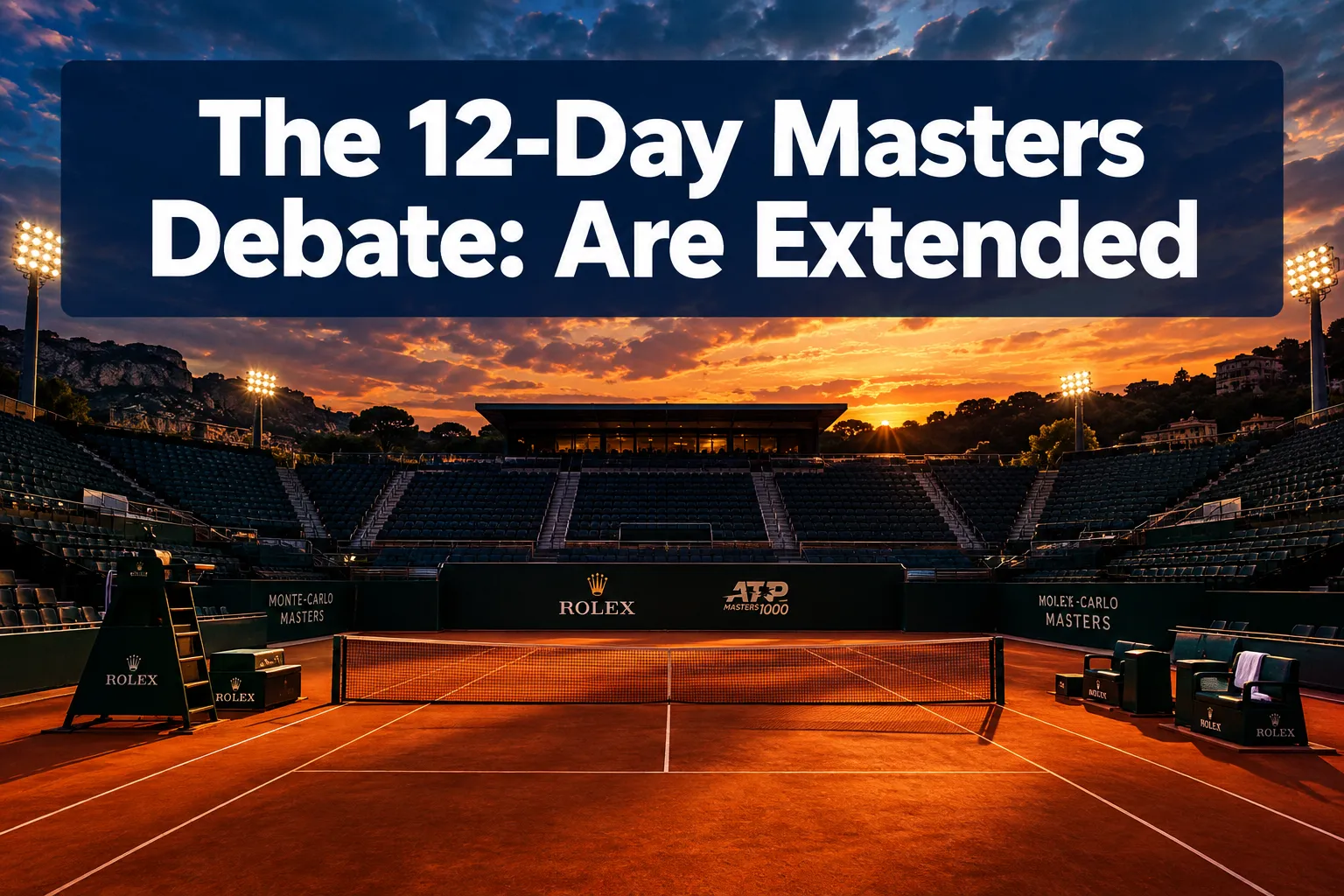
The 12-Day Masters Debate: Are Extended Events Helping or Hurting Tennis in 2026?
Last updated: September 7, 2026
Quick Answer: The 12-day Masters 1000 format, rolled out across seven ATP events starting in 2025, has split the tennis world. Top players like Arthur Fils and Alexander Zverev say the longer schedule pushes an already packed calendar past its limit. Tournament organizers and broadcasters see bigger revenue windows. The honest answer is: it helps some stakeholders and hurts others, and in 2026, that tension is louder than ever.
Key Takeaways
- Seven ATP Masters 1000 events now run 12 days instead of 9, adding an estimated three extra weeks to the annual calendar [2]
- Arthur Fils called the extended format “too long, almost like a Grand Slam” [5]
- Alexander Zverev proposed cutting Masters events back to one week in August 2026
- Diego Schwartzman described the current ATP calendar as “chaos” and called for a full overhaul [6]
- The Canadian Open and Cincinnati Masters run back-to-back as 12-day events, creating a brutal August stretch [1]
- Expanded draws mean more prize money opportunities, but mainly for players ranked 50-150
- Top seeds like Jannik Sinner and Novak Djokovic withdrew from the 2026 Canadian Open, highlighting fatigue concerns [10]
- Fans and broadcasters generally welcome the longer windows; player unions are pushing back
- The format change affects Wimbledon preparation, with the grass-court season squeezed further
- Lower-ranked players gain more matches and income; top players lose recovery time
What Is the 12-Day Masters Format in Tennis?
The 12-day Masters format is an expanded tournament structure applied to ATP Masters 1000 events, stretching each tournament from the previous 9-day model to 12 days. This is achieved by adding qualifying rounds and expanding the main draw, giving more players, including those ranked outside the top 50, a path into the field.
The ATP confirmed this change as part of its 2025 calendar overhaul, with seven Masters 1000 events adopting the new format [2]. The affected tournaments include Indian Wells, Miami, Monte-Carlo, Madrid, Rome, Canada (Montreal/Toronto), and Cincinnati [8].
What changed in practice:
- Main draws expanded from 96 to 128 players at most events
- Qualifying rounds added at the start of the week
- An extra rest day built into the schedule
- Total event length: 12 days vs. the previous 9

Why Did Tennis Change Masters Events to 12 Days?
The ATP expanded Masters 1000 events to 12 days primarily to increase commercial value, more matches means more broadcast content, more ticket revenue, and a larger platform for sponsors. It also creates more ranking points opportunities and prize money for a wider pool of players [3].
The ATP framed the change as a way to grow the sport’s footprint and bring Masters events closer to Grand Slam status. Broadcasters welcomed the longer windows, and host cities gained more tourism days per event [4].
The business case in brief:
- More matches = more broadcast hours sold
- Expanded draws = more players earning prize money
- Longer events = more hospitality and ticket revenue for host venues
- Greater global visibility for mid-ranked players
How Does the 12-Day Masters Affect Player Fatigue and Injuries?
For top players, the 12-day Masters format adds meaningful physical stress to an already demanding season. The 2026 Canadian Open saw a notable withdrawal wave, with Jannik Sinner and Novak Djokovic both pulling out, a pattern that players and coaches have directly linked to schedule congestion [10].
Arthur Fils was direct: “Two weeks is too much… it’s almost like a Grand Slam.” [5] That comparison matters because Grand Slams are spaced months apart. Masters 1000 events are not.
The back-to-back 12-day stretch of Canada and Cincinnati, two consecutive Masters events in August, is the flashpoint. Players who go deep in Montreal arrive in Cincinnati with almost no recovery window [1].
“Today it’s chaos.”, Diego Schwartzman, calling for a full ATP calendar overhaul [6]
Fatigue risk factors under the new format:
- Deep runs at 12-day events = up to 7 matches in 12 days
- Back-to-back Masters in August leave fewer than 5 days between finals and next first round
- Qualifying players face even more matches if they come through the draw
- Soft tissue injuries and cramping have increased in post-match press conferences anecdotally
Are Players Making More Money From Extended Masters Events?
Yes, but not equally. The expanded draws create more prize money opportunities, and players ranked 50-150 benefit the most from the extra qualifying and early-round matches [4]. For players outside the top 30, even a first-round main draw appearance at a 12-day Masters pays significantly more than a Challenger event.
Top-ranked players already earn appearance fees and deep-run bonuses at standard Masters events, so the financial upside for them is marginal compared to the physical cost.
Who gains financially:
- Players ranked 50-150: more main draw spots, more prize money
- Qualifiers: additional rounds mean additional earnings
- Tournament organizers: higher gate receipts and broadcast fees
Who sees limited financial gain:
- Top 20 players: already earning maximum prize money under the old format
- Players ranked outside the top 200: still unlikely to reach qualifying
12-Day Masters Schedule 2026: Dates and Locations
The seven 12-day Masters 1000 events in 2026 follow the same geographic spread as 2025, with the ATP calendar locked in through the end of the year [7].
| Event | Surface | Approx. Dates (2026) |
|---|---|---|
| Indian Wells (BNP Paribas Open) | Hard | Early March |
| Miami Open | Hard | Late March |
| Monte-Carlo Masters | Clay | April |
| Madrid Open | Clay | May |
| Italian Open (Rome) | Clay | May |
| Canadian Open | Hard | August |
| Western & Southern Open (Cincinnati) | Hard | August |
The August back-to-back, Canada followed immediately by Cincinnati, remains the most debated part of the schedule [1]. Both are now 12-day events, creating what players have described as a near-month of continuous competition before the US Open.
Does a Longer Masters Event Help or Hurt Tennis Ratings?
Broadcast ratings data from 2025 suggests the longer format has modestly increased total viewership hours, because more matches across more days gives networks more content to air [3]. However, the quality of early-round matches, often between qualifiers and lower-ranked players, tends to draw smaller audiences than late-round showdowns.
The real ratings risk is top-player withdrawals. When Sinner, Djokovic, or Carlos Alcaraz pull out of a 12-day Masters, the event loses its marquee draw, and ratings drop sharply regardless of how many days the tournament runs [10].
The ratings equation:
- ✅ More broadcast hours = more total viewers across the week
- ✅ Longer events give international time zones more scheduling options
- ❌ Top-player withdrawals hurt peak viewership
- ❌ Early rounds with unfamiliar players can feel like filler to casual fans
How Do Fans Feel About 12-Day Masters Tournaments?
Fan reactions are genuinely mixed, and they split along clear lines. Casual fans and tennis newcomers tend to appreciate the longer events, more matches, more chances to attend, and more days to plan around. Hardcore fans and those who follow the full tour calendar are more critical, especially when top players skip events due to fatigue.
This mirrors a dynamic seen across racket sports communities, when formats change, the most engaged fans often push back first. If you’re curious how community dynamics shape sports growth, the social aspects of pickleball and building community on the court offers an interesting parallel from another fast-growing racket sport.
Fan sentiment breakdown:
- Recreational tennis fans: generally positive, more event days, more tickets available
- Tour followers: frustrated by top-seed withdrawals and schedule fatigue
- Live attendees: appreciate the expanded draw and more match options per day
- TV viewers: mixed, love the big matches, less engaged in early qualifying rounds
What’s the Difference Between the Old and New Masters Format?
The core difference is draw size and duration. The old format ran 9 days with a 96-player main draw. The new 12-day format uses a 128-player draw with added qualifying rounds at the front end [9].
Old vs. New at a glance:
| Feature | Old Format | New Format |
|---|---|---|
| Duration | 9 days | 12 days |
| Main draw size | 96 players | 128 players |
| Qualifying rounds | Limited | Expanded |
| Rest days | 1 | 2 |
| Ranking points | Same | Same (main draw) |
| Prize money | Standard | Increased |
The ranking points structure for the main draw has not changed significantly, which is one reason top players feel the extra days add cost (physical) without adding reward (points) [8].
Are Top Players Skipping 12-Day Masters Events?
Yes, and it’s becoming a visible trend in 2026. The Canadian Open saw Sinner and Djokovic withdraw, and Taylor Fritz publicly commented on the exodus of top names from the draw [10]. Zverev went further, proposing in August 2026 that Masters events should be cut back to one week.
Medvedev has been a rare voice in support of longer Masters events, though even he acknowledged the calendar “needs fixing” overall.
Why top players skip:
- Physical fatigue from a 12-day event followed immediately by another 12-day event
- Strategic load management ahead of Grand Slams
- Injury prevention, deep runs at Masters mean 6-7 matches in under two weeks
- Reduced ranking points incentive relative to the physical cost
If you’re working on your own training load management as a recreational player, the principles aren’t that different, check out these intermediate drills to elevate your game for a structured approach to building fitness without burning out.
How Does the 12-Day Masters Impact Lower-Ranked Players?
Lower-ranked players, roughly those between 50 and 150 in the ATP rankings, are the clearest winners of the 12-day format. Expanded draws mean more main draw spots, more prize money, and more ranking points opportunities that were previously reserved for higher seeds [4].
For players grinding through Challengers, a first-round appearance at a 12-day Masters 1000 can be worth more in prize money and points than winning a mid-tier Challenger. That’s a meaningful shift.
Benefits for players ranked 50-150:
- More direct acceptance spots in the main draw
- Qualifying rounds create an additional entry path
- Higher prize money per round than Challenger events
- More exposure to top players and media coverage
The downside for smaller events: When more players chase Masters qualifying spots, Challenger and ATP 250 events lose some depth in their draws, a concern raised by tournament directors at smaller events.
Which Tennis Players Benefit Most From Extended Masters?
Players who benefit most from the 12-day format are those with strong physical endurance, deep baseline games, and rankings in the 50-100 range. These players gain the most from expanded draws and can accumulate points across a longer event without the same recovery pressure as players deep in the top 10 who must manage a full Grand Slam schedule.
Young, physically fresh players like Arthur Fils, despite his criticism of the format’s length, are structurally well-suited to the grind. The irony is that the players best-equipped to handle 12 days are often the ones calling it out as unsustainable.
Is the 12-Day Masters Good for Tennis Rankings Points?
For the main draw, ranking points at 12-day Masters 1000 events remain the same as under the old format, 1000 points for the winner, with the standard tiered distribution for each round [9]. The format change does not add bonus points for the extra rounds.
This is a key frustration for top players. The physical demand increased, but the points reward did not. For players entering through qualifying, there are now points available in qualifying rounds that didn’t exist before, a genuine benefit for lower-ranked players.
What Are the Downsides of 12-Day Masters Events?
The 12-Day Masters Debate: Are Extended Events Helping or Hurting Tennis in 2026? comes into sharpest focus when you list the downsides side by side.
Main criticisms:
- Calendar congestion: Seven 12-day Masters plus four Grand Slams creates a near-continuous season
- Player health: Back-to-back 12-day events in August are physically punishing [1]
- Top-player withdrawals: Marquee names skipping events reduces event quality and fan interest [10]
- Smaller event impact: Challenger and ATP 250 draws lose depth as players prioritize Masters qualifying
- No extra points: The reward structure hasn’t kept pace with the increased physical demand [9]
- Wimbledon preparation: The extended clay and hard-court Masters season leaves less time for grass-court prep
How Do 12-Day Masters Affect Wimbledon Preparation?
The 12-day Masters format compresses the grass-court season by pushing the hard and clay-court calendar later into the spring and early summer. Players who go deep at Rome (now a 12-day event in May) have less time to transition to grass before Queen’s Club and Halle [8].
For players who rely on grass-court rhythm, serve-and-volley styles, net-rushing games, this is a real competitive disadvantage. The transition from clay to grass typically needs 10-14 days of practice. A deep run at a 12-day Rome Masters can cut that window to less than a week.
Conclusion
The 12-Day Masters Debate: Are Extended Events Helping or Hurting Tennis in 2026? doesn’t have a clean answer, because it depends entirely on who you’re asking.
Tournament organizers, broadcasters, and mid-ranked players see genuine upside. More matches, more revenue, more opportunity. Top players and their medical teams see a calendar that was already tight now stretched past a reasonable limit.
The back-to-back August Masters remain the most urgent problem. Running two 12-day events consecutively, with the US Open immediately after, creates a physical gauntlet that no amount of prize money fully justifies.
What should happen next:
- The ATP should reconsider the back-to-back Canada-Cincinnati scheduling
- Ranking points should be adjusted upward to reflect the increased physical demand
- A player-led calendar task force (as Schwartzman suggested) deserves serious attention [6]
- Fans should keep watching, the debate itself is making tennis more visible and talked-about than it’s been in years
Whether you follow the pro tour or just love racket sports at any level, the health and sustainability of professional tennis matters. A sport that burns out its best players isn’t good for anyone in the racket sports community. And if the extended format pushes more fans toward shorter, faster racket sports formats, well, that’s a conversation worth watching too.
FAQ
Q: How many ATP Masters 1000 events now use the 12-day format? Seven ATP Masters 1000 events adopted the 12-day format starting in 2025, including Indian Wells, Miami, Monte-Carlo, Madrid, Rome, Canada, and Cincinnati. [2]
Q: Did the ranking points change when Masters events went to 12 days? No. The main draw ranking points structure remained the same, 1000 points for the winner, despite the longer format and larger draw. [9]
Q: Why are so many top players withdrawing from 12-day Masters in 2026? Top players cite fatigue and load management, particularly around the back-to-back Canadian Open and Cincinnati Masters in August. Sinner and Djokovic both withdrew from the 2026 Canadian Open. [10]
Q: What did Arthur Fils say about the 12-day Masters format? Fils said the extended format is “too long” and compared it to playing a Grand Slam, a standard that Masters events were never designed to match. [5]
Q: Does the 12-day format help lower-ranked players? Yes. Expanded draws give players ranked 50-150 more main draw spots, more prize money, and more ranking points opportunities than the old format provided. [4]
Q: What did Alexander Zverev propose about Masters events in 2026? Zverev proposed cutting Masters 1000 events back to one week, arguing the current 12-day format adds too much physical strain without proportional reward.
Q: How does the 12-day Masters affect Wimbledon preparation? Deep runs at late clay-court Masters (especially Rome) leave players less time to transition to grass, compressing a preparation window that typically needs 10-14 days.
Q: What did Diego Schwartzman say about the ATP calendar? Schwartzman called the current calendar “chaos” and called for a full structural overhaul, arguing the schedule has grown beyond what players can sustainably manage. [6]
Q: Is Daniil Medvedev in favor of the 12-day Masters format? Medvedev has been one of the few top players to express support for longer Masters events, though he has also acknowledged the overall calendar needs fixing.
Q: Does the 12-day Masters hurt smaller ATP events? Yes, indirectly. When more players chase Masters qualifying spots, Challenger and ATP 250 events can lose draw depth, reducing their competitive quality.
References
[1] Canada Cincinnati Montreal Toronto Atp Masters 2025 – https://www.tennis.com/news/articles/canada-cincinnati-montreal-toronto-atp-masters-2025
[2] Latp Devoile Son Calendrier 2025 Sept Masters 1000 Vont Desormais Durer 12 Jours – https://www.tennismajors.com/fr/atp-actualite/latp-devoile-son-calendrier-2025-sept-masters-1000-vont-desormais-durer-12-jours-711226.html
[3] The Atp Mens Tennis Tours 2025 Calendar Includes Expanded Events In Canada And Cincinnati – https://www.wcpo.com/sports/tennis/the-atp-mens-tennis-tours-2025-calendar-includes-expanded-events-in-canada-and-cincinnati
[4] Canadian Cincinnati Masters Expanded 12 Day Events 25 – https://www.espn.com/tennis/story/_/id/39784884/canadian-cincinnati-masters-expanded-12-day-events-25
[5] Its Too Long Arthur Fils Calls Out Extended Masters 1000 Events – https://tennisuptodate.com/atp/its-too-long-arthur-fils-calls-out-extended-masters-1000-events
[6] Today Its Chaos Diego Schwartzman Calls For Atp Calendar Overhaul – https://tennisuptodate.com/atp/today-its-chaos-diego-schwartzman-calls-for-atp-calendar-overhaul
[7] ATP Tour Tournaments – https://www.atptour.com/en/tournaments
[8] 2025 ATP Masters 1000 Tournaments – https://en.wikipedia.org/wiki/2025_ATP_Masters_1000_tournaments
[9] ATP Masters 1000 Tournaments – https://en.wikipedia.org/wiki/ATP_Masters_1000_tournaments
[10] Taylor Fritz Reacts Jannik Sinner Novak Djokovic Montreal Exits – https://www.profootballnetwork.com/tennis/taylor-fritz-reacts-jannik-sinner-novak-djokovic-montreal-exits/