USA Pickleball’s 2026 Rule Changes Explained: Rally Scoring, Adaptive Divisions, and Serve Clarifications
Last updated: April 22, 2026
Quick Answer: USA Pickleball’s 2026 rule changes introduce optional rally scoring (eliminating the frustrating “freeze”), a formal Adaptive Standing Division with a two-bounce allowance, and tighter serve clarifications. These updates apply to sanctioned tournament play starting in 2026, though rally scoring remains provisional pending a 2027 review. Recreational players are not required to adopt these changes but should understand them before entering any organized event.
Key Takeaways 🎯
- Rally scoring is now optional for most tournament formats — a point is scored on every rally, not just when the serving team wins [1][2]
- The “freeze” rule is gone in rally scoring formats — either team can win the game-ending point [1][4]
- Rally scoring is NOT allowed in double-elimination doubles events, Golden Ticket events, or USA Pickleball National Championships [2]
- A formal Adaptive Standing Division is now in the rulebook, with eligibility criteria and specific accommodations [1][3]
- Eligible adaptive players may let the ball bounce twice before returning it — but must declare this before the match [3]
- In mixed-ability doubles, only the declared eligible player can use the two-bounce allowance [3][4]
- Serve clarifications raise the standard for what counts as a legal serve [4]
- Rally scoring games can be played to 11, 15, or 21 points, with an end change at 4 points in single-game or tiebreaker formats [2]
- These changes reflect extensive third-party research and player feedback gathered by USA Pickleball [2][4]
What Are USA Pickleball’s 2026 Rule Changes, and Why Do They Matter?
USA Pickleball’s 2026 rule changes are the most significant updates to the official rulebook in several years. Three areas stand out: rally scoring, adaptive standing divisions, and serve clarifications. Together, they affect how matches are scored, who can compete with accommodations, and what a legal serve looks like.
For anyone entering a sanctioned tournament in 2026 — or just trying to stay current with the sport — understanding these changes is genuinely useful. The pickleball community has been debating rally scoring for years, and 2026 is the year it officially becomes a real (if provisional) option. Key milestones in pickleball history show how the sport has always evolved alongside its growing player base, and 2026 is no different.
How Does Rally Scoring Work in 2026?

Rally scoring means a point is awarded after every single rally — regardless of who served. Under the traditional side-out system, only the serving team could score. Rally scoring changes the math and the momentum of every match. [1][2]
The Basics
- Every rally ends with a point, whether the server wins or loses the exchange
- Games can be played to 11, 15, or 21 points under rally scoring [2]
- In single-game matches or tiebreakers, teams switch ends at 4 points [2]
- Tournament directors choose whether to use rally scoring — it’s not mandatory [2]
Why This Matters for Your Game
Under traditional scoring, matches could drag when a leading team couldn’t close out on their opponent’s serve. That stalling dynamic — commonly called the “freeze” — is eliminated in rally scoring formats. Either team can score the game-winning point at any time. [1][4]
“A majority of players requested this change,” according to USA Pickleball’s own third-party research, which analyzed hours of rally-scoring matches across multiple skill levels. [2]
For players coming from tennis, badminton, or padel backgrounds, rally scoring will feel familiar. If you’re newer to the sport, check out this overview of scoring systems in pickleball to get a solid foundation before diving into the 2026 format.
Choose rally scoring if: you want faster, more predictable match lengths and enjoy a format where every point carries equal weight.
Stick with traditional scoring if: you prefer the strategic serve-side advantage and are playing in events where rally scoring isn’t permitted.
Where Can (and Can’t) Rally Scoring Be Used?
Rally scoring is optional for most events, but it’s explicitly banned in certain high-stakes formats. Tournament directors have flexibility, but there are hard limits. [2]
✅ Allowed in:
- Standard singles and doubles tournament formats
- Games to 11, 15, or 21 points
❌ Not allowed in:
- Double-elimination doubles events
- 2026 USA Pickleball Golden Ticket events
- 2026 USA Pickleball National Championship events [2]
This matters if you’re targeting a national-level event. Those matches still use traditional scoring, so don’t abandon your side-out strategy entirely. The role of tournaments in pickleball culture gives helpful context on why format consistency at the top level is so important.
Common mistake: Assuming rally scoring is universal in 2026. Always confirm the format with your tournament director before your first match.
What Is the New Adaptive Standing Division?
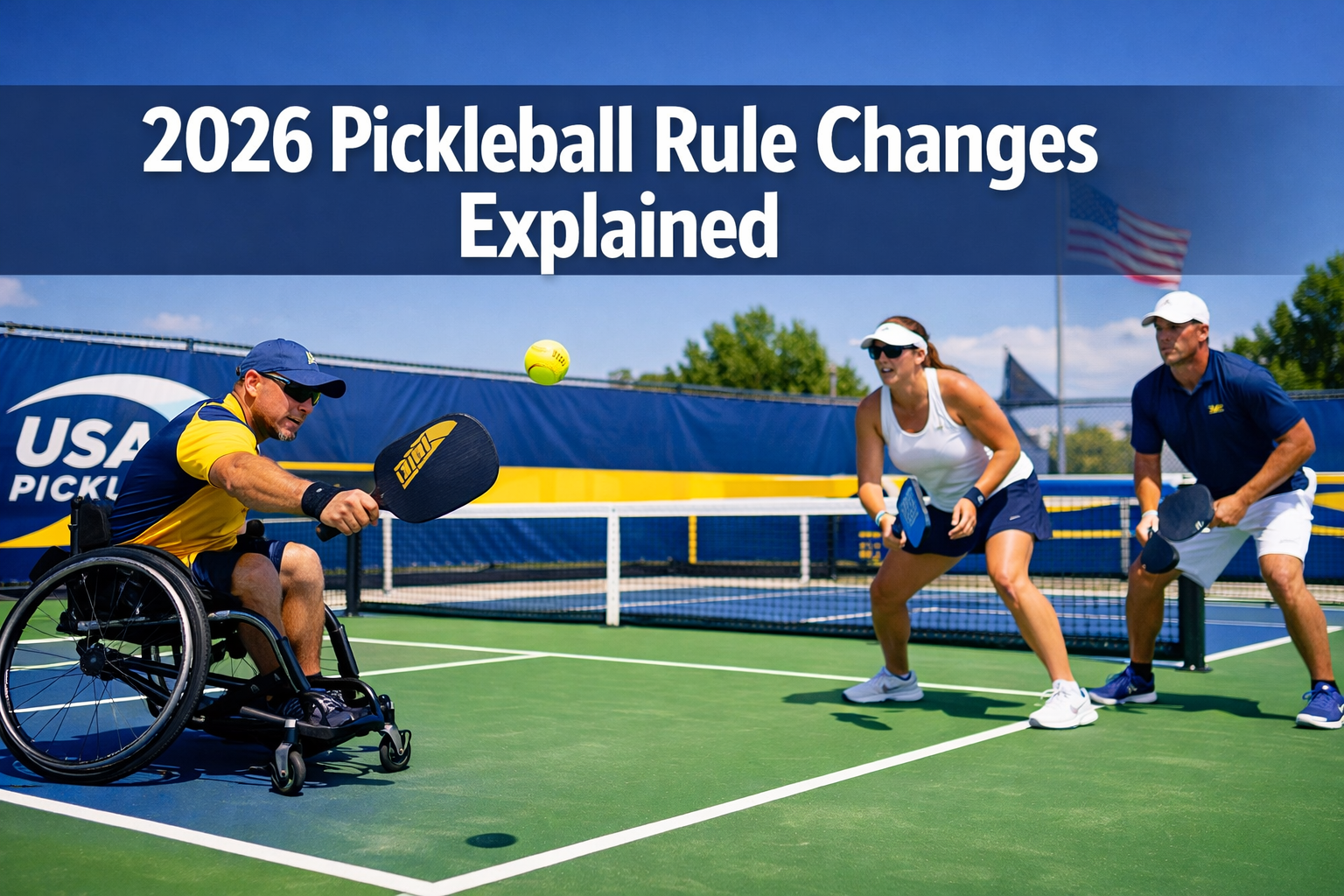
USA Pickleball has established a formal Adaptive Standing Division in the 2026 rulebook, complete with eligibility criteria, assistive-device rules, and specific accommodations for players with significant mobility or balance impairments. [1][3]
This is a meaningful step for the pickleball community. Previously, adaptive players often navigated a patchwork of informal accommodations. Now there’s a clear, official framework.
Who Is Eligible?
The two-bounce allowance — the division’s key accommodation — is designed for players with significant mobility or balance limitations. Examples include:
- Players with above-knee amputations
- Players with certain neurological conditions affecting balance or gait [3]
Eligibility isn’t self-declared casually. Some events may require a visible marker to signal the accommodation to opponents and officials. [3]
What Does the Two-Bounce Allowance Mean?
Normally, the ball can only bounce once before a player must return it. Under the adaptive standing accommodation, eligible players may let the ball bounce twice on the playing surface before returning it — but must return it before a third bounce. [3][4]
This small rule change can make a significant difference for players who need extra time to move into position. It keeps competition fair while genuinely opening the door for more people to play. The sport’s commitment to inclusion is one of the reasons the pickleball community continues to grow across generations.
How Does the Two-Bounce Allowance Work in Doubles?
In mixed-ability doubles, only the player who declared the accommodation can use the two-bounce allowance. Their partner — if not eligible — must play under standard rules. [3][4]
This safeguard keeps the accommodation from becoming a loophole. Here’s how it plays out practically:
| Situation | Two-Bounce Allowed? |
|---|---|
| Eligible adaptive player, singles | ✅ Yes |
| Eligible adaptive player, doubles (their shot) | ✅ Yes |
| Non-eligible partner in doubles | ❌ No |
| Opponent in any format | ❌ No |
Pre-match declaration is required. Players must declare their intent to use the two-bounce allowance before the match begins. Waiting until mid-game is not permitted. [3]
For more on how pickleball continues to welcome players of all abilities, see this piece on creating an inclusive pickleball community.
What Changed With Serve Rules in 2026?
The 2026 rulebook raises the bar for what counts as a legal serve, tightening standards that had become a source of disputes at the competitive level. [4]
While the full technical specifications are detailed in the official USA Pickleball rulebook, the practical takeaway is this: serves that previously existed in a gray area are now more clearly defined as legal or illegal. This reduces arguments and speeds up play.
If you’re unsure whether your serve technique is compliant, it’s worth reviewing the common fouls and violations in pickleball to check your form before your next tournament.
Edge case: Players who use a spin serve or unusual motion should double-check against the updated rulebook, as these are the serves most likely affected by the new clarifications. [4]
Is Rally Scoring Here to Stay?
Rally scoring is provisional for 2026. Its long-term future in USA Pickleball depends on a formal review scheduled for 2027. [2][3]
USA Pickleball conducted extensive third-party research before approving the provisional format — analyzing match footage and gathering player feedback across skill levels. The majority of players surveyed supported the change. [2][4]
That said, “provisional” means exactly what it sounds like. If the 2027 review finds that rally scoring negatively affects the game — whether strategically, commercially, or competitively — it could be modified or removed.
What this means for you: Learn rally scoring now, but don’t completely retool your game around it. Traditional scoring isn’t going anywhere yet, especially at the national championship level.
For a broader look at where the sport is heading, this article on the future of pickleball is worth a read.
Practical Tips for Adapting to the 2026 Changes
Whether you’re a recreational player or gearing up for your first tournament, here’s how to get ready:
For rally scoring:
- Practice staying mentally sharp on every single point — there’s no “free” rally anymore
- Work on beginner-friendly pickleball drills that build consistency, since every error now directly costs a point
- Review your basic pickleball strategies with the new scoring format in mind
For adaptive play:
- If you or a playing partner may qualify for the two-bounce allowance, contact your tournament director well before the event
- Declare the accommodation before the match — not during
For serve compliance:
- Film your serve and compare it to the updated USA Pickleball rulebook standards
- If in doubt, simplify your motion — a clean, legal serve beats a flashy one that gets called out
FAQ: USA Pickleball’s 2026 Rule Changes
Q: Does rally scoring apply to recreational play? No. These changes apply to sanctioned tournament play. Recreational players can adopt them informally if they choose, but there’s no requirement.
Q: Can any tournament use rally scoring in 2026? Most can, but not all. Double-elimination doubles events, Golden Ticket events, and the National Championships must use traditional scoring. [2]
Q: What games-to score is used with rally scoring? Tournament directors can choose games to 11, 15, or 21 points. [2]
Q: What is the “freeze” rule, and is it really gone? The freeze referred to the situation where a leading team couldn’t score the game-winning point on their opponent’s serve. In rally scoring, that dynamic doesn’t exist — any team can win any point. [1][4]
Q: Who qualifies for the two-bounce allowance? Players with significant mobility or balance impairments, such as above-knee amputees or those with qualifying neurological conditions. Eligibility is defined in the 2026 rulebook. [3]
Q: Does the two-bounce allowance apply to both players in doubles? No. Only the declared eligible player can use it. Their partner must follow standard rules. [3][4]
Q: When must a player declare the two-bounce accommodation? Before the match begins. Mid-match declarations are not permitted. [3]
Q: Will rally scoring become permanent? That depends on a 2027 review by USA Pickleball. It’s provisional for now. [2][3]
Q: Are there any changes to paddle or equipment rules in 2026? The primary 2026 changes focus on scoring, adaptive divisions, and serve clarifications. Check the official USA Pickleball rulebook for any equipment updates.
Q: Where can I read the full 2026 rulebook? The official USA Pickleball rulebook is available directly at usapickleball.org. [6]
Conclusion: What to Do Next
USA Pickleball’s 2026 rule changes are meaningful — not just for competitive players, but for anyone who cares about where the sport is heading. Rally scoring makes every point count. The Adaptive Standing Division opens the game to more players. And cleaner serve rules reduce disputes on the court.
Here’s a simple action plan:
- Check your next tournament’s format — confirm whether rally scoring is in play before you show up
- Review your serve against the updated 2026 standards to avoid unnecessary faults
- Learn the adaptive rules so you can support eligible playing partners and opponents fairly
- Practice with rally scoring in mind — consistency and mental focus matter even more when every rally is a point
- Stay tuned for the 2027 review — rally scoring’s future will be clearer then
The pickleball community is growing fast, and staying informed is one of the best ways to keep improving. Whether you’re just picking up a paddle or competing regularly, these changes are worth knowing — and now you do.
References
[1] How To Play Pickleball And Pickleball Rules For 2026 – https://padelspeed.com/blogs/news/how-to-play-pickleball-and-pickleball-rules-for-2026 [2] USAP Rulebook Change Document – https://usapickleball.org/docs/rules/USAP-Rulebook-Change-Document.pdf [3] 2026 USA Pickleball Rulebook Changes Key Updates For The New Year – https://www.selkirk.com/blogs/pickleball-education/2026-usa-pickleball-rulebook-changes-key-updates-for-the-new-year [4] 2026 USA Pickleball Rule Changes What’s Changing This Year – https://www.playpickleball.com/2026-usa-pickleball-rule-changes-whats-changing-this-year/ [5] 2026 Rulebook Highlights 5 Ways Pickleball Is Still Evolving – https://blog.controlthet.com/pickleball/2026-rulebook-highlights-5-ways-pickleball-is-still-evolving [6] USAP Official Rulebook – https://usapickleball.org/docs/rules/USAP-Official-Rulebook.pdf [7] Top Seven Rules Pickleball 2026 – https://www.thepaseoclub.com/blog/top-seven-rules-pickleball-2026


