2026 Table Tennis Tech Revolution: Video Analytics, AI Training Tools, and Pro Fitness Trends Transforming the Game
Last updated: September 3, 2026
Quick Answer: The 2026 table tennis tech revolution combines AI-powered video analytics, smart training robots, and fitness tracking to give players at every level access to coaching tools once reserved for Olympic programs. Apps like PingPi and platforms like SportsReflector can analyze your stroke mechanics, spin, and match patterns from a smartphone. The result is faster, more targeted improvement without the cost of full-time professional coaching.
Key Takeaways
- AI video analytics tools can now measure ball spin, speed, and stroke mechanics using just a smartphone camera
- Platforms like SportsReflector offer biomechanics scoring and subscription-based AI coaching for table tennis [3]
- PingPi delivers phone-only match review, ball landing maps, and 3D motion analysis [6]
- Consumer-grade AI training robots now feature adaptive workload control (similar to “Recovery Trigger” technology from tennis) [2]
- AI coaching tools cost anywhere from free (basic app tiers) to several hundred dollars per month for pro-level systems
- Real-time analytics and post-match analytics serve different purposes, both matter for development
- Wearables, UWB player tracking, and AI video are converging into unified fitness-plus-technique dashboards by late 2026
- AI tools work best alongside human coaching, not as a replacement
- Beginners benefit most from basic video feedback; pros extract value from granular data like spin rate and footwork efficiency
- You don’t need expensive equipment, a modern smartphone is enough to start with most apps
What Is AI Video Analytics for Table Tennis?
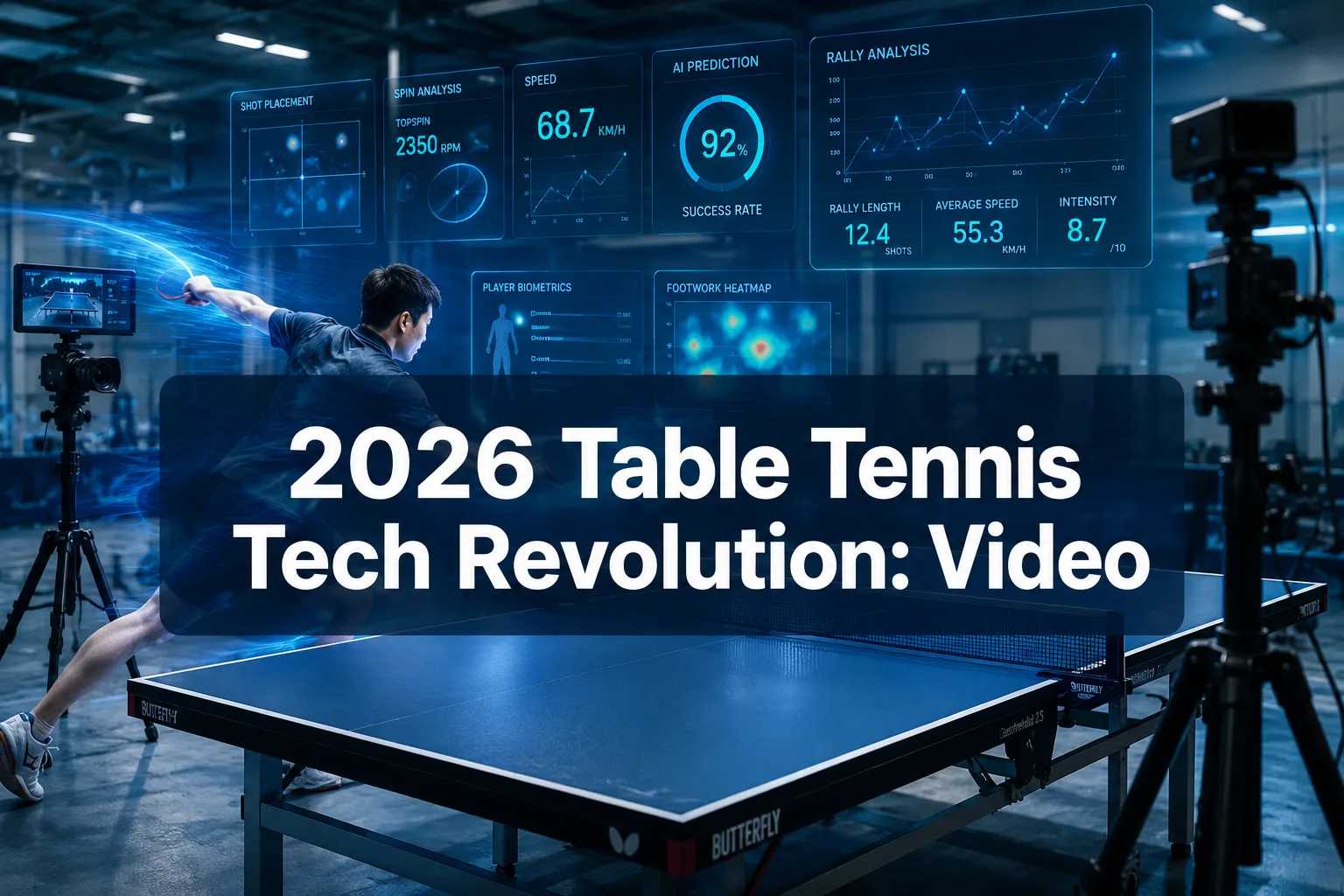
AI video analytics for table tennis is the use of computer vision and machine learning to automatically detect, measure, and report on ball movement, player technique, and match patterns from video footage. Instead of a coach manually reviewing hours of footage, the software flags key moments, scores your biomechanics, and generates actionable feedback.
In 2026, these systems range from free smartphone apps to dedicated court-side rigs with high-speed cameras and large touchscreens. The core functions are similar across tiers:
- Ball tracking: speed, trajectory, landing position
- Spin detection: topspin, backspin, sidespin identification
- Stroke analysis: racket angle, swing path, contact point
- Match statistics: rally length, shot distribution, error patterns

This technology matters because table tennis is one of the fastest racket sports, ball speeds can exceed 100 km/h and spin rates are extremely difficult to judge by eye alone. AI closes that perception gap.
How Do Pro Table Tennis Players Use AI Training Tools in 2026?
Top players in 2026 use AI training tools as a daily feedback layer on top of their existing coaching structure. The tools don’t replace their coaches, they give coaches better data to work with.
A typical pro workflow looks like this:
- Practice session recorded by fixed cameras or a smartphone on a tripod
- AI platform processes footage and generates a biomechanics score and shot-by-shot breakdown [3]
- Coach and player review the dashboard together, focusing on flagged weaknesses
- Training robot programmed to repeat the specific shot patterns that caused errors [1]
- Fitness data synced from wearables to track workload and recovery
Platforms like SportsReflector provide biomechanics scoring and structured coaching pathways specifically for table tennis [4]. Smart robots from brands like Pongbot, which debuted at CES 2026, now include “Recovery Trigger” technology that adjusts drill intensity based on the player’s real-time fatigue signals [2].
For players interested in how video analysis applies across racket sports, the principles are similar to what’s covered in video analysis learning from the pros in pickleball.
Best Video Analysis Software for Table Tennis in 2026
The best video analysis software for table tennis depends on your budget, skill level, and whether you want real-time feedback or post-match review.
Here’s a practical comparison of the leading options in 2026:
| Tool | Best For | Key Feature | Hardware Needed |
|---|---|---|---|
| PingPi | Beginners to intermediates | Ball maps, 3D motion, match review | Smartphone only [5][6] |
| SportsReflector | Intermediates to advanced | Biomechanics scoring, AI coaching | Smartphone or webcam [7] |
| Fastpong | Clubs and teams | Smart training ecosystem for coaches | Android device [10] |
| RNT/Liimba | Club-scale deployments | Multi-player tracking, dashboards | Dedicated camera system [8] |
Choose PingPi if you want to start today with zero extra hardware. Choose SportsReflector if you want structured coaching feedback with a biomechanics score. Choose Fastpong or RNT if you’re running a club and need multi-player management tools.
How Much Does AI Table Tennis Coaching Cost?
AI table tennis coaching ranges from free (basic app features) to several hundred dollars per month for professional-grade systems with dedicated hardware.
Practical cost breakdown for 2026:
- Free tier apps (PingPi basic, some SportsReflector features): limited shot counts or basic stats [5][7]
- Subscription apps (mid-tier): typically in the range of $10,$30/month for full analytics access
- Pro-level smart robots (like Pongbot’s CES 2026 system): consumer pricing not publicly listed, but positioned as premium training equipment [9]
- Club systems (RNT, Liimba): custom pricing based on installation and seat count [8]
The good news for recreational players: the most useful features, video review, basic shot mapping, and stroke feedback, are accessible at the low end of this range. You don’t need a $10,000 court-side rig to improve.
This mirrors what’s happened in other racket sports. Coaching technology that was once exclusive to elite programs is now reaching everyday players, much like the gear evolution described in the evolution of pickleball equipment from wooden paddles to modern gear.
Can AI Predict Table Tennis Player Performance?
Yes, AI systems in 2026 can predict likely performance trends based on historical data, but they are tools for probability, not certainty. Multimodal large-language-model (MLLM) coaching systems, validated in 2025 academic research and now active in 2026, can identify patterns in a player’s shot selection, error rates, and physical output to flag where performance is likely to drop or improve.
Practically, this means:
- Trend dashboards show whether your serve return accuracy is improving or plateauing over weeks
- Fatigue prediction (via workload data from robots like Pongbot) flags when training intensity should drop [2]
- Opponent modeling in some platforms can suggest tactical adjustments based on a recorded opponent’s tendencies
The accuracy of these predictions improves with more data. A player with three months of logged sessions will get more reliable forecasts than one with three sessions.
Table Tennis Fitness Tracking Technology in 2026
Fitness tracking for table tennis in 2026 goes well beyond step counts. The emerging standard combines wearable heart rate and movement sensors with UWB (ultra-wideband) court tracking and AI video to build a complete conditioning picture.
Key fitness metrics now tracked by smart systems:
- Footwork distance and speed per rally and per session
- Heart rate zones during match play vs. drilling
- Recovery time between high-intensity exchanges
- Workload accumulation across training weeks (the “Recovery Trigger” approach from Pongbot) [2]
Integrated robot-driven footwork drills, where the robot feeds balls to specific court positions and the system tracks how quickly and efficiently the player reaches each ball, are now a standard feature in pro-level training setups [1].
This integration of conditioning and technique data is also gaining traction in other racket sports. The physical benefits of playing pickleball and how it enhances fitness and coordination article explores similar fitness-sport crossover themes worth reading alongside this.
AI Training Tools vs. Human Coaching for Table Tennis
AI tools and human coaches serve different functions, they’re most effective when used together, not as substitutes for each other.
AI tools are better at:
- Consistent, objective measurement (no coach bias)
- Tracking large volumes of data across many sessions
- Identifying micro-errors in technique that are hard to spot in real time
- Providing feedback outside of scheduled coaching hours
Human coaches are better at:
- Reading a player’s motivation and mental state
- Making in-session tactical adjustments
- Teaching feel and touch, qualities that are hard to quantify
- Building the trust and accountability that drives long-term development
The practical advice: use AI tools to prepare better questions for your coach and to track whether their advice is actually changing your numbers. For players without regular access to a coach, AI tools fill a genuine gap. For more on how different coaching approaches shape development, the coaching methodologies guide for pickleball offers useful perspective that applies across racket sports.
Real-Time vs. Post-Match Table Tennis Analytics: What’s the Difference?
Real-time analytics deliver feedback during a session; post-match analytics process footage after play ends. Both are valuable, but they serve different training goals.
Real-time analytics:
- Instant feedback on each shot (speed, spin, placement)
- Useful for drilling specific skills with immediate correction
- Requires hardware capable of low-latency processing (high-speed cameras, dedicated processors)
- Best for structured practice sessions with a clear focus
Post-match analytics:
- Deeper statistical review of full matches or long sessions
- Identifies patterns across many rallies (e.g., you lose 70% of points after a third-ball attack)
- Works well with smartphone footage processed after the session [6]
- Best for tactical planning and long-term trend tracking
Most players benefit from starting with post-match analytics (lower cost, easier setup) and adding real-time feedback tools as their training becomes more structured.
How Accurate Is AI for Analyzing Table Tennis Spin and Speed?
AI spin and speed detection in 2026 is accurate enough to be practically useful, but accuracy varies by system quality and camera setup. High-speed camera systems (used in pro-level setups) can detect spin direction and approximate rate with high reliability. Smartphone-based apps like PingPi use computer vision on standard video, which is less precise for spin rate but reliable for spin direction and ball speed [5][6].
Factors that affect accuracy:
- Camera frame rate (higher = better spin detection)
- Lighting consistency at the venue
- Camera angle relative to the table
- Ball color contrast against the background
For recreational and intermediate players, smartphone-based accuracy is more than sufficient to identify patterns and improve. For elite-level spin analysis, dedicated hardware delivers meaningfully better data [8].
Table Tennis Video Analytics for Beginners vs. Pros
Beginners and pros use video analytics differently, and that’s exactly how it should be.
Beginners should focus on:
- Basic stroke form (racket angle, contact point)
- Ball placement consistency (are shots landing where intended?)
- Simple match stats (unforced error rate, serve patterns)
- Apps: PingPi or SportsReflector basic tier [5][7]
Advanced and pro players should focus on:
- Biomechanics scoring and joint-angle optimization
- Spin variation patterns across a match
- Opponent tendency modeling
- Footwork efficiency metrics
- Platforms: SportsReflector full tier, RNT, pro-level robot systems [3][8]
The common mistake is beginners trying to process too much data too soon. Start with one or two metrics, build a habit of reviewing footage, and add complexity as your game develops. This approach to skill-building applies across all racket sports, the intermediate drills guide for elevating your game covers the same principle well.
Common Mistakes When Using AI Training Tools in Table Tennis
The biggest mistake is treating AI feedback as the goal rather than a means to improve on the table. Here are the most common errors and how to avoid them:
- Data overload: Reviewing every metric after every session leads to paralysis. Pick one focus area per week.
- Ignoring context: A drop in your biomechanics score might mean fatigue, not technique regression. Cross-reference with your workload data.
- Poor camera setup: Shaky footage or bad angles produce unreliable analysis. Use a stable tripod and consistent positioning.
- Skipping the “so what”: Analytics tell you what happened. You still need to decide what to do about it, ideally with a coach or training partner.
- Neglecting physical conditioning: Tech tools focus on technique and tactics. Don’t let fitness tracking become an afterthought. [2]
Do You Need Expensive Equipment for Table Tennis Video Analysis?
No, a modern smartphone is enough to get started with most AI video analysis apps in 2026. PingPi, for example, runs entirely on a phone and delivers ball maps, match review, and 3D motion analysis without any additional hardware [5][6].
What you do need:
- A smartphone with a decent camera (most phones from 2022 onward work)
- A stable mount or tripod (inexpensive)
- Consistent, well-lit playing environment
- A subscription to an analytics app (free tiers available)
Expensive hardware (high-speed cameras, court-side processors, smart robots) adds accuracy and real-time capability, but the core value of video analytics, seeing your game from the outside and tracking patterns over time, is fully accessible at low cost.
How to Integrate Fitness Tracking with Table Tennis Training
Integrating fitness tracking with table tennis training works best when you treat conditioning data and technique data as two sides of the same coin, not separate systems.
Practical steps to integrate both:
- Log every session, duration, drill type, and perceived effort alongside any app analytics
- Use a wearable for heart rate and movement data during play (most sports watches work)
- Sync with your analytics app if the platform supports it (some pro-level systems do this automatically) [2]
- Set weekly load targets, track total training time and intensity to avoid overtraining
- Review fitness and technique trends together, if your error rate rises when your weekly load is high, that’s a recovery signal
- Use robot footwork drills to train conditioning and technique simultaneously [1]
For players who also train in other racket sports, this integrated approach transfers well. The benefits of training camps for accelerating skill development covers how structured, data-informed training blocks drive faster improvement.
FAQ
Q: Can I use AI table tennis coaching apps on Android? Yes. Fastpong is available on Android via Google Play [10], and several other platforms offer cross-platform support.
Q: Is SportsReflector only for table tennis? No. SportsReflector covers multiple sports, but it has a dedicated table tennis module with sport-specific biomechanics scoring [3][4].
Q: How long does it take to see improvement using AI analytics? Most players notice measurable changes in their tracked metrics within four to six weeks of consistent use, provided they act on the feedback rather than just collecting data.
Q: Do AI training robots replace drilling with a human partner? No. Robots are excellent for high-repetition technical drills, but they can’t replicate the variability, tactics, and pressure of a real opponent. Use both.
Q: What is “Recovery Trigger” technology in table tennis robots? Recovery Trigger is an adaptive training feature in Pongbot’s 2026 systems that monitors player fatigue signals and automatically adjusts drill intensity or pauses the session to prevent overtraining [2].
Q: Is PingPi free? PingPi has a free download with basic features. Full analytics access requires a subscription [5].
Q: How does AI detect spin in table tennis? AI systems use computer vision to track the ball’s rotation between frames. Higher frame rates and better lighting improve detection accuracy. Smartphone apps detect spin direction reliably; precise spin rate measurement requires higher-end hardware [6].
Q: Can clubs use these tools for multiple players at once? Yes. Platforms like Fastpong and RNT/Liimba are designed for club-scale deployment with multi-player management and coach dashboards [8][10].
Q: What if I don’t have a coach, can AI tools still help? Absolutely. AI tools are especially valuable for self-coached players because they provide objective feedback that’s otherwise hard to access. Start with a basic app and focus on one metric at a time.
Q: Are these tools useful for recreational players, or only competitors? Both. Recreational players benefit from basic video review and shot mapping. Competitors extract more value from deeper analytics, but the entry-level tools are genuinely useful at any level.
Conclusion
The 2026 table tennis tech revolution is real, and it’s accessible. You don’t need an Olympic training budget to use AI video analytics, smart robots, or fitness tracking tools, a smartphone and a free app is enough to start seeing your game differently.
Actionable next steps:
- Download PingPi or SportsReflector and record your next session from a tripod-mounted phone
- Pick one metric to focus on, serve placement, backhand error rate, or footwork distance
- Review footage weekly, not daily, to spot trends rather than noise
- Pair tech feedback with deliberate drilling, use what the data shows to shape your next practice
- Add fitness tracking once your technique review habit is established
The racket sports community is at a genuinely exciting point. Whether you play table tennis, pickleball, padel, or any other racket sport, the tools to train smarter are now within reach. Use them consistently, stay curious, and let the data guide your improvement, one session at a time.
References
[1] Ai Table Tennis Robot – https://store.pongbotsports.com/blogs/news/ai-table-tennis-robot [2] Pongbots Ai Tennis And Table Tennis Robots Make Ces 2026 Debut With Recovery Trigger Technology – https://the-gadgeteer.com/2026/01/20/pongbots-ai-tennis-and-table-tennis-robots-make-ces-2026-debut-with-recovery-trigger-technology/ [3] Table Tennis – https://sportsreflector.com/sports/table-tennis [4] Table Tennis – https://sportsreflector.com/ai-faq/table-tennis [5] Id6768219425 – https://apps.apple.com/us/app/pingpi-ai-table-tennis-coach/id6768219425 [6] pingpi.pro – https://pingpi.pro/ [7] Best Ai Table Tennis Coaching App – https://sportsreflector.com/best-ai-table-tennis-coaching-app [8] Tischtennis – https://rnt.de/en/solutions/sport-data/tischtennis/ [9] Pongbot Debuts Ces 2026 Pace 170000263 – https://finance.yahoo.com/news/pongbot-debuts-ces-2026-pace-170000263.html [10] Details – https://play.google.com/store/apps/details?id=com.fastpong.android