
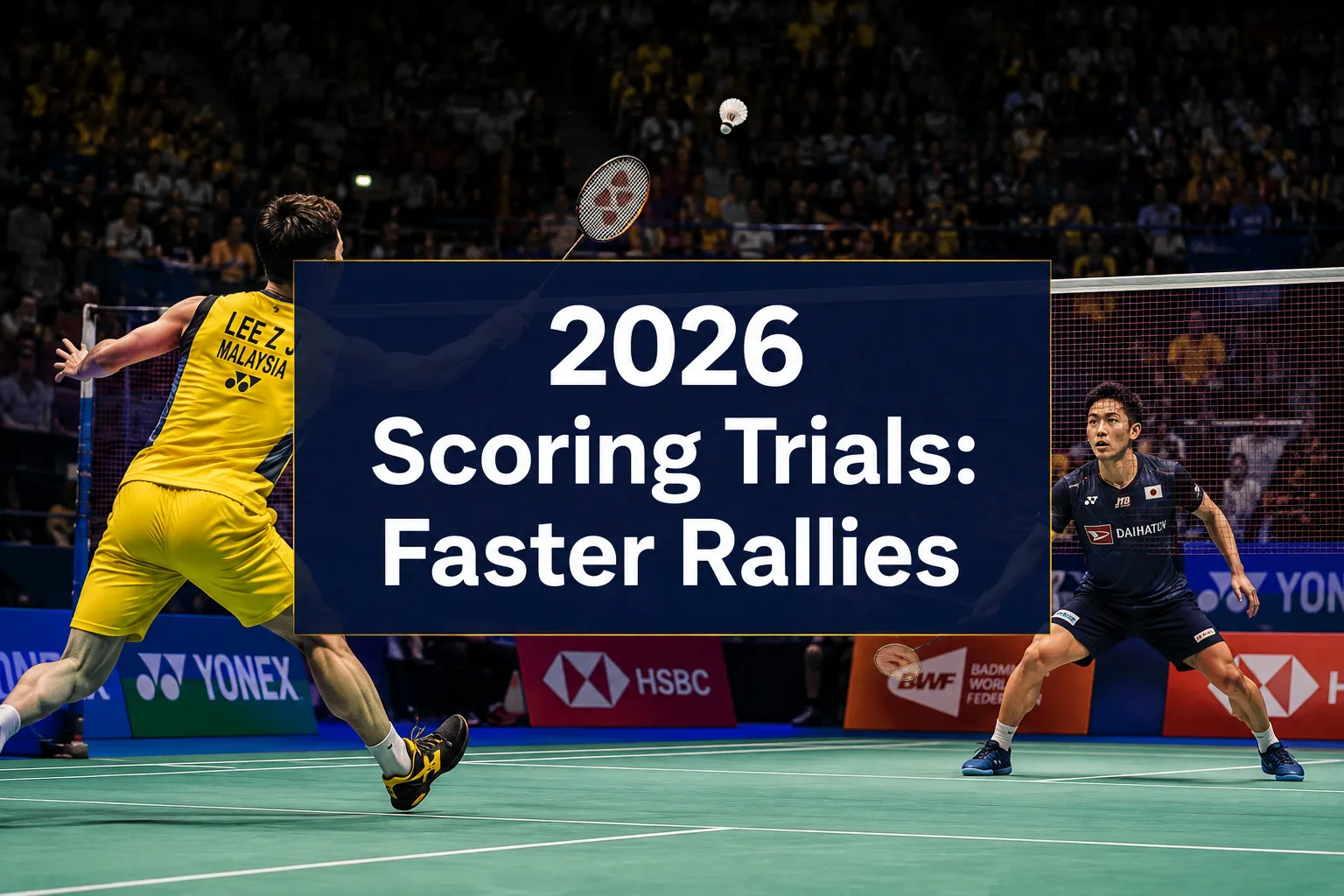
2026 New Scoring System Trials: Faster Rallies, Fan Reactions, and Path to BWF Adoption
Last updated: August 4, 2026
Quick Answer: In April 2026, the Badminton World Federation (BWF) formally approved a switch from the traditional 3×21 scoring format to a 3×15 rally-point system at its Annual General Meeting in Horsens, Denmark. The new format shortens matches, speeds up rallies, and is designed to boost viewership. The system is set to take full effect from January 2027, with select tournaments already trialing it in 2026.
Key Takeaways
- The BWF officially ratified the 3×15 scoring system in April 2026, replacing the long-standing 3×21 format [3]
- Each game now goes to 15 points instead of 21, with a cap at 17 (replacing the old deuce-to-30 rule) [4]
- The change is designed to shorten match durations and make badminton more appealing to broadcast audiences [3]
- Player reactions are divided, some welcome the faster pace, others worry about losing tactical depth [2]
- Top Indian coaches and players have raised concerns that the new system could strip the sport of its strategic essence [6]
- The Thomas Cup and Uber Cup were among the first major events to showcase the new format in 2026 [4]
- Full global implementation is scheduled for January 2027 [3]
- Doubles play is affected differently than singles, shorter games change serve rotation and partnership dynamics
- If fan and player feedback during the trial period is negative, the BWF could revisit the format before full rollout

What Is the 2026 Badminton Scoring System Change About?
The 2026 new scoring system trials mark the biggest rule shift in badminton in nearly two decades. The BWF voted to replace the 3×21 rally-point format with a 3×15 system, where each game is played to 15 points, with a cap at 17 if the score reaches 15-15.
The decision was passed at the BWF Annual General Meeting in Horsens, Denmark, in April 2026 [3]. The core goal is to make matches shorter, more intense, and easier to schedule for broadcasters and streaming platforms. A standard match under the old system could run 60-90 minutes or more. The new format aims to bring that down significantly.
This isn’t the first time the BWF has experimented with scoring. The federation trialed a 3×15 format with a 21-point cap as far back as 2025 in lower-tier events [7], gathering data before the formal vote.
How Does the New 2026 Scoring System Make Rallies Faster?
Fewer points per game means every rally carries more weight. Under the 3×15 system, a single mistake at 13-12 is far more costly than the same error at 18-17 under the old format, so players attack earlier and take fewer risks on extended defensive rallies.
Here’s what changes in practice:
- Shorter games mean less time to recover from a slow start
- The 17-point cap replaces the old deuce system, which could drag games out indefinitely
- Serve pressure increases because each service game represents a larger share of the total score
- Momentum swings faster, a 3-point run can flip a game in seconds
For fans watching live or on TV, this translates to more decisive moments, fewer long baseline exchanges, and matches that fit neatly into broadcast windows. The BWF has been transparent that broadcast appeal was a major driver behind the change [3].
How Is the 2026 Scoring System Different from Current Rules?
| Feature | Old System (3×21) | New System (3×15) |
|---|---|---|
| Points per game | 21 | 15 |
| Deuce rule | Yes (up to 30) | Cap at 17 |
| Typical match length | 60-90 min | Est. 40-60 min |
| Service rotation | Every rally | Every rally (unchanged) |
| Number of games | Best of 3 | Best of 3 |
The rally-point scoring method itself stays the same, every rally produces a point regardless of who served. What changes is the ceiling. Reaching 15 points faster compresses the psychological arc of each game and removes the long deuce battles that sometimes frustrated casual viewers [4].
Which Tournaments Are Testing the 2026 New Scoring System?
The Thomas Cup and Uber Cup in 2026 were among the first high-profile team events to feature the new format [4]. These tournaments gave the BWF real data on how elite players and live audiences responded to the change.
Earlier in the year, lower-tier BWF circuit events had already been used as testing grounds, with results feeding into the April AGM decision [7][8]. The trial approach allowed the federation to compare match statistics, average duration, rally counts, and viewer engagement metrics, before committing to a full rollout.
The 2026 trial period also covers select Super Series and World Tour events, with full adoption across all BWF-sanctioned competitions planned for January 2027 [3].
What Do Fans Think About the 2026 Badminton Scoring Trials?
Fan reactions to the 2026 new scoring system trials have been genuinely mixed, though enthusiasm for faster matches is noticeable among newer and casual viewers.
Fans who support the change say:
- Matches feel tighter and more exciting from the first point
- Shorter games mean they can watch more matches in a single session
- The format is easier to follow for people new to badminton
Fans who are skeptical say:
- Long, grinding matches are part of what makes badminton dramatic
- The old deuce system created memorable comeback moments
- 15 points feels “too quick”, some matches end before a rhythm develops
Social media discussions among the badminton community reflect this split [9]. Longtime fans of the sport tend to feel the change sacrifices depth for entertainment value, while newer audiences and casual viewers lean positive.
Do Players Prefer the Faster Rallies in the 2026 System?
Players are divided, and some of the most prominent voices have been critical. According to Reuters, the player community was noticeably split when the BWF ratified the 15-point system [2].
Top Indian coaches have been among the most vocal opponents. Several have argued that the new format could fundamentally alter the sport’s character, reducing the importance of stamina, mental resilience, and long-game strategy [6]. In a sport where players like Viktor Axelsen and PV Sindhu have built careers on physical endurance and tactical patience, a shorter format changes what skills matter most.
That said, some players, particularly those who favor aggressive, attacking styles, see the shorter format as an advantage. When every point counts more, fast-starting players with powerful smashes can dominate before opponents settle into a defensive rhythm.
For players looking to sharpen their attacking game regardless of format, working on advanced spin and placement techniques is increasingly valuable under either scoring system.
What Are the Downsides of the 2026 Badminton Scoring Changes?
The 2026 new scoring system trials have surfaced several legitimate concerns from coaches, players, and analysts.
Strategic depth shrinks. With only 15 points per game, there’s less room to implement a slow-build game plan. Players who rely on reading opponents over long rallies lose a key weapon [6].
Upsets become more likely, but not always in a good way. A lucky net cord or a single service error at 14-14 can end a game. Some argue this introduces randomness that doesn’t reflect true skill differences.
Doubles dynamics shift significantly. In doubles, serve rotation and partnership communication are built around longer games. Shorter games mean less time to establish patterns and exploit weaknesses (more on this below).
Coaching adjustments are steep. Coaches who have spent years building game plans around 21-point structures now need to rebuild their approach from scratch.
Athlete preparation changes. Endurance training, which has always been central to badminton tips at the elite level, becomes relatively less important compared to explosive power and early-game aggression.
Is the 2026 Scoring System Better for Viewership and Entertainment?
From a broadcast perspective, yes, the shorter format is clearly designed to help. Matches that fit into predictable time slots are easier to sell to TV networks and streaming platforms. The BWF has acknowledged this as a primary motivation [3].
For live arena audiences, the verdict is less clear. Some fans enjoy the intensity of a 15-point game. Others feel cheated when a match they traveled to watch ends in under 40 minutes.
The entertainment argument is strongest for:
- New fans who find long matches hard to follow
- Multi-match event days where shorter games allow more content
- Streaming platforms that need predictable content windows
It’s weaker for:
- Hardcore fans who value the full tactical arc of a long match
- Players who thrive on momentum-building over extended rallies
The parallel to other racket sports is worth noting. Formats like the Fast4 tennis trial and shorter table tennis sets have shown that condensed scoring can attract new audiences without necessarily replacing the traditional format entirely. If you’re curious how scoring and format changes affect community engagement across racket sports, the pickleball community’s growth story offers some interesting lessons.
How Long Will the Trial Period Last for the 2026 System?
The trial period effectively runs through 2026, with the BWF collecting performance data from Thomas Cup, Uber Cup, and select World Tour events before the January 2027 full rollout [3][4].
The AGM vote in April 2026 formally approved the system, but the phased implementation gives the federation time to address issues that emerge during live competition. Think of 2026 as the real-world stress test before the system becomes the global standard.
Key milestones:
- April 2026: BWF AGM ratifies the 3×15 system [3]
- Mid-2026: Thomas Cup and Uber Cup debut the format [4]
- Late 2026: World Tour events continue trialing the system
- January 2027: Full adoption across all BWF-sanctioned competitions [3]
How Does the 2026 Scoring System Affect Doubles vs. Singles Play?
The impact is meaningfully different between the two formats.
In singles, the change primarily affects stamina-based strategies. Players who grind opponents down over long rallies, a hallmark of elite singles play, have less time to execute that approach. Early aggression is rewarded more than it was under 3×21.
In doubles, the effects are more structural:
- Serve rotation happens less frequently per game, so partners get fewer opportunities to exploit favorable matchups
- Communication and positioning need to be sharper from the first rally, there’s no “settling in” period
- Momentum management is compressed; a 4-0 run in doubles under the new system is almost a third of the game gone
For doubles players, the shift is arguably more disruptive. Pairs that rely on building chemistry and reading opponents over time will need to adapt their approach. If you’re working on doubles coordination in any racket sport, effective communication drills become even more critical under a compressed scoring format.
What Happens If the BWF Doesn’t Fully Adopt the 2026 Scoring System?
The BWF has already voted to adopt the system, so a full reversal before January 2027 would require another AGM vote or emergency council decision. That’s unlikely but not impossible if trial data shows significant negative outcomes.
More realistically, if problems emerge during the 2026 trials, the BWF could:
- Adjust the cap (for example, moving from 17 back to a deuce system)
- Limit the format to specific event categories rather than applying it universally
- Extend the trial period beyond January 2027
The federation has shown willingness to experiment, the 2025 lower-tier trials [7] were specifically designed to build a data-backed case before the full vote. That same data-driven approach suggests they would respond to clear evidence of problems rather than pushing through a flawed system.
Are There Any Complaints About the 2026 Scoring Trial Format?
Yes, and they go beyond just “we prefer 21 points.” The most substantive complaints include:
- Inconsistency across events. During the trial phase, some tournaments used the new format while others didn’t, creating confusion for players preparing for multiple competitions.
- Lack of player consultation. Several coaches and players felt the change was driven by commercial interests rather than athlete feedback [6][2].
- Impact on developing players. Coaches working with younger athletes note that the 3×21 format teaches patience and resilience, qualities that a 3×15 game doesn’t develop as thoroughly.
- Broadcast gaps. Ironically, some broadcasters found that matches ending too quickly left awkward gaps in scheduled programming.
These complaints don’t necessarily mean the system will fail. But they’re worth tracking as the 2026 trial period continues. Understanding how rule changes affect both elite and recreational players is something the broader racket sports community continues to debate actively.
When Will the 2026 Scoring System Be Officially Adopted by BWF?
The BWF has set January 2027 as the date for full global adoption of the 3×15 scoring system [3]. The April 2026 AGM vote was the formal approval step, what remains is the transition period through the rest of 2026.
All national badminton associations affiliated with the BWF are expected to align their domestic competitions with the new format by that date. International tournaments, including the All England Open, BWF World Championships, and Olympic qualifying events, will all operate under the new system from January 2027 onward.
For recreational players and club-level competitors, the timeline to adopt the new format will vary by country and local association. Checking with your national federation or local club is the best way to know when the change hits your regular games.
FAQ
Q: What is the new BWF scoring system in 2026? The BWF adopted a 3×15 rally-point system in April 2026, replacing the 3×21 format. Each game goes to 15 points, with a cap at 17 if the score ties at 15-15.
Q: When does the 3×15 scoring system officially start? Full implementation across all BWF-sanctioned events is set for January 2027. Select tournaments, including the Thomas Cup and Uber Cup, began trialing the format in 2026.
Q: Why did the BWF change the scoring system? The primary reasons are shorter match durations, improved broadcast scheduling, and broader appeal to new and casual audiences. Commercial and viewership considerations were key drivers.
Q: Do professional players support the new scoring system? Player opinion is divided. Some players who favor aggressive styles welcome the change. Many others, particularly those with endurance-based games, have expressed concern about losing tactical depth.
Q: How does the 15-point system affect doubles play? Doubles pairs have less time to establish patterns and exploit matchups. Serve rotation happens fewer times per game, putting greater pressure on early communication and positioning.
Q: Can the BWF reverse the decision before January 2027? Technically yes, through another AGM vote or emergency council decision. In practice, a full reversal is unlikely unless trial data shows serious problems with the format.
Q: Does the 3×15 system change how players train? Yes. Explosive power, fast starts, and early aggression become more important. Long-rally endurance training, while still valuable, is relatively less central than under the 3×21 format.
Q: Is the new scoring system used at the Olympics? Olympic badminton falls under BWF rules. Once full adoption occurs in January 2027, the 3×15 system will apply to Olympic qualifying events and the Games themselves going forward.
Q: How does the 17-point cap work? If the score reaches 15-15, play continues until one player or pair reaches 17. There is no further deuce, 17 is the absolute ceiling.
Q: Where can I watch matches using the new scoring format? The Thomas Cup and Uber Cup in 2026 featured the new format. Check BWF’s official broadcast partners and streaming platforms for upcoming World Tour events using the 3×15 system.
Conclusion
The 2026 new scoring system trials represent a genuine turning point for badminton. The BWF’s move to 3×15 is bold, commercially motivated, and already sparking real debate across the racket sports community.
For fans, the faster format delivers more intensity per minute. For players, it demands a rethink of training priorities, less emphasis on grinding endurance, more on explosive early-game execution. For coaches, it means rebuilding game plans from the ground up.
Here’s what to do right now:
- Follow the trial results from the remaining 2026 World Tour events, real match data will tell you more than any debate
- Adjust your training if you play badminton competitively: prioritize fast starts, sharper serve pressure, and early attack patterns
- Check with your local club or national federation for when the 3×15 format hits recreational and club-level play in your area
- Stay engaged, the racket sports community’s feedback during this trial period genuinely matters to how the format evolves
Whether you’re a badminton player, a multi-sport athlete, or just someone who loves racket sports, this is a change worth understanding. And if you’re looking to sharpen your overall game while the rules evolve, building a structured practice routine is always a smart move regardless of what the scoreboard says.
References
[1] India Badminton 3×15 Scoring System July 2026 – https://www.olympics.com/en/news/india-badminton-3×15-scoring-system-july-2026
[2] Players Divided Bwf Ratifies 15 Point Scoring System 2026 04 28 – https://www.reuters.com/sports/players-divided-bwf-ratifies-15-point-scoring-system-2026-04-28/
[3] World Body Approves Switch 3×15 Scoring System January 2027 2026 04 25 – https://www.reuters.com/sports/world-body-approves-switch-3×15-scoring-system-january-2027-2026-04-25/
[4] Badminton Rule Change New Point System Bwf Thomas Cup 2901582 2026 04 25 – https://www.indiatoday.in/sports/badminton/story/badminton-rule-change-new-point-system-bwf-thomas-cup-2901582-2026-04-25
[5] Badminton World Federation Grants Approval To Use 3 X 15 Point System 23627538 – https://www.mid-day.com/amp/sports/other-sports/article/badminton-world-federation-grants-approval-to-use-3-x-15-point-system-23627538
[6] New Scoring System Badminton Could Lose Its Essence Say Top Indian Coaches 101777224691660 Amp – https://www.hindustantimes.com/sports/badminton/new-scoring-system-badminton-could-lose-its-essence-say-top-indian-coaches-101777224691660-amp.html
[7] Bwf Trial New 3 15 Scoring System With 21 Point Cap In 2025 – https://www.badmintonplanet.com/badminton-news/bwf-trial-new-3-15-scoring-system-with-21-point-cap-in-2025.html
[8] Content 118331637 – http://www.china.org.cn/world/Off_the_Wire/2026-02/12/content_118331637.shtml
[9] Facebook community discussion – https://www.facebook.com/groups/471103206956647/posts/2034125753987710/
[10] Snupo2zznzbctk4roagrl2knly – https://www.chosun.com/english/sports-en/2026/04/26/SNUPO2ZZNZBCTK4ROAGRL2KNLY/



![The Underrated Skill Transforming Pickleball in 2026: Mastering [Key Skill from Video] for Tournament Wins](https://rallyracket.com/wp-content/uploads/2026/06/The-Underrated-Skill-Transforming-Pickleball-in-2026-Mastering-Key-Skill-from-Video-for-Tournament-Wins-768x504.png "The Underrated Skill Transforming Pickleball in 2026: Mastering [Key Skill from Video] for Tournament Wins")