Smart Rackets Revolutionized Badminton in 2026: Top Models, Data Insights, and Pro Player Reviews
Last updated: May 12, 2026
Quick Answer: Smart badminton rackets are no longer a concept — they’re commercially available in 2026. Victor’s Intelligence chip system leads the market, tracking real-time swing speed, shot accuracy, and impact data through a connected app. Top models from Victor and Yonex now combine sensor technology with advanced materials like HM Graphite and Namd, giving players at every level actionable data to improve faster.
Key Takeaways
- Victor Intelligence is the first widely available smart chip system embedded in a badminton racket handle, tracking live performance metrics [6]
- Smart rackets connect to companion apps that display swing speed, smash power, shot count, and accuracy trends
- Advanced frame materials — including Namd, Tungsten, and High Resilience Modulus Graphite — are now standard across premium 2026 models [2]
- The Victor DriveX 12 is the top all-around smart-compatible flagship for 2026, balancing control, attack, and agility [2]
- The Yonex ASTROX 100ZZ (priced at approximately £231.99) remains the go-to power racket for intermediate to advanced players [2]
- Victor Thruster Ryuga II targets aggressive attackers with minimal vibration and strong shuttle acceleration [1]
- Ultra-slim shaft designs (as thin as 5.8 mm) now improve aerodynamics for faster swings without sacrificing stability [2]
- Amateur players can use smart racket data to set measurable training goals, similar to how fitness trackers changed running

What Exactly Is a Smart Badminton Racket?
A smart badminton racket is a standard-weight racket fitted with a sensor chip — usually in the handle — that records motion data during play and syncs it to a smartphone app. The racket itself plays like any performance model. The chip just adds a layer of real-time feedback.
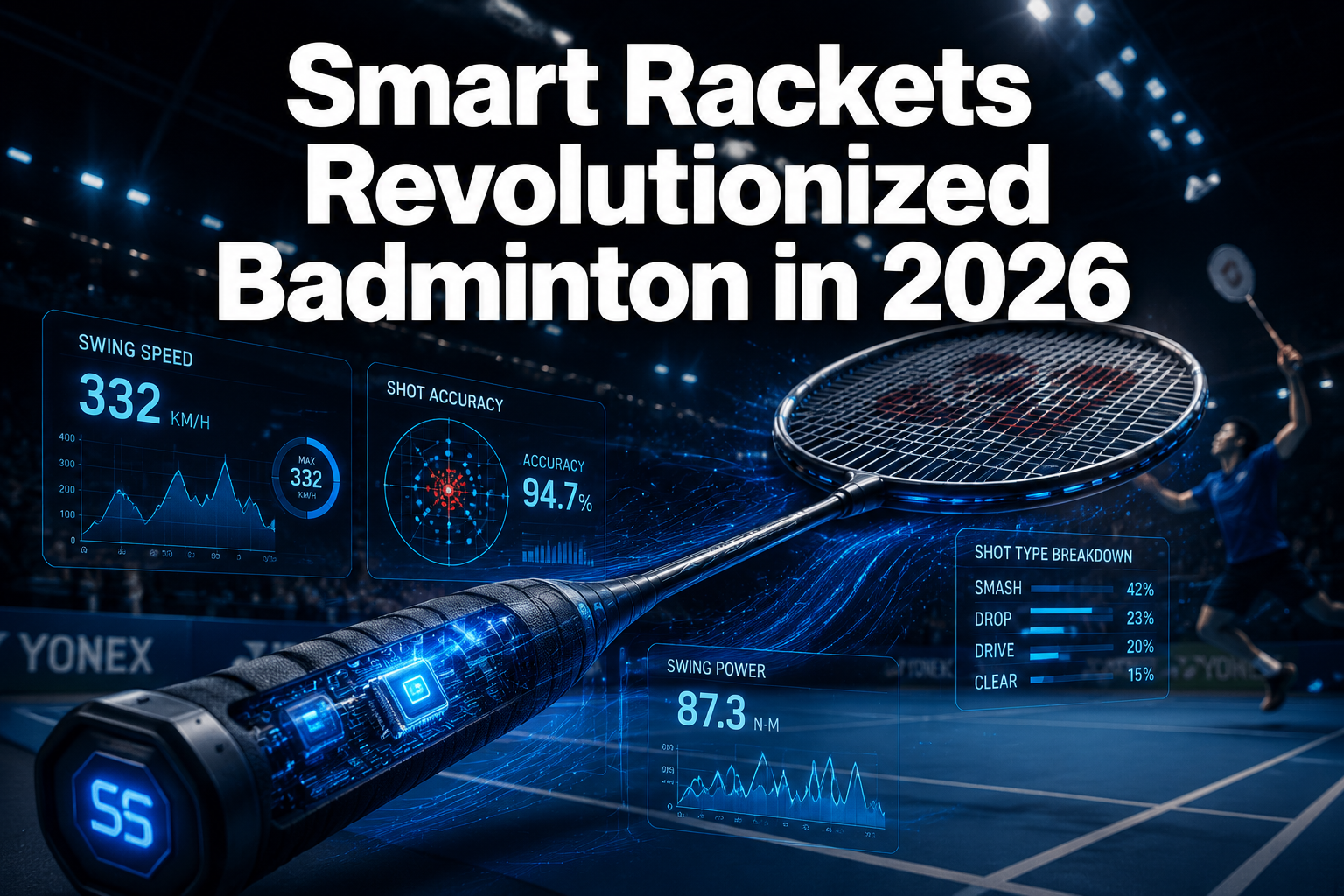
Victor’s Intelligence system, presented by their R&D team in 2026, is the clearest example of this technology reaching the market [3][6]. The chip tracks:
- Swing speed (how fast the racket head moves through impact)
- Shot type detection (smash, drop, clear, net shot)
- Impact accuracy (whether you’re hitting the sweet spot consistently)
- Rally and shot counts per session
- Fatigue patterns over time
This kind of data was previously only available to elite players with access to motion-capture labs. Now it’s accessible to anyone who can afford a mid-to-premium racket.
“Smart rackets close the gap between recreational players and coached athletes — not by replacing a coach, but by giving players the same quality of feedback.” — Rally Racket editorial team
How Smart Rackets Revolutionized Badminton in 2026: The Technology Behind the Data
The shift from concept to commercial product happened because sensor miniaturization finally caught up with racket engineering. Earlier prototypes added too much weight or disrupted balance. Victor’s Intelligence chip solves this by sitting flush inside the handle, keeping the racket’s swing weight and balance point unchanged [6].
Key technology layers in 2026 smart rackets:
| Feature | What It Does | Why It Matters |
|---|---|---|
| Embedded motion sensor | Captures 3D swing data at high frequency | Accurate shot-by-shot tracking |
| Bluetooth sync | Sends data to companion app in near real-time | No cables, no delay |
| Anti-torsion frame system | Reduces frame flex on off-center hits | Cleaner data readings |
| PowerBox frame standard | Improves strength-to-weight ratio | Consistent feel across all shots |
| Ultra-slim shaft (5.8 mm) | Reduces air drag during swing | Measurable speed gains [2] |
The anti-torsion and PowerBox frame systems aren’t just about feel — they also improve data accuracy. A frame that twists on impact creates inconsistent readings. Stiffer, more stable frames give the sensor cleaner motion signatures to interpret [1].
For players interested in how equipment technology has evolved across racket sports, the evolution of pickleball equipment from wooden paddles to modern gear follows a similar arc — materials first, then smart features.
Top Smart and High-Performance Badminton Racket Models in 2026
These are the models worth knowing in 2026, whether you want full smart features or just the best performance materials available.
Victor DriveX 12 — Best All-Around
Victor’s all-around flagship for 2026 combines control, aggressive attack power, and agile maneuverability in one frame [2]. It’s the model most compatible with the Victor Intelligence chip system and the one most coaches recommend for players transitioning from intermediate to advanced.
- Best for: Players who mix attacking and defensive play
- Frame: HM Graphite + DYNAMIC-SWORD aerodynamic shaping
- Balance: Even (slight head-light option available)
- Smart compatible: Yes
Victor Thruster Ryuga II — Best for Power Players
Designed specifically for aggressive attackers, the Ryuga II delivers strong shuttle acceleration and a solid, dampened feel on impact with minimal vibration [1]. If smash speed is your priority, this is the racket to test.
- Best for: Offensive singles players
- Frame: High Resilience Modulus Graphite + Tungsten
- Balance: Head-heavy
- Smart compatible: Partial (handle sensor adapter available)
Victor AURASPEED 100X Ultra — Best for Speed
The 5.8 mm ultra-slim Metallic Carbon Fiber shaft makes this the fastest-swinging racket in Victor’s 2026 lineup [2]. It suits players who rely on quick wrist action and fast net exchanges rather than raw power.
- Best for: Doubles players, net specialists
- Frame: Namd + DYNAMIC-SWORD frame
- Balance: Head-light
- Smart compatible: Yes
Yonex ASTROX 100ZZ — Best Premium Power Racket
Priced at approximately £231.99, the ASTROX 100ZZ remains the benchmark head-heavy power racket for intermediate to advanced players in 2026 [2]. It doesn’t carry a smart chip natively, but its reputation for smash consistency keeps it on every serious buyer’s shortlist.
- Best for: Advanced players focused on smash power
- Frame: HM Graphite + Namd
- Balance: Head-heavy
- Smart compatible: No (third-party sensor adapters exist)
What Data Do Smart Rackets Actually Track — and Is It Useful?
Smart rackets track swing speed, shot type, sweet spot accuracy, and session volume. For most players, swing speed and sweet spot data are the most immediately useful metrics.
Here’s how to use each metric practically:
Swing speed: Compare your smash swing speed across sessions. If it drops in the third game, that’s a fatigue signal — not a technique problem.
Sweet spot accuracy: A low sweet spot percentage (hitting outside the center strings frequently) usually points to grip issues or late swing timing, not power problems.
Shot type distribution: If your data shows 80% clears and 5% net shots in a singles match, you’re probably playing too defensively. The data makes that visible.
Session volume: Tracking shot counts helps prevent overuse injuries, especially for players ramping up training load.
For players who also play other racket sports, this kind of data-driven approach applies across disciplines. The same logic behind understanding shot selection in pickleball — making smarter decisions based on patterns — transfers directly to reading your badminton smart racket data.
How Pro Players Are Using Smart Racket Data in 2026
Elite players and their coaching teams are using smart racket data primarily for three things: fatigue management, technique calibration, and opponent preparation.
Fatigue management is the most immediate use. Coaches monitor swing speed trends across a tournament week. A 10–15% drop in smash swing speed between day one and day three is a reliable early warning sign for injury risk.
Technique calibration uses sweet spot accuracy data during training blocks. Players set a target (for example, 85% sweet spot contact rate during net drills) and track progress week over week.
Opponent preparation is more experimental. Some coaching teams are beginning to use shot distribution data to identify patterns — like a tendency to play cross-court clears under pressure — and build game plans around them.
Amateur players won’t have coaching staff analyzing their data, but the app interfaces for Victor Intelligence are designed to surface the same insights automatically [6]. The feedback is visual, simple, and actionable without needing a sports science background.
If you’re part of a local badminton club or online racket sports community, sharing session data with training partners is one of the best ways to use this technology. Connecting with other players through an online racket sports community can help you benchmark your numbers against players at a similar level.
Buying Guide: Choosing the Right Smart Racket for Your Level
Choose a smart-enabled racket if:
- You train at least 3 times per week and want measurable progress
- You’re working on a specific weakness (smash consistency, net game speed)
- You don’t have regular access to a coach
Stick with a standard high-performance racket if:
- You play casually once or twice a week
- Budget is a primary concern (smart models carry a 20–40% price premium, estimated)
- You prefer simplicity and don’t want to manage an app
Checklist before buying:
- Check shaft stiffness matches your swing speed (stiff for fast swings, medium for moderate)
- Confirm balance point suits your style (head-heavy for power, head-light for speed)
- Verify smart chip compatibility with your phone’s OS
- Test grip size — sensor handles can feel slightly different
- Check app availability in your region before purchase
For players newer to racket sports gear decisions, the same principles apply across sports. The beginner’s guide to choosing racket sports equipment covers the core concepts that transfer to badminton buying decisions.
How Smart Rackets Revolutionized Badminton in 2026: Training App Integrations
The companion apps for smart rackets are where the real value sits for amateur players. Victor Intelligence’s app (as of 2026) includes:
- Session dashboard: Shot count, swing speed average, sweet spot rate
- Progress charts: Week-over-week trends for key metrics
- Drill modes: Set targets for specific shot types and get real-time feedback
- Video sync: Some versions allow you to sync app data with phone video for side-by-side review
Third-party apps are also beginning to integrate with smart racket APIs, meaning players may eventually combine badminton data with general fitness tracking platforms.
For players who use video analysis to learn from their gameplay, syncing smart racket data with video footage creates a genuinely powerful feedback loop — you can see exactly what your body was doing when your swing speed peaked or dropped.
FAQ
Q: Are smart badminton rackets legal in official tournaments? A: Most governing bodies, including BWF, currently prohibit electronic devices during match play. Smart rackets are for training use only — the chip must be removed or deactivated before competition.
Q: How much do smart badminton rackets cost in 2026? A: Smart-enabled models typically carry a 20–40% premium over equivalent non-smart versions. Expect to pay £180–£300+ for a quality smart racket at the intermediate-to-advanced level (estimated range based on available pricing data).
Q: Does the sensor chip affect racket weight or balance? A: Victor’s Intelligence chip is designed to sit inside the handle without changing the racket’s swing weight or balance point [6]. Independent reviews confirm the feel is consistent with non-chipped versions of the same model.
Q: Which is better for beginners — smart racket or standard? A: Standard. Beginners benefit more from consistent coaching and court time than from data. A smart racket makes the most sense once you have enough technique to act on the feedback it provides.
Q: Can smart racket data replace a coach? A: No — but it supplements coaching effectively. Data shows what’s happening; a coach explains why and how to fix it. Used together, they’re more effective than either alone.
Q: Do Yonex rackets have smart chip options in 2026? A: Yonex has not released a native smart chip racket as of May 2026. Third-party sensor adapters exist but aren’t officially supported. Victor currently leads this segment [6].
Q: What’s the battery life on smart racket chips? A: Based on available product information, Victor Intelligence chips are designed for multiple training sessions per charge, with USB-C charging via the handle. Exact battery life varies by usage intensity.
Q: Is the Victor DriveX 12 suitable for intermediate players? A: Yes. It’s designed as an all-around racket, making it accessible for strong intermediates while still performing at advanced levels [2].
Conclusion: Should You Make the Switch to a Smart Racket?
Smart rackets are a genuine step forward for players who train with purpose. The data is real, the technology works, and the top 2026 models — especially the Victor DriveX 12 and AURASPEED 100X Ultra — perform at the highest level with or without the smart features active.
Actionable next steps:
- Assess your training frequency. If you play 3+ times per week, a smart racket will give you enough data to be useful.
- Identify your weakest area. Smash consistency? Net speed? Choose a model whose data tracking aligns with that goal.
- Try before you buy. Many specialist badminton retailers now offer demo sessions with smart rackets. Use them.
- Start with one metric. Don’t try to improve everything at once. Pick swing speed or sweet spot accuracy and track it for 4 weeks.
- Connect with other players. Comparing data with training partners accelerates improvement. Find your local racket sports community and share what you’re learning.
The best racket is always the one that helps you play smarter — and in 2026, smart rackets are finally living up to that promise.
References
[1] Victor Badminton Racket – https://sidelinesportsupply.com/blogs/posts/victor-badminton-racket [2] Top Badminton Rackets 2026 Reviews And Detailed – https://padelspeed.com/blogs/news/top-badminton-rackets-2026-reviews-and-detailed [3] Victor Intelligence (YouTube) – https://www.youtube.com/watch?v=fioHQbU0Quo [6] Smart Badminton Racket Victor Intelligence New – https://breathbadminton.com/smart-badminton-racket-victor-intelligence-new/
Meta Title: Smart Badminton Rackets 2026: Top Models & Data Insights
Meta Description: Discover how smart rackets revolutionized badminton in 2026. Explore top models, real-time data features, pro player insights, and a practical buying guide for all levels.