
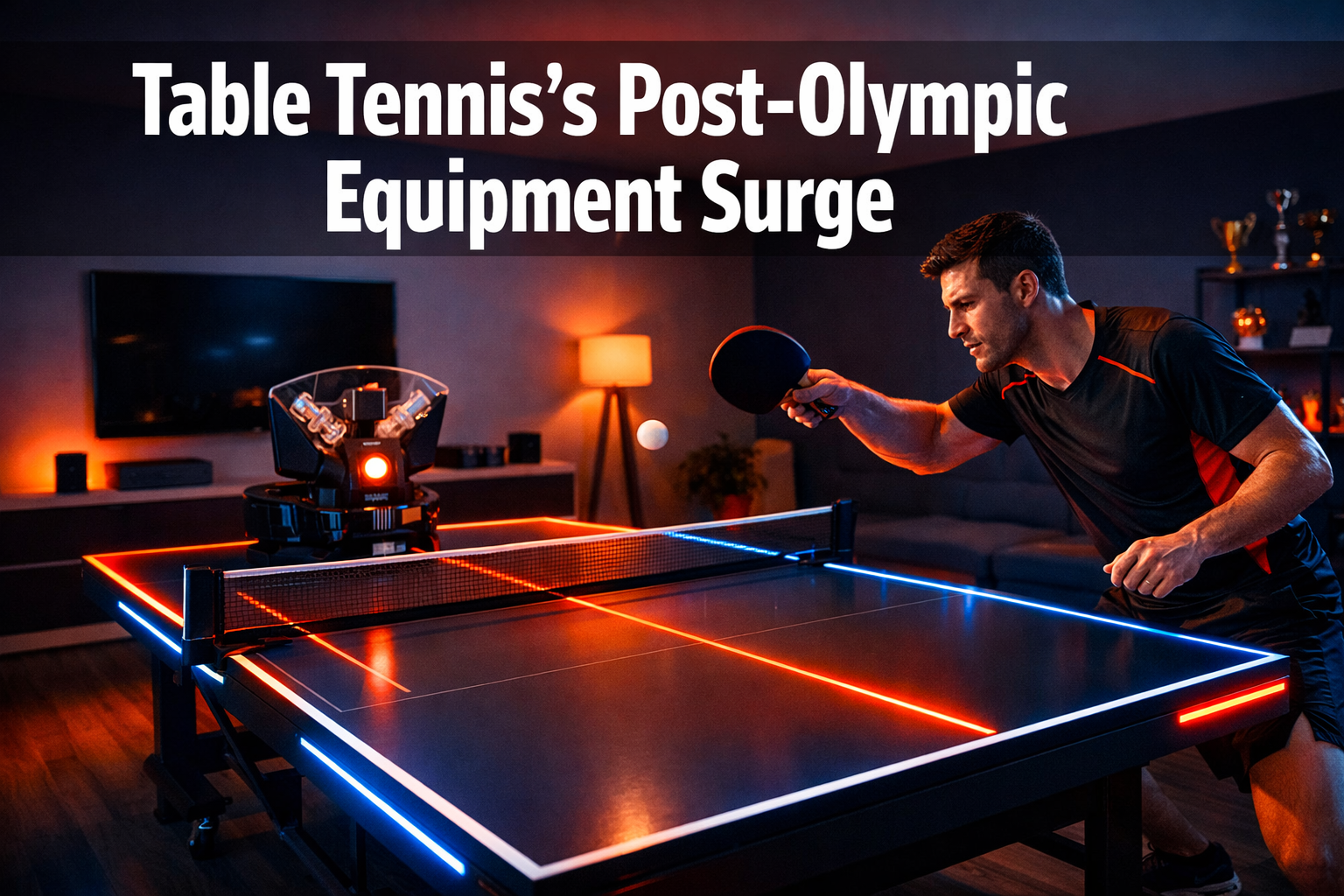
Table Tennis’s Post-Olympic Equipment Surge: Affordable Robots and Smart Tables Driving Home Practice in 2026
Last updated: April 13, 2026
Quick Answer: The global table tennis equipment market is valued at USD 1.57 billion in 2026 and growing at 5.3% annually, driven largely by rising demand for AI-powered ball robots and smart training tables [1]. Olympic and World Championship exposure is pushing recreational players to invest in home practice gear that was once only available to elite clubs. Affordable robots now start under $200, and interactive tables with built-in sensors are reaching mainstream retail shelves.
Key Takeaways 🏓
- The global table tennis equipment market is worth USD 1.57 billion in 2026 and projected to hit USD 1.93 billion by 2030 [1]
- Smart ball robots and training systems are one of the top growth drivers in the market right now [1]
- The 2026 World Table Tennis Championship is expected to inspire a new wave of home players and boost equipment sales [4]
- Entry-level ball robots are now available for under $200, making solo practice genuinely accessible
- Smart tables with embedded sensors, digital scoreboards, and app connectivity are entering the consumer market
- Olympic legacy consistently produces multi-year equipment demand surges across racket sports
- Home practice setups can now replicate many club-level drills without a training partner
- Customized and professional-grade gear is trending alongside smart tech, giving players at every level more options [1]
Why Is There a Table Tennis Equipment Surge in 2026?
Olympic and World Championship cycles reliably spike interest in racket sports — and 2026 is no exception. The 2026 World Table Tennis Championship is expected to inspire a new generation of players, increase global viewership, and elevate the sport’s profile through technology adoption [4]. That visibility translates directly into equipment sales, especially at the recreational and home-practice level.
This isn’t just a short-term bump. The table tennis equipment market is on a sustained growth path, with a projected CAGR of 5.3% through 2030 [1]. The key difference in 2026 is what people are buying: instead of just paddles and balls, consumers are investing in training systems that let them practice smarter at home.
What’s fueling the surge specifically:
- Post-championship inspiration from casual viewers who want to try the sport
- Lower prices on smart training hardware as manufacturing scales up
- Growing awareness that solo practice is possible with the right tools
- Crossover interest from players of other racket sports like pickleball and padel

What Are Affordable Ball Robots and How Do They Work?
A table tennis ball robot is a machine that automatically feeds balls to a player at set intervals, speeds, and spin levels. Entry-level models handle basic multi-ball drills; advanced models simulate real match conditions with programmable spin, speed, and placement variation.
Price tiers in 2026:
| Tier | Price Range | Best For |
|---|---|---|
| Entry-level | $150–$350 | Beginners, basic drills |
| Mid-range | $350–$800 | Intermediate players, spin variation |
| Advanced | $800–$2,000+ | Club players, full programmability |
| Pro/AI-assisted | $2,000+ | Competitive training, AI coaching |
Entry-level robots have dropped significantly in price as Chinese manufacturers scaled production. A player who wants to work on their forehand loop or backhand drive no longer needs a club membership or a willing training partner to get quality repetitions.
Choose an entry-level robot if: you’re a beginner or recreational player who wants consistent ball feeding for basic stroke development.
Choose a mid-range or advanced robot if: you’re working on specific spin responses, footwork patterns, or match-simulation drills.
What Makes a Table “Smart” — and Are They Worth It?
Smart tables embed sensors, cameras, or pressure-detection systems into the playing surface to track ball placement, speed, and spin in real time. Some connect to apps that display shot statistics, suggest drills, and log progress over sessions.
Key features to look for in a smart table:
- Ball-tracking sensors that show landing zones and shot patterns
- App connectivity (iOS and Android) for session logging and drill suggestions
- Built-in digital scoreboard for solo or two-player use
- Foldable design for home storage
- Compatibility with ball robots for fully automated training sessions
Are they worth the investment? For serious recreational players who practice regularly, yes. The feedback loop — seeing exactly where your shots land and how your spin varies — accelerates skill development in ways that solo practice without data simply can’t match.
“The best training tool is the one you’ll actually use. A smart table at home beats a club table you visit once a month.”
For players just getting started, a quality paddle and a basic robot will deliver more value per dollar than a premium smart table. Build the habit first, then upgrade the setup.
How Does Olympic Legacy Drive Home Practice Demand?
Every major championship cycle creates a wave of new players who want to replicate what they saw on screen. This pattern holds across racket sports — from pickleball’s explosive growth to the surges in tennis equipment sales following Grand Slam broadcasts. Table tennis follows the same logic.
The 2026 World Table Tennis Championship is specifically designed to leverage technology to grow the sport’s global audience [4]. Broadcasters are using enhanced ball-tracking graphics and player stat overlays that make the technical side of the game more visible and appealing to casual viewers.
When someone watches a world-class player loop a topspin winner from three feet off the table, they want to try it. And in 2026, the equipment to practice that shot at home is more accessible than ever.
This is the same dynamic that drives demand in the broader racket sports community — major events create inspiration, and the gear market responds. The difference now is that the gear has genuinely caught up with the inspiration.
What Should Beginners Know Before Buying Home Training Equipment?
Start simple. Most beginners don’t need a smart table or a programmable robot on day one. The fundamentals — grip, stance, basic strokes — can be developed with a decent paddle and a wall or basic ball feeder.
Recommended starter path:
- Get a quality paddle rated for beginners (avoid cheap pre-assembled sets with poor rubber)
- Practice basic strokes with a wall, a partner, or a simple ball feeder
- Add a basic robot once you have consistent stroke mechanics
- Consider a smart table when you’re practicing 3+ times per week and want performance data
This mirrors good advice for any racket sport. Just as choosing the right pickleball paddle matters more than buying the most expensive option, picking the right table tennis gear for your current level saves money and frustration.
Common beginner mistakes:
- Buying a robot before developing basic stroke mechanics
- Choosing a table based on price alone (surface quality matters for realistic ball bounce)
- Skipping footwork practice because the robot feeds the ball to the same spot every time
- Not building a structured practice routine around the equipment
How Do Smart Training Tools Compare to Club Practice?
Smart home setups and club practice serve different purposes — they work best together, not as replacements for each other.
Home setup strengths:
- Available any time, no scheduling needed
- Consistent repetition for stroke development
- Data tracking over weeks and months
- Lower long-term cost than club membership fees
Club practice strengths:
- Live opponents with unpredictable play styles
- Coaching feedback and correction
- Match simulation under pressure
- Community and motivation from other players
The ideal setup for a recreational player who wants to genuinely improve is home robot practice for technical development + club or league play for match experience. This mirrors how serious players in other racket sports approach training — using drills to build skills, then testing those skills in real play.
For players interested in applying advanced strategies for recreational players, home training tools are particularly useful for ingraining the muscle memory behind specific shot patterns before bringing them into match situations.
What’s Next for Table Tennis Equipment Technology?
The market is moving toward tighter integration between hardware and software. Ball robots are getting AI-assisted programming that adapts drill difficulty based on a player’s performance data. Smart tables are adding video analysis features that overlay shot trajectories on recorded footage.
The ITTF (International Table Tennis Federation) is also playing a role — its Equipment Assistance Programme in 2026 is actively supporting member associations with gear access, which filters technology adoption down to grassroots level [5]. As more clubs adopt smart training tools, the technology becomes more familiar to recreational players and demand for home versions increases.
Trends to watch through 2030:
- AI coaching assistants integrated into robot software
- Portable smart sensors that attach to any existing table
- Subscription-based drill libraries paired with robot hardware
- Crossover appeal to players from other racket sports seeking low-impact training options
The mastering topspin techniques approach — breaking skills into repeatable drills — is exactly what these tools are built to support. The technology is catching up to the methodology.
Conclusion: Should You Invest in Home Table Tennis Training Gear in 2026?
If you’ve been inspired by the 2026 World Championship and want to improve your game at home, the timing is genuinely good. Equipment prices are competitive, smart training tools are more capable than ever, and the market is full of options across every budget.
Actionable next steps:
- Assess your current level — beginner, intermediate, or competitive recreational
- Set a budget — entry-level setups (paddle + basic robot) start around $250–$400 total
- Prioritize a good paddle and table first — the surface and rubber quality affect every drill
- Add a robot once your strokes are consistent — repetition tools work best when you have something worth repeating
- Track your practice sessions — even a simple log of drills and duration shows progress over time
- Connect with other players — home practice builds skill, but match play builds game sense
Table Tennis’s Post-Olympic Equipment Surge: Affordable Robots and Smart Tables Driving Home Practice in 2026 represents a real shift in how recreational players can train. The gap between elite club practice and home practice is narrowing fast. Use that to your advantage.
Whether you’re a table tennis enthusiast or a multi-sport player exploring a new racket discipline, the racket sports training principles stay the same: practice consistently, use the right tools for your level, and enjoy the process.
FAQ
Q: What’s the cheapest effective ball robot for home use in 2026? Entry-level ball robots from brands like Newgy and iPong are available in the $150–$300 range and handle basic multi-ball drills well enough for beginners and casual players.
Q: Do I need a smart table to benefit from home practice? No. A standard table with a basic ball robot delivers significant practice value. Smart tables add data and feedback, but they’re an upgrade, not a requirement.
Q: How much space does a home table tennis setup require? A standard table is 9 feet long by 5 feet wide. With playing space on both ends, plan for a room at least 19 feet long and 11 feet wide. Foldable tables help with storage.
Q: Can a ball robot replace a training partner entirely? For technical stroke development, yes. For match preparation and tactical practice, no. Robots build mechanics; live opponents build game sense.
Q: Are smart tables compatible with all ball robots? Not universally. Check compatibility before buying. Some smart table brands have preferred robot partners or proprietary connectivity systems.
Q: Is table tennis equipment covered by the ITTF Equipment Assistance Programme? The ITTF Equipment Assistance Programme supports member associations with gear access, primarily targeting clubs and national programs rather than individual consumers [5].
Q: How long does it take to see improvement with a home robot? Most players notice measurable stroke consistency improvements within 4–6 weeks of regular practice (3–4 sessions per week), assuming they’re using correct technique.
Q: What’s driving the table tennis equipment market growth beyond robots? Customized gear, professional-grade paddles, and growing participation in Asia-Pacific and European markets are all contributing factors alongside smart training systems [1].
Q: Is table tennis a good cross-training option for other racket sports players? Yes. The hand-eye coordination, reaction speed, and spin recognition developed in table tennis transfer well to tennis, pickleball, and padel.
Q: Where can I find community and coaching support alongside home training? Local clubs, online communities, and platforms like the Rally Racket racket sports community hub offer coaching resources and peer connection for players at all levels.
References
[1] Table Tennis Equipment Market Report – https://www.researchandmarkets.com/reports/6215452/table-tennis-equipment-market-report
[4] How World Table Tennis 2026 Marks A New Era In The Sport – https://instasport.club/blogs/table-tennis/how-world-table-tennis-2026-marks-a-new-era-in-the-sport
[5] ITTF Equipment Assistance Programme 2026 Returns To Support Member Associations – https://www.ittf.com/2026/03/17/ittf-equipment-assistance-programme-2026-returns-to-support-member-associations/