Squash57 Explained: US Squash’s New Format for Beginners and Lifelong Players in 2026
Last updated: April 25, 2026
Quick Answer
Squash57 is a modified version of squash played on a standard squash court using a larger 57mm rubber ball and a shorter racquet. It creates longer rallies, a gentler learning curve, and a more welcoming entry point for beginners, older players, and athletes crossing over from tennis, pickleball, or padel. In 2026, US Squash launched its first national growth campaign to bring the format to clubs and players across the country.
Key Takeaways 🎯
- Squash57 uses the same court as traditional squash but with a larger ball and shorter racquet, making it easier to learn
- Scoring is best-of-five games to 11 points using point-a-rally (PAR) scoring; players must win by 2 at 10-10
- Mandatory protective eyewear is required for all players
- US Squash launched a national campaign in January 2026 under the slogan “Play Squash. Your Way” [1]
- The inaugural Squash57 Festival Series includes four national events culminating in the Pan American Championships [1]
- Free online coaching certification is available for Coach Pass holders through US Squash [1]
- Great crossover sport for tennis, pickleball, and padel players looking to expand their racket sports community
- The campaign ties directly to LA28, building squash momentum ahead of its Olympic debut [2]
What Exactly Is Squash57?
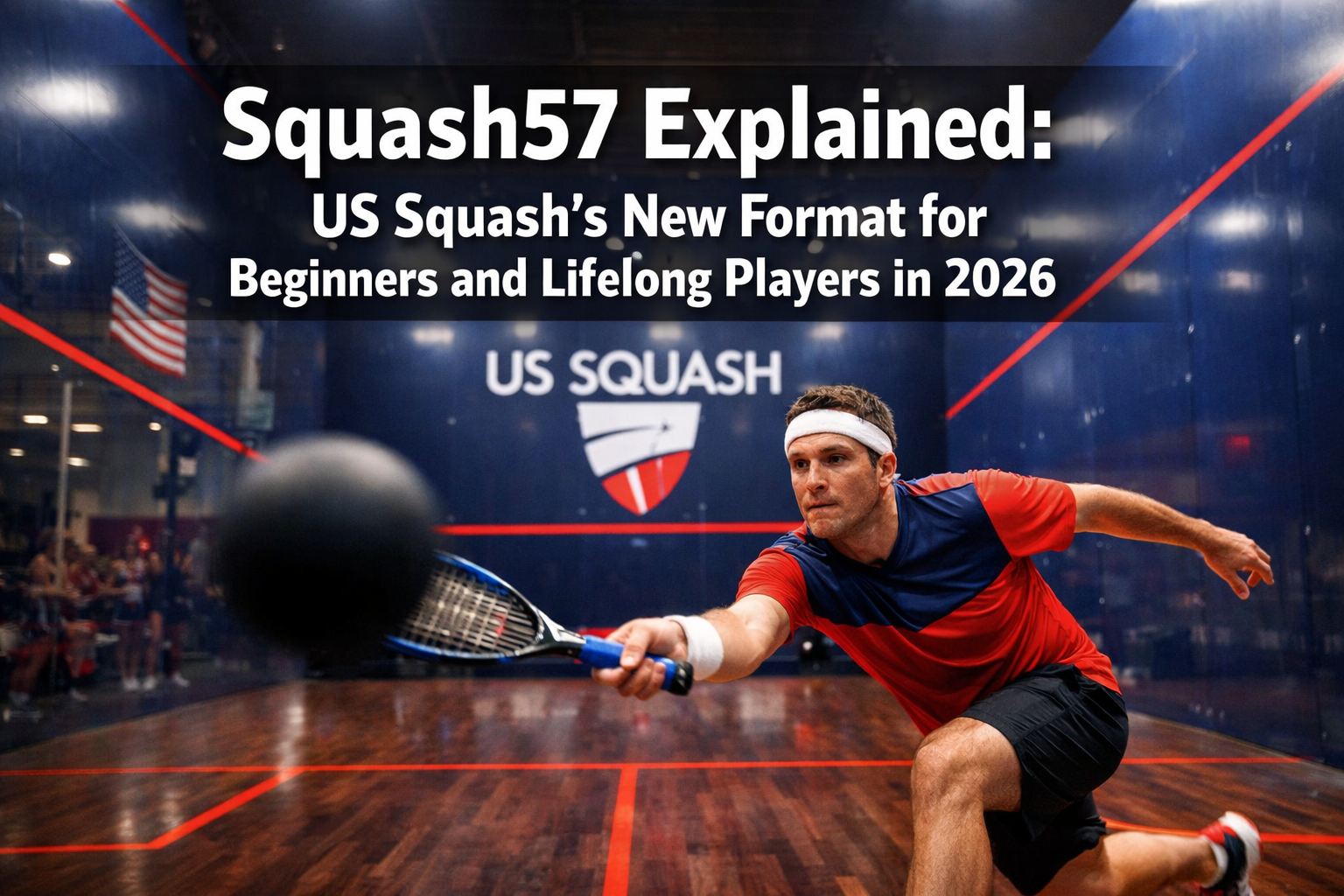
Squash57 is a player-friendly variant of squash designed to be more accessible without losing the sport’s core excitement. It’s played on a traditional squash court with a larger rubber ball (57mm in diameter) and a shorter racquet, which together produce longer rallies and more forgiving shot-making.
The name comes directly from the ball size. That one change — a bigger, bouncier ball — is what makes the game feel so different from traditional squash. Rallies last longer, the ball moves more predictably, and players have more time to react. For anyone who’s felt intimidated by the speed of standard squash, Squash57 changes the equation entirely. [2]
If you’re already active in the broader racket sports community — maybe you play pickleball, tennis, or padel — Squash57 will feel surprisingly familiar. The enclosed court adds a new dimension, but the rally-based gameplay and competitive scoring will click quickly.
How Does Squash57 Differ from Traditional Squash?
The core rules are similar, but a few key differences make Squash57 its own game.

| Feature | Squash57 | Traditional Squash |
|---|---|---|
| Ball size | 57mm rubber ball | Smaller hollow rubber ball |
| Racquet | Shorter (racquetball-style) | Standard squash racquet |
| Court | Standard squash court | Standard squash court |
| Rally length | Longer, more forgiving | Shorter, faster |
| Learning curve | Gentler | Steeper |
| Scoring | PAR to 11, best of 5 | PAR to 11, best of 5 |
The bigger ball bounces higher and travels more slowly off the walls, giving players extra time to set up shots. The shorter racquet is also easier to swing in tight spaces, which matters a lot inside a squash court. [3]
Choose Squash57 if: you’re new to court sports, returning after a long break, or transitioning from another racket sport. Traditional squash suits players who already have court-sport experience and want a faster, more technical game.
Squash57 Explained: Rules Every Beginner Needs to Know
The rules are straightforward, and most players pick them up within a session or two.
Serving:
- The server must have at least one foot in the service box
- The ball must bounce before being struck on the serve
- The serve must hit the front wall directly and land in the opposite back quarter
- If the first serve is a fault, a second serve is allowed [3]
During a rally:
- The ball can only bounce once on the floor before being returned
- If it bounces twice, the player who failed to return it loses the point [3]
- Players alternate hitting in doubles; each player moves back after hitting and forward when their turn comes [3]
Scoring:
- Each game is played first to 11 points on a point-a-rally (PAR) system — every rally wins a point, regardless of who served
- At 10-10, a player must win by 2 clear points
- A match is best of five games [3]
💡 Quick tip: PAR scoring means every rally matters. There’s no “side-out” like in older scoring systems. Stay focused on every single point.
What Equipment Do You Need for Squash57?
Getting started doesn’t require a big investment. The gear list is short and specific.
Required equipment: [3]
- ✅ Squash57 racquet (or a racquetball racquet)
- ✅ Official Squash57 ball (57mm)
- ✅ Non-marking athletic shoes
- ✅ Protective eyewear (mandatory for all players)
The eyewear requirement is non-negotiable. Inside an enclosed court, a ball or racquet to the face is a real risk. Good protective eyewear is inexpensive and widely available at most sporting goods stores.
US Squash also provides clubs and coaches with links to affordable starter equipment so new players don’t have to search far to get set up. [1] If you’re already familiar with choosing racket sports gear, the process here is just as straightforward — look for gear labeled specifically for Squash57 or racquetball-compatible.
Who Is Squash57 For? (And Who Will Love It Most)
Squash57 was built with inclusion in mind. US Squash’s 2026 campaign specifically targets beginners, lifelong players, former squash players, and athletes crossing over from other racket sports. [2]
Best fit for:
- Beginners with little or no court sport experience
- Older adults who want an active sport with longer rallies and less physical demand
- Tennis, pickleball, and padel players looking to try something new indoors
- Former squash players who stepped away and want an easier re-entry point
- Youth players building hand-eye coordination and court awareness
The appeal of racket sports for all ages is well-documented across the community, and Squash57 fits that same mold. It’s competitive enough to keep experienced players engaged but forgiving enough that first-timers aren’t overwhelmed.
Not the best fit for: elite squash players seeking maximum speed and technical challenge. For them, traditional squash remains the primary format.
Squash57 Explained: The 2026 US Squash National Campaign
In January 2026, US Squash launched its first-ever national Squash57 growth campaign under the slogan “Play Squash. Your Way.” [1]
The campaign rolls out monthly themes throughout the year, including:
- “What Is Squash57?”
- “For Racquet Sport Lovers”
- Spotlights on clubs running active Squash57 programs
What the campaign includes:
- The inaugural Squash57 Festival Series — four national events leading to the Squash57 Pan American Championships at the Arlen Specter US Squash Center [1]
- Free online Squash57 certification for Coach Pass holders [1]
- Posters, flyers, and promotional materials for clubs to use in their communities [1]
- Links to affordable starter equipment for clubs and coaches [1]
The timing is intentional. US Squash launched this campaign ahead of the LA28 Olympic Games, where squash will make its Olympic debut. Building grassroots participation now creates a foundation of fans and players ready to follow the sport at the highest level. [2]
For anyone curious about how tournaments and competitive formats work in racket sports, the role of tournaments in building racket sports culture offers useful context that applies directly to Squash57’s competitive structure.
How Does Squash57 Compare to Other Racket Sports?
Players coming from pickleball, tennis, or padel will notice both similarities and differences.
| Sport | Court type | Ball | Rally style | Indoor/Outdoor |
|---|---|---|---|---|
| Squash57 | Enclosed squash court | Large rubber ball | Long, wall-based | Indoor |
| Pickleball | Open court | Wiffle-style ball | Short, precise | Both |
| Tennis | Open court | Felt ball | Variable | Both |
| Padel | Enclosed glass court | Depressurized ball | Wall-based | Both |
| Traditional Squash | Enclosed squash court | Small hollow ball | Fast, technical | Indoor |
Squash57 shares padel’s wall-play DNA but uses a simpler court setup. It shares pickleball’s welcoming entry point but demands more movement. If you’ve been exploring singles vs. doubles formats in other racket sports, Squash57 offers both options with clear rules for each.
For multi-sport athletes who enjoy improving across different racket sports, Squash57 is a natural addition to the rotation.
How to Get Started with Squash57 in 2026
Getting on court is easier than most people expect. Here’s a simple path forward:
- Find a squash court near you — most facilities with squash courts can accommodate Squash57 with no modifications
- Pick up the gear — a Squash57 or racquetball racquet, the official ball, eye protection, and court shoes
- Learn the basic rules — serving, scoring, and the one-bounce rule cover most of what you need [3]
- Look for a local club or clinic — US Squash’s 2026 campaign is actively spotlighting clubs with Squash57 programs [1]
- Check for coaching resources — coaches with Squash57 certification can fast-track your development
If you’re brand new to court sports, starting with a beginner class or clinic is the most efficient way to build confidence. The benefits of joining beginner racket sport classes — skills, structure, and social connection — apply just as much to Squash57 as they do to any other format.
Coaches looking to add Squash57 to their programs can access free certification through US Squash’s Coach Pass program, making it a low-barrier addition to any club’s offerings. [1]
Frequently Asked Questions About Squash57
Q: Is Squash57 the same as racquetball? No. Squash57 is played on a squash court with squash-specific rules. A racquetball racquet can be used, but the game, court dimensions, and scoring are different from racquetball.
Q: Do I need prior squash experience to play Squash57? Not at all. Squash57 was designed specifically for beginners and players with no squash background. [2]
Q: Can I use my tennis or pickleball racquet? No. Players must use a Squash57 racquet or a racquetball racquet. Tennis and pickleball paddles are not permitted. [3]
Q: Is protective eyewear really mandatory? Yes, for all players in all formats. It’s a safety requirement, not a suggestion. [3]
Q: How long does a Squash57 match typically take? A best-of-five match at beginner level usually runs 30–45 minutes, though this varies with skill level and rally length.
Q: Where can I find Squash57 events in 2026? US Squash’s Festival Series includes four national events in 2026, culminating in the Pan American Championships at the Arlen Specter US Squash Center. [1]
Q: Can kids play Squash57? Yes. The longer rallies and more forgiving ball make it well-suited for youth players building coordination and court awareness.
Q: Is Squash57 played internationally? Yes. The format has international governing body recognition, and the 2026 Pan American Championships reflects its growing global footprint. [1]
Q: What’s the difference between singles and doubles in Squash57? In doubles, teams alternate hitting with players moving back after each shot and forward when their turn arrives. Teams also choose which player receives serve in each back quarter at the start of every game. [3]
Q: How does Squash57 connect to the LA28 Olympics? US Squash launched the 2026 national campaign to build grassroots momentum ahead of squash’s Olympic debut at LA28. [2]
Conclusion: Your Next Step on Court
Squash57 is one of the most accessible entries into court-based racket sports available in 2026. The rules are clear, the equipment is affordable, and the format rewards effort at every level — from first-timers to lifelong players returning to the game.
US Squash’s national campaign, Festival Series, and free coaching certification make this the right moment to explore it. Whether you’re already part of the racket sports community or just looking for something new to try indoors, Squash57 delivers real rallies, real competition, and a genuinely welcoming atmosphere.
Actionable next steps:
- 🎾 Find a squash facility near you and ask about Squash57 court time
- 🛒 Pick up a starter racquet, the official ball, and protective eyewear
- 📋 Review the official US Squash rules PDF to get comfortable before your first session [3]
- 🏆 Check the US Squash website for 2026 Festival Series event dates [1]
- 👥 If you coach, sign up for free Squash57 certification through the Coach Pass program [1]
For players who love the community side of racket sports, Squash57 brings that same energy into an enclosed court. Get on court, give it a rally or two, and see what the format can do for your game.
References
[1] Us Squash Launches First Ever National Squash57 Growth Campaign – https://ussquash.org/2026/01/us-squash-launches-first-ever-national-squash57-growth-campaign/ [2] Squash57 – https://ussquash.org/squash57/ [3] Squash 57 V2025 Copy 1 – https://ussquash.org/wp-content/uploads/2026/02/Squash-57-v2025-copy-1.pdf