Portable Padel Smash: How This Hybrid Outdoor Game Is Disrupting Traditional Court Access in 2026
Last updated: April 14, 2026
Quick Answer
Portable Padel Smash is a hybrid outdoor game that blends padel mechanics with a compact, court-free format, letting players enjoy the sport anywhere from parks to beaches without booking a dedicated court. It uses lightweight rackets, a low portable net, and a foam or rubber ball designed for casual outdoor play. In 2026, it’s gaining real traction among urban recreational players who want social, active fun without the barriers of traditional court sports.
Key Takeaways
- 🎾 No court needed: Portable Padel Smash sets up on any flat surface, grass, sand, or pavement, in under five minutes.
- 🏙️ Built for urban players: It directly solves the court access problem that frustrates millions of city-based racket sports fans.
- 🔀 Hybrid design: The game borrows padel’s compact racket and wall-play concepts but strips away the fixed enclosure requirement.
- 👥 Social-first format: Games typically run 2v2, making it easy to play with friends without organizing a full squad.
- 💰 Low entry cost: Starter kits are generally more affordable than a padel racket alone, lowering the barrier for beginners.
- 📈 Growing industry interest: Padel Smash as a brand has been building academy infrastructure and partnering with major racquet industry events in 2026 [1][2].
- 🎯 Crossover appeal: Tennis, pickleball, and badminton players pick it up quickly thanks to shared skills like hand-eye coordination and net play.
- ⚡ Beginner-friendly: The slower ball speed and smaller playing area make it more forgiving than full padel for new players.
What Exactly Is Portable Padel Smash?
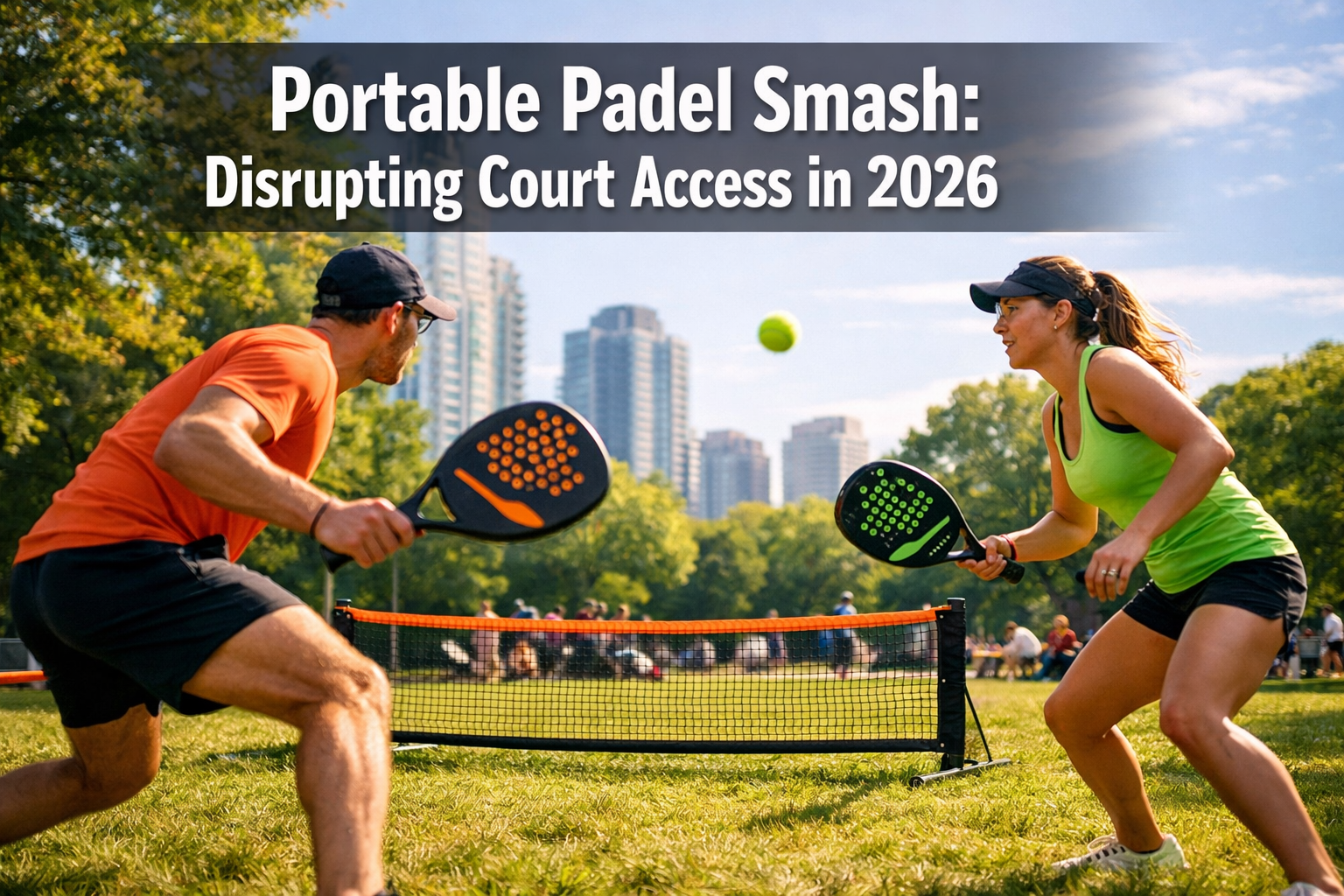
Portable Padel Smash is a simplified, mobile version of padel that removes the need for a fixed enclosed court. Players use short, solid-face rackets similar to padel bats, a low portable net (typically around knee to hip height), and a softer ball suited for open outdoor surfaces.
The core rules borrow from padel: rallying, net play, and smash shots are all central. But because there are no surrounding glass walls, gameplay adapts to use natural boundaries or agreed-upon lines marked with cones or tape.
Who it’s designed for:
- Beginners who find full padel courts intimidating or inaccessible
- Urban players without easy access to dedicated racket sport facilities
- Multi-sport athletes looking for a fun warm-up or cross-training game
- Families and social groups who want a low-setup outdoor activity
“The appeal is simple: you get the feel of a real racket sport without needing to book anything.”
Why Court Access Is a Real Problem in 2026

Court scarcity is one of the biggest frustrations in the racket sports community right now. Padel, in particular, has exploded in popularity across Europe, Latin America, and increasingly North America, but court infrastructure hasn’t kept pace with demand.
In many cities, dedicated padel courts are booked days in advance. Membership fees at padel clubs can run hundreds of dollars per month. And for players in smaller towns or suburban areas, the nearest court might be a 30-minute drive away.
This is exactly the gap that the Portable Padel Smash: How This Hybrid Outdoor Game Is Disrupting Traditional Court Access in 2026 concept fills. By removing the fixed-court requirement entirely, the game opens up racket sports to anyone with a patch of outdoor space.
Common court access barriers:
- Long booking queues at public facilities
- High membership or drop-in fees at private clubs
- Geographic gaps, especially in rural or suburban areas
- Limited hours at indoor venues
- Weather-dependent outdoor court availability
For context, pickleball faced a similar access challenge during its growth phase, and the history of how pickleball expanded from backyard play to a global sport offers a useful parallel for understanding how portable formats can drive mass adoption.
How Does Portable Padel Smash Compare to Traditional Padel?
Portable Padel Smash keeps what makes padel fun (compact rackets, fast net exchanges, and smash shots) while cutting the logistical overhead. Here’s a direct comparison:
| Feature | Traditional Padel | Portable Padel Smash |
|---|---|---|
| Court required | Yes (enclosed, 20m x 10m) | No (any flat surface) |
| Setup time | Booking required | Under 5 minutes |
| Equipment cost | $150–$400+ for racket alone | $40–$120 for full kit (estimated) |
| Players | 4 (doubles standard) | 2–4 |
| Skill barrier | Moderate to high | Low to moderate |
| Wall play | Yes (core mechanic) | Optional/adapted |
| Best for | Competitive development | Social and recreational play |
The trade-off is clear: you lose the wall-rebound mechanic that makes padel tactically deep, but you gain flexibility, affordability, and accessibility. For players who want to build racket skills before investing in full padel, it’s a practical stepping stone.
What Skills Transfer Between Portable Padel Smash and Other Racket Sports?
One of the strongest selling points of this hybrid game is how well it connects to other racket sports. Players with a background in tennis, pickleball, or badminton will find familiar patterns immediately.
Skills that carry over directly:
- Net play and volleys (especially useful for pickleball and padel crossover players)
- Hand-eye coordination developed in any racket sport
- Smash technique, which mirrors overhead shots in tennis and padel [3][4]
- Footwork patterns for small-court movement
- Reading the opponent’s position and shot selection
If you’re already working on shot types like dinks and smashes in pickleball, the smash mechanics in portable padel will feel very natural. The compact court size also rewards the same quick lateral movement you’d practice with footwork drills for pickleball.
Common mistake: Players from tennis backgrounds often swing too hard. The smaller court and softer ball reward controlled placement over raw power, especially at the net.
What Equipment Do You Need to Get Started?
Getting into Portable Padel Smash doesn’t require a big investment. A basic starter kit typically includes:
- Two to four padel-style rackets (solid face, shorter grip than tennis)
- A portable net with lightweight poles and a carry bag
- Foam or pressureless rubber balls suited for outdoor surfaces
- Boundary markers (cones or chalk lines)
When evaluating rackets for this format, the same principles from padel racket reviews apply. In 2026, brands like Adidas have released updated padel collections with improved balance and vibration control across their Metalbone, Cross It, and Arrow Hit lines [3][4], which gives players a wide range of options depending on their budget and playing style.
For beginners, a mid-range racket with a round or teardrop head shape offers the most forgiveness. Diamond-shaped heads (more common in advanced padel) generate more power but are harder to control on a portable setup where precision matters more.
Also worth checking: choosing the right footwear for court sports matters even in a casual portable format. Grass and sand surfaces need different grip than hard courts, so shoes with multi-directional traction make a real difference.
How Is the Padel Industry Responding to Portable and Hybrid Formats?
The broader padel industry is paying attention. Padel Smash, as an organization, has been actively investing in academy infrastructure and facility development [2], signaling that the brand sees long-term value in structured player development alongside casual play formats.
In March 2026, Padel Smash also announced a partnership with RacquetX 2026, one of the industry’s major trade and consumer events [1]. This kind of visibility at a mainstream racquet sports platform suggests that hybrid padel formats are being taken seriously as a growth segment, not just a novelty.
Meanwhile, equipment manufacturers are responding to the broader padel boom. The 2026 padel racket market has seen significant product launches, including exclusive reveals at RacquetX [5], and detailed new collections from major brands [6]. As portable formats grow, expect to see rackets designed specifically for casual outdoor play, lighter, more durable, and priced for entry-level buyers.
The parallel with pickleball’s growth trajectory is hard to ignore. Just as pickleball grew from a backyard game into a globally recognized competitive sport, portable padel formats could follow a similar path if the community infrastructure develops around them.
Who Should Try Portable Padel Smash (And Who Should Skip It)?
Great fit if you:
- Want to try padel before committing to court fees or club memberships
- Already play pickleball, tennis, or badminton and want a fun crossover activity
- Have a group of 2–4 friends who want a social outdoor game
- Live in a city where court access is limited or expensive
- Are looking for a low-impact, high-fun activity for mixed-ability groups
Probably not the right fit if you:
- Are training seriously for competitive padel (you need real courts for wall-play development)
- Prefer solo practice formats
- Want a sport with established local leagues or tournament structures (this is still early days)
For players who are newer to racket sports overall, it’s worth reading up on what to expect in your first few sessions with a new sport. The learning curve for portable padel is gentle, but having realistic expectations helps you enjoy the process.
How to Set Up and Play Your First Game
Setting up is genuinely fast. Here’s a simple process:
- Choose your surface. Grass, sand, or hard court all work. Avoid uneven ground.
- Set up the net. Most portable nets assemble in 2–3 minutes with snap-fit poles.
- Mark your boundaries. Use cones or chalk to define a rough 6m x 12m playing area (adjust for space available).
- Decide on scoring. Most casual games use rally scoring to 11 or 21, win by 2.
- Start with cooperative rallying. Before competitive play, spend 5 minutes just keeping the ball in play to get a feel for the surface and racket.
- Introduce smashes gradually. Once rallies are consistent, start working in overhead smashes from mid-court.
For anyone who wants to build on these basics and develop real racket sport skills, effective practice session strategies from the pickleball world apply directly here. Structured warm-ups, focused drills, and deliberate shot practice all transfer.
Conclusion: Should You Add Portable Padel Smash to Your Game?
The Portable Padel Smash: How This Hybrid Outdoor Game Is Disrupting Traditional Court Access in 2026 trend isn’t just a passing fad. It’s a practical response to a real problem: too many players, not enough courts.
For recreational players, it’s one of the easiest ways to get quality racket sports time without the scheduling headaches. For crossover athletes from pickleball, tennis, or badminton, it’s a fun way to expand your skill set. And for beginners, it’s a genuinely welcoming entry point into the padel world.
Actionable next steps:
- Try before you buy: Look for local parks or sports groups already running portable padel sessions.
- Invest in a starter kit: A mid-range kit with two rackets, a net, and balls is a reasonable first purchase.
- Connect with your local racket sports community to find other players who might want to join a casual game.
- Use it as a bridge: If you enjoy the format, start exploring full padel courts and clubs in your area.
- Track your progress: Even in casual play, working on specific skills like net volleys and smash placement will make you a better all-around racket sports player.
The racket sports community is growing fast, and portable formats are making it easier than ever to be part of it. Get out there and play.
Frequently Asked Questions
What is Portable Padel Smash? It’s a hybrid outdoor game that uses padel-style rackets and a portable net to replicate padel gameplay on any flat surface, no dedicated court required.
Is Portable Padel Smash the same as regular padel? No. Regular padel requires an enclosed court with glass walls, which are central to the game’s strategy. Portable Padel Smash adapts the format for open spaces, removing wall play but keeping the core racket mechanics.
How much does a Portable Padel Smash kit cost? Starter kits are estimated to range from $40 to $120, depending on racket quality and net design. This is significantly less than the cost of a standalone padel racket for competitive play.
What surfaces can you play on? Grass, sand, hard court, and packed dirt all work. Avoid slippery or very uneven surfaces for safety.
Is it suitable for kids? Yes. The slower ball speed and smaller court make it accessible for children, especially with a lighter racket option.
Can experienced padel players enjoy it? Yes, as a social or warm-up format. It won’t replace court training for competitive development, but it’s a fun way to stay active when courts aren’t available.
How many players do you need? Two players (singles) or four (doubles). Doubles is the more common and social format.
Does it help improve padel skills? It builds hand-eye coordination, net reflexes, and smash technique, all of which transfer to full padel. Wall-play strategy won’t develop without an actual court, though.
Where can I find other players? Check local parks, sports Facebook groups, and racket sports community apps. The format is new enough that you may need to introduce it to friends yourself.
Is the equipment the same as regular padel gear? Rackets are similar or identical to entry-level padel rackets. The ball is often softer and the net is shorter and lighter for portability.
References
[1] Watch – https://www.youtube.com/watch?v=MOSgfaKfff8 [2] Watch – https://www.youtube.com/watch?v=jxcCenp8tqA [3] Discover The New 2026 Collection N10 – https://allracquetsports.com/blog/discover-the-new-2026-collection-n10 [4] What S New In Adidas Padel Rackets 2026 – https://racketcentral.com/blogs/padel/what-s-new-in-adidas-padel-rackets-2026 [5] Watch – https://www.youtube.com/watch?v=YZIJNZyvPnM [6] Best Padel Rackets 2026 – https://padellog.com/blog/best-padel-rackets-2026