The 25-Second Shot Clock Era: Practical Strategy Changes for Baseliners, Servers, and Returners
Last updated: May 18, 2026
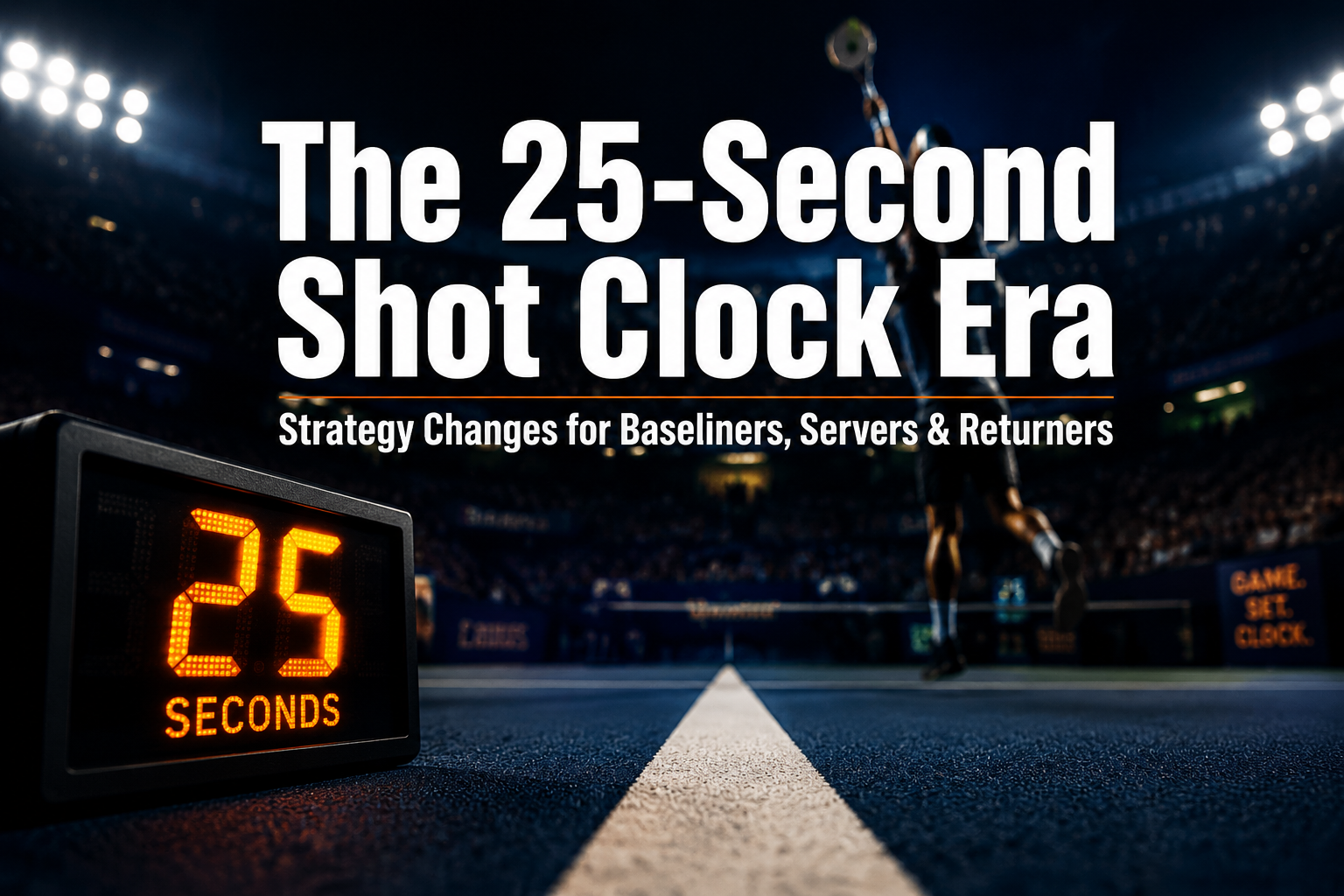
Quick Answer: The 25-second shot clock, now standard across ATP and WTA tour events, forces players to start their serve within 25 seconds of the previous point ending. For club players and recreational athletes, this rule is reshaping pre-serve rituals, return positioning, and rally tempo in ways that matter far beyond the pro tour.
Key Takeaways
- ⏱️ The 25-second clock starts when the chair umpire (or shot clock display) signals end of point — not when the server picks up the ball.
- 🎾 Servers who rely on long bounce routines need to cut their ritual to under 15 seconds to stay comfortable.
- 📍 Baseliners benefit from using clock awareness to reset positioning faster between points.
- 🔄 Returners can use the clock tactically — staying ready earlier disrupts the server’s rhythm.
- 🧠 Mental reset time is now a skill, not just a habit. Training it matters.
- 🏆 Point patterns are getting shorter on average as players adapt to faster play tempo.
- 🎯 Club-level players who practice timed pre-serve routines perform better under pressure.
- 📋 Soft tennis and padel players face similar timing experiments — the strategies here cross over.
What Is the 25-Second Shot Clock and Why Does It Matter?
The 25-second shot clock is a timing rule that requires the server to begin their serve within 25 seconds of the previous point ending. It applies between points during a game, with longer breaks allowed between games and sets.
The ATP introduced shot clocks at select events in 2018, and by 2026 the rule is fully embedded in professional tennis culture. What started as a pace-of-play fix has become a genuine tactical factor.
For recreational players, the clock matters even if no official is watching. Practicing within a 25-second window builds better mental habits, sharper focus, and more consistent pre-serve routines — all things that improve your game at any level.
How the 25-Second Shot Clock Era Changes Point Patterns
The short answer: Faster serve preparation compresses recovery time, which means players arrive at the next point with less physical and mental reset. That changes how rallies start and how errors cluster.
Before the clock, elite servers like Rafael Nadal famously used 30-plus second routines. That extra time allowed full physiological recovery — heart rate dropping, breathing settling. With 25 seconds as the hard limit, players must:
- Recover while walking, not standing still
- Breathe deliberately during the changeover walk to the baseline
- Commit to their game plan faster rather than deliberating between points
For club players, this creates a useful training mindset. If you’re used to bouncing the ball eight times and staring at the sky, trimming that to a focused 3-bounce ritual actually sharpens your serve consistency. The clock becomes a structure, not a constraint.
Practical tip: Time yourself in practice. Walk to the baseline, complete your routine, and serve — all within 20 seconds. Give yourself a 5-second buffer for match conditions.

Practical Strategy Changes for Baseliners in the 25-Second Shot Clock Era
Baseliners feel the clock differently than serve-and-volley players. As the returner or the player who just won a long rally, they need to reset position, recover breath, and mentally prepare — all while the clock runs.
Here’s what smart baseliners are adjusting:
Physical Reset on the Move
- Walk toward your baseline position immediately after the point ends.
- Use the walk itself as your breathing reset — 3 deep exhales while moving.
- Arrive at your ready position with 8–10 seconds still on the clock.
Tactical Reset Between Points
- Decide your next return strategy before you reach your position, not after.
- If you’re serving, commit to a serve direction during the walk.
- Avoid standing still to think — movement keeps your body ready.
Common mistake: Baseliners who stop and towel off after every point often burn 10+ seconds before even starting their mental reset. Save the towel for changeovers unless it’s genuinely necessary.
For players working on improving racket sports skills, building a timed between-point routine is one of the highest-return habits you can develop.
How Servers Should Adapt Their Pre-Serve Routine
The clock hits servers hardest because the serve ritual is where most time was previously spent. A well-designed pre-serve routine that fits inside 15 seconds (leaving 10 seconds of buffer) is the goal.
Building a 15-Second Serve Ritual
| Phase | Time Budget | What to Do |
|---|---|---|
| Walk to baseline | 0–5 sec | Breathe out, decide serve direction |
| Ball bounce / settle | 5–10 sec | 2–3 bounces max, find your grip |
| Visual lock + toss prep | 10–14 sec | Eyes on target zone, settle stance |
| Serve | 14–25 sec | Commit and execute |
Choose this approach if: You’re a player who currently bounces the ball more than 5 times or takes long pauses before tossing. Cutting the bounce count is the fastest fix.
Edge case: In windy conditions, you may need an extra moment to time your toss. Practice aborting the toss early rather than pausing before it — this keeps you within the clock while still adapting to conditions.
Learning to add variety to your shots becomes easier when your pre-serve routine is automatic. You free up mental space to think about where and how rather than when.
Returner Tactics: Using the Clock as a Weapon
Returners can use the shot clock tactically by being visibly ready early. When a returner takes their position and signals readiness with 10+ seconds left on the clock, it puts subtle pressure on the server to serve before they’re fully comfortable.
This isn’t gamesmanship — it’s smart positioning. Here’s how to use it:
- Get to your return position within 15 seconds of the previous point ending.
- Make eye contact with the server when you’re ready. This signals confidence.
- Stay light on your feet in a split-step ready position rather than standing flat.
- Don’t rush your own read — being physically ready early doesn’t mean mentally committing early. Stay loose until the toss.
Decision rule: If you’re playing someone who uses a long bounce routine to self-soothe, arriving early and looking calm disrupts that ritual more than any aggressive shot would.
Training Adjustments for Club Players and Soft Tennis Athletes
Club players and soft tennis athletes benefit from the same clock-awareness training as pros, just scaled to their context. The 25-second rule doesn’t officially apply at most recreational venues, but practicing within it builds better habits across all racket sports — including padel and pickleball.
Drills to Build Clock Awareness
- Timed serve practice: Set a phone timer. You have 20 seconds from picking up the ball to completing your serve. Repeat 20 times.
- Walk-and-decide drill: After each practice point, walk to your next position and verbally commit to your next shot choice before you arrive.
- Breathing ladder: Practice 3-count exhales during your between-point walk. It sounds simple — it works.
- Video review: Record a practice session and watch your between-point behavior. Most players are surprised how much time they waste standing still.
If you’re working with a coach or in a clinic setting, ask them to call out “clock!” when you exceed 20 seconds. The feedback loop is fast and effective. You can also find structured practice ideas through essential drills for building a strong foundation — many of the timing principles cross over from pickleball to tennis training.
For players who enjoy video analysis to learn from the pros, watching how top players handle the clock in real match footage is one of the best free coaching tools available in 2026.
How the Shot Clock Is Changing Rally Tempo and Match Dynamics
Faster point starts mean less recovery time, which statistically favors fitter players and those with efficient routines. While exact data varies by tournament and surface, the general trend observed since widespread clock adoption is that:
- Unforced errors cluster later in sets, when accumulated fatigue from faster play compounds.
- First-serve percentages matter more because there’s less time to mentally reset after a fault.
- Aggressive returners gain a slight edge because servers have less time to fully settle.
For recreational players, this translates to a useful training focus: fitness and routine efficiency are now part of your tactical toolkit, not just physical conditioning side notes.
Padel players facing similar timing experiments in their sport can check out padel strategy resources for parallel insights — the between-point mental game translates directly.
Common Mistakes Players Make Adapting to the Shot Clock
Most players make one of three mistakes when adjusting to timed play. Knowing them in advance saves a lot of frustration.
Mistake 1: Rushing the Toss
Cutting your routine too aggressively leads to a hurried ball toss, which wrecks serve consistency. The fix: shorten the bounce count, not the toss preparation.
Mistake 2: Ignoring the Mental Reset
Some players get physically to the baseline in time but skip the mental commitment step. They serve without a clear target. Result: more double faults and tentative serves.
Mistake 3: Letting the Clock Create Anxiety
The clock is a structure, not a threat. Players who treat it as pressure perform worse than those who treat it as a rhythm tool. Reframe it: the clock helps you stay in a consistent routine.
If you’re prone to match anxiety, pairing shot clock training with mental skills work pays off. The racket sports community at Rally Racket has resources to help you build both physical and mental game simultaneously.
FAQ: The 25-Second Shot Clock Era
Q: Does the 25-second clock apply at club and recreational level? A: Not officially in most recreational settings. But practicing within it builds better habits and prepares you for any competitive play where it does apply.
Q: What happens if a pro player violates the shot clock? A: The first violation in a game results in a warning. A second violation costs the server a fault (or the returner a point). Repeated violations can result in point penalties.
Q: How do I time my pre-serve routine without a clock on court? A: Count silently during your walk to the baseline. A 3-bounce routine with a deliberate breath takes roughly 8–10 seconds. You have plenty of time — the key is not wasting it standing still.
Q: Does the clock affect the returner at all? A: Yes. The returner must be ready to receive within the 25-second window. If the returner isn’t ready and the server serves, the point stands.
Q: Is the 25-second rule the same on all surfaces? A: The rule is uniform, but clay court players often feel more pressure because longer rallies mean more physical recovery needed between points.
Q: Can players request extra time for toweling or equipment issues? A: Yes, but only for genuine equipment issues. Routine toweling is expected to happen within the 25-second window or during changeovers.
Q: Does this rule apply in doubles? A: Yes. The same 25-second clock applies in doubles matches on tour.
Q: How does this affect junior players learning the game? A: Teaching juniors a short, consistent pre-serve routine from the start is now considered best practice. It’s easier to build the habit early than to break a long routine later.
Q: Are there similar timing rules in padel or pickleball? A: Padel has pace-of-play rules that are evolving. Pickleball has its own serve timing guidelines. The mental discipline of a timed routine applies across all racket sports.
Q: What’s the best way to practice the clock at home? A: Shadow serve routines with a timer. Stand at a baseline, simulate your walk, complete your routine, and “serve” — all within 20 seconds. Repeat until it feels natural.
Conclusion: Build the Clock Into Your Game Now
The 25-second shot clock era isn’t just a rule change for pros to manage — it’s a genuine shift in how tennis is played and how players should train. For baseliners, it means faster physical and mental resets. For servers, it means a tighter, more intentional pre-serve ritual. For returners, it’s a tactical opportunity hiding in plain sight.
Your action steps:
- Time your current routine in your next practice session. Just knowing your baseline is step one.
- Cut your ball-bounce count to 3 or fewer and practice until it feels natural.
- Walk with purpose between points — movement is recovery.
- Commit to a serve direction before you reach the baseline, not after.
- Use video review to spot wasted time in your between-point behavior.
Whether you play tennis, padel, or you’re exploring beginner pickleball strategies as a crossover sport, the mental discipline of timed play makes you a sharper, more consistent competitor. The clock is running — make it work for you.
Meta Title: 25-Second Shot Clock: Strategy Changes for Servers & Baseliners
Meta Description: Learn how the 25-second shot clock changes serve routines, return tactics, and rally tempo — with practical drills for club players and recreational athletes.