On-Court Coaching in 2026: How New Rules Are Rewriting ATP and WTA Match Strategy
Last updated: May 18, 2026
Quick Answer: On-court coaching in 2026 is now formally permitted at most ATP and WTA events under unified rule frameworks that allow coaches to give verbal and physical guidance during specific match intervals. This shift is changing how players prepare, how coaches communicate, and how match tactics evolve in real time — at every level of the game.
Key Takeaways
- 🎾 The ATP and WTA have aligned on structured on-court coaching windows during changeovers and set breaks in 2026.
- Coaches can now deliver tactical input directly to players at courtside, replacing the old hand-signal workarounds.
- Players who adapt fastest are those with strong pre-match systems and clear communication habits with their coaches.
- The rule change rewards preparation: coaches who arrive with multiple game plans are more effective than those who improvise.
- Mental resilience matters more than ever — players must filter coaching input quickly and stay focused mid-match.
- Recreational and club-level players can learn directly from how pros are using these coaching windows.
- The change is influencing how coaches are being trained and how tennis programs at all levels structure their support.
What Exactly Changed With On-Court Coaching in 2026?
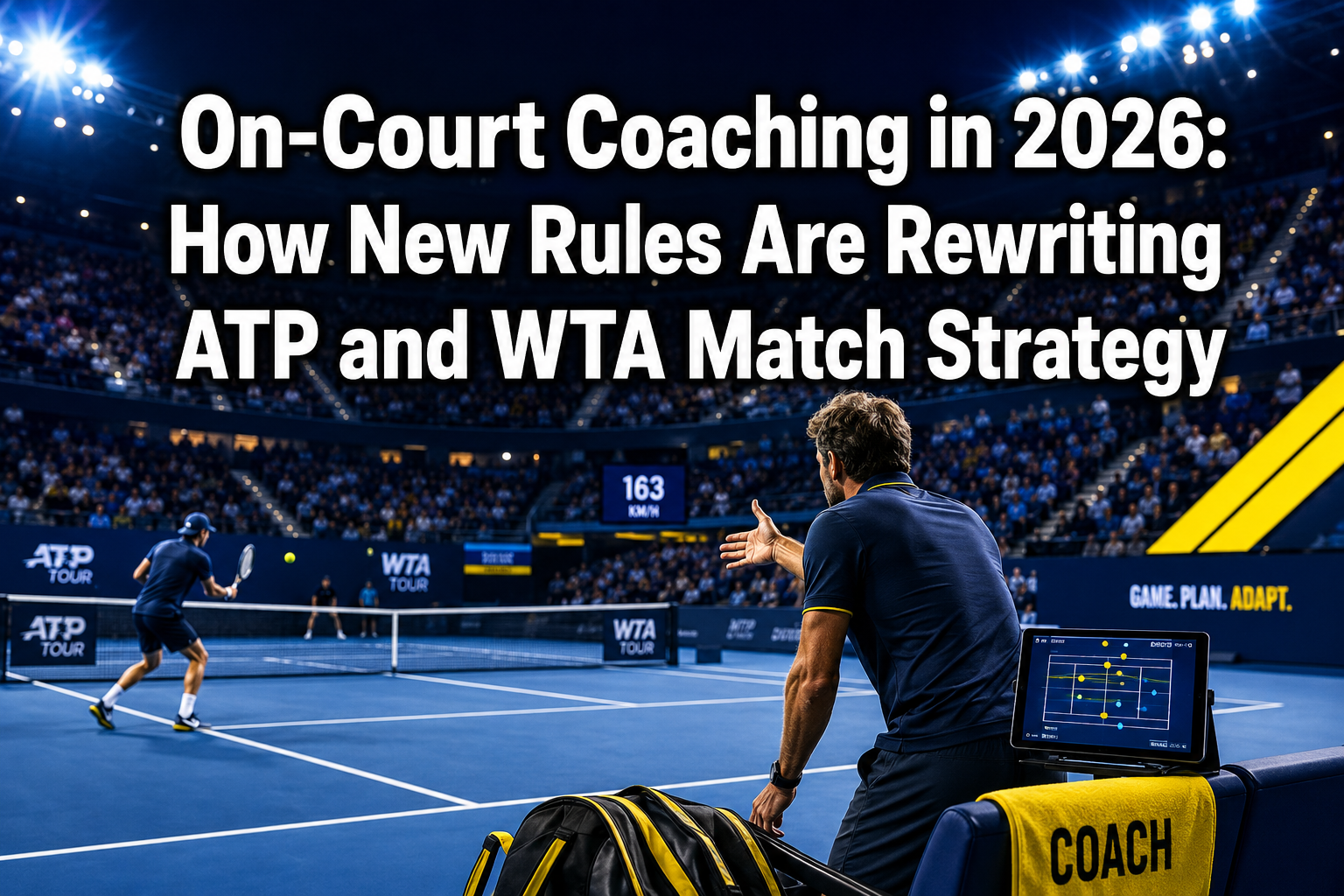
The 2026 rule updates formalized what had been a messy, inconsistently enforced gray area. Coaches can now enter the court or approach courtside during designated intervals — primarily at changeovers and between sets — to give direct verbal guidance.
Previously, the WTA allowed limited on-court coaching as a trial from 2018 onward, while the ATP resisted for years. In 2026, both tours operate under a shared framework that sets clear boundaries: one coach per player, defined time windows, and no coaching permitted during active play.
What’s allowed:
- Verbal communication during changeovers (up to 90 seconds)
- Physical approach to the player’s chair at set breaks
- Use of written notes or tactical cards
What’s still banned:
- Coaching from the stands during live points
- Electronic communication devices during play
- Team members other than the designated coach approaching the court
How Are Top Players Adapting Their Match Preparation?
On-court coaching in 2026 is changing how players and coaches structure their entire pre-match routine — not just what happens during the match.
The biggest shift is in pre-match scouting. Coaches now arrive at tournaments with opponent-specific tactical packages — essentially a menu of adjustments they can deploy during coaching windows. Players who used to rely on gut instinct mid-match now have a structured support system to fall back on.
Three preparation shifts happening at the top level:
- Scenario planning before the first ball is struck. Coaches and players rehearse specific tactical pivots (“If they’re dominating your backhand, here’s the adjustment”) so the coaching window conversation is fast and clear.
- Communication drills in practice. Some players are now incorporating timed communication exercises into training — practicing how to absorb a tactical change in under 60 seconds. This mirrors how partner drills can boost team communication and strategy at any level.
- Video review the night before. Coaches are using short video clips to flag opponent tendencies, so the player already has a mental map before the coaching window confirms it.
💡 Quick tip for club players: Even if you don’t have a courtside coach, you can borrow this idea. Walk into your match with two or three tactical “if/then” plans and you’ll feel far more in control.

How Is On-Court Coaching in 2026 Changing In-Match Tactics?
The most visible impact of on-court coaching in 2026 is tactical flexibility. Matches are no longer purely about who prepared better before the match — they’re also about who adapts better during it.
Coaches are now functioning more like basketball or soccer sideline staff, reading the match in real time and delivering targeted adjustments. This has made coaching a much more active, high-pressure role.
Tactical patterns emerging in 2026:
- Serve pattern resets: Coaches are flagging when opponents have “read” a player’s serve patterns and suggesting mid-match variation.
- Return position adjustments: Especially on clay, coaches are directing players to stand deeper or closer based on what they’re seeing from the opponent’s ball toss.
- Energy management cues: Coaches are also using windows to manage player effort — telling a player to shorten points when they look fatigued, for example.
For players who’ve worked on advanced strategies and smart tactics, this kind of real-time adjustment will feel familiar. The principle is the same: read the situation, pick the right tool, execute.
What Communication Styles Are Working Best?
Short, specific, and calm. That’s the coaching communication style proving most effective under the 2026 rules.
Coaches who arrive at the chair with a long list of observations tend to overwhelm players. The most effective coaches deliver one or two clear, actionable points and let the player process them.
Effective coaching window structure (roughly 90 seconds):
- Acknowledge what’s working (10 seconds) — keeps the player confident
- Name one specific problem (15 seconds) — concrete, not vague
- Give one adjustment (20 seconds) — simple and executable
- Reinforce the player’s belief (15 seconds) — send them back with energy
This mirrors the kind of focused mental approach covered in resources like how to stay focused and confident during matches — a principle that applies across all racket sports, not just tennis.
Common mistake: Coaches who use the window to vent frustration or list everything going wrong. Players leave the chair more confused, not less.
How Are WTA and ATP Players Responding Differently?
WTA players, on average, have had more exposure to on-court coaching given the tour’s earlier trial periods. Many top WTA players have built mature coaching relationships where the window is used efficiently and without friction.
ATP players are adapting more unevenly. Some veterans who built their games under the old “no coaching” culture are finding the new dynamic uncomfortable — they’re used to solving problems alone.
Generational split to watch in 2026:
| Player Group | Typical Response to On-Court Coaching |
|---|---|
| WTA veterans (30+) | Comfortable; many helped shape the trial rules |
| WTA younger players | Highly adapted; grew up with coaching support |
| ATP veterans (30+) | Mixed; some resist, some embrace |
| ATP younger players | Enthusiastic; see it as a competitive advantage |
The players thriving most are those who’ve built trust with their coaches over years of practice — not just match days. The coaching window is only as good as the relationship behind it.
What Does This Mean for Coaches and Tennis Programs?
On-court coaching in 2026 is raising the bar for what it means to be a professional tennis coach. It’s no longer enough to be a great practice-court technician. Coaches now need to be sharp tacticians, calm communicators, and quick readers of live match situations.
Tennis academies and national programs are already updating their coach education frameworks to include:
- Live match analysis training — reading patterns under pressure
- Communication skills workshops — delivering clear messages in short windows
- Psychological support training — knowing when a player needs calm vs. energy
This also has ripple effects for recreational coaching. Understanding different coaching methodologies and how they shape your game is valuable for any player looking to improve, regardless of the sport.
How Can Recreational Players Apply These Lessons?
Most club players don’t have a coach walking onto the court during changeovers. But the principles behind on-court coaching in 2026 still apply directly to recreational and competitive amateur play.
Practical takeaways for club and recreational players:
- Build a pre-match plan with two or three tactical options. Don’t just show up and hit. Know your adjustments in advance.
- Use changeovers to reset mentally. Even without a coach, treat the 90-second break as a mini-coaching session with yourself.
- Work on footwork and positioning as your base. Tactical adjustments only work if your movement is solid. Footwork drills that improve court movement are the foundation everything else builds on.
- Watch how pros use their coaching windows. You’ll pick up tactical cues and communication habits that translate directly to your own game.
- Find a training partner who can give you honest feedback. That’s your version of the on-court coach.
The racket sports community is full of players at every level learning from the pros. That’s one of the best things about following tours closely in 2026 — the tactical lessons are there for anyone willing to pay attention.
FAQ: On-Court Coaching in 2026
Q: Is on-court coaching now allowed at all ATP and WTA events in 2026? A: At most official ATP and WTA events, yes. The 2026 unified framework applies to the main tours. Some smaller challenger and ITF events may still follow older local rules, so check event-specific regulations.
Q: Can a player refuse coaching during a changeover? A: Yes. Coaching is permitted, not required. Some players prefer to manage their own match without input, and that remains their right.
Q: How long does a coach have to speak with a player during a changeover? A: The coaching window falls within the standard 90-second changeover. Coaches must complete their input before the chair umpire calls time.
Q: Can coaches use tablets or phones to show video during the window? A: Under the 2026 rules, electronic devices showing live match data or video are generally not permitted during play. Written notes and verbal communication are the standard tools.
Q: Does on-court coaching give wealthier players an unfair advantage? A: It’s a fair concern. Players with access to experienced, well-resourced coaching teams do benefit more. However, the rules apply equally, and many players with smaller teams are using the windows just as effectively through preparation.
Q: How does this affect doubles matches? A: Doubles teams can consult with their coach during the same windows. Communication between partners during play remains unrestricted, which already makes doubles a more collaborative format.
Q: Are junior tournaments adopting the same rules? A: Many junior circuits are moving toward similar frameworks, viewing it as good preparation for professional play. Check with your national federation for current junior rules.
Q: What’s the penalty if a coach violates the coaching rules? A: Violations typically result in a warning, followed by point penalties for repeated offenses. Serious or deliberate violations can result in the coach being removed from the player’s box.
Conclusion: What to Take Away From the 2026 Coaching Shift
On-court coaching in 2026 is one of the most meaningful structural changes professional tennis has seen in decades. It’s not just a rule tweak — it’s a fundamental shift in how matches are contested, how coaches operate, and how players think about in-match problem-solving.
For pros, the players winning the most from this change are those who’ve invested in deep coaching relationships, sharp pre-match preparation, and the mental discipline to absorb tactical input quickly and execute under pressure.
For recreational players, the lessons are just as real. Build your pre-match plan. Use your changeovers wisely. Work on the fundamentals — especially footwork and movement — so tactical adjustments actually stick. And if you have access to a coach or a smart training partner, treat that relationship as one of your biggest competitive assets.
The racket sports community is at its best when everyone — from ATP pros to weekend club players — is learning from the same game. In 2026, that game just got a lot more interesting to watch and to play.