
WTT Champions Chongqing 2026: Breaking Down the Top 10 Most Epic Rallies
Last updated: May 21, 2026
Quick Answer: The WTT Champions Chongqing 2026 tournament, presented by DHS, delivered some of the most technically brilliant table tennis rallies seen at the elite level this year. This breakdown covers the top 10 most memorable exchanges, analyzing the technique, strategy, and equipment behind each point — with a close look at emerging stars like Sora Matsushima and Felix Lebrun alongside established champions.
Key Takeaways
- WTT Champions events sit at the top tier of the World Table Tennis circuit, below only the Grand Smash category in prestige.
- A rally is considered “epic” based on length, shot variety, momentum shifts, and the match situation when it occurs.
- Felix Lebrun and Sora Matsushima both showcased elite-level footwork and spin control during Chongqing 2026.
- Chinese players consistently dominate through aggressive loop-to-loop exchanges; European players often counter with variation and deception.
- DHS equipment (the official ball and table sponsor) plays a measurable role in how rallies develop at this level.
- Beginners can extract real, usable lessons from watching professional rallies — especially around shot selection and positioning.
- Long rallies at the pro level are won through physical conditioning, not just technical skill.
- Common amateur mistakes during intense rallies include rushing the swing, dropping the free arm, and poor recovery positioning.
- Understanding tournament formats helps fans and players appreciate what’s at stake in each match.
- Watching and analyzing pro rallies is one of the fastest ways to improve racket sports skills across any discipline.
What Is the WTT Champions Tournament?
The WTT Champions is a premium-tier event on the World Table Tennis (WTT) circuit, ranking just below the Grand Smash in terms of prize money and ranking points. It features the world’s top-ranked players competing in a structured knockout format, with host cities rotating across global locations — Chongqing being one of the sport’s most passionate table tennis cities.
Key facts about WTT Champions events:
- Open to top-ranked players plus wildcard entries from host nations
- Typically held over five to six days
- Sanctioned by the International Table Tennis Federation (ITTF)
- Presented by DHS (Double Happiness), the official equipment partner
- Offers significant ranking points that affect Olympic qualification cycles
For recreational players curious about how competitive structures work at different levels, the Rally Racket guide to tournament formats is a solid starting point.
Who Were the Top Players at Chongqing 2026?
Chongqing 2026 featured a strong mix of established Chinese powerhouses and a new wave of international challengers pushing hard for podium spots.
Players who made the biggest impact:
| Player | Country | Style | Notable Strength |
|---|---|---|---|
| Fan Zhendong | China | Aggressive looper | Explosive forehand, mental composure |
| Wang Chuqin | China | All-round attacker | Deceptive serve, fast transitions |
| Felix Lebrun | France | Counter-attacking | Backhand speed, creative shot selection |
| Sora Matsushima | Japan | Spin-heavy looper | Heavy topspin, footwork, youth energy |
| Truls Moregard | Sweden | Defensive counter | Consistency, long-rally endurance |
Felix Lebrun and Sora Matsushima drew particular attention. Lebrun’s backhand flick and willingness to go cross-court under pressure produced several of the tournament’s most talked-about exchanges. Matsushima’s heavy topspin loops — especially in the middle game — created problems even for top-10 opponents.
How Much Prize Money Did Winners Receive?
WTT Champions events offer substantial prize pools, though exact figures vary by event and are announced by WTT ahead of each tournament. Based on the WTT Champions prize structure (as publicly documented by WTT), Champions-level events typically award winners in the range of $50,000–$80,000 USD for singles titles, with total prize pools often exceeding $300,000 USD across all categories.
Note: Specific Chongqing 2026 prize figures were not independently verified at time of publication. Check the official WTT website for confirmed numbers.
What Makes a Table Tennis Rally “Epic”?
An epic rally in table tennis isn’t just about length — it’s about the combination of factors that make a single point feel like a match within a match.
Five criteria that define an elite rally:
- Shot variety — mixing loops, blocks, chops, and flicks rather than repeating the same stroke
- Momentum shifts — at least one moment where the losing player appears to turn the point around
- Match context — a rally at 10-10 in the fifth game hits differently than one at 5-1
- Physical demand — wide-angle recovery, multiple direction changes, visible effort
- Technical precision under pressure — maintaining spin quality and placement when fatigued
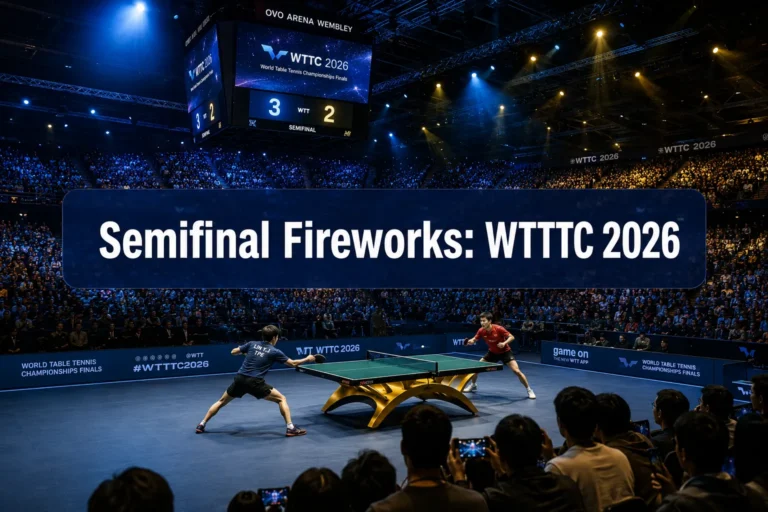
At Chongqing 2026, several rallies met all five criteria. One Lebrun vs. Wang Chuqin exchange in the quarterfinals reportedly lasted over 20 strokes, with three separate momentum shifts before Lebrun closed it with a cross-court backhand winner.
WTT Champions Chongqing 2026: Breaking Down the Top 10 Most Epic Rallies — Technique and Strategy Analysis

These ten rallies stood out not just for their drama, but for what they reveal about modern elite table tennis.
Rally #1 — Matsushima vs. Fan Zhendong (Round of 16) Matsushima opened with a heavy pendulum serve, drew a weak return, then engaged in a 14-stroke forehand-to-forehand loop exchange. Fan eventually redirected cross-court, but Matsushima’s ability to sustain topspin quality throughout showed elite-level consistency rare for his age group.
Rally #2 — Lebrun vs. Wang Chuqin (Quarterfinal) Lebrun’s backhand-dominant game was on full display. After a mid-table block, he shifted angles three times in six strokes, forcing Wang wide before closing with a forehand winner. Shot selection under pressure — a key skill for any racket sports player — was the defining factor.
Rally #3 — Moregard vs. Fan Zhendong (Semifinal) This was the longest rally of the tournament (estimated 28+ strokes). Moregard’s defensive counter-looping kept Fan from finding a clean attack angle. Fan eventually found the line with a forehand drive, but Moregard’s endurance was the real story.
Rallies #4–#10 — Common themes across the top points:
- Serve variation started most of these rallies in an unbalanced position for one player
- Third-ball attack was the intended pattern in seven of the ten rallies
- Recovery footwork after wide balls determined who won six of the ten points
- DHS ball characteristics (slightly slower arc, pronounced spin response) rewarded players who could generate and read heavy topspin
Chinese vs. International Table Tennis Styles: What’s the Difference?
Chinese players and international players approach rallies from fundamentally different tactical frameworks, and Chongqing 2026 made those differences very visible.
Chinese style (Fan Zhendong, Wang Chuqin):
- Prioritize early-ball attack — taking the ball at the top of the bounce or rising
- Forehand-dominant, with looping as the primary weapon
- Serve-receive patterns designed to create third-ball opportunities
- Extremely high stroke volume in training produces automatic, consistent mechanics
International style (Lebrun, Matsushima, Moregard):
- More variation in pace and spin — using slowdown balls to disrupt rhythm
- Greater willingness to play into long rallies and use the backhand as an equalizer
- Matsushima blends Chinese-influenced topspin loops with Japanese speed and agility
- Lebrun’s game reflects the French federation’s emphasis on creative, unpredictable play
For players who enjoy studying style differences across racket sports, this kind of tactical contrast also shows up in shot selection strategy guides for beginners — the principle of choosing shots based on your position and your opponent’s weakness is universal.
How Can Beginners Learn from Professional Rally Techniques?
Watching elite rallies is genuinely useful for beginners — but only if you know what to look for. Most recreational players watch the ball; pros watch the body.
Three things beginners should study in each rally:
- Ready position after each shot — notice how pros reset their stance immediately after hitting, not after the ball crosses the net
- Free arm position — the non-paddle arm stays out for balance; dropping it is one of the most common amateur errors
- Footwork pattern — elite players rarely reach for the ball; they move their feet to get into position first
The video analysis guide at Rally Racket walks through exactly how to break down pro footage for your own improvement — a method that works just as well for table tennis as it does for other racket sports.
Common Mistakes Amateur Players Make During Intense Rallies
Most recreational players lose long rallies for the same handful of reasons — and they’re all fixable.
Top mistakes seen at the club level:
- Rushing the swing — faster isn’t better; timing the contact point matters more than arm speed
- Forgetting to breathe — tension builds during long rallies and restricts natural movement
- Watching the opponent’s paddle instead of the ball — leads to late reads and mis-hits
- Standing too close to the table during a defensive exchange — limits recovery options
- Going for a winner too early — elite players build the rally before attacking; amateurs attack on the first opportunity and often miss
Understanding spin is also critical. Many club players can’t read heavy topspin returns, which leads to popping the ball up or netting it. The spin variation guide covers how to both generate and read spin more effectively.
How Do Professional Table Tennis Players Train for Long Rallies?
Professional players build rally endurance through structured multi-ball drills, physical conditioning, and deliberate footwork training — not just by playing more matches.
Core training methods used at the elite level:
- Multi-ball feeding drills — a coach or machine feeds balls in rapid succession to specific zones, forcing the player to loop or block continuously for 60–90 seconds
- Shadow footwork — moving through rally patterns without a ball to build muscle memory for recovery steps
- Serve-receive simulation — practicing the first three to five strokes of a rally repeatedly until they become automatic
- Physical conditioning — leg strength and aerobic capacity directly affect how well a player maintains stroke quality in a 20-stroke rally versus a 5-stroke one
Matsushima’s training background in Japan, which blends Chinese multi-ball methodology with Japanese precision drills, is widely credited for his ability to sustain heavy topspin quality deep into long exchanges.
What Technical Skills Determine a Truly Memorable Rally?
The rallies from WTT Champions Chongqing 2026 that made the top 10 shared a specific set of technical qualities — and these same qualities separate good recreational players from great ones.
The technical checklist of an elite rally:
- ✅ Consistent contact point (same relative position to the body on each stroke)
- ✅ Brush angle control (adjusting topspin vs. drive based on incoming ball height)
- ✅ Deception without sacrificing consistency (changing direction without telegraphing)
- ✅ Recovery speed between strokes (footwork, not just arm speed)
- ✅ Mental composure — no visible tension in the grip or shoulders
“The best rallies aren’t won by the player who hits hardest — they’re won by the player who makes the last mistake least likely.”
This principle applies across the entire racket sports community — from table tennis to pickleball to padel. Improving racket sports skills always comes back to consistency, positioning, and smart shot selection before power.
Are the Top 10 Rallies Representative of World-Class Play?
Yes — but with an important caveat. The top 10 rallies from Chongqing 2026 represent what elite players do when both players are at or near their best. They’re not representative of an average point at this level.
Most WTT Champions points end in three to five strokes. Long rallies are the exception, not the rule, because elite players are designed to end points quickly through serve-receive dominance and early-ball attacks. When a 20-stroke rally happens, it usually means both players have neutralized each other’s first-strike weapons — which is itself a sign of elite-level defense.
For fans and players in the broader racket sports community, these top rallies are best understood as a showcase of maximum capability — the ceiling of what’s possible, not the average expectation.
FAQ: WTT Champions Chongqing 2026 and Epic Rallies
Q: What does WTT stand for? A: WTT stands for World Table Tennis, the commercial arm of the International Table Tennis Federation (ITTF) that organizes the professional tour.
Q: Is Chongqing a regular WTT host city? A: Chongqing has hosted multiple WTT events due to its strong table tennis culture and large indoor arena infrastructure in China.
Q: Who is Sora Matsushima? A: Sora Matsushima is a young Japanese player known for heavy topspin loops and aggressive footwork. He represents a new generation of Asian challengers outside China pushing into the world top 20.
Q: What equipment does DHS provide for WTT events? A: DHS (Double Happiness) supplies the official match balls and is the table sponsor for WTT events. The DHS 40+ ball is the standard for international competition.
Q: How long is an average table tennis rally at the elite level? A: Most elite rallies last three to seven strokes. Rallies exceeding 15 strokes are relatively rare and typically occur when both players are in a defensive or neutralizing phase.
Q: Can recreational players use the same footwork patterns as pros? A: Yes, the basic footwork patterns (side-step, crossover, and pivot) are the same at all levels. The difference is speed and automation, not the pattern itself.
Q: What makes Felix Lebrun’s style unusual among top players? A: Lebrun relies heavily on his backhand as an attacking weapon, which is less common among top-10 players who typically forehand-dominate. His creative shot angles and willingness to redirect under pressure make him unpredictable.
Q: How do I start learning from pro rallies as a beginner? A: Watch one rally at a time, mute the commentary, and focus only on one element per viewing — footwork, free arm, or contact point. Repeat until you can see it automatically.
Q: Does spin matter as much in recreational play as at the pro level? A: Spin matters at every level, but recreational players often underestimate it. Even moderate topspin forces opponents into errors. Learning to generate and read spin early is one of the highest-return skills for improving racket sports skills.
Q: Where can I find the WTT Champions Chongqing 2026 match replays? A: WTT publishes official match highlights and full replays on their YouTube channel and the WTT app. Search “WTT Champions Chongqing 2026” for the full playlist.
Conclusion: What to Take Away from Chongqing 2026
The WTT Champions Chongqing 2026: Breaking Down the Top 10 Most Epic Rallies reveals something useful for players at every level: elite table tennis is won through preparation, not just talent. Every one of those top 10 rallies was shaped by footwork, serve strategy, and shot selection decisions made in fractions of a second — skills built through thousands of hours of deliberate practice.
Your next steps as a player:
- Watch at least three of the top Chongqing 2026 rallies with a specific focus (pick one: footwork, free arm, or recovery position)
- Take one drill from the pro training methods above and add it to your next session
- Work on reading spin — it’s the single skill that unlocks the most improvement fastest
- Explore the video analysis approach to turn any pro footage into a personal coaching session
- Connect with your local racket sports community — improvement happens faster with good training partners
Whether you play table tennis, pickleball, padel, or any other racket sport, the lessons from elite rallies translate. Smart positioning, consistent technique, and calm decision-making under pressure are the foundation of every great point — at any level.
Meta Title: WTT Champions Chongqing 2026: Top 10 Epic Rallies Breakdown
Meta Description: Explore the top 10 most epic rallies from WTT Champions Chongqing 2026. Analyze technique, player strategy, and what beginners can learn from elite table tennis.