Smart Rackets and AI Analysis: How 2026 Tech Is Transforming Padel Training and Performance
Last updated: May 31, 2026
Quick Answer: Smart rackets and AI analysis in 2026 give padel players real-time data on spin, power, shot type, and court positioning — feedback that used to require a professional coach watching every session. Systems range from clip-on sensors and wrist trackers to camera-based apps, and they’re now accessible enough for recreational players, not just pros.
Key Takeaways
- Smart padel rackets use embedded or clip-on sensors to track motion, spin, power, and shot type during live play
- AI systems like SmashIQ report shot classification accuracy as high as 97.9% [3]
- Camera-based platforms (no extra hardware needed) can analyze a full match in under a minute [3]
- Entry-level AI tracking apps are available for free or low monthly fees; premium hardware bundles range from roughly €100–€300
- AI analysis complements coaching — it doesn’t replace the human eye or on-court guidance [9]
- The biggest mistakes players make: ignoring the data after collecting it, and focusing only on power metrics instead of technique
- Smart tech is genuinely useful for beginners and intermediates, not just elite players
- Privacy varies by platform — check whether your session data is stored, shared, or sold before signing up
- Padel-specific AI tools now cover technique, positioning, decision-making, and even mental patterns [4]
- Video analysis combined with sensor data gives the most complete picture of your game
What Exactly Is a Smart Padel Racket and How Does It Work?
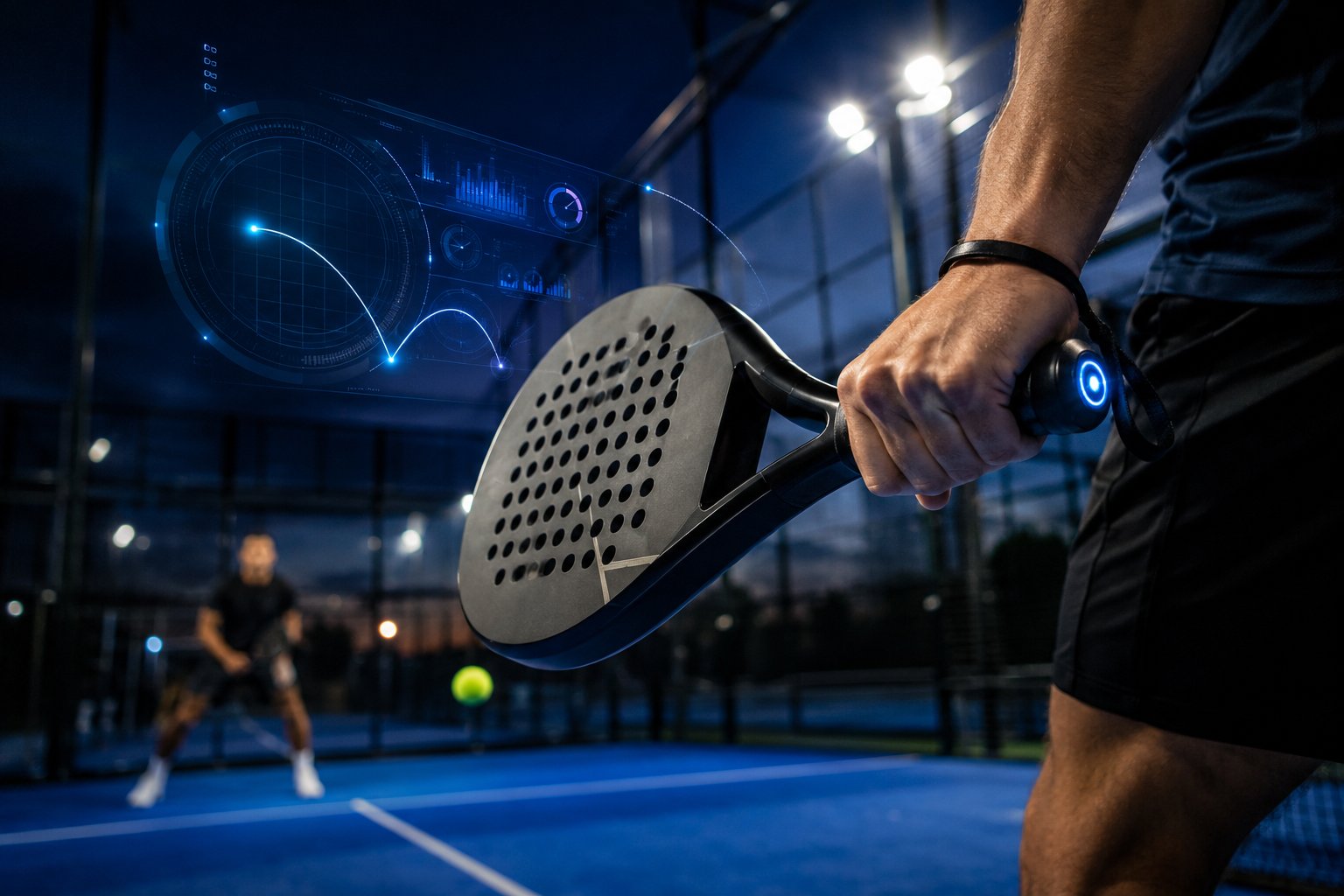
A smart padel racket is either a standard racket with a built-in sensor or a regular racket fitted with a clip-on tracking device. The sensor captures motion data — acceleration, rotation, and impact force — and sends it wirelessly to a smartphone app, where AI processes the numbers into readable feedback.
Here’s how the core technology works:
- Inertial measurement units (IMUs) detect the racket’s speed and angle during a swing
- Accelerometers and gyroscopes measure spin and impact force at the moment of ball contact
- Bluetooth or Wi-Fi transmits raw data to a paired app in real time
- AI models classify the data into shot types (bandeja, smash, volley, lob) and generate performance metrics
PadelPlay’s sensor, for example, clips onto any racket, pairs with an app, and uses an AI coach called “Coach Manu” to deliver personalized feedback. It achieves shot classification accuracy of over 85%, depending on shot type and playing style [1].
The Padel Band takes a slightly different approach — it’s a wrist-worn sensor using inertial measurement technology to capture stroke mechanics without modifying the racket at all [6].
Choose a clip-on sensor if you want to keep using your current racket. Choose a wrist tracker if you switch rackets often or prefer minimal gear changes.
What Kind of Data Do Smart Padel Rackets Actually Collect?
Smart padel systems collect far more than just shot count. The data categories typically include:
| Data Type | What It Measures |
|---|---|
| Shot classification | Smash, bandeja, volley, lob, drive |
| Power/speed | Racket head speed and estimated ball exit speed |
| Spin rate | Topspin, slice, and flat contact |
| Shot distribution | Which shots you use most, and when |
| Rally length | Average rallies per game, long vs. short point patterns |
| Court positioning | Where you tend to stand during different shot types |
| Technique score | Consistency of swing mechanics over time |
PadelIQ goes further by analyzing match videos to assess positioning, decision-making, offense, defense, and even mental patterns — generating detailed reports that track progress across multiple sessions [4]. CourtSight.io processes match footage and delivers heatmaps and performance metrics within 10 minutes, with no extra hardware required [5].
For players who want to improve racket sports skills across multiple disciplines, this kind of structured data is genuinely useful — it shows patterns that are almost impossible to spot in the moment.
How Accurate Are the Performance Metrics from AI Racket Tracking?
Accuracy varies by platform and shot type, but the best systems are genuinely impressive. SmashIQ claims 97.9% shot classification accuracy and processes a full match in 53 seconds using only a phone camera [3]. PadelPlay’s sensor-based system hits over 85% accuracy, with variation depending on the shot and playing style [1].
A study published in August 2025 in a peer-reviewed sports science journal compared traditional ranking methods with AI-driven computer vision approaches and found that AI systems can provide more objective, real-time performance evaluations with fewer biases than self-assessment [8].
A few honest caveats:
- Accuracy drops for less common or hybrid shots (like a rushed defensive smash)
- Camera-based systems need decent lighting and a stable filming angle
- Sensor-based systems can misclassify shots if the player has an unusual grip or swing style
- No system is perfect — treat the data as a strong guide, not a definitive verdict

How Much Do AI-Powered Padel Training Systems Cost in 2026?
AI padel training tools in 2026 span a wide price range, so there’s something for most budgets.
Free or low-cost options:
- Camera-based apps (like SmashIQ or CourtSight.io) often have free tiers or affordable monthly subscriptions, typically €5–€15/month [3][5]
- PadelIQ offers video analysis plans aimed at club-level players [4]
Mid-range hardware:
- Clip-on sensors like PadelPlay’s device sit in the €80–€150 range, with app subscriptions on top [1]
- The Padel Band wrist tracker is in a similar bracket [6]
Premium systems:
- SmartPadel’s AI ball machine with 3D computer vision is a club-level investment, estimated in the several-thousand-euro range — designed for academies and training centers rather than individual players [2]
Bottom line: A recreational player can get meaningful AI feedback for under €20/month using a camera app. If you want sensor-level detail, budget around €100–€200 upfront plus a small subscription.
Which Smart Racket Brands Are Best for Amateur Players?
For amateur padel players in 2026, the most practical options are platforms that don’t require expensive hardware or technical setup.
Best for ease of use: SmashIQ — just use your phone camera, no extra gear [3]
Best for shot-by-shot sensor data: PadelPlay — clips onto any racket, solid accuracy, friendly app interface [1]
Best for match video breakdown: PadelIQ or CourtSight.io — upload match footage and get a full tactical report [4][5]
Best for wrist-based tracking: Padel Band — good for players who don’t want to modify their racket [6]
If you’re also exploring padel equipment options for 2026, pairing a quality racket (like the Nox AT10 12K Lite, which features a 12K aluminized carbon face and HR3 White EVA foam core [7]) with a smart tracking system gives you both hardware performance and data-driven feedback.
Is a Smart Padel Racket Worth It for Beginners or Just for Pro Athletes?
Smart racket tech is worth it for beginners and intermediates — arguably more so than for advanced players, who already have coaches giving them detailed feedback.
Here’s why it works well for newer players:
- It shows patterns you can’t feel yet. A beginner often doesn’t know they’re hitting 80% of their shots from the back of the court. The data makes it visible.
- It gives objective feedback. No guessing whether your smash is improving — the power and consistency numbers tell you.
- It keeps sessions focused. Having a specific metric to work on (say, increasing bandeja accuracy from 60% to 75%) beats vague “practice more” advice.
That said, AI analysis works best alongside some baseline coaching. If your technique has fundamental flaws, the data will confirm the problem but won’t teach you how to fix it physically. Think of it as a training partner that tracks everything — useful, but not a replacement for a coach who can physically correct your stance or grip.
Players who’ve used video analysis to learn from the pros will find AI tracking a natural next step — it applies the same principle of watching and learning, just automated.
Can AI Racket Sensors Really Improve My Technique That Much?
Yes — but the improvement comes from acting on the data, not just collecting it. AI analysis identifies repeatable behaviors: shot types you overuse, positions you default to under pressure, and technique inconsistencies across a session [9].
What AI analysis helps improve fastest:
- Shot selection — seeing your shot distribution makes it obvious if you’re over-relying on one shot
- Consistency — technique scores across multiple sessions show whether you’re actually grooving better mechanics
- Positioning — heatmaps reveal if you’re drifting out of position habitually
- Rally management — data on rally length and point outcomes helps you understand your tactical tendencies
The skills that improve slowest with AI alone are those requiring physical feel — touch shots, net play, and reading your opponent’s body language. Those still need court time and human coaching.
For players working on movement alongside technique, pairing AI feedback with agility training exercises builds a more complete game.
What Are the Top Mistakes Players Make When Using Smart Racket Technology?
Most players make one of these five mistakes:
- Collecting data and never reviewing it. The app fills up with sessions, but nothing changes in training. Set aside 10 minutes after each session to look at the numbers.
- Obsessing over power metrics. High smash speed is satisfying to see, but technique consistency and shot selection matter more for winning points.
- Ignoring the baseline session. Without a starting point, you can’t measure progress. Record a full match before you change anything.
- Trusting accuracy blindly. If a session shows 40% shot misclassification (which can happen with unusual swings), the data is less useful. Cross-reference with video.
- Using tech as a substitute for practice. Tracking a bad habit doesn’t fix it. The data points you toward what to work on — then you still have to do the reps.
Which Professional Padel Players Are Already Using Smart Racket Tech?
Top-ranked players and their coaching teams have been integrating performance data tools for several years. While specific brand endorsements shift frequently, players at the World Padel Tour level — including those in the Alejandro Galán and Arturo Coello bracket — work with performance analysts who use video and sensor data to break down opponent tendencies and refine their own patterns [9].
The angle around players like Juan Lebrón Chincoa and Agustín Tapia is that maintaining dominance at the top level now requires data-informed training cycles, not just court hours. Tapia’s consistency in high-pressure points, for example, is the kind of pattern that AI tracking can quantify and then deliberately reinforce in practice.
For most recreational players, the takeaway is simple: the tools the pros use are now available at consumer prices. The gap between elite training methods and club-level training has narrowed significantly in 2026.
How Do Smart Rackets Compare to Traditional Coaching Methods?
Smart rackets and AI analysis are best understood as a complement to coaching, not a replacement [9]. Here’s a practical comparison:
| Factor | Traditional Coaching | AI/Smart Racket Analysis |
|---|---|---|
| Feedback timing | After the point or session | Real-time or within minutes |
| Coverage | Coach sees what they’re watching | Every shot, every session |
| Physical correction | Yes — coach can adjust grip, stance | No — data only |
| Cost | €40–€100+/hour | €5–€20/month (apps) |
| Tactical depth | High — coach reads the game | Good — pattern recognition |
| Motivation/accountability | High | Moderate (self-directed) |
The smartest approach: use AI tracking to identify what to work on, then bring those specific issues to a coaching session. That makes your coaching time more efficient and your practice more targeted.
Players exploring advanced strategies for recreational play will find AI data gives them concrete talking points to bring to a coach or training partner.
Are There Any Privacy Concerns with AI Tracking in Sports Equipment?
Yes, and they’re worth checking before you sign up. Most AI padel platforms collect session data — shot counts, timing, location (if GPS is enabled), and sometimes video footage. The key questions to ask:
- Is your data stored on their servers or locally on your device?
- Is it anonymized or linked to your profile?
- Can it be shared with third parties or used to train their AI models?
- Can you delete your data on request?
Camera-based systems that process match video are the most sensitive — you’re uploading footage of yourself and potentially other players. Check the platform’s privacy policy before uploading anything recorded at a club or public court, where other players haven’t consented.
Most reputable platforms (PadelPlay, SmashIQ, PadelIQ) publish clear data policies, but the specifics vary. Spending five minutes reading the privacy section before subscribing is worth it.
FAQ
Q: Do I need to buy a new racket to use smart padel technology? No. Most systems use clip-on sensors (like PadelPlay) or wrist trackers (like Padel Band) that work with any existing racket. Camera-based apps like SmashIQ require no hardware at all — just a phone.
Q: How long does it take to see improvement from AI padel analysis? Most players notice actionable patterns within 3–5 sessions of consistent tracking. Measurable technique improvement typically shows in 4–8 weeks if you’re actively working on the flagged areas.
Q: Can I use smart racket tech for other racket sports like pickleball or tennis? Some sensor platforms are sport-specific. SmashIQ and PadelPlay are built for padel. General motion sensors may work across sports, but shot classification accuracy will be lower without sport-specific AI training.
Q: Is a €150 sensor better than a free camera app? Not necessarily. Camera apps like SmashIQ can hit 97.9% shot classification accuracy [3]. Sensors give more granular data (spin rate, impact force) that cameras can’t capture. Choose based on what data matters most to you.
Q: What’s the minimum phone spec needed for camera-based AI analysis? Most platforms recommend a smartphone from 2021 or newer with a decent rear camera. Stable mounting (a tripod or court-side stand) matters more than phone specs for accuracy.
Q: Can AI analysis help with doubles strategy in padel? Yes — platforms like PadelIQ and CourtSight.io analyze positioning and court coverage, which directly applies to doubles tactics. Heatmaps showing where you and your partner stand relative to the net are particularly useful [4][5].
Q: Do professional coaches use these tools with their players? Increasingly yes. AI analysis is used to prepare for specific opponents, track player progress between sessions, and make coaching conversations more data-driven [9].
Q: Is the data from smart rackets accurate enough to trust for training decisions? For broad patterns (shot distribution, positioning tendencies), yes — accuracy is high enough to be useful. For precise metrics like exact spin RPM, treat the numbers as directional rather than definitive.
Conclusion
Smart rackets and AI analysis are genuinely changing how padel players train in 2026 — and the technology is no longer just for elite athletes. Whether you clip a sensor onto your current racket, strap on a wrist tracker, or simply prop your phone on a tripod and let a camera app do the work, you can now get the kind of structured, data-driven feedback that used to require a full coaching setup.
Actionable next steps:
- Start with a free or low-cost camera app (SmashIQ or CourtSight.io) to get a baseline read on your shot distribution and positioning
- Record 3–5 sessions before changing anything — you need a baseline to measure progress
- Pick one metric to improve per training block (e.g., bandeja consistency or court positioning)
- Bring the data to your next coaching session and use it to focus the conversation
- Revisit your privacy settings on any platform you sign up for
The racket sports community is getting smarter about training — and padel is leading the way. Joining that shift doesn’t require a big budget or a tech background. It just takes a willingness to look at your game honestly and act on what you find.
For more gear insights and training strategies across racket sports, explore the racket sports startups and innovations shaping the game right now.
References
[1] PadelPlay Smart Sensor – https://www.padelplay.ai/?utm_source=openai
[2] SmartPadel AI Training System – https://smart-padel.app/?utm_source=openai
[3] SmashIQ AI Coaching – https://playsmash.ai/?utm_source=openai
[4] PadelIQ AI Coach – https://www.padeliq.co/en?utm_source=openai
[5] CourtSight.io Tactical Analysis – https://courtsight.io/en?utm_source=openai
[6] Padel Band Review – https://www.padelracketreviews.com/padel-band-review/?utm_source=openai
[7] Nox AT10 12K Lite 2026 – https://padelverdict.com/rackets/nox-at10-12k-lite-2026/?utm_source=openai
[8] AI in Padel Performance Assessment – https://journals.sagepub.com/doi/abs/10.1177/17479541251370192?utm_source=openai
[9] Can AI Make You Better at Padel? Smart Training, Video Analysis and the Future of Coaching – https://padelspeed.com/blogs/news/can-ai-make-you-better-at-padel-smart-training-video-analysis-and-the-future-of-coaching?utm_source=openai