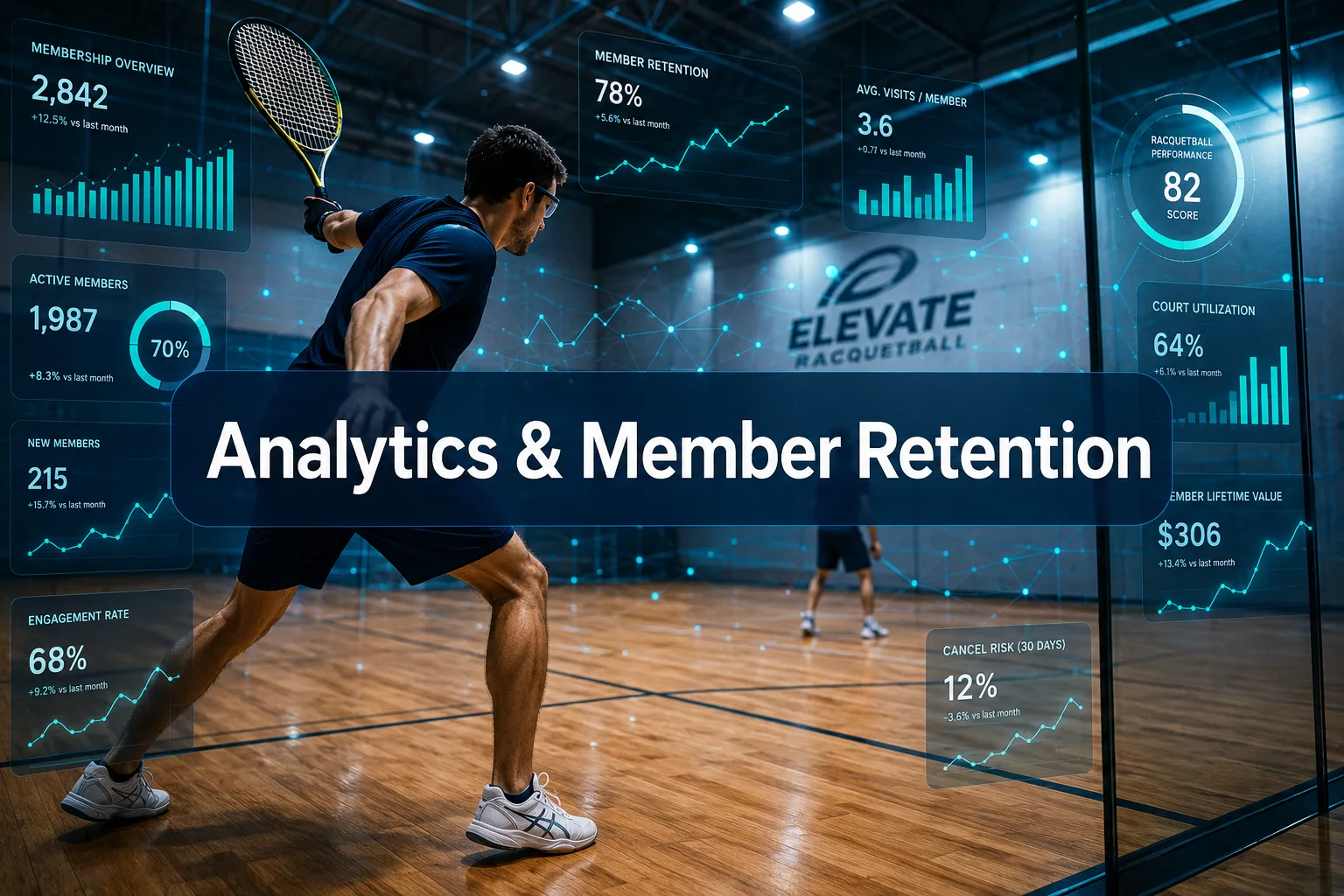
Data-Driven Personalization: How Racquet Clubs Are Using Analytics to Boost Member Retention in Racquetball
Last updated: August 7, 2026
Quick Answer: Data-driven personalization in racquet clubs means using member booking patterns, court usage, and engagement signals to deliver tailored drills, league recommendations, and outreach, before a member decides to quit. Clubs that apply this approach consistently report significantly stronger annual renewal rates than those relying on gut instinct alone.
Key Takeaways
- Members on annual billing stay active at 82% after one year versus just 35% for monthly payers [2]
- Over half of preventable cancellations happen within the first 90 days, making early personalization critical [2]
- Combining four data-driven tactics (automated onboarding, pause offers, renewal reminders, engagement scoring) can lift retention by 25-35 percentage points [1]
- “Early warning” churn signals include declining court bookings, 45+ day visit gaps, and reduced league participation [6]
- Members who play alone cancel at much higher rates than those in groups or with regular partners [3]
- Small clubs can start with free or low-cost tools; enterprise platforms like ClubEssential or CourtReserve scale up from there [7][8]
- Personalization works differently for casual vs. competitive players, one-size-fits-all messaging backfires
- The first 90 days and annual billing conversion are the two highest-ROI retention levers available to any club
What Is Data-Driven Personalization in Fitness and Racquet Clubs?
Data-driven personalization means using real behavioral data, court bookings, lesson attendance, guest invites, event sign-ups, to tailor every member’s experience rather than sending everyone the same newsletter. For racquet clubs, this goes beyond generic email blasts to include customized drill recommendations, targeted league placements, and proactive outreach triggered by actual usage patterns.
The core idea is simple: a member who books courts three times a week and attends clinics needs a very different communication than someone who visited once in the past month. Data-Driven Personalization: How Racquet Clubs Are Using Analytics to Boost Member Retention in Racquetball starts with capturing the right signals and ends with the right person getting the right message at the right time.
This approach applies to clubs of all sizes, from a two-court community facility to a 20-court private club, as long as they’re collecting even basic booking and attendance data.
How Do Racquet Clubs Use Analytics to Keep Members?
Racquet clubs use analytics to identify which members are thriving, which are drifting, and which are about to cancel, then act on that information before it’s too late.
The most effective clubs build what practitioners call a retention stack: a set of automated, data-triggered actions that run in the background without requiring staff to manually monitor every account [1]. Here’s how that typically works in practice:
- Automated welcome sequences fire within the first 7 days of sign-up, introducing new members to courts, leagues, and instructors
- Engagement scoring assigns each member a score based on booking frequency, days since last visit, and event participation
- Pause/freeze offers are triggered automatically when a member signals cancellation intent, giving them an alternative to quitting outright
- Renewal reminders go out based on billing cycle dates, not generic calendar blasts
Clubs also track social integration metrics: whether a new member has been matched with a regular partner, attended a group clinic, or been introduced to existing members. Analysis from 2026 shows that members who play alone are significantly more likely to cancel than those embedded in the club’s social fabric [3]. You can see real examples of how community connection drives loyalty in member testimonials about friendship and skill development in local clubs.
What Metrics Matter Most for Racquetball Member Retention?
The most predictive retention metrics are booking frequency, days since last visit, league participation rate, and social integration depth, not raw visit counts alone.
Clubs that only track “check-ins per month” miss the nuance. A member might check in regularly but only for solo practice, which is a weaker retention signal than someone who plays in a league, attends clinics, and brings guests [6]. The metrics that actually predict renewal include:
| Metric | Why It Matters |
|---|---|
| Days since last court booking | Gaps of 45+ days are strong churn flags [6] |
| Weekly booking frequency trend | A declining trend over 3-4 weeks signals disengagement |
| League/clinic re-attendance rate | First-timers who return are far more likely to renew [3] |
| Guest invites per member | Social connectors churn at lower rates |
| Membership tier engagement | Are premium members using premium benefits? [6] |
| Independent bookings in months 2-3 | Low solo bookings early = higher cancel risk [3] |
💡 Pro tip: Ask new members to name 2-3 existing members after 30 days. Clubs that track this simple social metric report it’s one of their strongest early renewal predictors [3].
What Data Should Racquet Clubs Collect from Members?
Clubs should collect booking history, attendance patterns, lesson and clinic participation, event sign-ups, guest activity, and billing cycle data as their core dataset. More advanced clubs also capture skill-level assessments and gear preferences.
Here’s a practical collection checklist:
- ✅ Court booking timestamps and frequency
- ✅ Lesson and clinic attendance (first-time vs. returning)
- ✅ League enrollment and match completion
- ✅ Event RSVPs and actual attendance
- ✅ Guest passes used
- ✅ Membership tier and billing cycle (annual vs. monthly)
- ✅ Cancellation or freeze requests (and outcomes)
- ✅ Communication open/click rates from club emails
What to skip early on: Don’t try to collect swing biomechanics data or wearable sensor feeds until the basics are running cleanly. The ROI on booking + billing data alone is substantial.
Best Analytics Tools for Tennis and Racquetball Facilities
The most widely used platforms in 2026 for racquet club analytics are CourtReserve, ClubEssential, and emerging AI-driven tools, each suited to different club sizes and budgets.
- CourtReserve focuses on court booking management and revenue-per-player tracking, making it strong for mid-size clubs that want booking analytics without a full CRM [8]
- ClubEssential offers a broader suite covering member management, billing, and engagement dashboards, built specifically for racquet and private clubs [7]
- IQ Sport AI is an emerging platform applying machine learning to member engagement prediction, worth watching for larger facilities [10]
- Whos-In specializes in retention benchmarking and automated member journeys, with strong data on what triggers renewals vs. cancellations [1]
Choose CourtReserve if your primary need is booking optimization and revenue tracking. Choose ClubEssential if you want an all-in-one member management and engagement platform. Start with spreadsheets + a basic CRM if you’re a small club just getting started, the tool matters less than the habit of reviewing data weekly.

How Much Does Personalization Software Cost for Racquet Clubs?
Costs range from free (basic CRM tools) to $300,$800+ per month for full-featured racquet club platforms, depending on club size and feature needs.
Exact pricing varies and changes frequently, so always request a current quote directly from vendors. As a general framework:
- Free to ~$50/month: Basic email tools (Mailchimp, HubSpot free tier) for automated welcome sequences and segmented newsletters
- ~$100,$300/month: Mid-tier booking + member management tools with basic analytics
- $300,$800+/month: Full platforms like ClubEssential or CourtReserve with engagement scoring, retention dashboards, and automated workflows [7][8]
The ROI case is strong: if annual billing members stay at 82% vs. 35% for monthly payers [2], converting even a handful of monthly members to annual plans can offset software costs quickly.
Can Small Racquet Clubs Afford Personalization Technology?
Yes, small clubs can start with free tools and manual processes, then layer in paid software as membership revenue grows. The key is starting with the data habit, not the platform.
A two-court club with 150 members can run effective personalization with:
- A free email tool for automated welcome sequences
- A shared spreadsheet tracking last visit date and membership type
- A weekly 15-minute staff review of members who haven’t booked in 30+ days
- A simple “pause instead of cancel” script for front desk staff
This costs almost nothing but addresses the biggest retention levers identified in the research [1][2]. Clubs exploring funding options for technology upgrades can also look into Racquet 360 funding resources for grants and support programs.
Do Personalization Strategies Actually Reduce Cancellations?
Yes, the evidence from 2026 benchmarks is clear. Clubs using a full retention stack (automated onboarding, engagement scoring, pause offers, renewal reminders) see 25-35 percentage point improvements in annual renewal rates compared to clubs using no structured approach [1].
The biggest single lever is the first 90 days. More than half of preventable cancellations happen in that window, which means personalized onboarding, first-lesson offers, partner matchmaking, league invitations, has an outsized impact on long-term retention [2][3]. This is also why hosting community tournaments and local events matters so much: events give new members a reason to return in that critical early period.
How to Personalize Member Experience at a Racquetball Club
Personalization works best when it’s triggered by behavior, not by calendar. The goal is to make every member feel like the club knows them, because it does.
For new members (Days 1-90):
- Send a personalized welcome email within 24 hours of sign-up
- Offer a complimentary skill assessment or first lesson
- Match them with a regular playing partner or beginner league
- Check in at Day 30 if they haven’t booked independently
For engaged members:
- Recommend advanced clinics based on skill level and booking history
- Invite them to competitive leagues aligned with their play frequency
- Offer gear recommendations based on play style (tracked through lesson notes)
- Recognize milestones (1-year anniversary, 100th court booking)
For at-risk members (45+ day gap, declining bookings):
- Trigger a personal outreach from a staff member or pro
- Offer a membership pause/freeze before they reach the cancel button
- Re-introduce them to a league or clinic they haven’t tried
For clubs looking to sharpen their players’ skills as part of the personalized experience, resources on improving racquet sports skills can complement in-club programming.
Personalization for Casual vs. Competitive Racquetball Players
Casual and competitive members have fundamentally different motivations, and personalization strategies that work for one group often backfire with the other.
Casual players are motivated by social connection, stress relief, and fun. They respond well to:
- Partner matchmaking and social league invitations
- Wellness-focused messaging (the mental health benefits of regular play resonate strongly here)
- Flexible scheduling reminders
- Low-pressure “come back” offers after absence
Competitive players are motivated by improvement and challenge. They respond well to:
- Skill-based drill recommendations
- Ladder league placements and tournament notifications
- Performance tracking and progress updates
- Pro lesson packages tied to specific weaknesses
Sending a competitive player a “just-for-fun mixer” invite, or a casual player an intense skills-assessment email, signals that the club doesn’t know them, and that erodes trust faster than no communication at all.
How to Use Booking Patterns to Predict Member Churn
Booking pattern analysis is one of the most reliable early-warning systems available to racquet clubs. A drop in weekly booking frequency, especially combined with a growing gap since the last visit, predicts cancellation weeks before the member ever contacts the front desk [6].
Key churn signals to monitor:
- 45+ days since last visit, flag for immediate personal outreach [6]
- Booking frequency drops by 50%+ over 3 weeks, trigger a check-in message
- No independent court bookings in months 2-3, new member at high cancel risk [3]
- Missed league matches without rescheduling, social disengagement signal
- Cancellation page visits, if your booking software tracks this, it’s a strong intent signal
The best clubs don’t wait for cancellations to analyze what went wrong. They run weekly dashboard reviews and assign staff to reach out to flagged members personally, a phone call or in-person conversation converts far better than an automated email alone [9].
What If My Racquet Club Has Limited Member Data?
Start collecting now, even imperfectly. A club with six months of booking history can already identify its highest-risk members and its most engaged ones.
If data is genuinely sparse, prioritize:
- Ask directly, a simple onboarding survey captures goals, skill level, and preferred play times
- Track billing type, annual vs. monthly is the single most predictive retention variable [2]
- Log lesson notes, instructors’ observations about skill gaps and preferences are valuable personalization inputs
- Monitor no-shows, missed bookings without rescheduling are easy to track and highly predictive
Don’t let perfect be the enemy of useful. Even basic segmentation (new member vs. veteran, casual vs. competitive, annual vs. monthly) allows for meaningfully different communications that outperform a one-size-fits-all approach.
How Long Does It Take to See Results from Personalization?
Most clubs see measurable retention improvements within 3-6 months of implementing structured personalization, with the clearest results visible at the first annual renewal cycle.
The fastest wins come from:
- Week 1: Automated welcome sequences reduce early dropout almost immediately
- Month 1-3: Engagement scoring identifies at-risk members in time to intervene
- Month 6-12: Annual billing conversion and renewal reminder campaigns show up in renewal rate data
Full retention stack results, the 25-35 percentage point improvement cited in benchmarks [1], typically require a complete annual cycle to measure accurately, since renewal rates are inherently annual metrics.
Common Mistakes Clubs Make with Member Analytics
Even well-intentioned clubs make predictable errors when starting with analytics.
Mistake 1: Tracking visits instead of engagement quality. A member who checks in daily for solo wall practice is less retained than one who plays twice a week in a league. Raw visit counts mislead.
Mistake 2: Waiting too long to intervene. By the time a member calls to cancel, the decision is usually already made. Clubs need to act at the 30-45 day inactivity mark, not after [6].
Mistake 3: Sending the same message to everyone. Generic “we miss you” emails have low conversion. Personalized outreach referencing a specific league or a specific instructor converts far better.
Mistake 4: Collecting data but never reviewing it. Analytics tools only work if someone looks at them weekly. Assign a specific staff member to own the retention dashboard.
Mistake 5: Ignoring billing cycle data. Converting monthly payers to annual billing is one of the highest-ROI moves available, yet many clubs never actively promote it [2].
Conclusion: Your Next Steps for Data-Driven Retention
Data-Driven Personalization: How Racquet Clubs Are Using Analytics to Boost Member Retention in Racquetball isn’t a luxury reserved for large private clubs with big tech budgets. The core principles, track behavior, act early, personalize by member type, and make social connection a measurable goal, are accessible to any club willing to build the habit.
Start here this week:
- Audit your billing mix. What percentage of members are on annual vs. monthly plans? Set a goal to shift 10-15% to annual billing this quarter.
- Pull a “last visit” report. Flag every member who hasn’t booked in 30+ days and assign staff to reach out personally.
- Segment your new members. Identify everyone who joined in the last 90 days and confirm they’ve been matched with a partner or invited to a league.
- Pick one tool. Even a free CRM or email platform with basic automation is enough to start running welcome sequences and renewal reminders.
- Review data weekly. Block 15 minutes every Monday to scan your engagement dashboard. Consistency beats sophistication.
The clubs winning at retention in 2026 aren’t necessarily the ones with the fanciest software. They’re the ones that treat member data as a conversation starter, and then actually have the conversation.
Frequently Asked Questions
Q: What is the single most important retention metric for a racquet club? Days since last court booking is the most actionable single metric. Members with 45+ day gaps are at high churn risk and need immediate personal outreach [6].
Q: How does annual billing affect member retention? Members on annual billing stay active at 82% after one year, compared to just 35% for monthly payers, nearly doubling paid months over a two-year window [2].
Q: When should a club start personalizing the member experience? Day one. More than half of preventable cancellations happen within the first 90 days, making the onboarding period the highest-leverage window for personalization [2].
Q: Can a small club with 100-200 members benefit from analytics? Yes. Even basic segmentation by billing type and a weekly review of inactive members can meaningfully improve retention without expensive software.
Q: What’s the best way to re-engage a member who hasn’t visited in 6 weeks? A personal phone call or in-person conversation from a staff member or instructor outperforms automated emails for re-engagement. Reference something specific, a league they played in, a drill they worked on [9].
Q: How do I personalize for casual players without alienating them? Focus on social connection and fun, partner matchmaking, social leagues, and low-pressure invitations. Avoid performance-heavy messaging that signals the club expects more than they want to give.
Q: Do pause/freeze offers actually reduce cancellations? Yes. Offering a pause option when a member signals cancellation intent converts a meaningful share of would-be cancellations into temporary holds, many of which reactivate [1].
Q: What’s a “programming re-attendance rate” and why does it matter? It’s the share of first-time clinic or event attendees who return for a second session. High re-attendance rates are a leading indicator of renewal, because returning attendees are building social habits at the club [3].
Q: How quickly can a club implement a basic retention stack? A basic version, welcome email sequence, billing type tracking, and a weekly inactive-member review, can be operational within two to four weeks using free or low-cost tools.
Q: Is racquetball personalization different from tennis or pickleball? The underlying data principles are the same. The main difference is that racquetball has a smaller active player base in most markets, making social matchmaking and league integration even more critical for retention.
References
[1] Club Retention Benchmarks 2026 – https://whos-in.app/research/club-retention-benchmarks-2026 [2] State Of Sports Facility Memberships – https://www.baselinepro.com/blog/state-of-sports-facility-memberships [3] Court Culture 2026 Programming Beyond The Match That Keeps Members Coming Back – https://privateclubmarketing.com/court-culture-2026-programming-beyond-the-match-that-keeps-members-coming-back/ [6] Tennis Club Analytics Utilization – https://orhuk.com/blog/tennis-club-analytics-utilization [7] Racquet Club – https://www.clubessential.com/racquet-club/ [8] Measuring Revenue Per Player – https://courtreserve.com/measuring-revenue-per-player/ [9] Owenstim Your Next Big Growth Hack For 2026 Is Just Activity – https://www.linkedin.com/posts/owenstim_your-next-big-growth-hack-for-2026-is-just-activity-7414864867880382464-xZPX [10] IQ Sport AI – https://www.linkedin.com/company/iqsportai