Racquetball Gear Evolution Post-RacquetX 2026: Strings, Grips, and Frames for Peak Performance
Last updated: August 21, 2026
Quick Answer: RacquetX 2026 accelerated racquetball equipment innovation by bringing together 125+ companies and 5,000+ attendees focused on advanced materials, smart tech, and cross-sport engineering. Post-event, the biggest shifts for racquetball players involve Zyex-core strings for better tension stability, specialized rubber grips with moisture management, and graphite/carbon-fiber frames built for improved power-to-weight ratios. Choosing the right combination depends on your skill level, playing style, and how often you compete.
Key Takeaways
- RacquetX 2026 (Fort Lauderdale, March 13-15) unified racquet sports innovation, directly influencing racquetball string, grip, and frame development.
- Zyex-based strings like Ashaway UltraKill offer superior tension stability and power compared to standard nylon, string at 10-20% lower tension than nylon for best results. [9]
- Multifilament strings such as the new Babolat Xplore (2026) are now explicitly marketed for racquetball, offering power and comfort in 15L, 16, and 17 gauges. [2]
- Graphite and carbon-fiber frames dominate the high-performance market; boron-reinforced and graphene-redistributed designs push stiffness and swing speed further. [1]
- Python’s replacement rubber grip is the official grip of USRA and Racquetball Canada, built on 10+ years of research into traction, weight, and flare.
- Overgrips (thin, tacky) suit players who want feel and sweat control; replacement grips (thicker, structured) suit players who need cushion and shock absorption.
- Beginners do best with aluminum frames and standard synthetic grips; advanced players benefit from graphite composites, Zyex strings, and specialized moisture-wicking grips.
- The racquetball equipment market was approximately USD 470 million in 2024 and is projected to reach USD 684 million by 2033, signaling sustained investment in gear quality.
- Strings should be replaced every 40-60 hours of play, or sooner if tension drops noticeably or fraying appears.
- Smart sensor integration and embedded analytics are the next frontier for racquetball frames, previewed at RacquetX 2026’s Innovation Showcase.
What Is RacquetX 2026 and How Did It Change Racquetball Equipment?
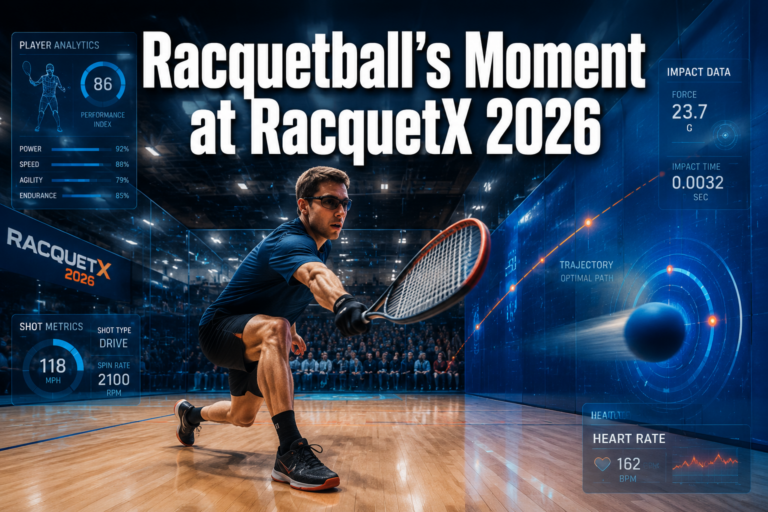
RacquetX 2026 is the racquet sports industry’s largest cross-sport trade and innovation event, held in Fort Lauderdale from March 13-15, 2026. It drew more than 5,000 attendees and 125+ companies spanning tennis, padel, pickleball, squash, badminton, racquetball, and table tennis. For racquetball specifically, the event accelerated the adoption of engineering advances already proven in tennis and squash, particularly in frame composites, string materials, and grip design.

The event’s “Innovation Showcase” and “Future of Racquet Sports Technology” sessions highlighted three directions that matter most for racquetball players in 2026:
- Advanced composite frames using graphite, carbon fiber, boron, and graphene redistribution for better stiffness and lighter swing weight [1]
- Cross-sport string technology, with brands like Babolat now explicitly listing racquetball as a target sport for their newest multifilament strings [2]
- Smart racquet integration, including embedded sensors for swing analytics, still emerging, but previewed as a near-term product category
The racquetball gear evolution post-RacquetX 2026 is not just about one product launch. It’s a shift in how manufacturers think about the sport: racquetball players now benefit from R&D budgets that span the entire racquet sports ecosystem.
Best Racquetball Strings for 2026 and Beyond
The best racquetball strings in 2026 prioritize tension stability, power delivery, and durability over raw stiffness. Two standout options are Ashaway’s UltraKill (Zyex core) and the newly launched Babolat Xplore multifilament.
Ashaway UltraKill uses a Zyex filament core with a monofilament nylon wear surface, available in 18 gauge (1.15 mm) and 17 gauge (1.25 mm). Zyex is a high-performance polymer that holds tension better than standard nylon and returns energy more efficiently, translating to more consistent power over the life of the string. [9]
Babolat Xplore, introduced in 2026 and explicitly listed for tennis, racquetball, and squash, offers “tremendous power and comfort” with above-average spin in 15L, 16 (1.30 mm), and 17 (1.25 mm) gauges in 40-foot sets. It’s a multifilament construction, meaning multiple thin fibers bundled together, which gives it a softer, more arm-friendly feel compared to monofilaments. [2]
Quick comparison:
| String | Type | Gauge Options | Best For |
|---|---|---|---|
| Ashaway UltraKill | Zyex core / nylon jacket | 17, 18 | Power + tension stability |
| Ashaway PowerKill Pro | Zyex jacket / multifilament | 16 | Durability + chronic breakers |
| Babolat Xplore | Multifilament | 15L, 16, 17 | Comfort + power |
Choose Zyex strings if you want long-lasting tension and maximum energy return. Choose multifilament if arm comfort and a softer feel are priorities.
How String Tension Affects Racquetball Performance
String tension directly controls the balance between power and control in racquetball. Lower tension creates a larger “trampoline effect,” producing more power but slightly less precision. Higher tension gives more control but reduces power and can increase arm stress.
For Zyex-based strings like Ashaway UltraKill and PowerKill Pro, Ashaway recommends stringing at 10-20% less tension than you’d use with standard nylon. [9] This is because Zyex is inherently more elastic, so it doesn’t need to be strung as loosely to achieve the same power output. Stringing Zyex too tight eliminates its main advantage.
Practical tension guidelines:
- Standard nylon strings: 28-35 lbs for most players
- Zyex strings: 22-30 lbs (10-20% lower than your nylon baseline)
- Multifilament strings: 25-33 lbs, depending on desired feel [7]
Common mistake: Many players string Zyex at the same tension as their old nylon strings, then wonder why the racquet feels stiff and the strings break faster. Drop the tension and let the material do its job.
Why Do Racquetball Strings Keep Breaking?
Strings break most often due to off-center hits, excessive tension, incompatible string gauge, or using the wrong string type for a player’s swing speed. Ashaway’s PowerKill Pro 16g was specifically engineered for chronic string breakers, using “Power Filament Technology” (PFT), Zyex filaments placed in the string’s jacket layer to increase durability and reduce frame stress during hard impacts. [7]
Other causes of premature breakage:
- Stringing at too high a tension for the string type
- Using a thin gauge (17-18) with a very fast swing speed
- Hitting the frame edge frequently (off-center contact)
- Notching at string crossings due to mismatched materials
Fix: Move to a 16-gauge string, drop tension by 10-15%, and check your swing mechanics. If breakage persists after those changes, PowerKill Pro or a similar reinforced construction is the right call. [7]
How Often Should You Replace Racquetball Strings?
Racquetball strings should be replaced every 40-60 hours of play for recreational players, and more frequently for competitive players who generate higher swing speeds. A reliable rule of thumb: restring as many times per year as you play per week. If you play three times a week, restring at least three times a year.
Signs it’s time to restring:
- Strings feel noticeably “dead” or less responsive
- Visible fraying or notching at string crossings
- Tension has dropped and shots feel inconsistent
- Any string has moved significantly out of alignment and won’t return
Dead strings don’t just hurt performance, they can also alter the frame’s stress distribution and contribute to racquet damage over time. [7]
Difference Between Synthetic and Natural Gut Racquetball Strings
Natural gut strings are rarely used in racquetball. The sport’s synthetic string options, nylon multifilament, monofilament nylon, and Zyex-based constructions, cover the full performance spectrum at a fraction of the cost and with better moisture resistance.
Synthetic nylon multifilament (like Babolat Xplore): soft, arm-friendly, good power, moderate durability. Best for players who want comfort. [2]
Zyex-core monofilament (like Ashaway UltraKill): excellent tension stability, strong power return, longer string life. Best for competitive players who want consistent performance over time. [9]
Standard nylon monofilament: budget-friendly, widely available, decent durability but loses tension faster than Zyex. Good for beginners.
Natural gut’s main advantage, feel and tension maintenance, is matched or exceeded by Zyex in racquetball applications, making it a non-issue for most players. [9]
What Grip Size Do You Need for Racquetball?
Most adult racquetball racquets come in a single standard grip size (typically 3⅝”), which is smaller than tennis grips. The key decisions are grip thickness and material, not size variation. A grip that’s too thin causes the racquet to twist in the hand during hard shots; too thick reduces wrist snap and feel.
How to check fit: Hold the racquet with a forehand grip. You should be able to fit one finger from your other hand between your fingertips and the base of your palm. If there’s no gap, the grip is too thin. If there’s more than one finger of space, it’s too thick.
Grip thickness options:
- Standard replacement grip: baseline thickness, good for most players
- Overgrip added on top: adds ~1-2 mm, good if the racquet feels too thin
- High-build replacement grip: adds more bulk, suited for larger hands or players who prefer a more stable feel
Racquetball Grip Materials Compared: Overgrip vs. Replacement Grip
Overgrips and replacement grips serve different purposes. A replacement grip is the base layer directly on the handle, it provides cushion, shock absorption, and structural feel. An overgrip is a thin wrap applied on top for added tackiness, sweat absorption, and feel customization.
Python’s replacement rubber grip, the official grip of USRA, Racquetball Canada, and the German Racquetball Association, features a herringbone pattern for improved vertical and horizontal traction, with optional stabilizing rings at the base for added racquet stability during high-intensity play. It’s the result of over 10 years of research into weight, thickness, flare, and grip mechanics. [6]
GAMMA Zorbicon gel-backed grips offer enhanced shock absorption and moisture reduction with a tacky surface, making them a strong choice for players with arm sensitivity or those playing in humid conditions. [6]
Yonex Wet Super Grap overgrips (listed for racquetball, badminton, tennis, and squash) provide non-slip, high-tack control and are a popular choice for players who want to refresh their grip feel without replacing the base layer. [4]
| Grip Type | Thickness | Best For | Replace When |
|---|---|---|---|
| Replacement grip | 1.5-2.5 mm | Base cushion, shock absorption | Every 3-6 months |
| Overgrip | 0.5-0.6 mm | Tackiness, sweat control | Every 4-8 hours of play |
Best Racquetball Frames in 2026: New Technology
The best racquetball frames in 2026 use graphite composites, graphene redistribution, or boron-reinforced layups to maximize stiffness-to-weight ratio and impact stability. These materials allow manufacturers to build frames that are both lighter and more powerful than previous aluminum or basic graphite designs. [1]
Top frame technologies in 2026:
- Graphene redistribution (HEAD): moves weight away from the shaft and into the frame for faster swing speed and more power at contact [1]
- Hy-Bor technology: integrates ultra-strong boron fibers into the shaft for maximum stability and energy return [1]
- CPS (Controlled Power System): proprietary shock-dampening design used in HEAD CPS Heat, reducing vibration while maintaining power transfer
- Launch-pad tubing: frame geometry designed to flex and snap back at contact, amplifying ball speed
Frame categories by player level:
- Beginner: Aircraft-grade aluminum or basic graphite composite, 170-185g, larger sweet spot, forgiving on off-center hits
- Intermediate: Graphite/composite blend, 155-170g, balanced power and control
- Advanced/Pro: Full graphite, graphene, or boron-reinforced, 145-160g, stiff for maximum power transfer
High-end frames for serious players typically start above USD 100, with premium models often exceeding USD 200 as advanced composites and proprietary technologies add cost. [1]
How to Choose Between Power and Control Racquetball Frames
Power frames suit players who rely on aggressive, fast swings and want the frame to amplify their shots. Control frames suit players with technically precise strokes who want predictable, consistent ball placement.
Choose a power frame if:
- You’re a beginner or intermediate player who needs help generating pace
- You play singles and rely on passing shots and ceiling balls
- Your swing speed is moderate
Choose a control frame if:
- You’re an advanced player with a fast, developed swing
- You play doubles and need precise shot placement
- You prioritize consistency over raw power
Edge case: Very advanced players sometimes prefer a slightly heavier, stiffer frame (control-oriented) because their swing speed already generates enough power, adding more power from the frame makes shots harder to control.
Racquetball Equipment for Beginners vs. Advanced Players
Beginners and advanced players have genuinely different needs, and buying the wrong gear for your level is one of the most common mistakes in the sport.
Beginners do best with:
- Aluminum or basic graphite frame (forgiving, affordable)
- Standard synthetic nylon strings at mid-tension
- Standard replacement grip with moderate cushion
- Budget range: USD 30-70 for a complete setup
Advanced players benefit from:
- Full graphite or graphene-reinforced frame
- Zyex-core strings (UltraKill 17 or PowerKill Pro 16) at optimized tension [9]
- Performance replacement grip (Python rubber) plus optional overgrip for sweat control
- Budget range: USD 100-250+ for frame alone
If you’re just starting out and exploring racquet sports more broadly, the same gear-selection logic applies across disciplines, see our guide to essential gear for new pickleball players for a useful parallel on how to avoid overspending early on.
Common Mistakes When Selecting Racquetball Gear
The most common mistake is buying gear designed for a different skill level, either overspending on a stiff pro frame that punishes mishits, or underspending on a dead aluminum racquet that limits development.
Other frequent errors:
- Stringing Zyex at nylon tension, reduces performance and accelerates breakage [9]
- Ignoring grip thickness, a grip that’s too thin causes wrist fatigue and loss of control
- Using an overgrip as a replacement, overgrips are too thin to provide adequate base cushion; they work on top of a replacement grip, not instead of one
- Buying a “power” frame when you need control, advanced players with fast swings often hit better with stiffer, more neutral frames
- Never replacing strings, dead strings feel mushy, reduce consistency, and can stress the frame unevenly [7]
Racquetball Gear Alternatives to Expensive Brands
Quality racquetball gear doesn’t require a top-tier budget. Several mid-range options deliver strong performance at lower price points.
- E-Force Bedlam-170 Lite: graphite frame, large sweet spot, well-reviewed for intermediate players at a mid-range price
- Python Intro 5000: aluminum/graphite construction, beginner-friendly, often recommended as a starter frame
- Klipper USA strings: budget-friendly synthetic strings available in racquetball gauges, solid for recreational players [8]
- Generic overgrips: for sweat control, many unbranded overgrips perform comparably to name-brand options at a fraction of the cost
The key is matching the gear tier to your actual playing frequency and level. A recreational player who plays once a week doesn’t need a USD 200 graphene frame, a USD 60-80 graphite composite will serve them well for years.
If you’re weighing whether to rent or buy gear while you’re still learning, the same cost-benefit logic explored in our renting vs. buying pickleball equipment guide applies directly to racquetball beginners.
What Racquetball Equipment Do Professional Players Use?
Professional racquetball players in 2026 typically use full graphite or graphene-reinforced frames in the 145-160g range, Zyex-based strings at optimized lower tensions, and structured rubber replacement grips with optional overgrips for match-day sweat control.
Commonly cited pro-level setups include:
- HEAD CPS Heat: graphite frame with Controlled Power System shock dampening
- E-Force Bedlam series: graphite, known for power and stability at competitive play
- Ashaway UltraKill 17 or PowerKill Pro 16 strings: Zyex-based for tension stability across long match sessions [9]
- Python official USRA grip: herringbone rubber replacement grip, the benchmark for competitive play
Professionals also tend to restring more frequently, sometimes every tournament, to ensure consistent tension and feel. The racquetball gear evolution post-RacquetX 2026 is pushing even more pros toward cross-sport string options like Babolat Xplore as multifilament technology catches up with Zyex in terms of tension stability. [2]
For players interested in how equipment choices intersect with technique development, our video analysis and learning from the pros guide offers a useful framework for studying how gear choices show up in actual match play.
FAQ
What happened at RacquetX 2026 that matters for racquetball players? RacquetX 2026 brought 125+ equipment companies to Fort Lauderdale in March 2026, where innovation sessions focused on advanced composites, smart racquet sensors, and cross-sport string technology. Racquetball players benefit directly as brands like Babolat now explicitly target the sport with new string products. [2]
What is the best string for a beginner racquetball player? A standard 16-gauge synthetic nylon multifilament string at mid-tension (around 28-32 lbs) is the best starting point. It’s forgiving, affordable, and widely available. Upgrade to Zyex-based strings once your game develops.
How do I know if my racquetball strings are dead? Dead strings feel noticeably less responsive, shots lack pop, the ball feels heavy on contact, and the string bed may look slightly out of alignment. If you can’t remember the last time you restrung, it’s probably time.
Is a graphite frame worth it for a recreational player? For players who compete occasionally or play more than once a week, a graphite composite frame in the USD 60-100 range is worth the upgrade from aluminum. The lighter weight and better energy transfer reduce arm fatigue over long sessions.
Can I use tennis overgrips on a racquetball racquet? Yes. Tennis overgrips (like Yonex Wet Super Grap) are explicitly listed for racquetball use and work well for sweat control and added tackiness. [4] Just make sure you have a proper replacement grip underneath.
What’s the difference between 16-gauge and 18-gauge racquetball strings? Thicker 16-gauge strings are more durable and hold tension longer. Thinner 18-gauge strings offer more feel and power but break faster, especially for hard hitters. Most players do well with 17-gauge as a middle ground.
Do professional racquetball players use overgrips? Many do, especially during matches where sweat is a factor. The typical pro setup is a structured rubber replacement grip (like Python’s USRA-official grip) with a thin tacky overgrip on top for match-day control.
What frame weight should I look for in racquetball? Beginners: 170-185g (easier to swing, more forgiving). Intermediate: 155-170g (balanced). Advanced: 145-160g (faster swing speed, more power transfer). Heavier isn’t always better, match the weight to your current swing mechanics.
Will smart racquet technology come to racquetball? It’s already previewed. RacquetX 2026’s Innovation Showcase highlighted embedded sensors and connected coaching tools as near-term product directions for racquet sports, including racquetball. Expect commercial products within the next 1-2 years.
What’s the most common grip mistake in racquetball? Using an overgrip as the only grip layer. Overgrips are too thin (0.5-0.6 mm) to provide adequate cushion or shock absorption on their own. Always start with a full replacement grip, then add an overgrip on top if needed.
Conclusion
The racquetball gear evolution post-RacquetX 2026 gives players at every level more options, and more reasons to be deliberate about what they put in their hands. The clearest takeaways: Zyex-based strings deliver better tension stability than nylon (string them 10-20% looser), graphite and graphene frames offer real performance advantages over aluminum for anyone playing more than casually, and grip choice matters more than most players realize.
Actionable next steps:
- Assess your current strings, if you can’t remember your last restring, schedule one now and try Ashaway UltraKill 17 or Babolat Xplore at a slightly lower tension than your usual setting.
- Check your grip, if your racquet twists on hard shots, add an overgrip or move up to a higher-build replacement grip.
- Match your frame to your level, beginners should resist the temptation of pro-level stiff frames; intermediates and above should seriously consider graphite composites.
- Watch the smart racquet space, RacquetX 2026 made clear that sensor-integrated frames are coming. If you’re investing in a premium frame now, look for brands already active in the connected equipment space.
For players exploring other racquet sports alongside racquetball, our guide to padel equipment in 2026 covers parallel innovations in composite frames and grip technology worth knowing about.
References
[1] New Racquets In 2026 – https://the-tennis-circle.com/new-racquets-in-2026/ [2] Babolat Xplore String – https://bellracquetsports.com/babolat-xplore-string/ [4] All Grips – https://store.racquetworld.com/all-grips.html [6] Grips – https://www.paddlepro.com/other-sports/racquetball/grips/ [7] Racquetball Index – https://www.ashawayusa.com/racquetball-index.php [8] Racquetball Strings – https://klipperusa.com/collections/racquetball-strings [9] Ultrakill – https://www.ashawayusa.com/ultrakill.php