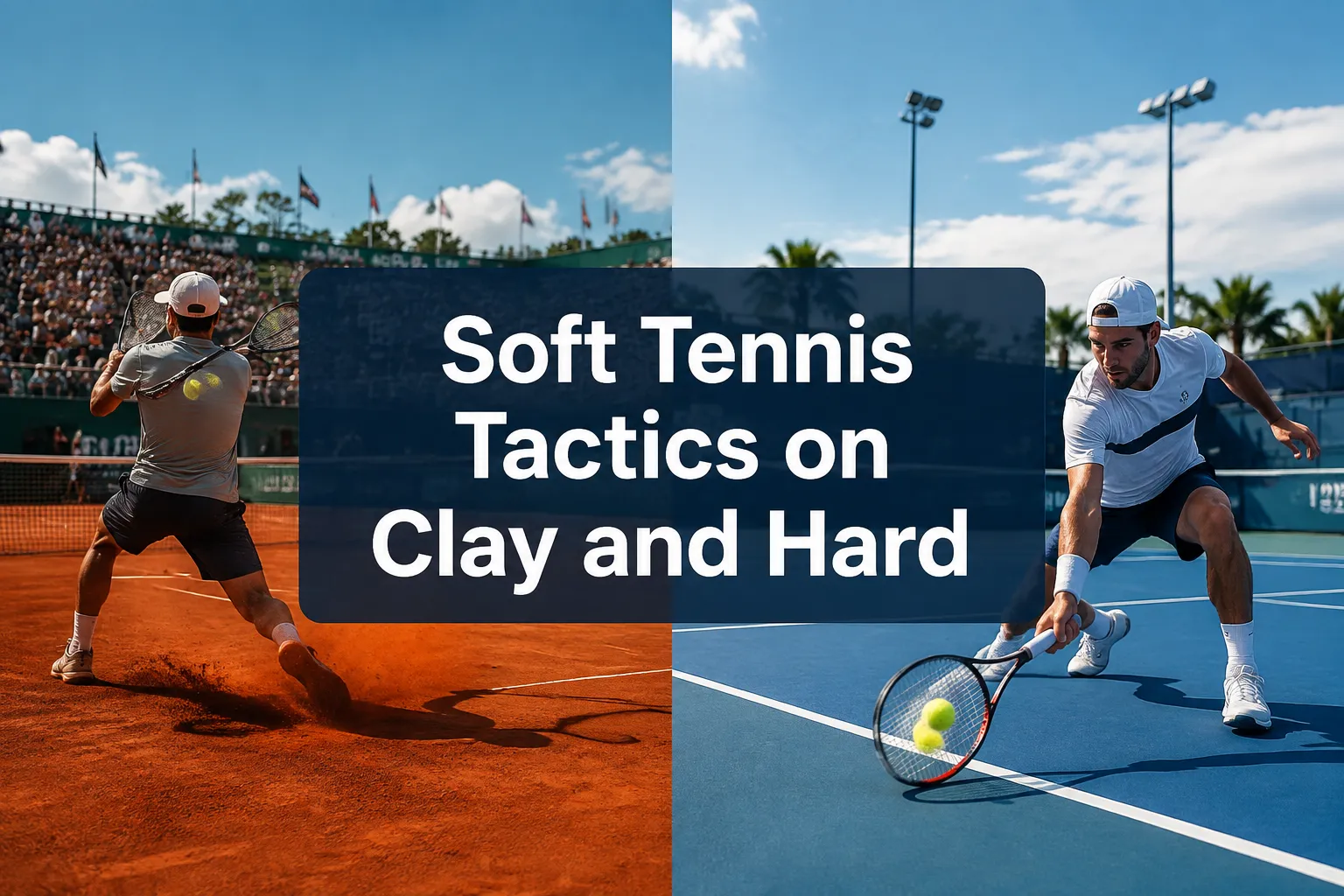
Soft Tennis Tactics on Clay and Hard Courts: Point Construction Lessons for Modern Baseliners
Last updated: August 24, 2026
Quick Answer: Soft tennis tactics, built around controlled angles, heavy spin, slice variations, and patient point construction, transfer directly to both clay and hard courts for modern baseliners. On clay, these patterns extend rallies and force errors; on hard courts, they create openings for early aggression. The key is knowing which surface rewards patience and which rewards forward pressure.
Key Takeaways
- Soft tennis tactics prioritize controlled angles, spin depth, and rally construction over raw power
- Clay courts reward heavy topspin, wide angles, and drop-shot patterns; hard courts reward early ball-striking and occasional net approaches
- Modern baseliners benefit from sliding on clay and compact footwork on hard courts
- The slice backhand is a high-value weapon on both surfaces, for different reasons
- Defensive lobs and reset shots are underused tools that soft tennis players develop naturally
- Equipment matters: string tension and racket weight affect how well soft tactics translate across surfaces
- Beginners often make the mistake of playing too aggressively on clay and too passively on hard courts
- Soft tennis tactics suit recreational players, older athletes, and anyone building consistency
- Point construction beats point-ending on clay; point acceleration beats grinding on hard courts
- Serve strategy on slower surfaces should favor placement and spin over power
What Is Soft Tennis and How Does It Differ From Regular Tennis?
Soft tennis is a racket sport played primarily in East and Southeast Asia that uses a soft rubber ball instead of a pressurized felt ball. The lighter ball travels slower, bounces lower, and rewards players who control angles and construct points rather than blast winners.
The tactical DNA of soft tennis, patient rally-building, wide-angle play, net rushes off short balls, and heavy use of slice and lob, maps almost perfectly onto what modern coaches call “smart baseline tennis.” The difference is that soft tennis formalizes these patterns from day one, while standard tennis players often discover them later.
Key differences at a glance:
| Feature | Soft Tennis | Standard Tennis |
|---|---|---|
| Ball | Soft rubber, slower | Pressurized felt, faster |
| Bounce | Lower, shorter | Higher, deeper |
| Rally length | Typically longer | Variable |
| Dominant tactic | Angle construction | Power + angle |
| Net play | Encouraged early | Situational |
For players in the broader racket sports community, soft tennis offers a useful tactical framework that crosses over into standard tennis, padel, and even pickleball.
Best Soft Tennis Tactics for Clay Courts

On clay, soft tennis tactics are almost a perfect fit. The slow surface, high bounce, and extra slide time reward exactly the patterns soft tennis builds: deep crosscourt rallies, sharp angles, and patient point construction [1].
Top clay court tactics adapted from soft tennis:
- Heavy topspin crosscourt: Push opponents wide and deep. Clay amplifies topspin bounce, making recovery harder [9].
- Short angle to the forehand corner: After pulling the opponent wide, a sharp angle winner or forced error is highly achievable on clay.
- Drop shot off a deep rally ball: When the opponent is pushed behind the baseline, a soft drop shot exploits the slow surface [5].
- Hit-behind pattern: After moving the opponent wide, hit back to where they came from, a classic soft tennis point-construction move.
- High looping ball to the backhand: Forces opponents into an uncomfortable high-backhand position, especially effective against one-handed backhands [3].
💡 Clay court rule of thumb: Work the point for 4-6 shots before going for the angle winner. Clay gives you time, use it.
Clay courts also slow the ball enough that serve placement matters more than serve speed [6]. A wide kick serve to the backhand, followed by a crosscourt forehand, is a reliable point-construction pattern that soft tennis players use instinctively.
Soft Tennis Strategies for Hard Courts
Hard courts are a neutral surface, they don’t dramatically favor any style, which means soft tennis tactics need slight adjustments [2]. The ball travels faster and bounces truer, so there’s less time to construct long rally sequences.
Adjustments for hard court soft tennis tactics:
- Move the contact point earlier. Hard courts reward players who take the ball on the rise rather than letting it drop [7].
- Use slice to steal time. A low skidding slice backhand keeps the ball fast and low, forcing the opponent to lift the ball, setting up your next attack.
- Shorten the rally construction window. Instead of 6-shot patterns, look to accelerate after 3-4 shots.
- Approach the net more often. Hard courts give less time for lob recovery, making net approaches more dangerous for the opponent.
- Wide serve + inside-out forehand. This combination works well on hard courts because the opponent has less time to recover from the wide pull.
Hard courts also put a premium on first-strike tennis, getting a short ball early and stepping in. Soft tennis players who train on clay need to consciously shift their mindset here.
How to Construct Points as a Modern Baseline Player
Point construction for modern baseliners means building a sequence of shots that progressively reduce the opponent’s options until a winner or forced error becomes available. It’s not about hitting one big shot, it’s about earning the right shot.
A simple 3-step point construction framework:
- Neutralize, Get the rally started with a safe, deep crosscourt shot. No risk, just placement.
- Maneuver, Use spin, angle, or pace variation to move the opponent out of position.
- Accelerate, When the short ball arrives, step in and finish with an inside-out forehand, down-the-line backhand, or net approach.
This framework is exactly what soft tennis tactics on clay and hard courts teach naturally. The surface changes the timing, but the logic stays the same.
For a deeper look at structuring your practice around these patterns, the guide on building a winning practice routine is worth bookmarking.
Common point construction mistakes:
- Going for the winner one shot too early
- Hitting to the center when a wide angle is available
- Forgetting to reset after a defensive shot (lob or slice)
- Standing too far behind the baseline on hard courts
Soft Tennis vs Aggressive Tennis: Which Is Better?
Neither style is universally better, the right approach depends on the surface, the opponent, and the score. Soft tennis tactics prioritize consistency and pattern-building; aggressive tennis prioritizes early pressure and winners.
On clay, soft tennis tactics win more often because the surface slows the ball and rewards patience [9]. On hard courts, a blend works best, start with soft tennis construction, then accelerate when the opportunity appears [7].
Choose soft tennis tactics if:
- You’re playing on clay or a slow hard court
- The opponent makes more errors than you win outright points
- You’re down in a match and need to stabilize
- You’re an older or recreational player prioritizing consistency
Choose aggressive tactics if:
- You’re on a fast hard court or grass
- The opponent is a strong defender who thrives in long rallies
- You have a clear physical advantage in speed or power
The smartest players in 2026 blend both, using soft construction to set up aggressive finishes.
Soft Tennis Equipment and Racket Recommendations
The right equipment makes soft tennis tactics easier to execute, especially on clay. String choice and racket weight directly affect spin potential, touch, and control [10].
Equipment tips for soft tennis-style play:
- Racket weight: A slightly heavier racket (300-315g) helps generate topspin depth without extra arm effort.
- String type: Polyester strings at lower tension (48-52 lbs) produce more spin and better feel for drop shots and slices [10].
- Grip size: A slightly smaller grip allows more wrist snap for topspin and angle shots.
- String pattern: An open string pattern (16×19) generates more spin than a dense 18×20 pattern, ideal for clay court soft tactics.
For players exploring gear across multiple sports, racket sports equipment reviews at Rally Racket cover everything from tennis to padel and pickleball setups.
Common Mistakes Beginners Make With Soft Tennis Tactics
The biggest mistake is treating soft tennis tactics as purely defensive. Soft tennis is patient, not passive, every shot should have a purpose.
Top mistakes and how to fix them:
- ❌ Hitting too short on clay, Short balls get punished. Keep depth as the priority, then add angle.
- ❌ Overusing the drop shot, Drop shots only work when the opponent is behind the baseline. Use them sparingly.
- ❌ Forgetting to move forward, After a good angle shot, step in. Don’t wait at the baseline for the next ball.
- ❌ Ignoring the lob, The defensive lob is a reset tool, not a surrender. Use it to buy time and reposition.
- ❌ Using the same pattern repeatedly, Good opponents adjust. Mix crosscourt with down-the-line every few games.
For players new to court movement concepts, the guide on positioning and movement for new players covers the fundamentals well.
Soft Tennis Footwork and Court Positioning on Clay
Footwork on clay is fundamentally different from hard courts, and it’s one area where soft tennis tactics on clay and hard courts diverge most clearly. Clay allows and rewards sliding, which lets players cover wide balls without losing balance [8].
Clay court footwork principles:
- Slide into wide forehands and backhands rather than stopping dead. This preserves momentum for the recovery.
- Stay closer to the baseline center between shots. Clay rallies are longer, so energy conservation matters.
- Small adjustment steps before contact are more important than big running steps, get set early.
On hard courts, sliding is less effective (and harder on joints). Instead, split-step timing and compact recovery steps are the priorities.
💡 Modern coaching in 2026 treats sliding and movement patterns as central to clay baseline tactics, not just a nice-to-have skill [8].
Soft Tennis Slice Techniques and Angles
The slice is one of the most versatile tools in soft tennis-style play. On clay, a well-placed slice stays low and skids through the court, disrupting the opponent’s rhythm [3]. On hard courts, it steals time and forces a lift.
Slice applications by surface:
- Clay: Use slice to change pace after a heavy topspin exchange. A slice down the line after a crosscourt rally often catches opponents off guard.
- Hard court: Use slice as an approach shot, low bounce, forcing a weak reply you can put away at net.
- Both surfaces: The slice lob (a disguised lob hit with a slice motion) is a high-percentage defensive reset that soft tennis players develop naturally.
Angle creation with slice: A wide slice to the deuce side pulls opponents off the court, opening the entire ad side for the next shot. This is a core soft tennis point construction pattern that works on any surface [4].
How to Develop Consistency With Soft Tennis on Different Surfaces
Consistency across surfaces comes from understanding what each surface demands, then adjusting spin, pace, and positioning accordingly [6].
Surface-specific consistency tips:
- Clay: Hit with more topspin and aim for deeper targets. The slower surface forgives higher-arcing shots.
- Hard court: Flatten out slightly and aim for earlier contact. Consistency here means fewer unforced errors, not just rally length.
- Both: Practice the same point construction patterns on each surface, then adjust the timing and spin level.
A structured practice routine that includes surface-specific drills is the fastest path to cross-surface consistency. Pairing this with doubles play tactics and partner coordination helps translate individual consistency into match-winning team play.
Soft Tennis for Older Players and Recreational Tennis
Soft tennis tactics are especially well-suited to older and recreational players. The emphasis on consistency, angles, and smart point construction reduces physical strain while keeping the game competitive.
Why soft tennis tactics work for recreational players:
- Fewer all-out sprints, smart positioning reduces the need for explosive movement
- Lower injury risk, spin and placement replace power as the primary weapons
- More enjoyable rallies, longer exchanges are more fun and better practice
- Easier to learn, pattern-based play is more predictable than power tennis
Players over 40 who want to stay competitive without grinding their joints will find that soft tennis-style baseline play extends their active years on court significantly.
Soft Tennis Transition Shots and Net Play
Soft tennis encourages net play more than most recreational tennis styles, and that’s a tactical edge worth developing. The transition from baseline to net is built into soft tennis point construction patterns.
When to approach the net using soft tennis patterns:
- After a drop shot that pulls the opponent short
- After a wide angle that leaves the court open
- After a deep slice approach that forces a weak reply
- After a serve that pulls the opponent wide on a hard court
At the net: Use soft volleys and angle volleys rather than power. The goal is to redirect, not blast. A well-placed crosscourt volley after a wide approach is almost impossible to retrieve.
The transition shot, the ball hit while moving forward, is the bridge between baseline construction and net finishing. Keep it low, keep it angled, and move through it rather than stopping to hit.
Clay Court vs Hard Court Soft Tennis Differences: A Direct Comparison
The core soft tennis tactics on clay and hard courts are the same, but the timing, spin level, and aggression threshold differ meaningfully [2][6].
| Tactical Element | Clay Court | Hard Court |
|---|---|---|
| Rally length target | 6-8 shots | 3-5 shots |
| Topspin level | High (heavy) | Medium |
| Slice use | Pace change, disruption | Approach, time theft |
| Net approaches | After short ball only | More frequent |
| Serve strategy | Spin + placement | Placement + pace |
| Footwork style | Slide-based | Compact, split-step |
| Drop shot frequency | Moderate | Low |
| Defensive lob | High value | Situational |
The biggest mental shift: clay rewards patience; hard courts reward decisiveness. Soft tennis players who master both mindsets become genuinely difficult opponents on any surface [7].
Conclusion: Start Applying These Tactics Today
Soft tennis tactics on clay and hard courts give modern baseliners a repeatable, intelligent framework for winning points, not just hitting balls. The patterns are learnable, the footwork is trainable, and the results show up quickly when practiced consistently.
Actionable next steps:
- Pick one pattern (e.g., crosscourt + wide angle + hit-behind) and drill it for 15 minutes in your next session.
- Adjust your string tension if you’re playing clay regularly, lower tension improves spin and touch.
- Watch your rally length in matches. If you’re going for winners before shot 4, you’re rushing.
- Add the slice to your practice rotation, it’s the most underused weapon in recreational tennis.
- Use the 3-step framework (neutralize → maneuver → accelerate) as a mental checklist during points.
Whether you’re a recreational player looking for smarter ways to compete or a multi-sport athlete crossing over from pickleball or padel, these tactics will make your baseline game more consistent and more fun. That’s what the Rally Racket racket sports community is all about, playing smarter at every level.
FAQ
What is soft tennis? Soft tennis is a racket sport played with a soft rubber ball instead of a pressurized felt ball. It originated in Japan and is popular across East Asia. The slower ball rewards controlled angles, spin, and patient point construction over raw power.
Can soft tennis tactics work on hard courts? Yes. Soft tennis tactics work on hard courts with adjustments, take the ball earlier, shorten the rally construction window, and approach the net more often. The core patterns (angles, slice, lob) remain effective on any surface.
What is the best surface for soft tennis-style play? Clay is the most natural fit for soft tennis tactics. The slow surface, high bounce, and extra slide time reward exactly the patterns soft tennis develops: deep crosscourt rallies, sharp angles, and patient point construction.
Is soft tennis good for beginners? Yes. Soft tennis tactics emphasize consistency and pattern-based play over power, which makes them easier and safer for beginners to learn. The focus on angles and rally construction builds better fundamentals than trying to hit winners early.
What strings should I use for soft tennis-style play on clay? Polyester strings at lower tension (48-52 lbs) with an open string pattern (16×19) produce the most spin and touch for soft tennis tactics on clay. This setup improves topspin depth and drop shot feel.
How do I stop going for winners too early? Use the 3-step framework: neutralize with a deep crosscourt, maneuver with an angle or pace change, then accelerate only when the short ball arrives. Count your shots, if you’re finishing before shot 4, you’re rushing.
What’s the difference between soft tennis and defensive tennis? Soft tennis is patient, not passive. Every shot has a purpose, to move the opponent, create an opening, or force an error. Defensive tennis reacts; soft tennis constructs. The difference is intentionality.
Is the slice backhand important in soft tennis tactics? Yes. The slice is one of the most versatile tools in soft tennis-style play. On clay it disrupts rhythm; on hard courts it steals time and sets up net approaches. It’s an essential part of the tactical toolkit.
When should I approach the net using soft tennis patterns? Approach after a drop shot, a wide angle, or a deep slice approach that forces a weak reply. The transition to net should follow a shot that reduces the opponent’s options, not a neutral exchange.
Are soft tennis tactics suitable for older players? Absolutely. Soft tennis tactics reduce physical strain by replacing power with placement and spin. Older and recreational players benefit from fewer all-out sprints, lower injury risk, and more enjoyable, longer rallies.
References
[1] Clay Courts And Surface Speed – https://hartru.com/blogs/har-tru-blog/clay-courts-and-surface-speed
[2] The Pro S Guide To Grass Clay And Hard Courts – https://insights.made-in-china.com/The-Pro-s-Guide-to-Grass-Clay-and-Hard-Courts_PTIaRstVvJij.html
[3] Clay – https://judydixontennis.com/clay/
[4] Difference In Tennis Surfaces – https://teachme.to/blog/difference-in-tennis-surfaces
[5] Strategies For Playing On Clay Courts – https://www.tennislibrary.com/strategies-for-playing-on-clay-courts-9412058/
[6] Hard Clay Grass And Astroturf Tennis Court Surface Guide – https://www.lta.org.uk/play/tennis-tips-and-techniques/hard-clay-grass-and-astroturf-tennis-court-surface-guide/
[7] Tennis Game Surface Adaptations – https://tennisguide.net/tennis-playing-surfaces/tennis-game-surface-adaptations/
[8] My Coach Sept 2010 – https://www.tennis.com.au/wp-content/uploads/2010/08/My-Coach_Sept-2010.pdf
[9] Clay Court Strategy And Tactics – https://gabejaramillo.com/clay-court-strategy-and-tactics/
[10] Clay Court Tennis – https://shoprestring.com/blogs/news/clay-court-tennis