Central American and Caribbean Games 2026: Racquetball’s Caribbean Moment in Santo Domingo
Last updated: August 28, 2026
Quick Answer: The XXV Central American and Caribbean Games, held in Santo Domingo, Dominican Republic in July, August 2026, featured racquetball as a full medal sport. Mexico dominated the competition, sweeping team gold in both men’s and women’s events, while the host nation earned historic bronze medals that energized local fans and put Caribbean racquetball firmly on the regional map.
Key Takeaways
- 🏟️ Santo Domingo hosted the XXV Central American and Caribbean Games in 2026, marking the Dominican Republic’s second time hosting the event
- 🇲🇽 Mexico won gold in both the men’s and women’s team racquetball events, continuing a streak of dominance dating back to 1990
- 🇩🇴 The Dominican Republic earned four bronze medals in racquetball, delivering a genuine “Caribbean moment” for the host nation
- 🇬🇹 Guatemala emerged as Mexico’s strongest challenger, finishing silver in the women’s team event
- 🇨🇷 Costa Rica took silver in the men’s team event and bronze in the women’s, confirming its status as a top-three racquetball nation in the region
- 🎾 Racquetball differs from squash and tennis in court design, equipment, and scoring, making it a uniquely fast-paced sport
- 🏆 Qualification for the Games required athletes to compete through national and regional federation pathways
- 📍 The racquetball venue in Santo Domingo was purpose-prepared for the Games, supporting the sport’s growth in the Caribbean
What Are the Central American and Caribbean Games 2026?
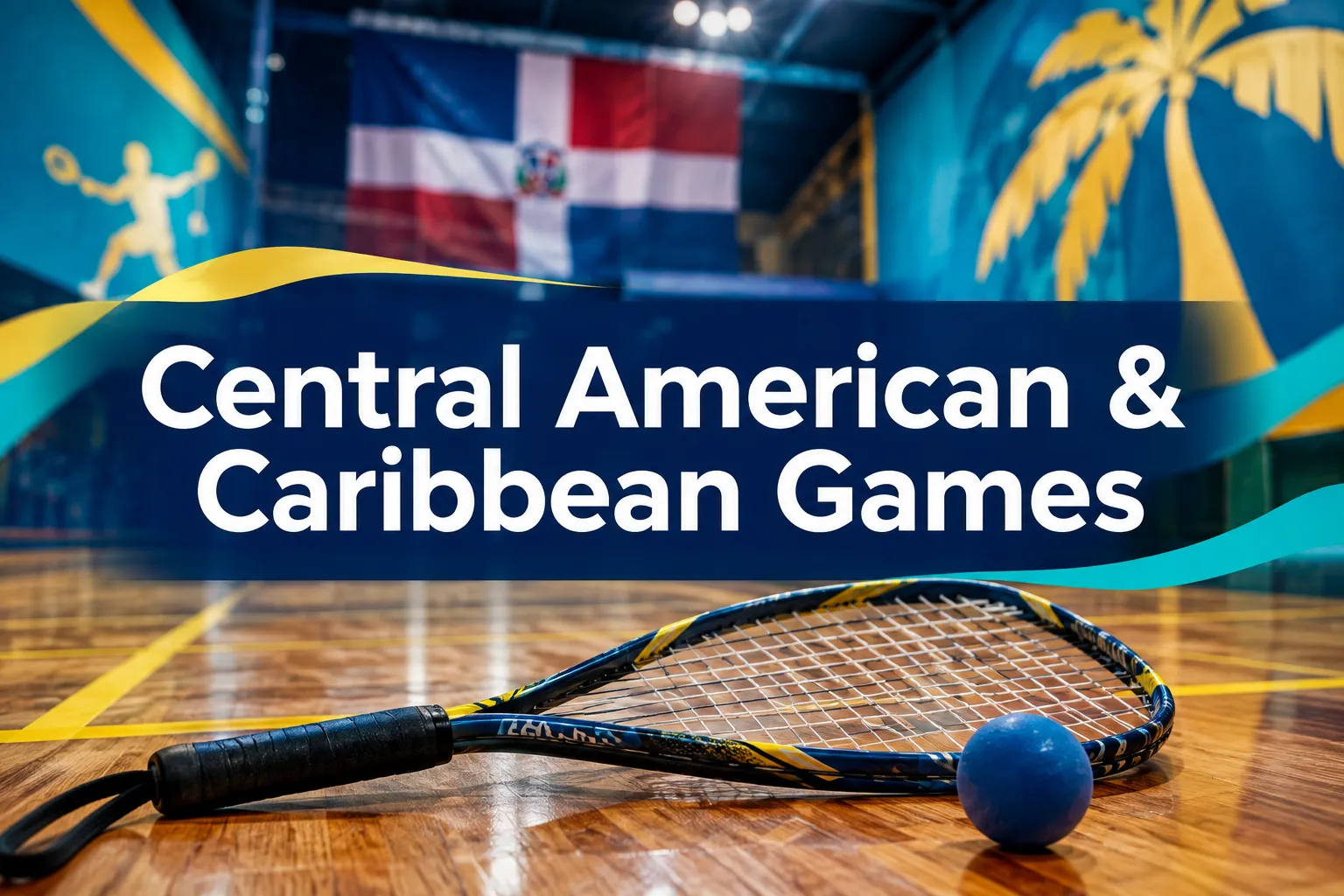
The Central American and Caribbean Games are the oldest regional multi-sport event in the Americas, predating even the Pan American Games. The 2026 edition, officially the XXV Central American and Caribbean Games, took place in Santo Domingo, Dominican Republic, bringing together athletes from across Central America, the Caribbean, and northern South America to compete across dozens of sports [3].
The Games run under the umbrella of ODECABE (the Central American and Caribbean Sports Organization) and are held every four years. For 2026, Santo Domingo served as the host city, giving the Dominican Republic a rare opportunity to showcase its sports infrastructure and emerging athletic talent to the entire region [3].
Racquetball has been a fixture of the Games for decades, and the 2026 edition was no exception, featuring singles, doubles, and team events for both men and women [2].
Where Are the 2026 Central American and Caribbean Games Being Held?
Santo Domingo, the capital of the Dominican Republic, is the host city for the 2026 Central American and Caribbean Games. It’s the second time the Dominican Republic has hosted this regional showcase, and the city invested significantly in venue preparation across multiple sports [3].
The choice of Santo Domingo reflects the Dominican Republic’s growing ambition in regional sports. The city’s infrastructure, including upgraded indoor courts, made it a practical and symbolic choice for a Caribbean nation eager to demonstrate its sporting credentials.
Santo Domingo Venue for Racquetball at the 2026 Games
The racquetball events at the 2026 Central American and Caribbean Games were held at an indoor facility in Santo Domingo equipped with regulation four-wall courts. The venue was prepared specifically to meet international racquetball standards, with proper court dimensions, lighting, and spectator seating [4].
Hosting racquetball in the Dominican Republic carried extra meaning: the sport has a passionate local following, and playing in front of a home crowd gave Dominican athletes a visible boost. Local media covered the bronze medal wins extensively, framing them as a point of national pride [8].

For fans attending in person, the racquetball venue offered an intimate, high-energy atmosphere, the enclosed courts amplify every shot, making it one of the louder and more exciting live sports experiences at the Games.
Racquetball Schedule at the Central American Caribbean Games 2026
The racquetball competition ran as part of the broader Games program in late July and early August 2026. Team events concluded on August 1, 2026, with Mexico claiming both the men’s and women’s team gold medals on the same day [6][7].
The schedule followed a standard multi-round format:
- Preliminary rounds: Nations competed in group play to determine seedings
- Semifinals: Top teams advanced to knockout rounds
- Finals and bronze medal matches: Held on August 1, 2026, closing out the racquetball program [9]
The condensed schedule is typical for multi-sport Games, where racquetball shares venue time with other sports. Athletes and coaches plan their peak performance around a tight window of competition days.
How Do You Qualify for Racquetball at the 2026 Games?
Athletes qualify for racquetball at the Central American and Caribbean Games through their national sports federations, which are affiliated with the International Racquetball Federation (IRF). Each member nation submits its team roster based on national rankings, selection trials, or federation discretion [4].
Key qualification factors include:
- National ranking: Top-ranked players in their country earn automatic consideration
- Regional standing: Performance at IRF-sanctioned regional events strengthens a player’s case
- Federation selection: Coaches and national federations have discretion to select based on form and team fit
Countries with stronger racquetball programs, like Mexico, Guatemala, and Costa Rica, typically field full rosters across all events. Smaller nations may qualify in select categories only.
Countries Competing in Racquetball at the 2026 Games
Multiple nations from Central America and the Caribbean sent racquetball teams to Santo Domingo. The competition featured a clear hierarchy, with Mexico at the top and several nations competing hard for silver and bronze [2][9].
Key competing nations and their results:
| Country | Men’s Team | Women’s Team |
|---|---|---|
| Mexico 🇲🇽 | 🥇 Gold | 🥇 Gold |
| Costa Rica 🇨🇷 | 🥈 Silver | 🥉 Bronze |
| Guatemala 🇬🇹 | 🥉 Bronze (shared) | 🥈 Silver |
| Dominican Republic 🇩🇴 | 🥉 Bronze (shared) | 🥉 Bronze |
The men’s team final was a Mexico, Costa Rica showdown, with Guatemala and the Dominican Republic sharing bronze. In the women’s event, Mexico defeated Guatemala in the final, while the Dominican Republic and Costa Rica claimed bronze medals [6][7][8].
Best Racquetball Players From the Caribbean Region and Mexico’s Dominance
Mexico has been the dominant force in regional racquetball since 1990, winning gold at virtually every Central American and Caribbean Games cycle. That streak continued in 2026 with a clean sweep of both team gold medals [7][9].
Guatemala has steadily closed the gap, particularly in women’s racquetball, where its team pushed Mexico to a competitive final. Costa Rica’s men’s team earned silver, confirming that Central American nations are the sport’s regional powerhouses.
The Dominican Republic’s performance was the story of the host Games. Earning four bronze medals, across men’s and women’s team events, represented a genuine breakthrough for Caribbean racquetball. Local players competing in front of home crowds demonstrated that the sport’s talent base is widening beyond the traditional Central American strongholds [8].
“The Dominican Republic’s four bronzes weren’t a consolation, they were a statement that Caribbean racquetball has arrived.”, framing from regional sports coverage [8]
Is Racquetball Popular in the Caribbean? What Makes It a Caribbean Sport?
Racquetball has a dedicated following across the Caribbean, though it remains less mainstream than baseball or football in most island nations. The Dominican Republic, Puerto Rico, and Cuba have historically been the strongest Caribbean racquetball nations, with active club scenes and national federation programs [4][5].
What gives racquetball a Caribbean character is partly practical: the sport requires only an indoor court, a racket, and a ball, making it accessible in urban environments where outdoor space is limited. It’s also fast, social, and easy to learn at a casual level, qualities that resonate with Caribbean sports culture.
The 2026 Games in Santo Domingo gave the sport a visibility boost in the region. When the host nation wins bronze medals in front of a packed local crowd, it inspires the next generation of players to pick up a racket. For fans curious about how racquet sports compare, exploring outdoor racket games offers useful context on the broader family of racket sports.
How Is Racquetball Different From Squash and Tennis?
Racquetball, squash, and tennis are all racket sports, but they differ significantly in court design, equipment, and rules. Racquetball is played on a fully enclosed four-wall court, while tennis uses an open outdoor court and squash uses a smaller enclosed court with different wall dimensions.
Key differences at a glance:
- Court: Racquetball uses all four walls plus the ceiling as legal playing surfaces; squash does not use the ceiling; tennis has no walls
- Ball: Racquetball uses a hollow rubber ball that bounces faster than a squash ball
- Racket: Racquetball rackets are shorter and wider than tennis rackets
- Scoring: Racquetball typically uses rally scoring to 15 points per game; squash uses point-a-rally to 11; tennis uses a love/15/30/40 system
- Serve: In racquetball, the server must bounce the ball before hitting it into the front wall; squash serves directly to the front wall
The enclosed court and fast ball make racquetball one of the quickest racket sports to play, rallies are short, intense, and physically demanding. Players interested in developing racket sport skills across formats may find value in intermediate drills to elevate your game.
Racquetball Rules at the Central American Caribbean Games 2026
The racquetball competition at the 2026 Central American and Caribbean Games followed International Racquetball Federation (IRF) rules. These are the standard rules used at all major international competitions [4].
Core rules to know:
- Scoring: Matches are best-of-three games; each game is played to 15 points using rally scoring (every rally scores a point regardless of who served)
- Tiebreaker: If the match reaches one game each, a tiebreaker game is played to 11 points
- Service: The server bounces the ball and strikes it to the front wall; the ball must land behind the short line on the return
- Hinders: If a player obstructs their opponent’s shot, a hinder is called and the rally is replayed
- Out serves: Serving into the ceiling, two side walls, or out of bounds results in a fault or out
Team events at the Games typically involve multiple singles and doubles matches, with the team’s total wins determining the result.
Racquetball Prize Money at the Central American Caribbean Games
The Central American and Caribbean Games do not award cash prize money to athletes in the traditional sense. Medals are the primary honor, and any financial rewards come from athletes’ home country federations or national Olympic committees, not from the Games organization itself [3].
Some nations offer government bonuses or federation stipends for medal-winning performances at major regional Games. The exact amounts vary by country and are set by each nation’s sports ministry or federation, not by ODECABE or the Games organizing committee.
For athletes, the real value of a medal at the Central American and Caribbean Games is in national recognition, federation funding, and qualification pathways toward larger events like the Pan American Games or World Championships.
Ticket Prices for Racquetball at the Central American Caribbean Games 2026
Specific ticket pricing for individual racquetball sessions at the 2026 Games has not been publicly confirmed in available sources. Multi-sport Games typically offer day passes or venue-specific tickets, with pricing set by the local organizing committee.
Fans in Santo Domingo generally found racquetball accessible as a spectator sport, indoor courts hold smaller crowds than stadium events, which often means tickets are more affordable and the atmosphere is more intimate. Checking the official Games website or local ticket platforms in the Dominican Republic was the recommended route for purchasing access.
Racquetball Training Tips for Competitive Play
Competing at the level seen at the 2026 Central American and Caribbean Games requires consistent, structured training. The top nations, Mexico, Guatemala, Costa Rica, develop players through national academies and regular international competition exposure.
Practical training priorities for competitive racquetball:
- Front-wall accuracy: Most winning shots start with precise front-wall placement. Drill straight kills and cross-court passes daily
- Court movement: Racquetball is as much about footwork as shot-making. Practice split-step positioning after every shot
- Serve variety: A strong Z-serve, drive serve, and lob serve keep opponents guessing
- Physical conditioning: Short, explosive rallies demand interval-style fitness training, not just endurance
- Mental focus: Points happen fast. Staying composed between rallies is a skill in itself
Players building a foundation in racket sports may also benefit from broader skill-development resources. The principles in beginner pickleball strategies and key techniques translate well to court positioning and shot selection across racket disciplines. Similarly, essential drills for developing consistency reinforce the repetition-based approach that competitive racquetball demands.
Conclusion
The Central American and Caribbean Games 2026 delivered a memorable racquetball chapter in Santo Domingo. Mexico’s continued dominance confirmed its place as the region’s standard-bearer, but the real story was the depth emerging beneath it. Guatemala’s women pushed hard for gold, Costa Rica’s men claimed silver, and the Dominican Republic’s four bronze medals gave the host nation something to celebrate and build on.
Actionable next steps for fans and players:
- 📺 Follow IRF events, the International Racquetball Federation website lists upcoming regional and world-level competitions where 2026 Games athletes will compete next
- 🎾 Try the sport, find a local racquetball court and book a beginner session; the sport is easier to start than it looks at the elite level
- 🇩🇴 Watch Dominican racquetball develop, the 2026 bronzes signal a generation of players worth tracking over the next four-year cycle
- 📖 Explore related racket sports, understanding how racquetball fits alongside other racket games enriches appreciation for the sport; the history of pickleball and its rise as a global phenomenon shows how quickly a racket sport can grow with the right momentum
The Caribbean moment in Santo Domingo wasn’t just about medals. It was a signal that racquetball’s regional map is expanding, and the next Games cycle will be more competitive for it.
FAQ
Q: When did the racquetball team finals take place at the 2026 Central American and Caribbean Games? A: The men’s and women’s team racquetball finals were held on August 1, 2026, in Santo Domingo, Dominican Republic.
Q: Who won gold in racquetball at the 2026 Central American and Caribbean Games? A: Mexico won gold in both the men’s and women’s team racquetball events at the 2026 Games.
Q: Did the Dominican Republic win any racquetball medals in 2026? A: Yes. The Dominican Republic earned four bronze medals in racquetball at the 2026 Games, in both the men’s and women’s team events, as the host nation.
Q: What country finished second in men’s team racquetball at the 2026 Games? A: Costa Rica won the silver medal in the men’s team racquetball event, defeating Guatemala and the Dominican Republic, who shared bronze.
Q: How long has Mexico dominated racquetball at the Central American and Caribbean Games? A: Mexico’s racquetball dominance at the Central American and Caribbean Games dates back to approximately 1990, making it a multi-decade streak at the regional level.
Q: Is racquetball an Olympic sport? A: As of 2026, racquetball is not an Olympic sport, though it is included in the Pan American Games and regional multi-sport events like the Central American and Caribbean Games.
Q: How many players are on a racquetball team at the Central American and Caribbean Games? A: Team events typically involve multiple players competing in singles and doubles matches. The exact roster size is set by the IRF and the Games organizing committee, generally ranging from three to five players per team.
Q: What is the difference between racquetball and squash? A: Racquetball uses a larger, bouncier hollow rubber ball and a fully enclosed court where the ceiling is in play. Squash uses a smaller, less bouncy ball on a narrower court where the ceiling is out of bounds.
Q: Where can I watch racquetball from the 2026 Central American and Caribbean Games? A: Coverage was available through Dominican Republic national broadcasters and regional sports networks. Highlights and match replays may be available through the IRF and ODECABE official channels.
Q: Is racquetball growing in popularity in the Caribbean? A: Yes. The Dominican Republic’s bronze medal performances at the 2026 Games reflect growing investment in the sport at the national level, and the home-crowd atmosphere in Santo Domingo is expected to inspire new players across the region.
References
[1] theracquetballblog.blogspot – http://theracquetballblog.blogspot.com/2026/08/
[2] Racquetball At The 2026 Central American And Caribbean Games – https://en.wikipedia.org/wiki/Racquetball_at_the_2026_Central_American_and_Caribbean_Games
[3] 2026 Central American And Caribbean Games – https://en.wikipedia.org/wiki/2026_Central_American_and_Caribbean_Games
[4] Xxv Central American And Caribbean Games 2026 – https://www.internationalracquetball.com/xxv-central-american-and-caribbean-games-2026/
[5] theracquetballblog.blogspot – http://theracquetballblog.blogspot.com/
[6] Jcc 2026 Mexico Conquista El Oro En El Racquetbol Por Equipos – https://dominicanaaldia.com/2026/08/01/jcc-2026-mexico-conquista-el-oro-en-el-racquetbol-por-equipos/
[7] Mexico Conquista Doble Oro En Racquetbol Y Cierra Con Seis Titulos En Centroamericanos 2026 – https://www.jornada.com.mx/noticia/2026/08/01/deportes/mexico-conquista-doble-oro-en-racquetbol-y-cierra-con-seis-titulos-en-centroamericanos-2026
[8] Racquetball Rd Obtiene Bronce Por Equipo En Santo Domingo 2026 – https://elnuevodiario.com.do/racquetball-rd-obtiene-bronce-por-equipo-en-santo-domingo-2026/
[9] Centroamericanos 2026 Mexico Cierra Con Dos Oros Por Equipos Y Domina El Raquetbol En Santo Domingo 2026 – https://www.informador.mx/deportes/centroamericanos-2026-mexico-cierra-con-dos-oros-por-equipos-y-domina-el-raquetbol-en-santo-domingo-2026-20260801-0092.html
[10] Centroamericanos Santo Domingo 2026 Medallero – https://www.olympics.com/es/noticias/centroamericanos-santo-domingo-2026-medallero