
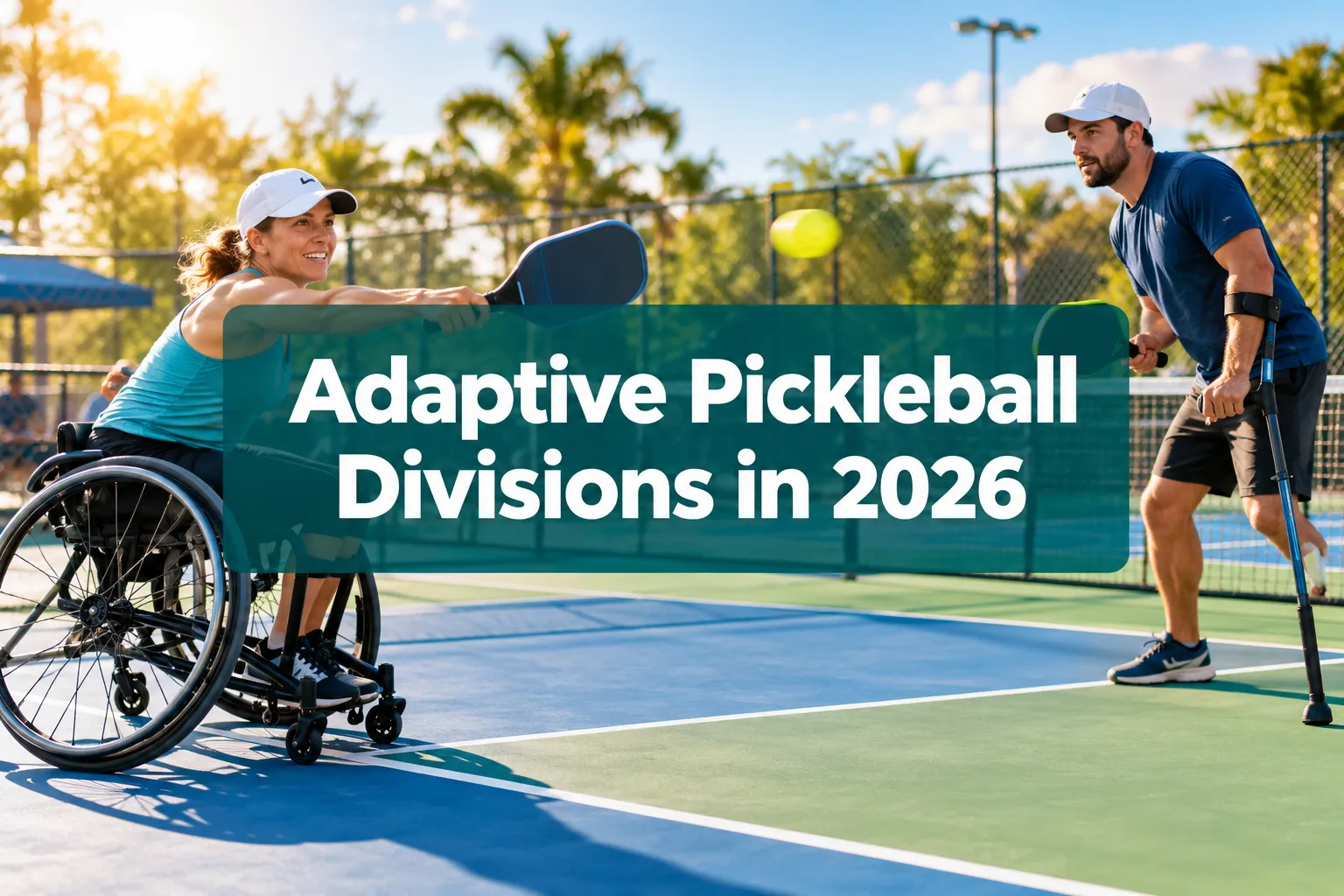
Adaptive Pickleball Divisions in 2026: Two-Bounce Rules, Hybrid Doubles, and Inclusive Play Strategies
Last updated: October 7, 2026
Quick Answer: In 2026, USA Pickleball formally added an Adaptive Standing Division to its official rulebook, allowing mobility-impaired players to request a two-bounce allowance during rallies. Hybrid doubles pairs an adaptive player with a non-adaptive partner under asymmetric rules, and wheelchair divisions now have dedicated national championship events. These changes make competitive and recreational pickleball more accessible than ever before.
Key Takeaways
- 🏓 USA Pickleball’s 2026 rulebook formally recognizes an Adaptive Standing Division for players with mobility impairments [6]
- 🔁 The two-bounce rule in adaptive play lets the ball bounce twice before a mobility-impaired player must return it, distinct from the standard two-bounce (double-bounce) serve rule [4]
- 🤝 Hybrid doubles teams pair one adaptive player with one non-adaptive player, with asymmetric rules applied based on pre-match declarations
- ♿ Wheelchair pickleball has its own two-bounce allowance and now features a dedicated 2026 Numotion USA Pickleball Wheelchair National Championships
- 📋 Players must declare adaptive status before a match, not mid-game, to access modified rules
- 🎾 Able-bodied players can participate in hybrid doubles but compete under standard rules for their own shots
- 🏅 Adaptive clinics and “pickleball for every ability” programs are expanding at local parks and recreation centers in 2026 [8]
- 🛒 Specialized equipment, including sport wheelchairs and extended-grip paddles, improves performance and safety for adaptive players
- 📍 Adaptive tournaments are listed through USA Pickleball’s official event finder and local club networks
- 🌍 These rule changes represent a meaningful step toward a fully inclusive racket sports community
What Are Adaptive Pickleball Divisions and How Do They Work?
Adaptive pickleball divisions are structured competitive categories designed for players with physical disabilities or mobility impairments. They operate under modified rules that level the playing field without changing the core game. [6]
In 2026, USA Pickleball formalized this structure by adding the Adaptive Standing Division to its official rulebook. This division covers players who have a qualifying mobility impairment but compete on foot rather than in a wheelchair. The key modification is a two-bounce allowance during rallies, meaning the ball may bounce twice on the player’s side before they must return it.
Here’s how the division structure breaks down in 2026:
| Division | Who It’s For | Key Rule Modification |
|---|---|---|
| Adaptive Standing | Mobility-impaired, standing players | Two-bounce allowance in rallies |
| Wheelchair | Players using sport or standard wheelchairs | Two-bounce allowance; dedicated championships |
| Hybrid Doubles | Mixed adaptive/non-adaptive pairs | Asymmetric rules per player status |
| Open/Standard | All other players | Standard USA Pickleball rules apply |
Players register for the appropriate division before competition. If you’re new to pickleball rules in general, start with our beginner’s guide to understanding pickleball rules before diving into adaptive modifications.
What Is the Two-Bounce Rule in Adaptive Pickleball?

In adaptive pickleball, the two-bounce rule allows a player with a qualifying mobility impairment to let the ball bounce twice on their side of the court before returning it. This is a rally accommodation, it applies throughout the point, not just on the serve. [4]
This is different from the standard “double-bounce rule” (sometimes also called the two-bounce rule) that applies to all pickleball players. In standard play, the serve and the return of serve must each bounce once before players can volley, that’s a serving sequence rule, not a rally accommodation [7].
Key distinctions:
- Standard two-bounce rule: Applies to the serve and return only; both teams must let the ball bounce once each before volleying begins [5]
- Adaptive two-bounce allowance: Applies throughout the rally for the eligible player; the ball may bounce twice on their side before they return it
The adaptive allowance gives players with limited mobility extra time to reach the ball. It doesn’t change the net height, court dimensions, or scoring. The opponent still plays under standard rules unless they also have adaptive status.
Common mistake: Assuming the adaptive two-bounce rule replaces the standard double-bounce serve rule. It doesn’t, both rules apply simultaneously in adaptive play. [6]
How Do Hybrid Doubles Teams Work in Adaptive Pickleball?
Hybrid doubles pairs one adaptive player with one non-adaptive (able-bodied) partner on the same team. The adaptive player uses modified rules for their own shots; the non-adaptive partner follows standard rules for theirs. [6]
This format makes it possible for friends, family members, and community players of different ability levels to compete together, which is a big part of why the racket sports community has embraced it so enthusiastically.
How hybrid doubles works in practice:
- Pre-match declaration: The adaptive player declares their status and applicable rule modifications before the match begins
- Asymmetric rules: When the ball is on the adaptive player’s side, the two-bounce allowance applies; when it’s on the non-adaptive partner’s side, standard rules apply
- Serving rotation: Both players rotate serves as in standard doubles, no changes to the serving sequence
- Scoring: Standard rally scoring applies to the whole team (see more on scoring below)
- Court positioning: No mandatory positioning rules based on adaptive status, teams choose their own formation
Choose hybrid doubles if: You want to play competitively alongside a partner who has a mobility impairment, or you’re an adaptive player who wants to compete with a non-adaptive friend without either player being disadvantaged by a mismatch in rules.
What Disabilities Qualify for Adaptive Pickleball Divisions?
Adaptive pickleball divisions are designed for players with physical mobility impairments that affect their ability to move around the court under standard rules. This includes, but isn’t limited to, conditions affecting the legs, hips, or lower body function. [6]
USA Pickleball’s 2026 adaptive framework focuses on functional mobility rather than a specific diagnosis list. The guiding principle is whether the impairment materially affects a player’s ability to reach the ball within the standard one-bounce rule.
Examples of qualifying conditions (not exhaustive):
- Lower limb amputations (with or without prosthetics)
- Spinal cord injuries affecting leg mobility
- Neurological conditions affecting gait (e.g., multiple sclerosis, cerebral palsy)
- Severe arthritis or joint conditions limiting movement speed
- Post-surgical mobility restrictions (with appropriate documentation)
Players using wheelchairs qualify for the dedicated Wheelchair Division rather than the Adaptive Standing Division. If you’re unsure which division fits your situation, contact your local USA Pickleball affiliate or the tournament director before registering.
How Is Adaptive Pickleball Different from Regular Pickleball?
Adaptive pickleball uses the same court, net, ball, and basic scoring as standard pickleball, the differences are limited to specific rule accommodations for eligible players. [1]
For most of the game, you’d barely notice a difference. The ball still travels the same way, dinking and smashing still work the same, and the community atmosphere is identical. The modifications exist to remove barriers, not to create a separate sport.
Side-by-side comparison:
- Court size: Same in both formats
- Net height: Same in both formats
- Ball and paddle: Same equipment (with optional adaptive gear)
- Scoring: Same rally scoring system in 2026
- Two-bounce serve rule: Applies in both formats
- Rally two-bounce allowance: Adaptive only, not in standard play
- Pre-match declaration: Required in adaptive; not applicable in standard
If you’re already comfortable with basic pickleball strategies, transitioning to adaptive play as a non-adaptive partner in hybrid doubles is straightforward.
What Are the Official 2026 Adaptive Pickleball Rules?
The 2026 USA Pickleball rulebook formally codifies the Adaptive Standing Division with these core rules [6]:
- Eligibility declaration: Players must declare adaptive status and the specific accommodation needed before the match, not during play
- Two-bounce rally allowance: The ball may bounce twice on the adaptive player’s side during any rally point
- Serving rules unchanged: The standard double-bounce serve rule still applies to all players, including adaptive players
- Wheelchair division separation: Wheelchair players compete in their own dedicated division with its own two-bounce allowance, not in the Adaptive Standing Division
- Hybrid doubles structure: Asymmetric rule application based on each player’s declared status
The 2026 rules also introduced rally scoring across more divisions and clarified serve mechanics, changes that benefit adaptive players by making matches more predictable in length [9]. For a full breakdown of all 2026 rule changes, USA Pickleball’s official rules summary is the authoritative reference [10].
Can Able-Bodied Players Compete in Adaptive Pickleball?
Yes, able-bodied players can participate in hybrid doubles as the non-adaptive partner. They compete under standard rules for their own shots and do not receive the two-bounce rally allowance. [6]
Able-bodied players cannot enter the Adaptive Standing Division or Wheelchair Division as solo competitors. Those divisions exist specifically for players with qualifying impairments.
What able-bodied players should know before entering hybrid doubles:
- You’ll need to understand your partner’s specific accommodation so you can anticipate rally flow
- Communication before and during warm-up is essential, know which rules apply to which player
- Your own game doesn’t change; focus on positioning to support your partner’s reach limitations
- It’s a genuinely fun format that builds empathy and community through pickleball
How Do You Set Up an Inclusive Pickleball Program?
An inclusive pickleball program gives players of all ability levels a structured, welcoming way to participate. The best programs combine rule education, adaptive equipment access, and community-building. [8]
In October 2026, The Woodlands Township in Texas launched a “Pickleball for Every Ability” program featuring adaptive clinics, open play sessions, and equipment lending, a strong model for recreation centers nationwide [8].
Steps to set up an inclusive program:
- Assess your facility, Check court surfaces for wheelchair accessibility; smooth, level courts are essential
- Train your instructors, Coaches should understand adaptive rules and basic disability awareness
- Source adaptive equipment, Sport wheelchairs, extended-grip paddles, and lower-compression balls help new adaptive players
- Offer structured clinics, Separate beginner adaptive sessions before integrating players into open play
- Promote hybrid doubles, Mixed-format play builds community faster than segregated sessions
- Connect with USA Pickleball, Register as an affiliate to access resources, rule guides, and event listings
Promoting inclusivity in pickleball starts with small, consistent actions, and the racket sports community grows stronger every time a new player finds their place on the court.
What Equipment Do You Need for Adaptive Pickleball?
Standard pickleball equipment works for most adaptive players, but a few targeted upgrades make a real difference. The right gear reduces injury risk and improves confidence on the court.
Essential gear for adaptive players:
- Sport wheelchair: A lightweight, low-seat-height chair with angled wheels for stability and quick lateral movement, standard wheelchairs aren’t designed for court sports
- Paddle: A standard pickleball paddle works, but players with limited grip strength benefit from paddles with cushioned, extended handles or wrist straps
- Shoes/footwear: Standing adaptive players should prioritize court shoes with strong lateral support, see our guide on essential gear for new pickleball players for a solid starting point
- Gloves: Improve grip for players with reduced hand strength
- Ball selection: Standard outdoor or indoor balls both work; lower-compression balls can be used in beginner adaptive clinics to slow the game down
Gear tip: Don’t invest in a sport wheelchair before trying a loaner from a local adaptive sports program. Fit and seat height vary significantly, and the right chair depends on your specific mobility needs.
For broader paddle selection advice, our guide to choosing your first pickleball paddle covers the key specs to look for.
Where Can You Find Adaptive Pickleball Tournaments?
The best starting point is the USA Pickleball official tournament finder at usapickleball.org, which lists sanctioned events including adaptive and wheelchair divisions. In 2026, the dedicated Numotion USA Pickleball Wheelchair National Championships and wheelchair divisions at the Oceanview USA Pickleball National Championships are the flagship events. [6]
Other ways to find adaptive play near you:
- Search local parks and recreation departments, many now run adaptive clinics (like The Woodlands program) [8]
- Check with adaptive sports organizations in your region (e.g., Disabled Sports USA affiliates)
- Join online pickleball communities where adaptive players share local event listings
- Contact your nearest USA Pickleball ambassador, they often know about informal adaptive open-play sessions that don’t appear in official listings
For general tips on finding local pickleball courts and clubs, the same community-first approach applies to adaptive play.
How Do You Score in Hybrid Doubles Pickleball?
Hybrid doubles uses the same scoring system as standard doubles pickleball. In 2026, USA Pickleball expanded rally scoring to more divisions, meaning a point is scored on every rally regardless of which team served. [9]
Scoring basics for hybrid doubles:
- Games are typically played to 11 points, win by 2
- Rally scoring: every rally produces a point, no side-out required
- Both players on a team rotate serves in standard doubles order
- The adaptive two-bounce allowance doesn’t affect scoring, it only affects whether a shot is legal
If you’re new to keeping score, our beginner’s guide to pickleball scoring breaks it down clearly.
What Are Common Mistakes Beginners Make in Adaptive Pickleball?
Most beginner mistakes in adaptive pickleball come from misunderstanding which rules apply when, and from underestimating the physical demands of court sports for adaptive players. [6]
Top mistakes to avoid:
- Forgetting to declare adaptive status before the match, you can’t request the two-bounce allowance mid-game; it must be declared upfront
- Confusing the adaptive two-bounce allowance with the standard double-bounce serve rule, they’re different rules that coexist [7]
- Using a standard wheelchair instead of a sport wheelchair, it limits mobility and increases injury risk
- Skipping warm-up, adaptive players, especially wheelchair users, are still at risk for upper-body strain; check our injury prevention strategies for pickleball players before your first session
- Not communicating with your hybrid doubles partner, asymmetric rules require both players to understand each other’s accommodations before the first point
Is Adaptive Pickleball Good for Wheelchair Users?
Absolutely, wheelchair pickleball is one of the fastest-growing adaptive racket sports formats in 2026, with dedicated national championships and a growing network of local programs. It’s well-suited to wheelchair users because the two-bounce allowance directly addresses the core challenge of court coverage. [6]
Why wheelchair pickleball works well:
- The two-bounce allowance gives players time to position their chair before returning
- The court dimensions stay the same, so the game remains challenging and competitive
- Sport wheelchairs allow surprisingly quick lateral movement with practice
- The social and physical benefits of pickleball, cardiovascular fitness, coordination, community, apply fully to wheelchair players
- National-level competition (Numotion USA Pickleball Wheelchair National Championships) gives players a clear competitive pathway
For wheelchair users new to the sport, starting with a local adaptive clinic before entering tournament play is the most practical path forward.
FAQ
Q: Does the adaptive two-bounce allowance apply on the serve? No. The serve and return of serve must still follow the standard double-bounce rule for all players. The adaptive two-bounce allowance applies only during rallies after the serve sequence is complete. [4]
Q: Can an adaptive player use the two-bounce allowance on every shot? Yes, once declared, the allowance applies throughout the match for every rally. The player doesn’t need to signal each time. [6]
Q: What if both players in a doubles team have adaptive status? Both players declare their status pre-match. Each player’s two-bounce allowance applies to shots on their side of the court. The opponent team plays under standard rules unless they also have adaptive declarations.
Q: Is there a rating system for adaptive pickleball players? USA Pickleball is developing adaptive skill ratings, but as of 2026, most adaptive divisions use self-reported skill levels or tournament director assessments. Check with individual tournament organizers for current rating requirements. [6]
Q: Can adaptive rules be used in recreational (non-tournament) play? Yes, in casual play, players can agree to adaptive accommodations informally. The formal declaration process applies to sanctioned tournament play.
Q: Do hybrid doubles teams need to register differently than standard doubles teams? Yes. At least one player must register with adaptive status, and the team must indicate hybrid doubles format at registration. Tournament directors confirm eligibility before play begins.
Q: What’s the difference between the Adaptive Standing Division and the Wheelchair Division? The Adaptive Standing Division is for players who compete on foot with a qualifying mobility impairment. The Wheelchair Division is for players who use a wheelchair during play. Both use a two-bounce rally allowance, but they are separate competitive divisions with separate draws. [6]
Q: Are there age divisions within adaptive pickleball? Many tournaments offer age-bracketed adaptive divisions (e.g., 50+, 60+), especially at national championship level. Check individual event listings for age bracket details.
Q: How long does it take to learn adaptive pickleball as a wheelchair user? Most new wheelchair players develop basic rally competency within 4-6 sessions, especially with coached instruction. Sport wheelchair handling is the steepest learning curve, the pickleball skills transfer quickly from other racket sports experience.
Conclusion
Adaptive Pickleball Divisions in 2026 represent a genuine shift in how the sport welcomes players of all abilities. The formalized Adaptive Standing Division, the two-bounce rally allowance, and the hybrid doubles format aren’t just rule tweaks, they’re the foundation of a more inclusive racket sports community.
Your next steps:
- Check your eligibility, review USA Pickleball’s 2026 rulebook or contact a local ambassador if you have a mobility impairment
- Find a local program, search usapickleball.org or your parks and recreation department for adaptive clinics near you
- Try hybrid doubles, if you’re an able-bodied player, invite an adaptive friend to the court and experience the format firsthand
- Get the right gear, borrow before you buy, especially for sport wheelchairs
- Join the community, adaptive and inclusive play sessions are growing fast, and the welcoming atmosphere is one of pickleball’s greatest strengths
Every player deserves a place on the court. In 2026, the rules are finally catching up to that idea. 🏓
References
[1] Complete Pickleball Rules Guide 1 – https://www.pickleball.com/docs/en/article/complete-pickleball-rules-guide-1.html [4] Two Bounce – https://pickleballus.org/play/rules/court/two-bounce/ [5] Pickleball Two Bounce Rule – https://dillball.app/guides/pickleball-two-bounce-rule/ [6] 2026 Usa Pickleball Rule Changes Whats Changing This Year – https://playpickleball.com/2026-usa-pickleball-rule-changes-whats-changing-this-year/ [7] What Is The Two Bounce Rule In Pickleball – https://pickleball.com/docs/en/article/what-is-the-two-bounce-rule-in-pickleball [8] 100526 Pickleball For Every Ability – https://www.thewoodlandstownship-tx.gov/Township-News/2026-Press-Releases/October/100526-Pickleball-for-Every-Ability [9] Usa Pickleballs 2026 Rule Changes Explained Rally Scoring Adaptive Divisions And Serve Clarifications – https://rallyracket.com/usa-pickleballs-2026-rule-changes-explained-rally-scoring-adaptive-divisions-and-serve-clarifications/ [10] Usap Rules Summary – https://usapickleball.org/docs/rules/USAP-Rules-Summary.pdf


