
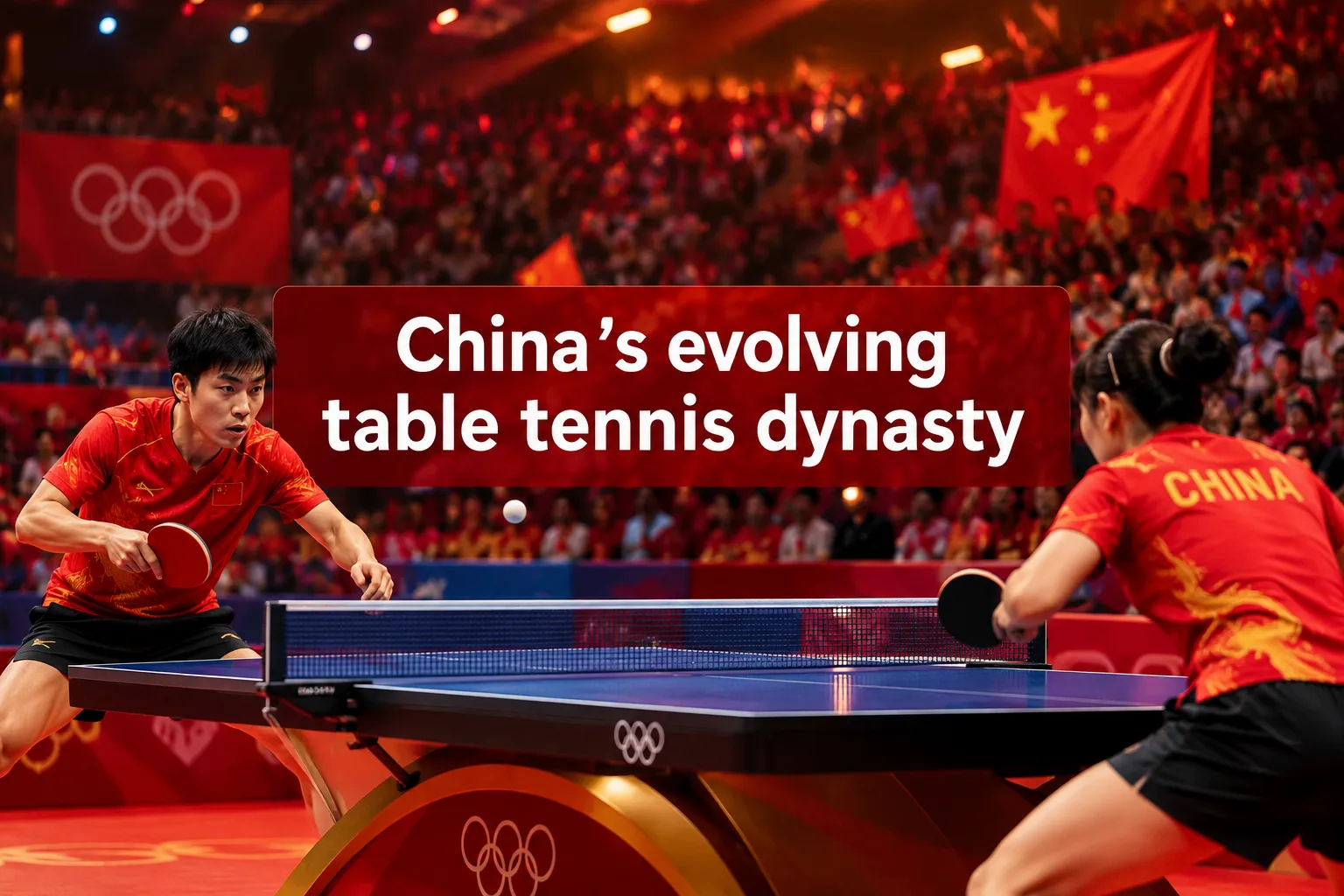
China’s Evolving Table Tennis Dynasty and Build-Up to LA28
Last updated: October 15, 2026
Quick Answer: China remains the undisputed force in Olympic table tennis, having swept all five gold medals at Paris 2024. As of 2026, China’s evolving table tennis dynasty and build-up to LA28 is defined by a deliberate generational shift, fast-tracking younger stars like Wang Chuqin and Kuai Man alongside proven champions, while absorbing rare losses to Japan and South Korea as useful pressure tests before the 2028 Los Angeles Olympics.
Key Takeaways
- 🥇 China won all five table tennis gold medals at Paris 2024, its sixth complete Olympic sweep [2][4]
- 🏆 Ma Long claimed his sixth Olympic gold in Paris, an all-time record in the sport [6]
- 📉 China’s men’s team lost to Japan at the 2026 Asian Games, ending a 32-year continental winning streak [3]
- 🌟 The 2026 squad for the World Team Championships and Asian Games features multiple players born after 2003, signaling a clear youth push [10]
- 🇯🇵 Japan and South Korea are the closest challengers, consistently pushing China in team events
- 🎯 Wang Chuqin, Sun Yingsha, and Wang Manyu are the likely cornerstones of China’s LA28 team
- 🔄 China’s selection process blends direct qualification for top-ranked players with competitive internal trials [8]
- 🌍 WTT Smash events and the 2026 Asian Games are being used as live testing grounds for new player combinations [9][10]
- ⚡ The 2026 World Team Championships in London showed China’s resilience and squad depth [8]
- 🏓 Racket sports training at elite Chinese academies starts as young as age six, creating a conveyor belt of talent
Why Is China So Dominant in Table Tennis?
China’s dominance in table tennis comes down to three things: volume of participation, depth of state-backed infrastructure, and a culture that treats the sport as a national priority. With tens of millions of players and a government-funded pipeline stretching from primary school to the national team, China simply produces more elite players than any other country.
The numbers back this up. At Paris 2024, China completed a full gold-medal sweep across all five table tennis events, men’s singles, women’s singles, mixed doubles, men’s team, and women’s team [2][4]. It was the sixth time China had won every Olympic table tennis gold on offer.
What makes this sustainable:
- State sports schools identify and recruit talented children as young as six
- Full-time coaches, sports science support, and dedicated facilities are standard at provincial level
- Internal competition is fierce, making China’s national team is arguably harder than winning a world title
- Players train against each other constantly, meaning they’re battle-tested before international competition even begins
How Has China’s Table Tennis Strategy Changed Over the Years?
China’s strategy has shifted from relying on a handful of generational stars to building a deeper, more renewable squad. The era of Ma Long and Zhang Jike as the sole pillars is giving way to a model that blends experienced champions with fast-tracked youth.
At Paris 2024, Ma Long won his sixth Olympic gold, an unprecedented achievement [6]. But China’s coaches were already rotating younger players into major tournaments alongside him. By 2026, the national roster for both the World Team Championships and the Asian Games featured multiple players born after 2003, including Lin Shidong, Kuai Man, Wen Ruibo, and Xiang Peng [10].
The shift is also tactical. China is experimenting with new doubles partnerships and testing which combinations work best against Japan’s aggressive counter-attacking style and South Korea’s power game. WTT Smash events in 2026, including the China Smash in Beijing and the Singapore Smash, are being used explicitly as competitive labs for these pairings [9].
The core strategic shift: Less reliance on one or two veterans, more investment in a squad where five or six players could realistically anchor an Olympic team by 2028.
Who Are China’s Top Table Tennis Players for LA28 Olympics?
No official LA28 roster exists yet, but current form and squad selection patterns point clearly to the likely core group. China’s LA28 contingent will almost certainly be built around mid-20s stars who are already world No. 1 ranked in 2026.
Projected LA28 core players (based on current trajectories):
| Player | Gender | Current Status |
|---|---|---|
| Wang Chuqin | Men | World No. 1, named in 2026 World Team Champs squad [8] |
| Sun Yingsha | Women | World No. 1, 2026 World Team Champs squad [8] |
| Wang Manyu | Women | Top-ranked, 2026 China Smash doubles winner [9] |
| Lin Shidong | Men | Rising star, 2026 Asian Games squad [10] |
| Kuai Man | Women | 2026 doubles champion, Asian Games squad [9][10] |
| Wen Ruibo | Men | Top Chinese seed at 2026 China Smash |
| Xiang Peng | Men | 2026 Asian Games and World Champs squad [8][10] |
Ma Long’s participation at LA28 would make him 38 at the time of the Games, possible, but unlikely in a team format given China’s youth push.

What’s the Difference Between Chinese and European Table Tennis Styles?
Chinese players typically favor a high-speed, loop-dominated attacking style with exceptional footwork and consistency under pressure. European players, particularly from Sweden, Germany, and France, tend to rely more on physical power, variation in spin, and tactical unpredictability.
The contrast shows up clearly in results. At Paris 2024, China’s men’s team defeated Sweden 3-0 in the team final, with Ma Long, Wang Chuqin, and Fan Zhendong leaving little room for European variation to disrupt their rhythm [2]. France’s Félix Lebrun has been one of the few European players to consistently challenge Chinese opponents, and notably he was the top seed at the 2026 China Smash, a rare distinction for a non-Chinese player.
Key style differences:
- Chinese style: High-tempo rallies, aggressive forehand loops, superior consistency, mental composure under pressure
- European style: More physical variation, heavier serves, willingness to disrupt rhythm, stronger backhand in some players
- Asian rivals (Japan/South Korea): Blend Chinese-influenced technique with faster reaction play and aggressive counter-looping
Understanding these differences matters for any racket sports player studying elite technique. Good footwork fundamentals are central to the Chinese model, their players cover the table with minimal wasted movement.
How Does China Train Table Tennis Players From a Young Age?
China’s youth development system is the most structured in any racket sport globally. Children showing early aptitude are identified through school programs and funneled into provincial sports schools, often before age eight.
The development pipeline:
- School-level identification, coaches scout primary schools for coordination, reflexes, and attitude
- Provincial sports schools, full-time training alongside academic study, often from age 8-12
- National youth teams, top performers compete in domestic junior circuits with national team coaches watching
- Senior national squad trials, internal competitions determine who earns spots; top-ranked players qualify directly [8]
- International exposure, WTT events and World Championships serve as the final proving ground
This system creates a deep competitive pool. The 2026 Asian Games squad included players born after 2003 who had already competed at World Team Championship level [10]. That kind of accelerated development is difficult for other nations to replicate without similar state investment.
For recreational players curious about how structured youth programs build long-term skill, the principles translate well, consistent partner drills to boost team play and deliberate practice routines are the amateur equivalent of China’s elite pipeline.
What Challenges Is China Facing in Table Tennis Right Now?
China’s biggest challenge in 2026 is managing a generational transition without losing competitive ground. The men’s program in particular is under pressure after losing the Asian Games team final to Japan 2-3 in September 2026, ending a 32-year run of Asian Games men’s team golds [3].
Current pressure points:
- Men’s team depth: With Ma Long aging out, Wang Chuqin and Lin Shidong need to develop consistent winning partnerships before LA28
- Japan’s rise: Japan’s men’s team has closed the gap significantly, combining Chinese-trained technique with home-grown intensity
- South Korea’s challenge: South Korea pushed China hard at the 2026 World Team Championships, though China won their quarterfinal 3-0 [8]
- Psychological pressure: Younger Chinese players now carry enormous expectation, any loss is magnified domestically
- Selection complexity: The women’s side uses a hybrid system of direct qualification and trials, which can create internal tension [8]
The Asian Games loss is widely viewed in expert commentary as a useful wake-up call rather than a structural decline [3]. China is expected to respond with intensified preparation for its younger male players ahead of LA28.
Which Countries Are Catching Up to China in Table Tennis?
Japan and South Korea are the most credible challengers to China’s dominance, followed by Germany and France in Europe. Japan’s breakthrough at the 2026 Asian Games, beating China 3-2 in the men’s team final, is the clearest evidence yet that the gap is narrowing [3].
The main challengers:
- Japan: Strong technical base, aggressive counter-attacking, home advantage at the 2026 Asian Games in Aichi-Nagoya. Beat China in the men’s team final [3]
- South Korea: Competitive at World Championships level; pushed China in 2026 [8]
- France: Félix Lebrun is a genuine singles threat; was top seed at 2026 China Smash
- Germany: Consistent European medal contender, strong at individual events
- Sweden: Historical rival; lost the Paris 2024 men’s team final to China 0-3 [2]
None of these nations yet has the squad depth to beat China across all five Olympic events. But Japan’s men’s team win in 2026 shows that team gold is no longer a certainty for China at every major competition.
How Many Medals Does China Usually Win in Table Tennis at the Olympics?
China typically wins between four and five gold medals at each Olympics. Since table tennis became an Olympic sport in 1988, China has won the vast majority of all available gold medals across every Games.
At Paris 2024, China won all five golds available, men’s singles, women’s singles, mixed doubles, men’s team, and women’s team [2][4]. This was the sixth time China had achieved a complete sweep. Even in years where China didn’t sweep, it rarely finished with fewer than three or four golds.
For context, the table tennis program at the Olympics offers five gold medals per Games (as of the current format). China’s historical gold medal rate in the sport is estimated at well above 60% of all available golds since 1988, a record unmatched in any other Olympic racket sport.
What’s China’s Selection Process for Olympic Table Tennis Teams?
China uses a performance-driven selection system that combines world ranking thresholds with internal trials. Top-ranked players, typically the world No. 1 and No. 2, qualify directly, while others must earn their spots through domestic competition [8].
For the 2026 World Team Championships in London, China named a 10-player roster. On the women’s side, Sun Yingsha and Wang Manyu qualified directly based on ranking, while Wang Yidi, Chen Xingtong, and Kuai Man competed through trials [8]. The men’s squad included Wang Chuqin (direct), with Lin Shidong, Zhou Qihao, Xiang Peng, and Liang Jingkun filling remaining spots [8].
This system is likely to continue through the LA28 cycle. It keeps the squad competitive internally and gives coaches flexibility to tailor team compositions to specific opponents and formats.
How Is China Preparing Specifically for LA28 Table Tennis Competition?
China’s evolving table tennis dynasty and build-up to LA28 is being structured around a full competitive calendar that treats every major 2026 event as preparation. The 2026 World Team Championships, Asian Games, and WTT Smash series are all explicitly framed as platforms to test new-generation players and refine squad combinations [1][10].
Key preparation steps underway in 2026:
- Youth integration: Players born after 2003 are being given major tournament experience now, so they peak around 2028 [10]
- Doubles testing: New pairings like Wang Manyu and Kuai Man are competing at WTT Smashes to build chemistry [9]
- Opponent-specific prep: Losses to Japan are being analyzed to sharpen tactical responses for the men’s program [3]
- Selection trials: The hybrid qualification system ensures internal competition stays fierce through 2027 [8]
- Coaching continuity: China’s national coaching staff is maintaining consistent methodology while introducing new technical inputs for younger players
The 2026 Asian Games women’s team gold, beating Japan 3-0 in the final to secure China’s sixth consecutive Asian Games women’s team title, confirmed the women’s program is on track. The men’s program has more work to do.
What Common Mistakes Do Table Tennis Players Make Against Chinese Opponents?
Players facing Chinese-trained opponents, at any level, tend to make the same tactical errors. Understanding these mistakes can help any racket sports player improve their game strategy.
Common mistakes:
- Playing into their tempo: Chinese players thrive on fast exchanges. Slowing the game down with heavy backspin and variation disrupts their rhythm more than trying to out-speed them
- Ignoring the serve: Chinese players use highly varied, short serves with deceptive spin. Rushing the return without reading the spin is the fastest way to lose a point
- Staying passive: Waiting for errors rarely works, Chinese players are too consistent. You need to create pressure, not wait for it
- Poor court positioning: Chinese players exploit positional errors ruthlessly. Staying centered and balanced is non-negotiable
- Underestimating backhand play: Modern Chinese players like Wang Chuqin have elite two-wing attacks. Targeting the backhand as a “weak side” no longer works
These lessons apply broadly across racket sports. Good shot selection for beginners starts with understanding your opponent’s strengths, not just your own.
Is Table Tennis Popularity Declining in China?
Table tennis participation in China remains extremely high by global standards, though there are signs that younger generations are increasingly drawn to basketball, esports, and other sports. The sport’s cultural status as China’s “national sport” keeps it well-funded and institutionally supported regardless of participation trends.
Chinese media coverage of major events, particularly the Paris 2024 Olympics sweep and the 2026 Asian Games, generates massive domestic viewership. The national team’s results are a source of genuine national pride, and state investment in the sport shows no sign of decreasing ahead of LA28.
The sport also benefits from the global growth of racket sports generally. As communities around the world build racket sports communities around games like pickleball, padel, and badminton, table tennis continues to attract players who value its accessibility and technical depth.
How Do Chinese Table Tennis Academies Compare to Other Countries?
Chinese provincial sports schools and national academies have no direct equivalent in the rest of the world. They combine full-time coaching, sports science, video analysis, and competitive internal leagues under one roof, and they start working with athletes years earlier than most national programs.
Comparison snapshot:
| Factor | China | Japan/South Korea | Europe |
|---|---|---|---|
| Entry age | 6-8 years | 8-10 years | 10-12 years |
| Training hours/week | 30-40+ | 20-30 | 15-25 |
| State funding | Very high | High | Moderate |
| Internal competition depth | Extremely deep | Deep | Moderate |
| Coaching-to-player ratio | High | High | Lower |
Japan and South Korea have significantly improved their academies over the past decade, which explains their growing competitive results. European programs rely more on club structures than centralized academies, which limits early specialization.
For recreational players, the takeaway is that structured training camps and consistent coaching accelerate development at any level, not just the elite.
What Happened to China’s Table Tennis Dominance at Recent World Championships?
China’s dominance at recent World Team Championships remains largely intact, though the margins are tightening. At the 2024 ITTF World Team Table Tennis Championships Finals in Busan, China won both the men’s and women’s titles, beating France 3-0 in the men’s final and Japan 3-2 in a tighter women’s final [7].
At the 2026 World Team Championships Finals in London, China’s men recovered from a group-stage loss to South Korea by beating them 3-0 in the quarterfinals, while the women’s team also advanced with a 3-0 win over South Korea [8]. These results show that China’s squad depth holds up even when individual matches go against them.
The pattern across recent championships: China wins, but the path is getting harder. Japan’s 3-2 women’s final win at Busan and their 2026 Asian Games men’s team breakthrough are the clearest signs that China’s evolving table tennis dynasty and build-up to LA28 will be tested more seriously than any previous Olympic cycle.
Conclusion: What to Watch as LA28 Approaches
China’s evolving table tennis dynasty and build-up to LA28 is the most interesting storyline in elite racket sports right now. The program is simultaneously the most dominant force in the sport’s history and the most openly self-critical, using every loss to Japan or South Korea as data, not drama.
Actionable takeaways for fans and players:
- Watch Wang Chuqin and Sun Yingsha, they’re the clearest indicators of where China’s program is heading
- Track Japan’s men’s team, their 2026 Asian Games win is the first real crack in China’s armor in decades [3]
- Follow WTT Smash events, these are where China’s new combinations get tested before the Olympics
- Study Chinese footwork and serve technique, even recreational players can improve racket sports skills by borrowing from the world’s best
- Check back on squad announcements in 2027, that’s when LA28 selection patterns will become clearer
Whether you’re a table tennis fan, a competitive player, or just someone who loves watching elite racket sports, the next two years leading to LA28 will be worth following closely. The dynasty isn’t fading, it’s evolving.
FAQ
Q: Has China ever lost all table tennis gold medals at an Olympics? No. China has never been shut out of Olympic table tennis gold. Even in its “worst” Olympic performances, it has won multiple gold medals. The sport has been on the Olympic program since 1988.
Q: Who is the greatest table tennis player of all time? Ma Long is widely considered the greatest male table tennis player in history. His six Olympic gold medals, the most ever in the sport, set a benchmark that may stand for decades [6].
Q: Will Ma Long compete at LA28? No official announcement has been made. Ma Long will be 38 at the time of LA28. While not impossible, China’s youth push makes his inclusion in a team event unlikely. Individual events remain a remote possibility.
Q: Why did China lose the men’s team event at the 2026 Asian Games? Japan beat China 3-2 in the men’s team final at the Aichi-Nagoya Asian Games, ending China’s 32-year run of continental men’s team golds [3]. Expert commentary frames this as a result of Japan’s improved depth and China’s ongoing generational transition in the men’s program.
Q: How does China pick its Olympic table tennis team? Top-ranked players (typically world No. 1 and No. 2) qualify directly. Others earn spots through internal trials. The system is performance-driven and reviewed each Olympic cycle [8].
Q: Is Sun Yingsha the best women’s player in the world? As of 2026, Sun Yingsha holds the world No. 1 ranking and is a central figure in China’s squad for both the World Team Championships and LA28 preparations [8].
Q: How many table tennis events are at the Olympics? The Olympics currently features five table tennis events: men’s singles, women’s singles, mixed doubles, men’s team, and women’s team.
Q: What racket sports are growing fastest globally? Pickleball and padel are the fastest-growing racket sports globally by participation numbers. Table tennis remains the most-played racket sport worldwide by total participants.
Q: Can recreational players learn from Chinese table tennis technique? Yes. Footwork patterns, serve variation, and consistent loop technique from the Chinese model translate well to recreational play. The principles of structured practice and deliberate repetition apply at every level.
Q: When will LA28 table tennis events take place? The 2028 Los Angeles Olympics are scheduled for July, August 2028. Specific venue and schedule details for table tennis had not been confirmed as of October 2026.
References
[1] China.org.cn, http://www.china.org.cn/2026-09/24/content_118710922.shtml
[2] Paris 2024 Table Tennis All Results People’s Republic of China Win Gold Men Team, https://www.olympics.com/en/news/paris-2024-table-tennis-all-results-people-s-republic-of-china-win-gold-men-team
[3] Chosun English Sports, https://www.chosun.com/english/sports-en/2026/09/26/YTD4KJO7VZBXJHD4FRQIG4NFJU/
[4] China Completes Table Tennis Gold Clean Sweep, https://www.thedailystar.net/sports/sports-special/paris-olympics-2024/news/china-completes-table-tennis-gold-clean-sweep-3673961
[5] Paris 2024 Women’s Table Tennis Results China Takes Team Gold, https://www.olympics.com/en/news/paris-2024-womens-table-tennis-results-china-takes-team-gold
[6] Chinese Table Tennis Legend Ma Long Wins Sixth Olympic Gold Medal, https://oca.asia/news/5383-chinese-table-tennis-legend-ma-long-wins-sixth-olympic-gold-medal.html
[7] World Team Table Championships Finals 2024 China Sweeps Competition Stage Set Paris, https://www.nbcolympics.com/news/world-team-table-championships-finals-2024-china-sweeps-competition-stage-set-paris
[8] en.olympic.cn Sports News, https://en.olympic.cn/news/Sports_News/2026/0408/694239.html
[9] World Table Tennis, https://www.cricketnmore.com/sports-topics/world-table-tennis
[10] China.org.cn, http://www.china.org.cn/2026-09/16/content_118698076.shtml