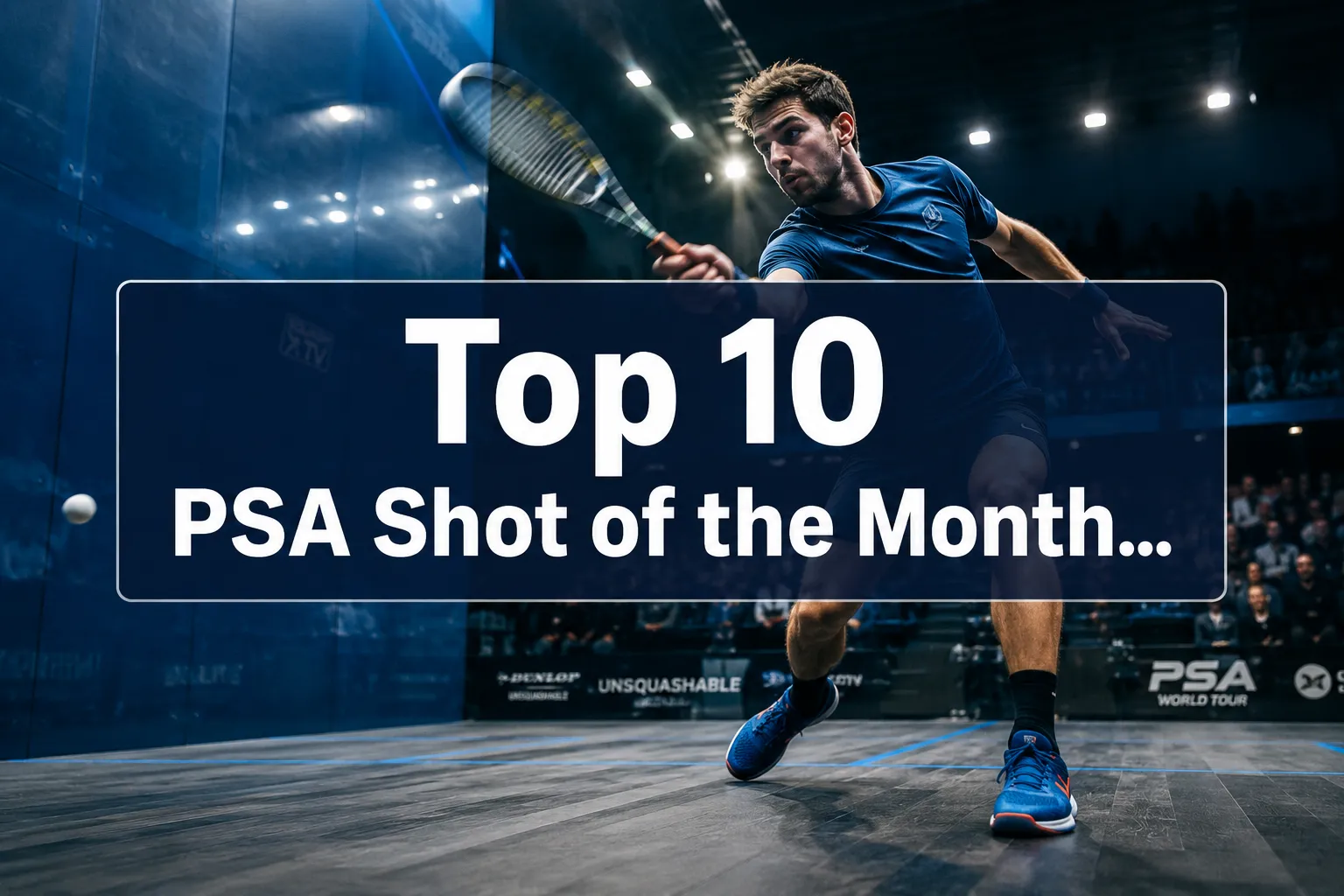
Top 10 PSA Shot of the Month Contenders Beyond January: Evolution of Technique in 2026 Pro Squash
Last updated: August 1, 2026
Quick Answer: The Top 10 PSA Shot of the Month Contenders Beyond January: Evolution of Technique in 2026 Pro Squash highlights a remarkable shift in how elite players are combining spin, deception, and court geometry to produce shots that were rarely seen even five years ago. From February through the summer tour events, 2026 has already delivered a string of jaw-dropping moments on SQUASHTV that any serious squash fan, and ambitious club player, should study closely.
Key Takeaways 🎯
- The PSA Shot of the Month award celebrates the most technically impressive and creative shots from professional tour events each month.
- In 2026, attacking drop shots and reverse-angle nicks are dominating the contender lists more than traditional power drives.
- Players like Ali Farag, Paul Coll, and Nour El Sherbini continue to push technical boundaries, while a new generation of under-25 players is introducing fresh shot patterns.
- Judges weigh difficulty, execution under pressure, court position, and the shot’s impact on the rally outcome.
- Equipment changes, particularly lighter, stiffer racket frames, have made wrist-heavy deception shots more accessible at the pro level.
- Recreational players can replicate the core mechanics of these shots through targeted ghost drills and wall-feed practice.
- Court surface and humidity conditions directly affect which shot types get attempted and which ones end up on highlight reels.
- The racket sports community worldwide is growing faster than ever, and squash is benefiting from that momentum in 2026.

What Is the PSA Shot of the Month Award in Professional Squash?
The PSA (Professional Squash Association) Shot of the Month is a monthly fan-voted and editorially selected award that recognizes the single most outstanding shot played on the PSA World Tour during that calendar month. It’s part of the broader PSA media ecosystem, primarily distributed through SQUASHTV, and serves as both a celebration of skill and a showcase for the sport’s global audience.
Each month, the PSA or its media partners compile a shortlist of standout moments from tour events. Fans vote online, and the winning shot is announced via PSA social channels and SQUASHTV highlights.
Why it matters beyond the trophy:
- It drives fan engagement and introduces casual viewers to elite technique.
- It creates a reference library of the sport’s best moments, useful for coaches and players studying shot patterns.
- It reflects broader trends in how the game is evolving at the highest level.
How Has Squash Technique Evolved in 2026 Compared to Previous Years?
Squash technique in 2026 is faster, more deceptive, and more physically demanding than it was even in 2022. The biggest shift is the move away from pure length-and-width attrition toward shot combinations that use disguise and spin to force errors.
Key technical shifts visible in 2026 tour play:
- Wrist-led deception: Players are holding shots longer before committing to direction, making it nearly impossible for opponents to read the shot early.
- Reverse angles: Cross-court nicks and reverse boasts are appearing more frequently as players exploit opponents caught leaning.
- Spin on the drop: Topspin and slice on short shots are creating unpredictable bounces that hug the side wall.
- Attacking from deep: More players are attempting winners from behind the service box, rather than waiting for a front-court opportunity.
This evolution is partly driven by better physical conditioning, players can recover faster, so they’re willing to take more risks earlier in rallies.
Who Are the Top Squash Players Competing for Shot of the Month Awards?
The players most frequently appearing in Shot of the Month shortlists in 2026 are a mix of established world-class names and emerging talents who are rewriting what’s considered possible on a squash court.
Consistent contenders in 2026:
| Player | Nationality | Known For |
|---|---|---|
| Ali Farag | Egypt | Tactical disguise, reverse angles |
| Paul Coll | New Zealand | Relentless retrieving, unexpected winners |
| Nour El Sherbini | Egypt | Precision drops, court coverage |
| Mostafa Asal | Egypt | Raw power combined with touch |
| Tinne Gilis | Belgium | Creative shot selection under pressure |
New under-25 players from Malaysia, England, and France are also making regular appearances on shortlists, reflecting the sport’s growing depth globally. If you’re interested in how competitive racket sports communities develop talent, the racket sports industry disruption tag at Rally Racket covers some of those broader trends.
What Makes a Squash Shot Worthy of PSA Shot of the Month Recognition?
A shot earns PSA Shot of the Month consideration when it combines at least three of the following qualities: extreme difficulty, perfect execution, high-pressure context, and a decisive impact on the rally or match.
The five criteria that matter most:
- Difficulty, Was the player in a compromised position? Was the shot technically demanding?
- Execution, Did the shot land exactly where intended, with the right pace and spin?
- Pressure context, Was it a match point, a deciding game, or a crucial rally?
- Creativity, Did the player do something unexpected or rarely seen at that level?
- Impact, Did the shot win the rally outright, or force an error on the very next shot?
“The best shots don’t just win the point, they make the crowd and the opponent wonder how it was even possible.”
A routine drop shot hit from an easy position won’t make the list, even if it’s technically clean. Context is everything.
Best Squash Shots February Through December 2026: What to Watch For
The Top 10 PSA Shot of the Month Contenders Beyond January: Evolution of Technique in 2026 Pro Squash spans the full calendar year, and each month tends to reflect the specific tour events and court conditions of that period.
Standout shot categories emerging across the 2026 tour calendar:
- February, March (indoor hard-court season): Tight-angle nicks off the back wall, exploiting fast court conditions.
- April, May (major championship windows): High-pressure drops and reverse boasts in deciding games.
- June, August (summer tour events): More attacking play as players push for ranking points; expect power-disguise combinations.
- September, December (World Championship build-up): Tactically complex shots designed to expose specific opponent weaknesses.
SQUASHTV archives these moments monthly, and watching them in slow motion is genuinely one of the best free coaching resources available to club players. For players in other racket sports looking to develop similar shot IQ, the principles of court positioning strategies translate well across disciplines.
How Do Judges Select PSA Shot of the Month Winners?
Selection combines fan voting with editorial input from PSA media staff. The process is not purely democratic, the editorial team curates the shortlist before fans vote, which means only shots that meet a baseline quality threshold reach the public ballot.
The selection process in brief:
- PSA media team reviews footage from all tour events that month.
- A shortlist of 4-6 shots is compiled based on the five criteria above.
- The shortlist is posted to PSA social channels and SQUASHTV.
- Fans vote over a set window (typically 5-7 days).
- The winner is announced and featured in a dedicated highlight video.
Common edge case: Occasionally, a technically simpler shot wins because it happened in a high-profile final with massive viewership. Fan voting naturally favors moments more people witnessed live.
What’s the Difference Between Attacking and Defensive Shots in Modern Squash?
In modern professional squash, the line between attacking and defensive shots is blurrier than it used to be. A well-disguised drop shot from a defensive position can flip the rally entirely, while a hard drive hit from mid-court can be purely defensive if it’s just buying time.
Simple breakdown:
- Attacking shots aim to win the rally outright or force an immediate error: drops, nicks, reverse angles, and volley drops.
- Defensive shots aim to reset the rally and recover position: length drives, lobs, and cross-court passes.
What’s changed in 2026: Players are converting defensive positions into attacking opportunities more often, using spin and deception to turn a scramble into a winner. This is exactly the kind of shot that earns Shot of the Month nominations, the unexpected attack from a seemingly impossible position.
Which Squash Players Are Known for Innovative Shot Techniques?
Ali Farag is widely regarded as the most technically innovative player of his generation, particularly for his ability to disguise the same swing into three or four different shot outcomes. Mostafa Asal brings an unusual combination of raw power and delicate touch that makes him unpredictable. On the women’s tour, Nour El Sherbini’s drop shot precision and Hania El Hammamy’s attacking instincts are setting new standards.
Players to watch for pure shot innovation in 2026:
- Ali Farag, deception and reverse angles
- Mostafa Asal, power-touch combinations
- Hania El Hammamy, aggressive front-court attacking
- Paul Coll, retrieval converted into unexpected winners
- Youssef Ibrahim, emerging talent with creative shot selection
Common Mistakes Players Make When Attempting Advanced Squash Shots
Most club players who try to replicate pro-level shots fail for the same handful of reasons. Understanding these mistakes is the fastest way to improve your own shot technique.
The most common errors:
- Telegraphing too early: Committing to direction before the last moment removes all deception value.
- Wrong grip pressure: Gripping too tightly kills wrist flexibility, which is essential for disguise and spin.
- Poor court position: Attempting a drop shot when you’re stretched or off-balance almost always results in a loose ball.
- Ignoring the T: Hitting a great shot and then not recovering to the T immediately gives the opponent time to respond.
- Copying the shot, not the setup: The shot itself is only the last 10% of the play. The footwork, positioning, and swing preparation are what make it work.
For players who want to build better movement habits, the same principles that apply in advanced racket sports strategy are directly relevant to squash court movement.
How Equipment Changes Have Affected Squash Shot Evolution in 2026
Racket technology in 2026 has meaningfully influenced the shot patterns showing up on PSA highlight reels. Lighter frames (many now under 120g) with stiffer carbon layups give players more control over wrist-led shots without sacrificing power.
Key equipment trends affecting shot selection:
- Lighter frames allow faster swing speeds and quicker wrist snap for deception shots.
- Tighter string tensions (some pros playing above 30 lbs) increase control on drop shots and nicks.
- Thinner beam profiles improve aerodynamics for volley play, making attacking volleys more viable.
- Grip technology improvements have reduced slippage during high-spin shots.
These changes don’t just affect pros. Club players using updated racket technology can access better spin and control than was possible five years ago. If you’re reviewing gear across racket sports, checking out racket sports equipment reviews is a solid starting point.
Are There Squash Shots That Are Overrated or Underrated by Fans?
Yes, fan perception and technical reality don’t always align. The most overrated shot in fan voting is the hard straight drive that catches the nick by accident. It looks spectacular, but it’s largely luck. The most underrated shots are the perfectly weighted lobs and dying-length drives that set up the winner two shots later, fans rarely vote for the shot that created the opportunity.
Overrated by fans:
- Lucky nick off a hard drive
- Flashy reverse boast that only worked because the opponent guessed wrong
Underrated by fans:
- The volley drop that forces a weak reply (setting up the actual winner)
- The dying-length drive that pins an opponent in the back corner
- The deceptive hold that creates the opening two shots before the winner
How Court Conditions Affect Which Shots Get Featured in PSA Awards
Court conditions, temperature, humidity, and surface type, directly influence ball speed and bounce, which in turn shapes which shots are even viable. On cold, slow courts, the ball sits up more, making drops and nicks harder to execute cleanly. On warm, fast courts, the ball skids through, rewarding attacking play.
Condition-to-shot relationship:
- Cold/slow courts: Length and width dominate; drops require more precision.
- Warm/fast courts: Attacking shots are more viable; nicks are more rewarding.
- High humidity: Ball gets heavier and slower, favoring power players.
- Glass-back courts (major events): Crowd noise and visibility can affect player concentration, adding a pressure layer to already difficult shots.
Major PSA events are typically played on glass-back courts in climate-controlled arenas, which standardizes conditions somewhat, but venue-to-venue variation still influences what ends up on the shortlist.
How to Improve Your Own Squash Shot Technique Like the Pros
The Top 10 PSA Shot of the Month Contenders Beyond January: Evolution of Technique in 2026 Pro Squash aren’t just entertainment, they’re a coaching resource. Club players can extract real, actionable lessons from every highlight.
A practical 4-step approach:
- Watch in slow motion. SQUASHTV and PSA social clips are often available frame-by-frame. Focus on the player’s racket preparation and footwork before the shot, not just the shot itself.
- Isolate one element. Don’t try to copy the whole shot. Pick one aspect, grip, swing path, or court position, and drill it in isolation.
- Use ghost drills. Move to the shot position without hitting the ball, focusing on balance and recovery to the T. Do this 20-30 times per session.
- Feed and repeat. Have a partner or coach feed balls to a specific position so you can practice the shot in a controlled environment before trying it in a match.
Drill example for the drop shot:
- Stand at the back of the service box.
- Have a partner feed a loose ball to mid-court.
- Practice taking the ball early and rolling it tight to the front wall with a short, compact swing.
- Recover to the T after every rep.
This kind of deliberate practice is what separates players who admire great shots from players who eventually hit them. The same learning approach works across racket sports, whether you’re working on pickleball serving technique or squash drop shots, deliberate repetition with feedback is the method that works.
What Training Methods Help Develop Championship-Level Squash Shots?
Championship-level shot-making is built on three foundations: technical repetition, tactical pattern recognition, and physical conditioning. No single training method covers all three, so elite players and serious club players combine several approaches.
Most effective training methods for advanced shot development:
- Solo hitting: 20-30 minutes of wall practice daily builds consistency and muscle memory for swing mechanics.
- Condition games: Play games where only certain shots score (e.g., only drops and nicks count), forcing you to attempt and improve specific shot types.
- Video analysis: Recording your own play and comparing it to PSA footage reveals positioning and timing gaps you can’t feel in the moment. The principles behind using video analysis to improve your game apply directly here.
- Physical conditioning: Lateral agility and core stability training directly improve your ability to hit from compromised positions, exactly the situations where Shot of the Month contenders are created.
- Coaching feedback: A coach watching your practice can catch technical errors that video alone might miss.
Choose ghost drills if you want to improve court movement and recovery. Choose solo hitting if you want to build shot consistency. Choose condition games if you want to practice shot selection under pressure.
FAQ
What is the PSA Shot of the Month? It’s a monthly award from the Professional Squash Association recognizing the most outstanding shot played on the PSA World Tour that month, selected through a combination of editorial curation and fan voting via SQUASHTV and PSA social channels.
How often is the PSA Shot of the Month announced? Once per month, covering shots from all PSA tour events played during that calendar month. The shortlist is typically posted mid-month, with the winner announced shortly after the voting window closes.
Can recreational players learn from PSA Shot of the Month clips? Yes. Watching these clips in slow motion, focusing on racket preparation, footwork, and court position rather than just the final shot, is one of the most effective free coaching tools available to club players.
Which players win PSA Shot of the Month most often? Historically, Egyptian players dominate due to the depth of talent from that nation. In 2026, Ali Farag, Mostafa Asal, and Nour El Sherbini are the most frequent contenders, though players from New Zealand, England, and Malaysia are increasingly competitive.
Does equipment affect who wins Shot of the Month? Indirectly, yes. Players using lighter, stiffer rackets with high string tension have more access to wrist-led deception shots, which are the most common Shot of the Month winners in 2026.
What’s the difference between a nick and a drop shot in squash? A drop shot lands close to the front wall with low pace, ideally dying before the opponent can reach it. A nick is a specific outcome where the ball hits the junction of the side wall and floor simultaneously, producing a virtually unplayable rolling ball.
Are PSA Shot of the Month clips free to watch? Many clips are posted free on PSA social media channels. Full match footage and extended highlights are typically behind the SQUASHTV subscription paywall.
How do court conditions affect squash shot selection? Warm, fast courts favor attacking shots like drops and nicks. Cold, slow courts make the ball sit up more, requiring greater precision for the same shots to be effective.
What’s the most common mistake club players make copying pro shots? Attempting the shot without the correct court position and preparation. The shot itself is the last 10%, the footwork, swing preparation, and balance that precede it are what make it work.
Is squash growing in 2026? Yes. Squash is benefiting from the broader growth of the global racket sports community, with new venues, increased streaming viewership, and a younger generation of players entering the sport across multiple continents.
Conclusion: Take These Lessons to Your Next Session
The Top 10 PSA Shot of the Month Contenders Beyond January: Evolution of Technique in 2026 Pro Squash aren’t just highlights, they’re a masterclass in what’s possible when technique, athleticism, and tactical intelligence combine under pressure.
Your actionable next steps:
- Subscribe to SQUASHTV (or follow PSA social channels) and watch at least one Shot of the Month clip per month in slow motion.
- Pick one shot type from the 2026 contenders list that matches your current skill level and drill it specifically for 4 weeks.
- Use ghost drills to build the movement and recovery habits that make advanced shots possible in real match situations.
- Join your local squash community, practicing these shots with a partner who challenges you is far more effective than solo drilling alone.
The racket sports community thrives when players share knowledge and push each other to improve. Whether you’re a squash regular or you’re crossing over from pickleball or another racket sport, the principles of deliberate practice, shot IQ, and smart court movement apply everywhere. Keep watching, keep drilling, and enjoy the process. 🎯