
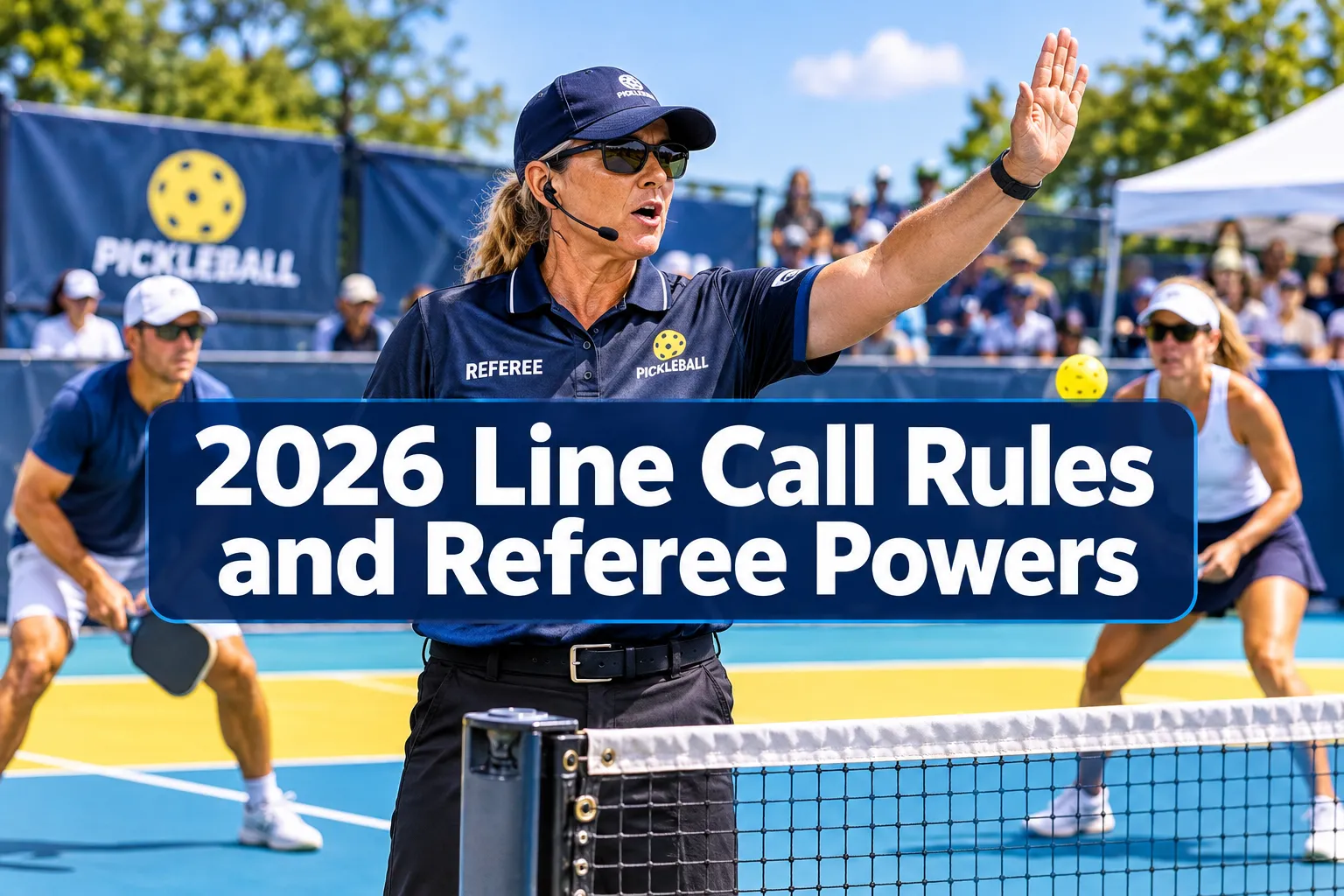
2026 Line Call Rules and Referee Powers: Avoiding Penalties with Prompt Calls and No Spectator Help
Last updated: November 11, 2026
Quick Answer: The 2026 line call rules tighten two key areas: players must make “out” calls immediately and loudly, and spectators are now explicitly prohibited from influencing any line call. Referees have expanded powers to issue warnings and penalties at any point. Miss either requirement in a sanctioned match and you can lose the point, or worse.
Key Takeaways
- The 2026 USA Pickleball rulebook changed language from “should not” to “must not” regarding spectator input on line calls [1]
- A prompt call means calling “out” immediately after the ball bounces, hesitation can cost you the point
- Spectators cannot call lines under any circumstances, even if a player asks them
- Referees can now issue procedural penalties before, during, and after a rally
- If you’re unsure whether a ball was out, the rules say call it good, benefit of the doubt goes to the opponent
- Appeals are limited to rally-ending line calls and must happen right away
- Electronic Line Calling (ELC) is expanding in professional tennis, reducing the need for human judgment at the top level
- These rules apply to both singles and doubles, with extra coordination required in doubles
- Asking a referee to reconsider a non-line-call ruling can earn you a warning
- Casual recreational play follows these principles too, knowing them keeps games friendly and fair
What Exactly Changed With Line Calls in 2026
The biggest shift in 2026 is the language itself. USA Pickleball’s updated rulebook replaced permissive phrasing with firm prohibitions, moving from “should not” to “must not” when it comes to spectator involvement [1][2]. The timing requirement for “out” calls also received clearer codification under Rule 8.F, removing grey areas that players previously used to delay or contest calls [1].
Before 2026, the rules implied best practices. Now they set hard standards with direct penalty consequences. That’s a meaningful upgrade for tournament play.
Key rule changes at a glance:
- Spectator input: moved from discouraged to explicitly banned [1]
- Prompt call standard: now codified with specific timing expectations [1]
- Referee authority: extended to pre-game and post-rally situations [3]
- Appeals: scope narrowed to rally-ending line calls only [1]

Why Can’t Spectators Help Call Lines Anymore
Spectators cannot make line calls because doing so would give one player an unfair advantage and undermine the integrity of the match. This doctrine has existed in tennis for years under USTA and ITA codes [4][5], and USA Pickleball has now formally aligned with it.
The 2026 rulebook states that only the players on the court, or the assigned referee in officiated play, have authority over line calls [1]. Spectator coaching and interference are explicitly barred in pickleball officiating manuals [3].
Why it matters: A loud crowd call can influence a player’s decision even when unintentional. The rule eliminates that pressure entirely.
The most common scenario where this comes up: a ball lands near the baseline and a courtside friend shouts “out!” The player who benefits cannot use that input, and in officiated play, the referee may issue a warning to the offending party.
For more on building a respectful court community, check out how to connect with local pickleball groups and find playing partners.
What Counts as a Prompt Call and Why Does It Matter
A prompt call means calling “out” loudly and immediately after the ball lands, before the next shot is played. If you wait, the call is no longer valid and the ball is considered in [1].
This matters because delayed calls are a known form of gamesmanship. Players sometimes wait to see if their shot was effective before deciding to call a ball out. The 2026 rules close that loophole.
What “prompt” looks like in practice:
- Call “out” the moment the ball bounces outside the line
- Use a clear, audible verbal call, not a hand signal alone
- Do not wait for your opponent’s reaction before calling
Common mistake: Calling out a ball after returning it. That sequence means the shot is already in play and the “out” call comes too late to stand.
What Penalty Do You Get for a Slow Line Call
A late or unclear line call results in the ball being ruled in, awarding the point to your opponent. In officiated matches, repeated issues can escalate to a formal warning, then a point penalty, and eventually game or match penalties [1][3].
The penalty progression in sanctioned USA Pickleball events typically follows this order:
- Verbal warning, first offense, logged by the referee
- Point penalty, the opponent receives the point
- Game penalty, in severe or repeated cases
- Disqualification, for egregious conduct or repeated violations [3]
Referees at Golden Ticket events have been specifically instructed to enforce prompt call standards from the first rally [3]. Don’t assume a warning is guaranteed before a point penalty at high-stakes tournaments.
How Is This Different From the Old Line Call Rules
Before 2026, the rules used softer language that left room for interpretation. Players could argue intent, and spectator calls existed in a grey zone, frowned upon but not always penalized. The 2026 update removes ambiguity [2].
| Area | Pre-2026 | 2026 |
|---|---|---|
| Spectator input | “Should not” influence calls | “Must not”, explicitly banned |
| Prompt call timing | Implied standard | Codified in Rule 8.F |
| Referee authority | Limited to in-rally | Extends pre-game and post-rally |
| Penalty triggers | Inconsistently applied | Clearer progression, applied earlier |
The shift mirrors how tennis has long handled these situations, USTA guidelines have held a firm “benefit of the doubt to the opponent” standard for years [5], and pickleball is catching up fast.
For a visual breakdown of pickleball rules, the visual guide to pickleball rules with infographics is a great reference.
Do These 2026 Rules Apply to Professional Tennis Too
Professional tennis operates under separate governing bodies, so the USA Pickleball rules don’t directly apply. However, the same core principles, no spectator input, prompt calls, benefit of the doubt to the opponent, are firmly embedded in USTA and ITA rulebooks [4][5].
At the professional level, Electronic Line Calling (ELC) has largely replaced human line judges on major tours, reducing disputes dramatically. The human judgment rules still apply at amateur, collegiate, and club levels where ELC isn’t deployed.
ITA rules for collegiate tennis echo the same no-spectator doctrine, with explicit language about audience members staying out of call decisions [4].
What Happens If Someone in the Crowd Yells About a Line
If a spectator calls a ball out during live play, that call carries zero official weight. The players and referee are the only valid sources of line decisions [1]. In officiated matches, the referee may issue a warning to the spectator or ask tournament staff to address the situation.
If a player is visibly influenced by the spectator call and stops playing, it’s treated similarly to an unforced error, the rally outcome stands or the referee uses judgment based on what was observable.
Edge case: If spectator interference is deliberate and repeated (such as a coach calling lines from the stands), it can be escalated to a conduct violation against the player they’re associated with [3].
Can Players Still Challenge Line Calls in 2026
Yes, but the scope is narrow. Players can appeal a line call to the referee only when it directly ended a rally, and only immediately after the rally concludes [1]. There’s no “review later” option.
Appeals that fall outside this window, or that target non-line-call decisions (like a foot fault or kitchen violation), are handled differently and may earn a warning if the player pushes the issue [1][6].
For related guidance on common fouls and violations in pickleball, it’s worth reviewing what qualifies as a challengeable call vs. a referee judgment call.
Which Sports Adopted the 2026 Line Call Rules
The specific 2026 codification applies to USA Pickleball sanctioned events [1][2]. However, the principles, no spectator interference, prompt calls, benefit of the doubt, are consistent standards across pickleball, tennis (USTA, ITA), padel, and badminton at competitive levels.
Each sport has its own governing body and rulebook, so exact wording differs. But any player moving between racket sports will find these values consistent, which helps when crossing over between games.
Interested in what’s happening in the badminton market in 2026? Similar officiating principles are being reinforced across the sport.
Does the Rule Work Differently for Doubles Matches
In doubles, both partners share line call responsibility. Either player can make the call, but the team must be consistent, if one player calls out and the other calls in, the ball is ruled in [1].
The no-spectator rule applies equally in doubles. Having four players on the court doesn’t create more “valid” call sources, it’s still only the two teams and the referee.
Doubles-specific tip: Establish a pre-match communication habit with your partner about who calls which lines. The player closest to the ball typically has the best view, but both should be ready to call confidently.
For deeper doubles strategy, doubles play tactics on communication and partner coordination covers exactly this kind of on-court teamwork.
Can You Get Penalized for Asking the Referee to Look Again
Asking for clarification on a line call that ended the rally is allowed, once, immediately [1]. If you ask the referee to reconsider a judgment call (like a kitchen fault or service fault), you risk a warning for questioning a non-appealable decision [6].
Repeated questioning after a ruling is finalized is treated as unsportsmanlike conduct in most sanctioned events. At Golden Ticket tournaments specifically, players are briefed pre-match that referee judgment calls are final [3].
Simple rule: One respectful question, right away, on a rally-ending line call only. Anything beyond that moves into penalty territory.
What’s the Difference Between Prompt Calls and Instant Replay
A prompt call is a player’s verbal decision made in real time, right after the ball lands. Instant replay (or Electronic Line Calling) is a technology-based review system used in professional and select high-level events.
They serve different functions:
- Prompt call: Player responsibility, immediate, verbal, no technology required
- Instant replay/ELC: Technology-driven, used for review challenges, expanding in professional tennis
At the recreational and club level, ELC doesn’t exist, prompt calls are your only tool. At pro tennis events, ELC has largely replaced line judges on major tours, so player-initiated calls are rarely in play [5].
For improving your overall skills and avoiding common mistakes, expert tips from coaches on common mistakes and how to avoid them is worth a read.
Conclusion
The 2026 line call rules remove ambiguity that created unnecessary disputes on the court. Call “out” immediately and clearly, never accept or use spectator input, and understand your appeal rights before you need them.
Actionable next steps:
- Review USA Pickleball Rule 8.F before your next sanctioned event, know the exact prompt call standard [1]
- Brief your doubles partner on who calls which side before warm-up
- Practice calling immediately during drills, build the habit of calling in real time, not after the point
- At tournaments, read the player instructions sheet, Golden Ticket events include referee authority reminders specific to that event [3]
- If unsure, call the ball good, that’s the rule, and it keeps the game clean
These rules exist to protect fair play for everyone on the court, from first-time rec players to seasoned competitors. The racket sports community runs better when everyone knows and respects the same standards.
FAQ
Q: What is a prompt line call in pickleball? A prompt line call is an immediate verbal call of “out” made right after the ball lands outside the boundary, before the next shot is played. Any delay makes the call invalid under 2026 rules.
Q: Can a spectator call a ball out in pickleball? No. Spectators have no authority to make line calls under any circumstances. Only the players or the assigned referee can make valid calls in 2026 sanctioned play.
Q: What happens if I call a ball out too late? The call is ruled invalid and the ball is considered in, awarding the point to your opponent.
Q: Can a referee penalize me before a rally starts? Yes. The 2026 rules expand referee authority to pre-game and pre-rally situations, including conduct near the court during warm-up or between points.
Q: What’s the benefit-of-the-doubt rule? If you didn’t clearly see a ball land out, you must call it good. The benefit of the doubt always goes to the opponent.
Q: Are these rules different in casual recreational play? The official rules apply to sanctioned events, but recreational players are encouraged to follow the same principles for fair, dispute-free games.
Q: Can I appeal a foot fault call? No. Foot faults are referee judgment calls, not line calls, and are not subject to player appeal in 2026 rules.
Q: What if both doubles partners disagree on a call? If one partner calls out and the other calls in, the ball is ruled in. The team must agree, a split call defaults to good.
Q: Does Electronic Line Calling replace player line calls? At the professional level, ELC largely handles line decisions. At recreational and club levels, player prompt calls remain the standard.
Q: How fast does a referee need to make a line call? Referees are expected to make rulings promptly to maintain rally flow. No exact second-count is published, but deliberate delay or inconsistency can be appealed or escalated.
References
- USAP Official Rulebook. usapickleball.org.
- USAP Rulebook Change Document. usapickleball.org.
- 2026 USAP GT San Diego Player Instructions. usapickleball.org.
- 2025-26 ITA Rulebook. ncaaorg.s3.amazonaws.com.
- 2025 Friend at Court (USTA). usta.com.
- Rules Suggestion Entry 2223. rules.usapickleball.org.


