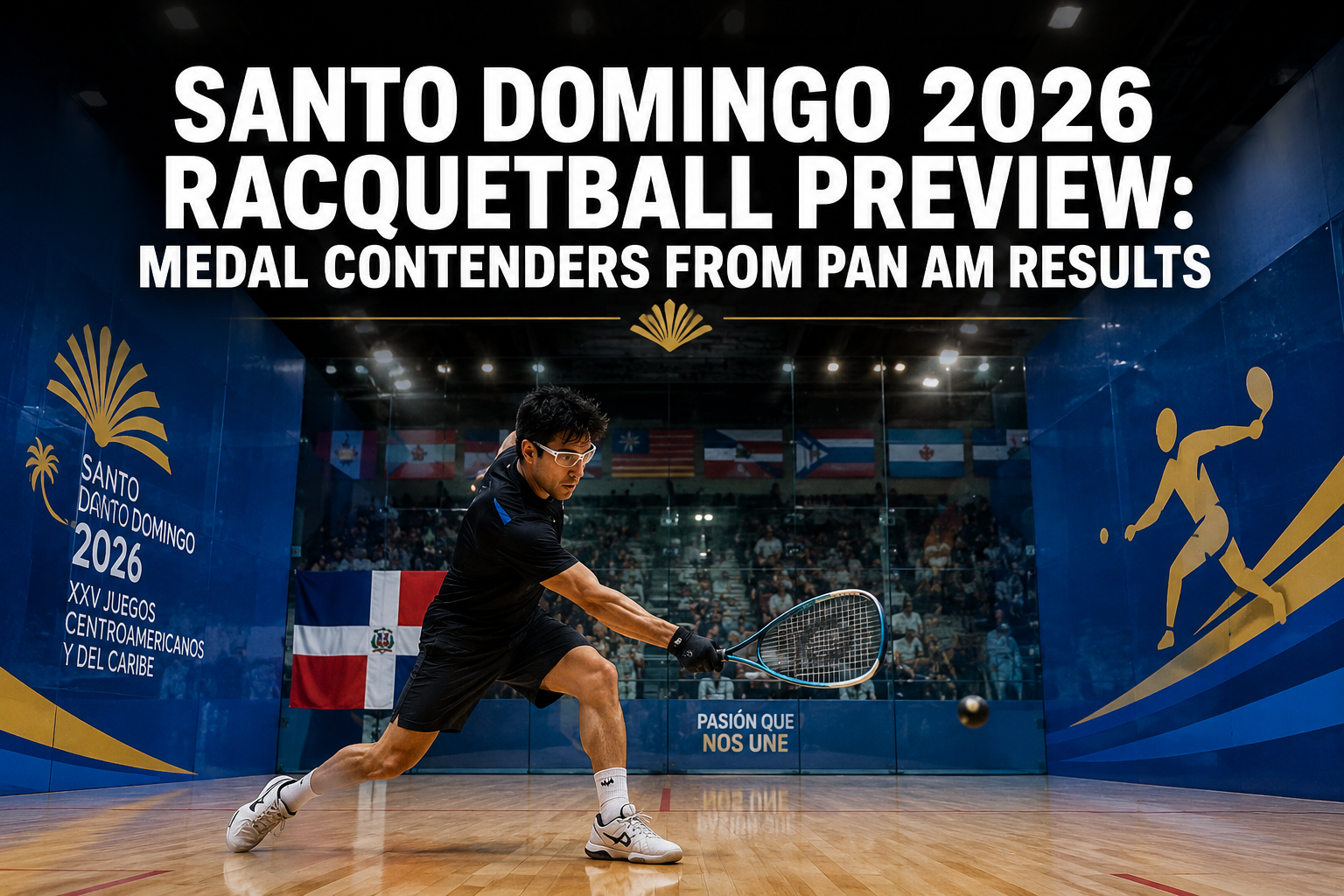
Central American Games Racquetball Preview: Santo Domingo 2026 Medal Contenders from Pan Am Results
Last updated: May 29, 2026
Quick Answer: The Santo Domingo 2026 Central American and Caribbean Games (July 21–August 2) will feature a racquetball field shaped heavily by 2026 Pan American Championship results. Mexico and Argentina enter as the strongest overall programs, while Costa Rica’s Andrés Acuña and Larissa Faeth (Pan Am mixed doubles champions) lead the Central American charge. Bolivia’s Conrrado Moscoso is the men’s singles favorite to watch, and the women’s draw is Argentina’s María José Vargas to lose.
Key Takeaways 🏆
- Bolivia’s Conrrado Moscoso won men’s singles at the 2026 Pan American Racquetball Championships, making him the top seed to track [1]
- Argentina’s María José Vargas swept women’s singles AND women’s doubles gold at Pan Ams [1]
- Mexico won men’s doubles, men’s team, and has historically won 11 of 12 women’s gold medals at Pan American Games [3]
- Costa Rica’s Acuña and Faeth are Pan Am mixed doubles champions and the top Central American medal hope [2]
- The Central American and Caribbean Games run every four years; Santo Domingo 2026 is the 24th edition
- Racquetball uses a hollow rubber ball, a strung racquet, and a fully enclosed four-wall court — distinct from squash and tennis
- Central American athletes typically receive minimal prize money; national federation support and sponsorships vary widely
- Age divisions (open, junior, masters) are typically offered, giving younger athletes a pathway to compete
- Pan Am Championship results directly influence seeding and qualification for the Games
- Canada’s Samuel Murray and Coby Iwaasa add North American depth to the broader regional picture [4]
What Are the Central American Games and How Often Do They Happen?
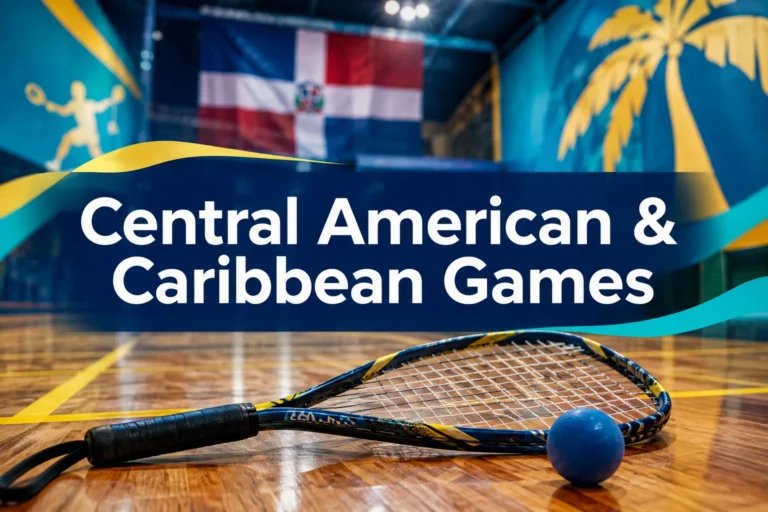
The Central American and Caribbean Games are a multi-sport regional competition held every four years, organized by ODECABE (the Central American and Caribbean Sports Organization). They are the oldest regional multi-sport games in the Americas, first held in 1926 — making Santo Domingo 2026 the centennial edition.
- Host city: Santo Domingo, Dominican Republic
- Dates: July 21–August 2, 2026
- Participating nations: Roughly 30+ countries from Central America, the Caribbean, and parts of South America
- Racquetball status: A featured sport with individual and team events
“Santo Domingo 2026 marks 100 years of the Central American and Caribbean Games — making every gold medal carry extra historical weight.”
The Games are separate from (but closely linked to) the Pan American Games, which include a wider field. For racquetball athletes, the Central American and Caribbean Games often serve as a proving ground and a direct qualifier pathway for larger competitions.
Which Countries Typically Dominate Racquetball in Pan American Competitions?
Mexico and the United States have historically led Pan American racquetball, but Mexico’s depth is especially notable at the regional level. According to historical Pan American Games records, Mexico has won 11 of 12 gold medals in women’s events and 6 of 12 in men’s events across recent editions [3].
The current power rankings heading into Santo Domingo 2026:
| Country | Strength | Key 2026 Pan Am Result |
|---|---|---|
| 🇲🇽 Mexico | Men’s & Women’s depth | Men’s doubles + men’s team gold [1] |
| 🇦🇷 Argentina | Women’s dominance | Women’s singles + doubles gold [1] |
| 🇧🇴 Bolivia | Men’s singles | Men’s singles gold (Moscoso) [1] |
| 🇨🇷 Costa Rica | Mixed doubles | Mixed doubles gold (Acuña/Faeth) [2] |
| 🇨🇦 Canada | Competitive depth | Murray & Iwaasa in contention [4] |
For the Central American and Caribbean Games specifically, Guatemala, El Salvador, and Costa Rica are the most competitive Central American nations, with Costa Rica currently riding its highest profile in years.
Central American Games Racquetball Preview: Top Athletes from Guatemala, El Salvador, and Costa Rica
Costa Rica leads the Central American pack in 2026, thanks to Andrés Acuña and Larissa Faeth’s Pan Am mixed doubles title [2]. Guatemala and El Salvador have produced competitive players at the national level, though neither has matched Costa Rica’s recent Pan Am podium success.
Costa Rica 🇨🇷
- Andrés Acuña — Pan Am mixed doubles champion; strong serve-and-volley style
- Larissa Faeth — Pan Am mixed doubles champion; known for court coverage and consistency
Guatemala 🇬🇹
- Has historically fielded strong junior programs that feed into senior competition
- Watch for up-and-coming players who qualified through CENAC (National Center for High Performance)
El Salvador 🇸🇻
- Smaller federation budget but consistent participation in regional events
- Athletes typically train through club programs with limited national funding
Common mistake for fans: Assuming Costa Rica is only a “small program.” Acuña and Faeth’s Pan Am gold proves otherwise — they are genuine medal threats in Santo Domingo.
How Do National Rankings and Pan Am Results Impact Medal Chances in Santo Domingo 2026?
Pan Am Championship results directly influence seeding at the Central American and Caribbean Games. Athletes who performed well at the 2026 Pan American Racquetball Championships enter Santo Domingo with higher seeds, favorable draw positions, and proven match-pressure experience [1].
Here’s how it works practically:
- Seeding: Top Pan Am finishers receive protected seeds, avoiding each other in early rounds
- Confidence: A Pan Am title signals current peak form — coaches and opponents take notice
- Qualification: Some nations use Pan Am results as the primary selector for their Games roster
Choose this logic: If an athlete won or medaled at Pan Ams within the same calendar year as the Games, treat them as a genuine podium threat — not just a participant.
Central American Games Racquetball Preview: Santo Domingo 2026 Medal Contenders from Pan Am Results

The clearest medal picture comes from stacking Pan Am results against the Santo Domingo field. Here are the athletes with the strongest cases for podium finishes:
Men’s Singles
- 🥇 Conrrado Moscoso (Bolivia) — Pan Am champion; explosive shot-making and elite fitness [1]
- 🥈 Watch for Mexican and Guatemalan challengers in the semis
Women’s Singles
- 🥇 María José Vargas (Argentina) — Pan Am champion; swept singles and doubles [1]
- 🥈 Mexican women’s program is deep enough to challenge in every round [3]
Mixed Doubles
- 🥇 Andrés Acuña & Larissa Faeth (Costa Rica) — reigning Pan Am champions; chemistry and court awareness are elite [2]
Men’s Doubles
- 🥇 Javier Mar & Rodrigo Montoya (Mexico) — Pan Am champions; Mexico’s doubles tradition is unmatched [1]
Women’s Doubles
- 🥇 Vargas & Valeria Centellas (Argentina) — Pan Am champions; strong communication and shot selection [1]
What Equipment and Rules Make Racquetball Different from Other Racquet Sports?
Racquetball is played in a fully enclosed four-wall court, using a hollow rubber ball and a strung racquet — no net, no out-of-bounds lines, and serves must hit the front wall first. This makes it faster and more physically demanding than tennis or squash in many ways.
Key differences at a glance:
- Court: 20 ft wide × 40 ft long × 20 ft high, fully enclosed
- Ball: Hollow rubber, roughly 2.25 inches in diameter — much bouncier than a squash ball
- Scoring: Rally scoring to 15 points (first two games), tiebreaker to 11
- Serve: Must bounce once before hitting the front wall (unlike squash)
- Eye protection: Mandatory at all sanctioned events
For fans curious about how racquet sports compare, understanding the basic rules of racquet games can help build context — even if pickleball uses a paddle and a very different court setup. The core skill of reading ball angles transfers across all racquet disciplines.
How Much Prize Money or Sponsorship Do Central American Racquetball Athletes Typically Receive?
Prize money in Central American and Caribbean Games racquetball is minimal to nonexistent at the Games level itself — athletes compete for medals and national pride, not cash. Sponsorship varies widely by country and athlete profile.
- Mexico and Argentina have the strongest federation support and attract equipment sponsors (racquet brands, apparel)
- Costa Rica, Guatemala, El Salvador athletes often self-fund or rely on small national Olympic committee stipends
- IRT (International Racquetball Tour) events do offer prize money for professionals, and the IRT has been expanding its Latin American presence [5]
- A top-ranked IRT player might earn a few thousand dollars per event — not a full living wage for most
Bottom line: Most Central American racquetball athletes treat the Games as a career highlight, not a paycheck. The real value is ranking points, visibility, and potential sponsorship leverage after a medal.
What Training Programs Help Athletes Prepare for Regional Multi-Sport Competitions?
Elite racquetball preparation for a multi-sport Games combines sport-specific drilling, physical conditioning, and mental readiness over a 12-to-24-month cycle. Athletes who peaked at the 2026 Pan Am Championships likely began their preparation cycle in late 2024.
A typical preparation structure:
- Base phase (months 1–6): Aerobic conditioning, strength building, footwork patterns
- Sport-specific phase (months 7–12): Court drilling, shot variety, match simulation
- Competition phase (months 13–18): Tournament play, video review, tactical adjustments
- Peak phase (final 8–12 weeks): Reduced volume, sharpening speed and reaction time
Physical priorities for racquetball specifically:
- Lateral quickness and change-of-direction speed
- Shoulder and rotator cuff strength (injury prevention)
- Cardiovascular endurance (matches can last 45–90 minutes)
- Wrist and forearm power for shot velocity
For athletes interested in building racquet sport fitness from the ground up, beginner-friendly drills and exercises offer a useful framework for developing court movement and hand-eye coordination — skills that transfer across racquet disciplines.
Which Past Pan Am Racquetball Champions Are Likely to Compete in Santo Domingo 2026?
Several athletes with Pan American Games or Championships pedigree are expected in Santo Domingo. The 2026 Pan Am Championships served as the most recent form guide [1].
Confirmed or likely competitors based on Pan Am results:
- Conrrado Moscoso (Bolivia) — 2026 Pan Am singles champion [1]
- María José Vargas (Argentina) — 2026 Pan Am singles and doubles champion [1]
- Javier Mar & Rodrigo Montoya (Mexico) — 2026 Pan Am doubles champions [1]
- Andrés Acuña & Larissa Faeth (Costa Rica) — 2026 Pan Am mixed doubles champions [2]
- Samuel Murray & Coby Iwaasa (Canada) — experienced Pan Am competitors with podium history [4]
What Common Mistakes Do Amateur Racquetball Players Make That Pros Avoid?
The biggest gap between amateurs and pros isn’t power — it’s court positioning and shot selection. Amateurs tend to hit hard and hope; pros hit smart and move their opponent.
Top mistakes to avoid:
- Hugging the back wall: Pros stay near center court (the “T”) to cover more angles
- Telegraphing shots: Wrist snap at contact, not early shoulder rotation, keeps opponents guessing
- Skipping the ceiling ball: A well-placed ceiling shot is one of the most effective defensive tools — amateurs rarely use it
- Ignoring footwork: Most errors come from being out of position, not from poor technique
- Overusing power: A controlled cross-court pass often beats a hard kill shot
Improving shot selection is a skill that develops with structured practice. Advanced strategies for shot selection and shot selection for beginners offer useful frameworks that apply to any fast-paced racquet sport.
How Do Younger Athletes Break Into Competitive Racquetball at a National Level?
Young racquetball players typically enter the competitive pipeline through junior national championships, school programs, or club academies. Most Central American federations hold annual junior events that feed directly into senior team selection.
Steps for a junior athlete:
- Join a club or federation-affiliated program (ages 10–16)
- Compete in regional junior tournaments to build ranking points
- Attend national training camps (often run by Olympic committees)
- Target junior Pan Am Championships as a first major international event
- Transition to open/senior divisions by age 18–20
Are there age categories at the Central American Games? Yes — the racquetball program typically includes open (senior), junior (under 18/21), and masters (35+) divisions, though the exact categories vary by edition. Open division is the most prestigious and the one covered in this preview.
What Physical Conditioning Is Most Important for Racquetball Success?
Racquetball demands a rare combination of explosive speed, sustained aerobic endurance, and upper-body power. Of these, lateral quickness and cardiovascular base are the two most trainable and most impactful.
Priority conditioning areas:
- Lateral agility drills — ladder work, side shuffles, reactive cone drills
- Interval cardio — 30-second sprints with 15-second rest mimics rally patterns
- Core stability — rotational strength drives shot power and protects the lower back
- Shoulder prehab — band work and rotator cuff exercises prevent the most common racquetball injury
Athletes who combine proper warm-up routines with structured court practice see faster improvement and fewer injuries. This principle holds across all racquet sports, from racquetball to pickleball to squash.
FAQ: Santo Domingo 2026 Racquetball
Q: When exactly is racquetball scheduled at the Santo Domingo 2026 Games? A: The Games run July 21–August 2, 2026. Racquetball’s specific schedule within that window is set by ODECABE and the local organizing committee — check official Games channels closer to the event.
Q: Is racquetball an Olympic sport? A: No. Racquetball is not currently on the Olympic program, though it is a featured sport at the Pan American Games and Central American and Caribbean Games.
Q: Who is the favorite for men’s singles in Santo Domingo? A: Bolivia’s Conrrado Moscoso, the 2026 Pan Am champion, is the top seed and strongest favorite heading in [1].
Q: Who is the favorite for women’s singles? A: Argentina’s María José Vargas, who won both singles and doubles at the 2026 Pan Ams, is the clear favorite [1].
Q: Can Costa Rica win multiple medals? A: Yes. Andrés Acuña and Larissa Faeth are defending Pan Am mixed doubles champions [2], and Costa Rica’s program has the depth to challenge in other events.
Q: Does Mexico always win racquetball at these Games? A: Mexico is historically dominant — 11 of 12 women’s Pan Am gold medals in recent editions — but Argentina and Bolivia are mounting serious challenges in 2026 [3].
Q: How is racquetball scored? A: Rally scoring to 15 points in games one and two; tiebreaker game to 11. Every rally produces a point regardless of who served.
Q: What equipment do players need? A: A strung racquet (max 22 inches), a hollow rubber ball, and mandatory eye protection. Court shoes with non-marking soles are also required.
Q: Are there doubles events at the Central American Games? A: Yes — men’s doubles, women’s doubles, and mixed doubles are all standard events alongside singles and team competitions.
Q: How does the IRT relate to these Games? A: The International Racquetball Tour is the professional circuit. Games athletes may also compete on the IRT, and the tour has been expanding in Latin America [5], raising the overall competitive level in the region.
Q: Where can I follow results from Santo Domingo 2026? A: ODECABE’s official website and the International Racquetball Federation (IRF) are the primary sources for live results and schedules.
Q: Is racquetball growing in Central America? A: Yes. Costa Rica’s Pan Am title, Mexico’s consistent dominance, and the IRT’s regional expansion [5] all point to a sport gaining visibility and participation across the region.
Conclusion: What to Watch and Who to Back 🎯
The Central American Games Racquetball Preview: Santo Domingo 2026 Medal Contenders from Pan Am Results picture is clearer than it has been in years. Pan Am results give a reliable form guide, and the storylines are compelling:
- Moscoso vs. the field in men’s singles is the marquee individual matchup
- Vargas’s double-gold chase in women’s singles and doubles is Argentina’s defining narrative
- Costa Rica’s Acuña and Faeth carry the hopes of every Central American fan wanting a local hero on the podium
Actionable next steps for fans and followers:
- Bookmark the IRF and ODECABE websites for official schedules and live results
- Follow national federation social media (Costa Rica, Mexico, Argentina, Bolivia) for athlete updates
- Watch the mixed doubles draw — it’s the event where Central American nations have the best shot at gold
- Track junior events alongside the open draw; tomorrow’s Pan Am champions are competing in Santo Domingo right now
Whether you’re a dedicated racquetball fan or a multi-sport Games enthusiast, Santo Domingo 2026 promises some of the most competitive racquetball the region has seen. The Pan Am results have set the stage — now it’s time to watch who delivers under Games pressure.
References
[1] 2026 Pan American Racquetball Championships – https://en.wikipedia.org/wiki/2026_Pan_American_Racquetball_Championships?utm_source=openai
[2] Ticos Andres Acuna Y Larissa Faeth Se Coronan Campeones Panamericanos De Racquetball – https://www.larepublica.net/noticia/ticos-andres-acuna-y-larissa-faeth-se-coronan-campeones-panamericanos-de-racquetball?utm_source=openai
[3] Racquetball At The Pan American Games – https://en.wikipedia.org/wiki/Racquetball_at_the_Pan_American_Games?utm_source=openai
[4] Team Canada Announced For The 2026 Pan American Championships – https://racquetballcanada.ca/team-canada-announced-for-the-2026-pan-american-championships/?utm_source=openai
[5] IRT Expands To Argentina And Ecuador Strengthening Central And South American Presence – https://irttour.com/irt-expands-to-argentina-and-ecuador-strengthening-central-and-south-american-presence/?utm_source=openai