
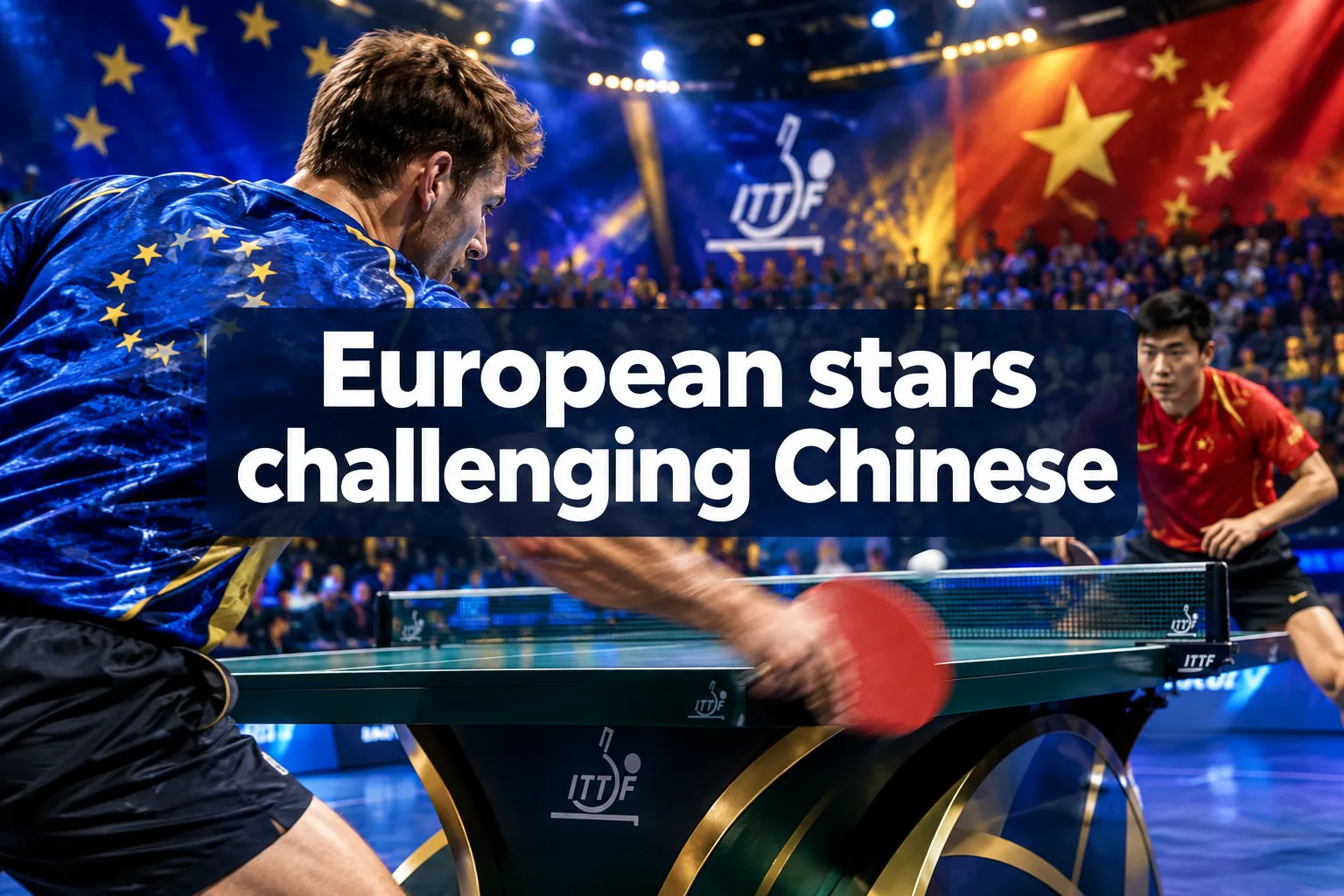
European stars challenging Chinese dominance in the latest ITTF world rankings
Last updated: September 17, 2026
Quick Answer: European stars are genuinely challenging Chinese dominance in the latest ITTF world rankings, particularly in men’s singles and men’s doubles. France’s Félix Lebrun sits at No. 2 in the world, Sweden’s Truls Möregård holds a consistent top-5 position, and the Lebrun brothers lead the men’s doubles rankings as the No. 1 pair globally. China still controls the top spot and dominates women’s events, but the gap in men’s table tennis has narrowed significantly in 2026. [1][2][3]
Key Takeaways
- 🏓 Wang Chuqin (China) remains No. 1 in men’s singles with up to 10,677 points, but Félix Lebrun (France) is the closest challenger at No. 2 with 7,479 points [3][5]
- 🇫🇷 Félix Lebrun is the highest-ranked non-Chinese player in men’s singles as of mid-September 2026 [1][3]
- 🇸🇪 Truls Möregård (Sweden) has been ranked as high as No. 2 in some recent snapshots and holds a firm top-5 position [2][5]
- 🇩🇪 Germany, Sweden, France, Slovenia, and Denmark all have multiple men’s players inside the top 20 [1][5]
- 🥇 Alexis and Félix Lebrun (France) are ranked No. 1 in men’s doubles worldwide with 4,658 points [2]
- 👩 Women’s singles remains heavily Chinese-dominated, with Wang Manyu and Sun Yingsha at the top; Germany’s Sabine Winter is the lone European in the top 10 in some snapshots [2]
- 📊 ITTF rankings update weekly, based on points earned at sanctioned WTT and ITTF events over a rolling period [4][7]
- 🌍 European federations have invested heavily in youth development and high-performance coaching, narrowing the traditional gap with China
What Are the Latest ITTF World Rankings in 2026?
The ITTF world rankings are updated weekly and reflect cumulative points from sanctioned international tournaments. As of mid-September 2026, China’s Wang Chuqin leads men’s singles with 10,677 points, while Japan and Europe occupy the next several positions. [5][8]
Here’s a snapshot of the men’s singles top 10 from recent ranking updates:
| Rank | Player | Country | Approx. Points |
|---|---|---|---|
| 1 | Wang Chuqin | China | 10,677 |
| 2 | Félix Lebrun | France | 7,479 |
| 3 | Harimoto Tomokazu | Japan | , |
| 4 | Sora Matsushima | Japan | , |
| 5 | Truls Möregård | Sweden | , |
| 9 | Alexis Lebrun | France | , |
| ~12 | Dang Qiu | Germany | , |
| ~14 | Darko Jorgic | Slovenia | , |
Sources: [1][2][5]. Point totals vary slightly across weekly snapshots.
Note: Ranking positions shift week to week. The figures above reflect multiple September 2026 snapshots and may not match a single snapshot exactly.
Women’s singles tells a different story. Wang Manyu leads with 9,465-9,115 points (depending on the snapshot), followed by Sun Yingsha. Japan’s Miwa Harimoto sits at No. 3 in some updates, with Germany’s Sabine Winter the only European in the top 10. [2]
Which European Table Tennis Players Are Ranked Highest Right Now?

Several European men are firmly embedded in the global top 20, making the European stars challenging Chinese dominance in the latest ITTF world rankings story one of the most compelling in the sport right now. [1][2][5]
Top-ranked European men (September 2026):
- Félix Lebrun (France), No. 2 in the world [3]
- Truls Möregård (Sweden), No. 5 (ranked as high as No. 2 in some updates) [2][5]
- Alexis Lebrun (France), No. 9-11 [1][5]
- Dang Qiu (Germany), Top 15 [1][5]
- Darko Jorgic (Slovenia), Top 15 [2]
- Benedikt Duda, Patrick Franziska, Simon Gauzy, Anders Lind, Flavien Coton, All inside the top 20 [5]
Top-ranked European women:
- Sabine Winter (Germany), No. 9 in one recent snapshot [2]
- Most other European women sit outside the top 10, with Chinese players holding the top positions
Decision rule: If you’re tracking which European player is most likely to challenge for No. 1 in men’s singles, watch Félix Lebrun first, then Möregård. Both have the points and tournament results to make a realistic run.
How Is China Performing in the Current ITTF Rankings?
China remains the benchmark in world table tennis, but European stars challenging Chinese dominance in the latest ITTF world rankings is no longer just a headline, it’s backed by real data. [4][8]
In men’s singles, Wang Chuqin holds No. 1 with a significant points lead, but the gap to Félix Lebrun (around 1,378-3,198 points depending on the snapshot used) is the smallest a non-Chinese player has come in years. [3][5]
In women’s singles, China’s hold is far stronger. Wang Manyu and Sun Yingsha sit 1st and 2nd with 9,000+ points each, and multiple Chinese players fill the top five. European women are largely outside the top eight. [1][2]
China’s current strengths:
- Dominant in women’s singles (top 4-5 positions)
- Men’s singles No. 1 position held by Wang Chuqin
- Deep bench of ranked players across all categories
Where the challenge is real:
- Men’s doubles: The Lebrun brothers (France) hold the No. 1 spot [2]
- Men’s singles top 5: Now includes two non-Chinese players consistently
- Depth in men’s top 20: European nations collectively outnumber Chinese players in that bracket [5]
How Does the ITTF Ranking System Work?
The ITTF ranking system assigns points based on results at sanctioned events, and those points determine a player’s global position. Rankings update every week. [4][7]
Key mechanics:
- Points are earned at ITTF-sanctioned and World Table Tennis (WTT) events, including WTT Grand Smashes, WTT Contenders, WTT Star Contenders, and the World Championships
- Higher-tier events award more points for deep runs and titles
- Points decay over time, older results contribute less as new tournaments are played
- Separate rankings exist for men’s singles, women’s singles, men’s doubles, women’s doubles, and mixed doubles
- Weekly updates mean rankings can shift after every major event [4][8]
Common mistake: Comparing rankings from different weeks as if they’re the same snapshot. The Lebrun vs. Möregård position, for example, has flipped more than once in 2026 depending on which tournaments fell in the scoring window.
What Tournaments Count Toward ITTF World Rankings?
Points toward the ITTF world rankings come from sanctioned international events across the WTT circuit and traditional ITTF competitions. [4][8]
Main ranking events:
- WTT Grand Smash, Highest points available (equivalent to Grand Slams in tennis)
- WTT Champions, Second-tier, significant points for finalists
- WTT Star Contender and Contender, Mid-tier events, important for depth players
- ITTF World Championships, Major points, held annually or biennially
- Olympic Games, Significant points contribution
- Continental Championships, Count toward rankings for regional qualifiers
European players benefit from the WTT circuit’s global spread. Events in Europe, the Middle East, and Asia all provide opportunities to accumulate points without traveling exclusively to Asia-based tournaments.
Why Are European Players Improving in Table Tennis?
European players are closing the gap because of structural changes in how the sport is developed and coached across the continent. This isn’t a sudden spike, it’s been building for over a decade. [1][5]
Key reasons for European improvement:
- Youth academies and national programs: France, Sweden, and Germany have invested heavily in junior development. The Lebrun brothers, for example, came through a structured French federation pathway
- Access to Chinese coaching: Several European clubs and national teams have hired Chinese coaches, bringing elite technical knowledge into European training environments
- WTT circuit access: More international events mean more ranking points available outside of Asia
- Multi-sport athletic development: European players often cross-train in ways that build athleticism alongside technical skill, a pattern familiar to anyone in the broader racket sports community
- Video analysis and sports science: Modern tools like video review (used across racket sports training at every level) help European players break down Chinese opponents’ patterns in detail. This mirrors how players in other racket sports use video analysis to improve skills
- Club competition in Europe: The Bundesliga (Germany) and other European leagues attract top Asian players, giving European athletes regular high-level match experience
How Do European Training Methods Compare to Chinese Approaches?
China’s table tennis system is state-supported, centralized, and volume-heavy. European programs are more individualized but increasingly technical. [1][5]
| Factor | China | Europe |
|---|---|---|
| Training volume | Extremely high (full-time from youth) | High but more structured around school |
| Coaching model | Centralized national academies | Club + national federation hybrid |
| Tactical style | All-round with elite footwork | Often more attacking, spin-focused |
| Sports science | Advanced, integrated | Growing rapidly |
| Competition exposure | Domestic league + international | European leagues + WTT circuit |
The gap in raw training hours is still real, but European players are making up ground through smarter preparation, a principle that applies across all racket sports. Whether you’re working on beginner padel strategies or elite table tennis, quality of practice increasingly matters as much as quantity.
Are European Women’s Table Tennis Players Also Challenging China?
Honestly, not yet at the same level as the men. Women’s singles remains firmly Chinese-dominated, with Wang Manyu and Sun Yingsha holding the top two spots with 9,000+ points each. [1][2]
Germany’s Sabine Winter is the lone European in the top 10 in some 2026 snapshots, but she sits at No. 9, well behind the Chinese and Japanese players above her. [2]
Why the gap is larger in women’s events:
- China’s women’s program is even more competitive domestically, meaning Chinese players face harder internal competition before reaching international events
- Japan has emerged as a stronger challenger to China in women’s events than Europe has
- European women’s programs have not yet produced the same depth of top-10 talent as the men’s side
This could change. Several young European women are rising through junior ranks, and the same structural investments driving men’s success are being applied to women’s programs too.
Which European Player Has the Best Chance to Beat Chinese Players?
Félix Lebrun (France) is the most likely European player to beat top Chinese opponents on any given day, based on current rankings and recent results. Truls Möregård (Sweden) is a close second. [2][3]
Why Félix Lebrun:
- Ranked No. 2 globally, the closest any non-Chinese player has been to No. 1 in recent years [3]
- Aggressive attacking style that disrupts Chinese players’ rhythm
- Still improving at 19 years old (as of 2026), with his best years ahead
- Already has wins over top-ranked Chinese players in WTT events
Why Möregård:
- Ranked No. 5, with multiple top-5 finishes in major WTT events
- Consistent performer across different surface and ball conditions
- Has demonstrated the ability to win under pressure in high-stakes matches [2][5]
Edge case: In a single match, any top-10 player can beat any other. Rankings reflect consistency over time, not a guaranteed head-to-head outcome.
Which European Countries Have the Strongest Table Tennis Programs?
Five European nations stand out as having the deepest, most competitive table tennis programs in 2026. [1][5]
- France, Home of the Lebrun brothers; strong federation investment and youth pipeline
- Sweden, Long history of world-class players (Jan-Ove Waldner, BjörnBorg era through to Möregård); strong club culture
- Germany, Bundesliga is one of the world’s best club leagues; Dang Qiu, Benedikt Duda, Patrick Franziska all ranked globally
- Slovenia, Darko Jorgic’s rise has put Slovenia on the map as a serious table tennis nation
- Denmark, Anders Lind and others maintain consistent top-20 presence
The strength of European club leagues, particularly the German Bundesliga, is a key structural advantage. Players compete weekly against world-class opponents, building the match toughness that translates to ranking points at WTT events.
What Changed in the ITTF Rankings Recently?
The most significant recent shift is Félix Lebrun’s consolidation at No. 2 and Truls Möregård’s sustained top-5 presence, both confirmed across multiple August, September 2026 ranking updates. [1][2][3][5]
Recent notable changes:
- Félix Lebrun moved to No. 2 and has stayed there across multiple weekly updates [3]
- Möregård has appeared as high as No. 2 in some snapshots, competing with Lebrun for that position [2][5]
- The Lebrun brothers claimed the No. 1 men’s doubles ranking, a first for a European pair in recent memory [2]
- Multiple Europeans (Dang Qiu, Jorgic, Lind, Duda, Gauzy, Franziska, Coton) are now consistently inside the top 20, representing greater European depth than in previous years [5]
What hasn’t changed: Wang Chuqin’s No. 1 position and China’s dominance in women’s events remain intact.
Conclusion
The story of European stars challenging Chinese dominance in the latest ITTF world rankings is real, measurable, and accelerating. Félix Lebrun at No. 2, Truls Möregård at No. 5, and the Lebrun brothers holding the No. 1 men’s doubles spot are not flukes, they reflect years of structural investment in European table tennis programs.
China still leads overall, especially in women’s events, and Wang Chuqin’s No. 1 position is not under immediate threat. But the men’s singles picture in 2026 looks more competitive than it has in decades.
What to watch next:
- Track weekly ITTF rankings at ranking.ittf.com or tabletennis.global
- Follow WTT Grand Smash results, these events move the rankings most
- Watch Félix Lebrun’s next major tournament performance; a title win could close the gap to No. 1 significantly
- Keep an eye on European women’s juniors, the next generation may change the women’s picture too
Whether you’re a table tennis fan, a competitive player, or just someone who loves watching racket sports at the highest level, this is one of the most exciting competitive storylines in the sport right now. And if it inspires you to pick up a paddle of your own, the racket sports community is always welcoming new players, whatever sport calls to you.
FAQ
Q: Who is currently ranked No. 1 in ITTF men’s singles? Wang Chuqin of China holds the No. 1 position in men’s singles as of mid-September 2026, with approximately 10,677 points. [5]
Q: Which European player is ranked highest in the world? Félix Lebrun of France is ranked No. 2 in the world in men’s singles as of the latest 2026 rankings, making him the highest-ranked European player. [3][1]
Q: Are the Lebrun brothers ranked No. 1 in doubles? Yes. Alexis and Félix Lebrun (France) are ranked No. 1 in men’s doubles with 4,658 points as of August, September 2026. [2]
Q: How often does the ITTF update its world rankings? The ITTF updates world rankings every week, reflecting results from the most recent sanctioned tournaments on a rolling points basis. [4][7]
Q: Is China still dominant in women’s table tennis? Yes. China holds the top two positions in women’s singles (Wang Manyu and Sun Yingsha), with multiple Chinese players in the top five. European women are largely outside the top eight. [1][2]
Q: What is the point gap between Félix Lebrun and Wang Chuqin? As of the Week 34 2026 rankings, the gap was approximately 1,378 points (Wang Chuqin at 8,857 vs. Lebrun at 7,479). Later snapshots show Wang Chuqin with higher totals, suggesting the gap varies by snapshot. [3]
Q: Which European countries have the strongest table tennis programs? France, Sweden, Germany, Slovenia, and Denmark are the five strongest European table tennis nations in 2026, based on the number of players in the global top 20. [1][5]
Q: Can Félix Lebrun realistically reach No. 1 in the world? Based on current trends and ranking proximity, analysts consider it a realistic possibility over the next 12-18 months if Lebrun continues his current form and wins at major WTT events. This is an informed projection, not a confirmed outcome. [1][3]
Q: What tournaments give the most ITTF ranking points? WTT Grand Smash events offer the highest points, followed by WTT Champions events, WTT Star Contenders, and the ITTF World Championships. [4][8]
Q: How does the ITTF ranking system work? Players earn points by reaching later rounds in sanctioned ITTF and WTT events. Higher-tier events award more points. Points decay over time, and rankings update weekly. [4][7]
References
[1] Classement Mondial Tennis De Table Ittf Alexis Felix Lebrun – https://www.olympics.com/fr/infos/classement-mondial-tennis-de-table-ittf-alexis-felix-lebrun
[2] World Rankings – https://tabletennis88.com/world-rankings/
[3] Detail Ihfimvaz1909257 – https://www.ecns.cn/cns-wire/2026-08-19/detail-ihfimvaz1909257.shtml
[4] Ittf Table Tennis World Ranking – https://www.ittf.com/ittf-table-tennis-world-ranking/
[5] Rankings – https://www.tabletennis.global/en/rankings
[6] Detail Ihfimvaz1909257 – https://www.ecns.cn/m/news/sports/2026-08-19/detail-ihfimvaz1909257.shtml
[7] Ittf World Ranking – https://en.wikipedia.org/wiki/ITTF_World_Ranking
[8] Rankings – https://www.ittf.com/rankings/