
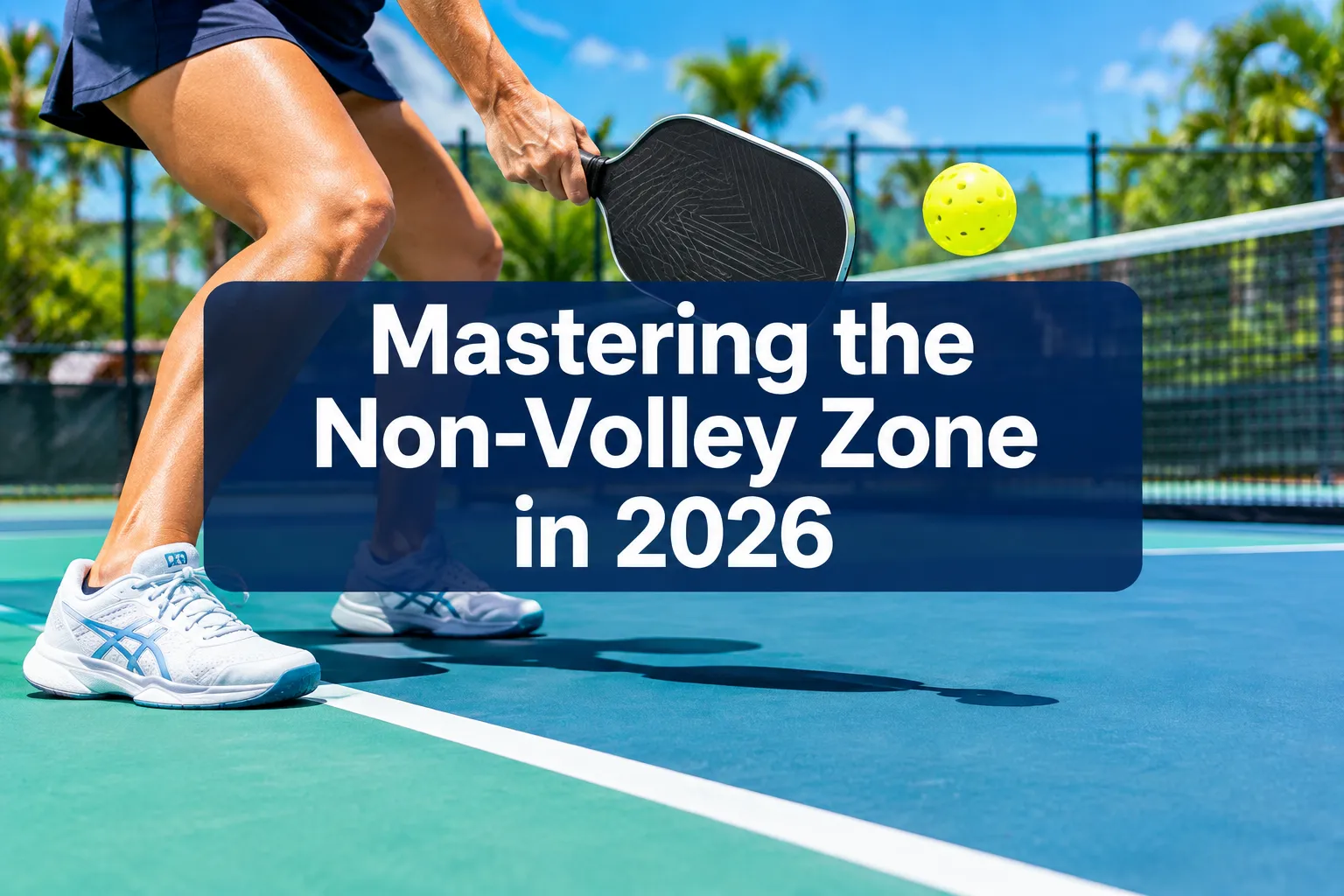
Mastering the Non-Volley Zone in 2026: Advanced Strategies Post-Rule Updates
Last updated: October 21, 2026
Quick Answer: The non-volley zone (NVZ), or “kitchen,” is the 7-foot area on each side of the net where players cannot volley the ball. Mastering the Non-Volley Zone in 2026 means understanding the latest rule clarifications around footwork, momentum, and the act of volleying, then building your kitchen strategy around those rules to win more points at every level.
Key Takeaways
- The NVZ is a 7-foot-deep rectangle on each side of the net where volleying is never allowed [1]
- In 2026, the USA Pickleball and UPA-A rulebooks expanded the definition of “act of volleying” to include follow-through and momentum [2]
- A serve that lands in the NVZ is now a fault against the server [3]
- Both feet must be completely outside the NVZ before you can hit a volley, even after stepping in for a dink [2]
- Your paddle, clothing, and hat count: any equipment touching the NVZ during a volley is a fault [4]
- Dinking and “in-and-out” footwork around the kitchen are the foundation of elite play
- Beginners benefit from learning kitchen basics early, it shapes smarter positioning habits from day one
- Stacked doubles formations where one player stays near the kitchen are now explicitly addressed in 2026 rules [2]
What Exactly Is the Non-Volley Zone and Why Does It Matter?
The non-volley zone is the 7-foot-by-20-foot rectangle on each side of the net, bounded by the NVZ line (also called the kitchen line), the sidelines, and the net. No player may volley, hit the ball out of the air, while standing in this zone or touching its lines [1].
It matters because it prevents players from dominating the net with smash attacks. The kitchen forces rallies, rewards precision, and makes pickleball the strategic, touch-based game it is.

Why the kitchen is central to every rally:
- It slows down the game at the net, creating dink exchanges that test patience and placement
- It rewards soft hands and smart positioning over raw power
- Controlling the kitchen line gives you the best angle to attack, and to defend
For a full breakdown of how the NVZ fits into pickleball’s broader rule set, see this visual guide to pickleball rules.
What Rule Changes Happened to the Kitchen in 2026?
Two major updates reshaped how players think about the NVZ in 2026.
1. The “act of volleying” definition expanded. Both USA Pickleball and UPA-A now explicitly state that the act of volleying includes not just the swing but also the follow-through and any resulting momentum. Your volley, follow-through, and momentum must all occur completely outside the NVZ [2]. If your swing carries you into the kitchen after contact, it’s a fault.
2. Serves landing in the NVZ are a fault. The 2026 USA Pickleball Rulebook Change Document confirms that a served ball must clear the opponent’s NVZ. Any serve landing in the kitchen is a fault against the server [3].
What this means practically:
- You can no longer “lean in” aggressively and step into the zone post-swing
- Momentum control and footwork become a measurable skill, not just a courtesy
- Serve depth becomes more important, short serves now carry an automatic penalty
UPA-A also confirmed that one partner standing in the kitchen while the other volleys is legal, as long as they don’t touch during the act of volleying [2]. This legitimizes modern stacked formations.
How Do the 2026 Rule Updates Change My Actual Playing Strategy?
The 2026 clarifications reward controlled, intentional movement. Players who used to “get away” with drifting into the kitchen after an aggressive volley now face consistent fault calls.
Adjust your strategy in three ways:
- Practice stopping your momentum before and after volleys near the kitchen line. Shuffle steps and a low, balanced stance help.
- Serve deeper. With NVZ faults now called on short serves, aim for the back third of the service box consistently. See our guide on mastering the serve with techniques and drills for depth targeting drills.
- In stacked doubles formations, the non-volleying partner can legally stay in the kitchen, use this intentionally as a defensive positioning tool [2].
What Are the Biggest Mistakes Beginners Make in the Non-Volley Zone?
Most beginners make the same handful of errors around the kitchen. Knowing them early saves a lot of lost points.
| Mistake | Why It Happens | Fix |
|---|---|---|
| Stepping in before the ball bounces | Rushing to get closer to the net | Hold your position; let the bounce come to you |
| Paddle or clothing crosses the line during a volley | Overextending the swing | Shorten your backswing; keep the stroke compact |
| Forgetting foot position after a dink | Focus on the ball, not feet | Reset both feet outside the line after every kitchen visit |
| Popping the ball up from the kitchen | Too much backswing | Keep the paddle face open and the swing soft |
The momentum fault (new in 2026) catches a lot of players off guard. Even if your feet are legal at contact, following through into the zone results in a fault [2].
For a broader look at beginner fundamentals, this beginner’s overview of basic pickleball strategies is a great starting point.
Can Your Paddle Touch the Kitchen Line When Volleying?
No. Any part of your body, paddle, clothing, or equipment, including your hat, that touches the NVZ or its lines during a volley is a fault [4][5]. The line is part of the zone.
Quick rule: If it’s on you and it touches the kitchen while you’re volleying, it’s a fault. No exceptions.
This includes the act of volleying as defined in 2026 rules: the swing, follow-through, and momentum all count [2]. So a paddle that clips the line on the follow-through is a fault even if your feet never entered the zone.
How Far Back Do You Have to Stand from the Non-Volley Zone Line?
There is no minimum distance. Players may stand as close to the NVZ line as they want to volley, as long as they don’t touch the line or the zone itself [1].
In practice, elite players hover just inches behind the kitchen line to attack balls early. This “aggressive positioning” is legal under 2026 rules, provided the actual contact, follow-through, and momentum stay entirely outside the zone [2][6].
Tip: Position your toes just behind the line. That gives you the earliest possible contact point while staying safely outside the NVZ.
Can You Step Into the Kitchen After You Hit a Volley?
No, not immediately. After any contact with the NVZ, both feet must make contact with the playing surface completely outside the zone before you can hit another volley [2]. This is the “clear both feet” rule formalized in the 2026 Official Referee Casebook.
You can step into the kitchen to play a ball that has already bounced, such as a dink. But if you want to hit the next shot as a volley, you must fully exit the zone first.
The “in-and-out” sequence:
- Ball bounces in the kitchen → step in and play it
- Ball is coming back → step fully outside the NVZ line with both feet
- Now you may volley
This footwork pattern is the backbone of advanced dinking and counter-attack play.
What’s the Best Dinking Technique for the Non-Volley Zone?
A good dink lands softly in the opponent’s kitchen, forcing a low return. The best technique is a short, controlled stroke with an open paddle face, initiated from the shoulder, not the wrist.
Dinking checklist:
- ✅ Grip pressure light (3 out of 10)
- ✅ Paddle face slightly open (angled upward ~10-20°)
- ✅ Knees bent, weight forward
- ✅ Stroke from the shoulder, minimal wrist
- ✅ Aim cross-court for the most net clearance and lowest bounce angle
Cross-court dinks are safer because the net is lower at the center and the angle pulls opponents out of position. Straight dinks are effective when you want to keep pressure on one side.
For more on placement and spin in kitchen exchanges, check out advanced techniques for mastering spin and placement.
What’s the Difference Between Kitchen Strategy in Doubles vs. Singles?
In doubles, both players aim to reach the kitchen line together and hold it as a unit. In singles, one player controls the kitchen while managing more court to cover alone.
Doubles kitchen strategy:
- Move to the NVZ line together after the third shot
- One player stays near the kitchen while the other attacks, legal under 2026 stacking rules [2]
- Communicate on middle balls to avoid both stepping in simultaneously
Singles kitchen strategy:
- Use the kitchen more selectively; coming in on every point is riskier with more court to cover
- Dink cross-court to create angles, then attack the open side
- Depth on your drops matters more because there’s no partner to cover you
See our full breakdown in singles vs. doubles play: key differences and strategies.
Is Mastering the Kitchen Important for Beginners, or Should I Focus on Other Shots First?
Start with kitchen basics early, don’t wait. Most points in recreational pickleball are won and lost at the kitchen line, so developing a sense of kitchen positioning and basic dinking habits from the start pays off faster than working on power shots.
You don’t need to perfect the dink right away. Focus on two things first:
- Know the rule, understand when you’re in or out of the NVZ
- Practice patience, learn to let the ball bounce in the kitchen instead of rushing a volley
Once those habits are solid, layering in technique becomes much easier. For a structured starting point, this beginner’s guide to basic pickleball strategy concepts covers the fundamentals well.
How Do Advanced Players Use the Kitchen to Dominate Points?
Advanced players treat the kitchen as an offensive weapon, not just a rule to avoid breaking. They use precise dink placement, body positioning, and timing to force opponents into errors.
Key advanced tactics:
- Speed-up attacks: After a patient dink exchange, an unexpected hard drive toward the opponent’s shoulder resets the rally on your terms
- Erne shots: Jump outside the court sideline and volley a wide dink before it crosses the NVZ, legal as long as you don’t touch the NVZ or its extension
- Third-shot drops: Landing the drop near or just inside the kitchen line forces opponents into low contact and inhibits their offensive volleys [1]
- Hovering the line: Standing inches behind the NVZ line to attack balls the moment they clear the net, maximizing downward angle
These tactics pair well with the advanced strategies guide on when and how to use each fundamental skill.
What’s the Most Common Myth About Non-Volley Zone Rules?
The biggest myth: “You can never be in the kitchen.” False. You can be in the NVZ at any time, you just can’t volley while you’re in it or touching its lines [4][5].
Players step into the kitchen constantly to play bounced balls (dinks). The rule only restricts volleying, not presence in the zone.
Other common myths:
- “Your paddle can cross over the line if your feet don’t.”, Wrong. The paddle touching the line during a volley is a fault [4]
- “If you dink from outside the kitchen, your follow-through can cross the line.”, Only true if the ball was bouncing, not a volley
- “Both players must stay outside the kitchen at all times.”, False. In doubles, a partner can stand in the kitchen while the other volleys [2]
Are There Drills or Coaching Programs to Master Kitchen Play?
Yes, and structured practice makes a measurable difference. Here are the most effective drills for recreational and tournament players.
Top kitchen drills:
- Cross-court dink rally, Two players dink back and forth cross-court from the kitchen line for 5 minutes. Focus on consistency, not speed.
- Dink-to-attack drill, Start dinking; one player calls “go” and speeds up. Practice resetting after the attack.
- Kitchen line footwork ladder, Use an agility ladder placed parallel to the NVZ. Practice stepping in, playing a phantom dink, and clearing both feet out cleanly.
- Third-shot drop target drill, Place a cone just inside the NVZ. Practice dropping from the baseline to land near the cone consistently.
For coaching programs, USA Pickleball’s ambassador program and many IPTPA-certified coaches offer NVZ-focused clinics. Online platforms like Pickleball Studio and the Selkirk TV coaching series also have kitchen-specific modules.
Conclusion: Own the Kitchen, Own the Game
The kitchen is where pickleball is won. Mastering the Non-Volley Zone in 2026 comes down to three things: knowing the updated rules cold, building clean footwork habits, and practicing with purpose.
Your next steps:
- Review the 2026 rule change on momentum and the act of volleying, it affects how you finish every volley near the net
- Add a 10-minute cross-court dink drill to every practice session
- Work on serve depth to avoid the new NVZ serve fault
- If you play doubles, try the one-player-in-kitchen stacking formation in a casual game first
The players who dominate at the kitchen line aren’t always the most athletic. They’re the most patient, most precise, and best at turning rules into tactics. Start there, and the rest of your game follows.
FAQ
Can I reach my paddle over the NVZ to volley? Yes, your paddle may reach over the zone as long as your feet and body stay outside the NVZ and its lines. Contact, follow-through, and momentum must all remain outside [2][6].
What happens if my shirt brushes the NVZ line on a volley? It’s a fault. Any clothing, equipment, or body part touching the zone or its lines during the act of volleying results in a fault [4][5].
Does the NVZ rule apply during the serve? In a different way, yes. A serve that lands in the NVZ is a fault against the server under 2026 rules [3].
Can I jump over the kitchen line to volley? Yes, if you take off from outside the zone and land outside the zone. If you land inside the NVZ after the volley, it’s a fault.
Is the kitchen line itself part of the NVZ? Yes. The NVZ line is part of the zone. Touching it during a volley is a fault [1].
What counts as “completely outside the NVZ” for footwork? Both feet must make contact with the playing surface outside the zone and its lines before you can hit a volley [2].
Can wheelchair players enter the NVZ? The front (smaller) wheels and rear stabilizing wheels may contact the NVZ at any time. A fault occurs if the large rear wheel or anything the volleying player is carrying touches the NVZ during a volley [2][3].
Do I need to re-establish position before volleying after a dink in the kitchen? Yes. Both feet must fully exit the NVZ and touch the court surface outside the zone before you may volley [2].
Is an Erne shot legal under 2026 rules? Yes, provided you don’t touch the NVZ or its sideline extension during the shot and you take off from outside the zone.
How does the new “momentum” rule affect my game practically? It means you cannot aggressively lean or lunge toward a volley if your follow-through will carry you into the kitchen. Shorter, more controlled strokes near the line are now essential.
References
- Usap Official Rulebook. usapickleball.org.
- V0.9 8.24.26 Upa A Rulebook. upaa.unitedpickleball.com.
- Usap Rulebook Change Document. usapickleball.org.
- Complete Pickleball Rules Guide 1. pickleball.com.
- What Is the Kitchen Rule in Pickleball. pickleball.com.
- 2026 Upa A Rulebook V0.8 5.17.2026. upaa.unitedpickleball.com.